Your knee is sore after a long walk. Is it hurt? Is it injured? You’re not sure which word fits. So you type “hurt vs injured” into the search bar, hoping for a clear answer.
You’re not alone here. This word pair feels almost the same, but it doesn’t quite match up. People use them like twins in daily talk. Doctors, coaches, and insurance forms don’t. That gap is exactly why so many people stop mid-sentence and second-guess themselves.
Good news, though. This one’s easy once you see it laid out. No confusing rules, no long grammar lecture. Just a clear way to know which word fits, and why it matters more than you’d think.
The One-Line Answer
Short version, if that’s all you need right now:
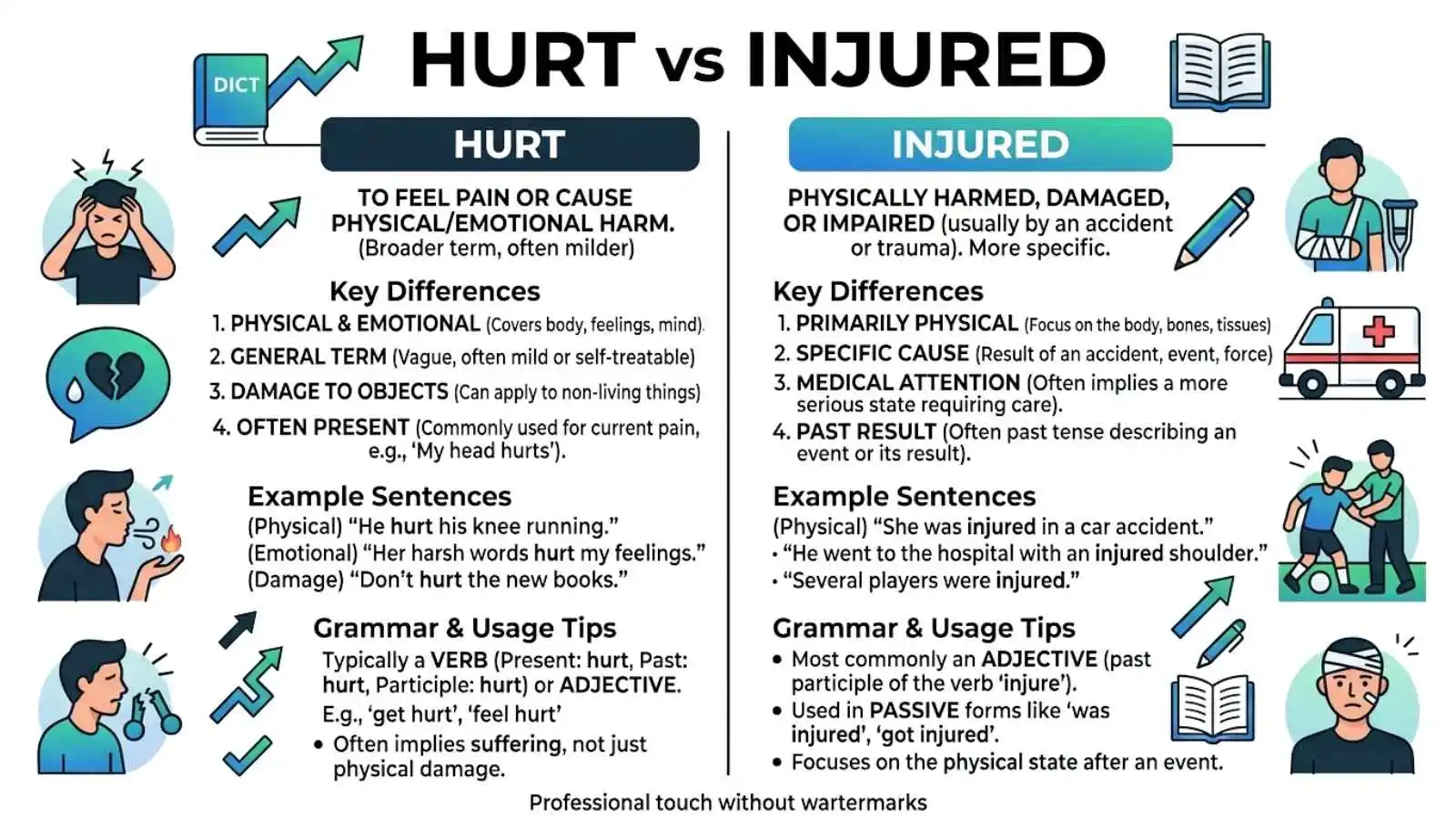
Hurt is the wide word. Pain, feelings, small stuff, big stuff, it covers all of it.
Injured is the narrow word. It almost always means real physical harm, the kind a doctor could point to.
Every injury hurts. Not everything that hurts is an injury. That’s really the whole rule.
A Small Story to Make It Click
You stub your toe on the couch leg. Classic. It hurts, you hop around cursing for a minute, then you’re fine. Nobody calls that an injury. The word’s just too big for a stubbed toe.
Now flip it. You’re out on a run, your ankle rolls wrong, and it swells up fast. You can’t put weight on it. A doctor looks at it and says “sprain.” Now you’re injured. And yeah, it still hurts, probably a lot.
That’s the whole difference in two examples. Hurt is the feeling on top. Injured is the damage underneath, when there’s something real enough for a doctor to name.
What Each Word Really Covers
| Word | What It Covers | Feels Like |
| Hurt | Pain, upset feelings, small or big harm | Casual, everyday, flexible |
| Injured | Physical damage to the body | Specific, medical, more serious |
Here’s a fun little test for this: “hurt” works for feelings too. Say something mean to a friend, and “that hurt her feelings” makes total sense. Try “that injured her feelings” instead. Sounds wrong, right? That’s because “injured” just doesn’t stretch that far. It stays in the body.
The Simple Body Test
One question does most of the work here: is there real physical damage a doctor could point to?
Yes? Go with “injured.” Broken bones, torn muscles, deep cuts, sprains, that whole category.
No, or just soreness, a bruise, tired legs, hurt feelings? “Hurt” is your word.
That’s basically it. One question, most mix-ups solved.
When to Reach for Each One
Small scrape, bruise, sore muscle: “Hurt.” Example: “My arm hurts a little after the gym.”
Clear physical injury, broken bone, torn ligament: “Injured.” Example: “He was injured during the game and had to leave on a stretcher.”
Feelings, not the body: Always “hurt.” Example: “She was hurt by his comment.”
Medical forms, accident reports, insurance claims: “Injured” sounds more official here, and honestly, it’s what these forms expect.
Coaches talking to a team: “Injured” for anything serious enough to pull a player out. “Hurt” for the everyday aches that don’t stop practice.
If it needs a doctor or real recovery time, that’s your cue for “injured.” Everything smaller, or anything emotional, stays “hurt.”
Try It Yourself: Quick Practice
- “She twisted her knee and can’t walk on it.” → injured (real physical problem)
- “His feelings were ___ when nobody invited him.” → hurt (emotional)
- “The player was ___ during the tackle and left the field.” → injured
- “I bumped my elbow, it kind of ___.” → hurts
- “The report said three workers were ___ in the accident.” → injured
Got most of those right? You’ve basically got it down already. This isn’t a hard rule to keep, once it clicks.
Common Mix-Ups People Make
Using “injured” for everyday soreness. A tired muscle after leg day is “hurt,” not “injured,” unless there’s actual damage behind it.
Writing “hurt” on an official form. Forms want “injured.” It reads clearer and more serious to whoever’s processing it.
Calling hurt feelings “injured.” Feelings get hurt. Only the body gets injured. Keep that line firm.
Assuming the two words always mean the same level of harm. They don’t. “Injured” usually signals something worse than plain old “hurt.”
Downplaying real injuries by calling them “hurt” out of habit. If there’s real damage, say “injured.” Softening it with “hurt” can actually confuse people about how serious things are.
Where You’ll Actually See These Words
Text to a friend: “I hurt my back a little moving furniture, nothing serious.”
News report: “Two people were injured in the car accident this morning.”
Workplace email: “Please report to HR if you are injured on the job site.”
A personal story: “Her words hurt more than she probably realized.”
Sports update: “The star player is injured and will miss the next three games.”
How These Words Grew Apart
Both trace back a long way, just down different paths.
Hurt comes from an old French word, “hurter,” meaning “to strike” or “to knock against.” Early English speakers stretched it to cover physical pain and emotional pain both, and that flexible, casual use just stuck around for centuries. Nobody ever narrowed it down.
Injured comes from Latin, “injuria,” meaning “wrong” or “unlawful act.” It actually started with a legal flavor, tied to harm done to someone unfairly. Over time, English settled it into a more medical and formal role, mostly describing real body damage.
So “hurt” stayed loose and everyday. “Injured” picked up a more serious, official tone somewhere along the way. That old split is basically why the two words feel different today, even though they’re cousins.
A Few Related Words Worth Knowing
| Word | Meaning | Example |
| Hurt | Pain, physical or emotional | “My leg hurts a bit.” |
| Injured | Physical body damage | “He was injured in the fall.” |
| Wounded | Injured, often from a weapon or sharp object | “The soldier was wounded in battle.” |
| Sore | Mild, aching pain, usually muscles | “My legs are sore from running.” |
| Damaged | Harm to an object, sometimes used loosely for the body | “The car was damaged in the crash.” |
FAQs
Can something be both hurt and injured at once? Yes, and honestly, that’s the most common case. Break your arm, and it’s injured. It’s also going to hurt. Both words show up together all the time.
Is “hurt” less serious than “injured”? Usually. “Hurt” covers everything from mild to fairly bad. “Injured” leans toward the more clearly physical, often more serious end of things.
Can “injured” describe feelings? No. That word stays with the body. Feelings always get “hurt.”
Which word fits an accident report? “Injured.” It’s the standard, expected word in medical and official writing.
Is it wrong to say “I’m hurt” after a car crash? Not wrong exactly, but “injured” reads clearer in a serious moment like that, especially to medical staff trying to figure out what’s going on.
Do doctors even use the word “hurt”? Sure, informally. “Where does it hurt?” is a normal question. But once they describe the actual problem, they’ll usually say “injured” or name the specific injury.
Why do people mix these two up so much? Because most injuries do hurt, so the words blur together in everyday speech. “Injured” is just the more precise, physical term underneath it.
Wrapping It Up
“Hurt” and “injured” aren’t exact twins, even though they show up together constantly. “Hurt” is the wide, flexible word, covering everything from a stubbed toe to a broken heart. “Injured” stays narrower, reserved for real physical harm.
Quick trick to keep in your back pocket: if a doctor could point to actual damage, say “injured.” If it’s just pain, soreness, or a bad feeling, “hurt” fits better.
Once this distinction clicks, you’ll stop second-guessing yourself. Texting a friend, filling out a form, writing up a report, whatever it is, you’ll just know which word to grab.