You’re writing an email. “Thank you for your enquiry” or “thank you for your inquiry”? Both look fine. Spellcheck says nothing. Now you’re stuck.
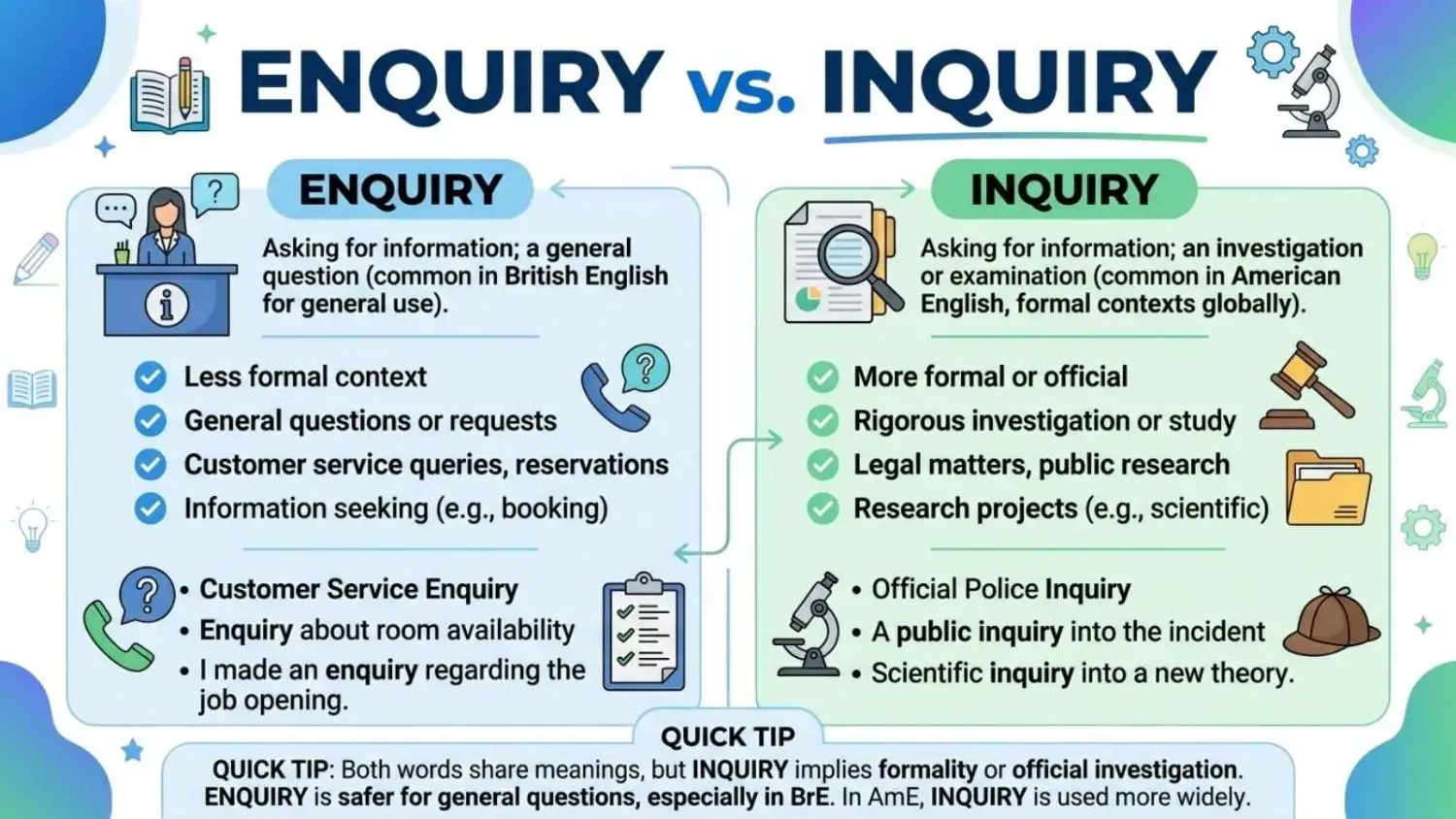
Here’s the fun part. This is not just a US versus UK spelling thing, like “colour” and “color.” In British English, these two words can mean slightly different things. That’s the part worth knowing.
The Quick Answer
Inquiry is used everywhere. American English uses only this one word. British English uses it too, but mostly for big, formal checks or investigations.
Enquiry is only used in British English. It’s mostly for small, everyday questions.
So if you’re American, this is easy. Just use “inquiry,” every time. If you’re British, there’s a small extra rule, and that’s where people get stuck.
Where the Mix-Up Really Comes From
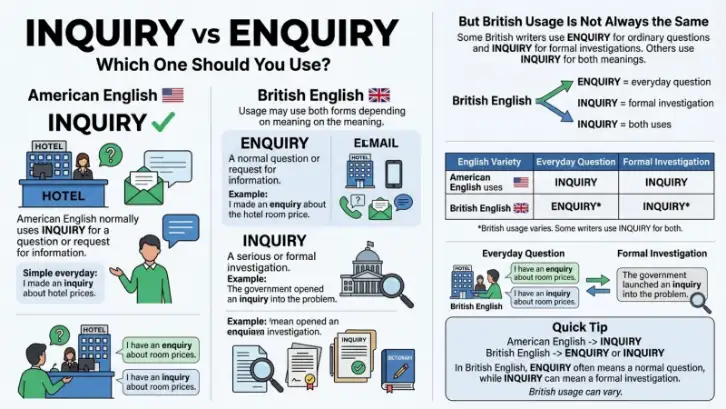
Ask an American which word is right, and they’ll say “inquiry” fast, no doubt. That’s the only one they use.
Ask someone from the UK, and you’ll get a longer answer. Many British writers use “enquiry” for a normal question, like asking a hotel about room prices. Then they switch to “inquiry” for something serious, like a big government check into a problem.
But even in the UK, not everyone follows this rule the same way. Some places always split the two words. Other places just use “inquiry” for everything and don’t bother. So even British writers argue about this sometimes.
Where These Words Come From
Both words come from the same old Latin word, “inquirere,” which meant “to look into” or “to ask about.” For a long time, English only had one spelling.
Then, around the 1600s, “enquiry” showed up as a new second spelling. It likely came from French, since French had its own version too. Both spellings were used in English for a long time, with no clear rule.
The big-question versus small-question split came much later. It grew slowly in British writing and law, not from any old, fixed rule. It just became a habit over time.
Breaking Down the Difference
| Situation | American English | British English |
| Asking a normal question | Inquiry | Enquiry (most times) |
| A big, formal check | Inquiry | Inquiry |
| Government or legal matters | Inquiry | Inquiry (always) |
| Customer service question | Inquiry | Enquiry (often) |
| School or science use | Inquiry | Inquiry (most times) |
See the pattern? “Inquiry” covers everything in American English, no matter what. In British English, only the big, formal stuff always keeps “inquiry.” Small, daily questions often use “enquiry” instead, but not always.
So Which One Should You Use?
Writing for American readers? Easy. Always use “inquiry.” No other choice needed here.
Writing for British readers about something big and formal, like a government check or legal case? Use “inquiry.” Most British writers agree on this part.
Writing for British readers about something small, like store hours? “Enquiry” is the older, more expected word here. But “inquiry” won’t get you in trouble either.
Writing for readers from many countries, and don’t want to think too hard? Just use “inquiry.” It works everywhere and skips the whole small-versus-big question rule.
Working for a company with a style guide? Follow their rule first. Many UK companies now just use “inquiry” for everything, since keeping two spellings straight takes extra work.
A Few Real Mistakes People Make
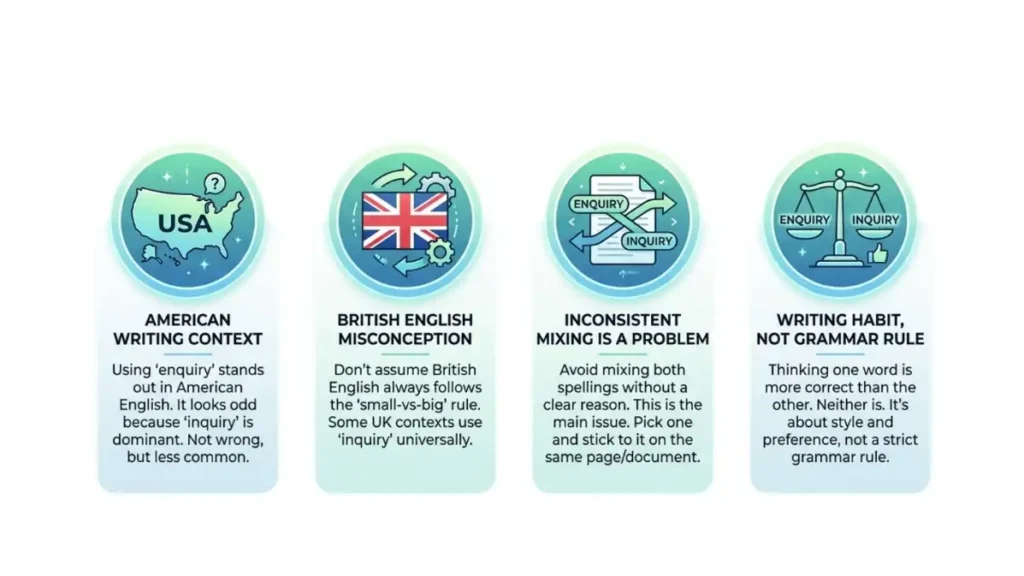
Using “enquiry” in American writing. This one stands out fast. It’s not really wrong, but it looks odd to American readers, since they barely see this word.
Thinking British English always follows the small-versus-big rule. It doesn’t. Some places skip the rule and just use “inquiry” for everything.
Mixing both spellings in one document without a clear reason. This is the real problem, more than picking either word alone. If you choose “enquiry” for small questions, stay with that choice through the whole page.
Thinking one word is more correct than the other. Neither is. This is just a writing habit, not a strict grammar rule.
Quick Practice
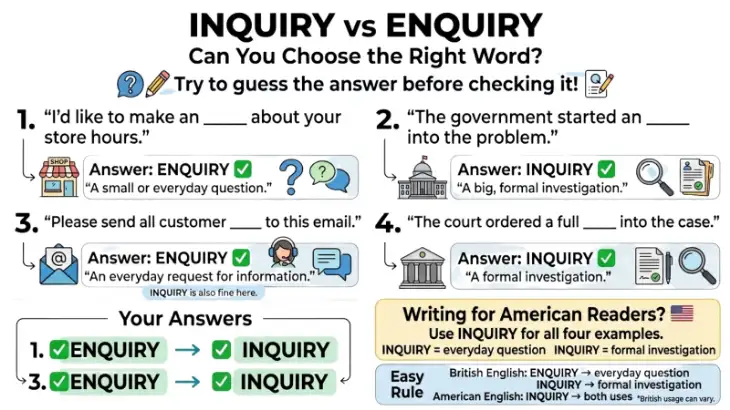
Try to guess the answer before you check it.
- “I’d like to make an ___ about your store hours.” → Enquiry (small question)
- “The government started an ___ into the problem.” → Inquiry (big, formal)
- “Please send all customer ___ to this email.” → Enquiry (though “inquiry” is fine too)
- “The court ordered a full ___ into the case.” → Inquiry (formal, always)
If you’re writing for American readers, just remember: every example above would simply use “inquiry.”
Real-World Examples
A UK hotel website: “For booking enquiries, please call our front desk.”
A US customer service page: “Submit your inquiry and we’ll respond within 24 hours.”
A British news headline: “Public inquiry into hospital deaths begins next month.”
A UK small business email: “General enquiries: contact@business.co.uk”
An American legal paper: “This inquiry is about the events of March 12th.”
How This Has Changed Over Time
Here’s something worth knowing. “Enquiry” has slowly become less common, even in the UK. Many British companies and news sites now just use “inquiry” for everything. Part of this is because a lot of global business writing follows American style. Part of it is because two spellings for one word is extra work most writers don’t want.
So if “enquiry” feels less common than you expected, even in British writing, that’s not just in your head. The gap between these two words has been getting smaller for a while.
Similar Word Pairs Worth Knowing
| Pair | Note |
| Enquiry / Inquiry | Small vs big question, mostly in British English |
| Ensure / Insure | Different meanings, not the same word |
| Enclose / Include | Close in meaning, but not exact twins |
Quick warning: “ensure” and “insure” look like a similar pair, but they actually mean different things. Don’t mix them into this same rule by mistake.
FAQs:
Is “enquiry” wrong in American English? Not really wrong, but it’s barely used there. “Inquiry” is the only common word in the US.
Do British people always split the two words? No, not always. Some do, some don’t. Many UK groups now just use “inquiry” for everything.
Which word should I use if I don’t know my reader? Use “inquiry.” It works everywhere and skips the whole small-versus-big rule.
Do the two words sound different? No, they sound the same. The only difference is in spelling, and sometimes in British English, in meaning too.
Can “enquiry” ever mean a big, formal check? It can, but it’s less common. The rule is a habit, not a strict law.
Why does American English only use “inquiry”? American spelling changes in the 1800s made many words simpler, and “inquiry” became the one standard word.
Is this word split growing or shrinking? Shrinking. “Enquiry” is used less, even in the UK, as more writing follows the simpler “inquiry” style.
Wrapping Up:
“Inquiry” is the safe word. It’s correct in American English and works fine in British English too. “Enquiry” is the more specific British word, mostly used for small, everyday questions, though even that rule is fading.
If you remember just one thing, remember this: “inquiry” always works, for everyone, everywhere. Save “enquiry” only for casual British writing, and even then, it’s a choice, not a must.
Small words like this don’t change if people understand you. But getting them right makes your writing feel careful and clean, not just good enough.

Emily Carter is an English grammar writer based in Portland, Oregon, with 7+ years of experience turning tricky grammar rules into simple, easy lessons.










