You’re writing a message to a small shop, thanking them for good service. Maybe you want to say you shop there a lot. So you type the word. Then you stop. Is it “patronise”? Or is it “patronize”? Both look right. Both feel normal. So which one do you use?
This mix-up isn’t about right or wrong. It’s about which side of the world taught you your spelling. Both forms are correct, and both mean the exact same thing. The confusion happens because people see both spellings all over the internet, in books, and on different websites, with no clear sign of which one fits their own writing.
There’s also a second meaning worth knowing. Sometimes this word means you shop somewhere a lot. Other times, it means talking to someone in a way that feels a bit rude or “above” them. Either way, the spelling question stays the same.
Here’s a quick answer first. Then you’ll learn where the word comes from, why two spellings exist, and which one fits your writing best.
Patronise vs Patronize – Quick Answer
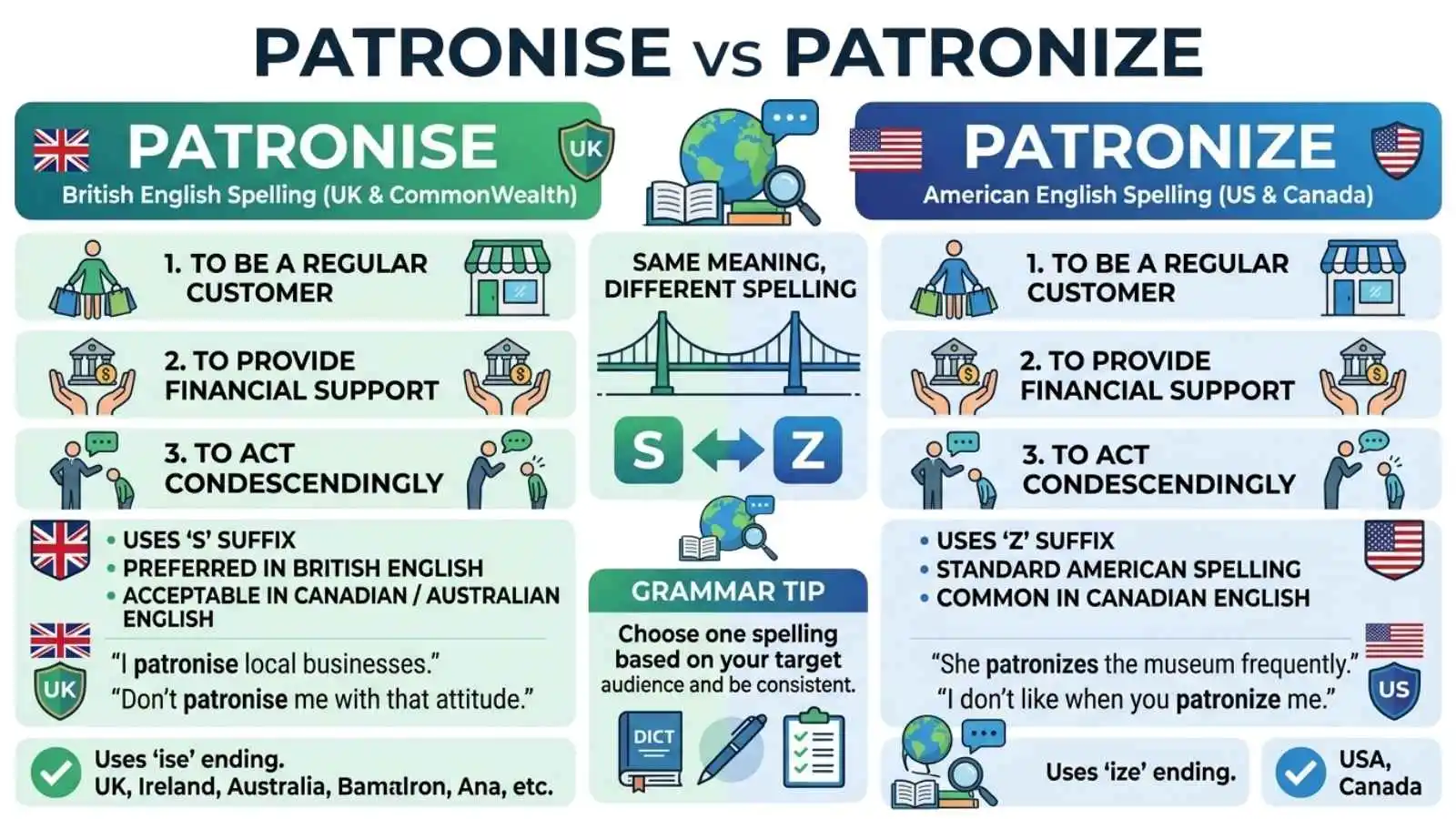
Both spellings are correct. The real split comes down to British English versus American English.
- Patronise → British English (UK, India, Pakistan, Australia, and most nearby countries)
- Patronize → American English (USA, Canada)
A few quick examples:
- “I try to patronise local shops instead of big chains.” (UK style)
- “I try to patronize local shops instead of big chains.” (US style)
- “Please don’t patronise me, I understand the plan just fine.” (UK style)
- “Please don’t patronize me, I understand the plan just fine.” (US style)
So the word can mean two things: shopping somewhere a lot, or talking to someone in a way that feels rude or “above” them.
Where Does This Word Come From?
This word grew out of “patron,” an old word tied to a Latin word meaning “helper” or “someone who protects.” Long ago, a patron was someone who helped and looked after another person, often someone with less money or power. Over time, this idea changed, and a “patron” became known as a person who shops at the same place again and again, almost like helping that shop by staying loyal to it.
Then there’s the second meaning, the one about talking down to someone. This grew out of the same idea in a simple way. When a rich or powerful patron helped someone weaker, that relationship could feel a bit uneven, even a little bit “above” the other person at times. Over hundreds of years, this small change in meaning stuck to the word, giving us the modern sense of talking to someone as if they know less or matter less.
Now, why two spellings? The same reason shows up in words like “organise/organize” and “realise/realize.” British English kept an older way of spelling, closer to its French and Latin roots. American English later changed a lot of these words to use “z” instead, so the spelling would match the sound more closely.
Is This a British vs. American Spelling Difference?
Yes, and this is a true case of it, just like “colour/color” and “organise/organize.” Both spellings are fully correct. Your choice depends only on which style of English you are writing in.
| Feature | British English | American English |
| Word form | patronise | patronize |
| Verb base | patronise | patronize |
| Noun form | patronisation | patronization |
| Region | UK, nearby countries | USA, Canada |
| Spelling rule | Uses “s” | Uses “z” |
This same pattern shows up again and again in English. Words like “organise/organize,” “realise/realize,” “recognise/recognize,” and “specialise/specialize” all follow this exact “s” versus “z” split. Learn the rule once, and it works for all of them.
Which Spelling Should You Use?
Your reader decides this one for you.
Writing for readers in the UK, India, Pakistan, Australia, or other nearby countries? Go with “patronise.” Writing for American or Canadian readers, or for big global business content where American English is often used? Use “patronize” instead. Not sure who’s reading, or writing for a mixed group of readers? Just pick one spelling and stick with it the whole way through.
If the rest of your writing already uses American spelling, like “organize” or “color,” keep that same habit and use “patronize” too.
Common Mistakes with Patronise and Patronize
Mistakes
1: Switching between both spellings in the same piece of writing This looks messy, even though each spelling works fine on its own.
- ❌ “We patronise local shops, and we always patronize small businesses too.”
- ✅ Pick one spelling and use it the whole way through.
2: Writing a sentence that could be read the wrong way Since the word has two meanings, a sentence can sometimes feel unclear.
- Unclear: “He patronized the new coffee shop.” (Does this mean he shops there a lot, or that he spoke down to someone?)
- Clearer: “He shops at the new coffee shop often.” or “He spoke to the staff in a rude, superior way.”
3: Forgetting the naming-word form changes too The related word follows the exact same “s” versus “z” pattern.
- British: “patronisation”
- American: “patronization”
4: Thinking one spelling is somehow better Neither one wins here. This is just about where you live and learned English, not correctness.
Patronise and Patronize in Everyday Writing
An email might say: “We’re thankful that so many customers keep coming back to shop with us.” (US style, using “patronize”)
A news story might read: “Some people said the leader’s words sounded patronising toward voters.” (UK style)
A social media post could look like: “Love supporting local shops, we try to patronize small businesses whenever we can. ” (US style)
Formal writing might state: “The manager’s tone was seen as patronising by several workers.” (UK style)
Each version changes a little based on the writer’s style of English, while the meaning stays exactly the same either way.
Patronise vs Patronize – Search Trends and Usage
Search data shows a clear split by region. People in the US and Canada use “patronize” a lot, especially in business writing, customer messages, and daily talk about supporting local shops. Meanwhile, “patronise” stays the normal choice across the UK, India, Pakistan, Australia, and most nearby countries.
Around the world, “patronize” tends to show up more in global business writing, since American English carries a lot of weight in worldwide online content. Even so, “patronise” stays strong in UK and nearby news, schools, and government writing.
Interest in the “talking down to someone” meaning often rises during news stories about politics or work, especially when someone’s tone toward another person becomes the main topic.
Comparison Table: Word Variations
| Variation | UK Spelling | US Spelling |
| Action word | patronise | patronize |
| Naming word | patronisation | patronization |
| Describing word (for tone) | patronising | patronizing |
| Example phrase | “a patronising remark” | “a patronizing remark” |
FAQs:
Is “patronise” correct English? Yes, it’s the normal British English spelling, used across the UK and most nearby countries.
So is “patronize” wrong? Not at all. It’s simply the American English form of the same word.
Why does English even have two spellings for this? British English kept an older way of spelling with “s.” American English later changed many similar words to use “z” instead, mostly in the 1800s.
Does “patronize” always mean being rude? No. It has two separate meanings: shopping somewhere a lot, or talking to someone in a rude, “above them” way. The rest of the sentence usually makes the meaning clear.
Can both spellings show up in the same article? Better not to. Pick one and stay with it, since switching back and forth can look like a mistake instead of a style choice.
Which spelling works best for global writing? “Patronize” often works better for a wide, global, or American group of readers. “Patronise” still works well for UK and nearby readers.
What’s the describing-word form of this word? “Patronising” in the UK, “patronizing” in the US, both used to describe a tone or comment that feels rude or “above” someone.
Conclusion:
This choice was never about right or wrong. “Patronise” and “patronize” simply show British versus American spelling habits, the same kind of split you’ll see in “organise/organize” and “realise/realize.” Both spellings carry the exact same two meanings: shopping somewhere a lot, or talking to someone in a way that feels rude or superior.
Writing for UK, Indian, Pakistani, or Australian readers? Use “patronise.” Writing for an American or Canadian audience, or big global business content? Go with “patronize.” The one rule that really matters is staying the same all the way through, since switching between both spellings in one piece looks careless, even though each one works fine on its own.
Once you pick a style, that same “s” versus “z” pattern carries over to words like “organise/organize” and “realise/realize” too, and your writing will feel clean and clear from start to finish.

Welcome to the official author page of Clara Wordsmith, grammar writer at Wordnomic. Clara specializes in explaining confusing English words, grammar rules, spelling differences, and vocabulary topics with clear examples and beginner-friendly explanations.










