The word describe is used when you explain what someone, something, or a place is like. You may use it in school assignments, work emails, stories, or daily conversations. However, using the same word again and again can make your writing feel repetitive.
There are many synonyms of describe that can help you express your ideas more clearly. Words like explain, depict, portray, outline, and illustrate have similar meanings, but each word works best in a different situation. For example, you can describe a person by talking about their looks, portray a character in a story, or outline the main points of a plan.
Choosing the right word depends on what you want to explain and how much detail you need to give. Some alternatives are simple and common, while others are more useful in formal writing, reports, and creative work.
In this guide, you will learn more than 40 synonyms of describe, their meanings, and examples. You will also discover the differences between similar words and how to choose the best alternative for your sentence.
Synonyms of Describe: Quick Answer
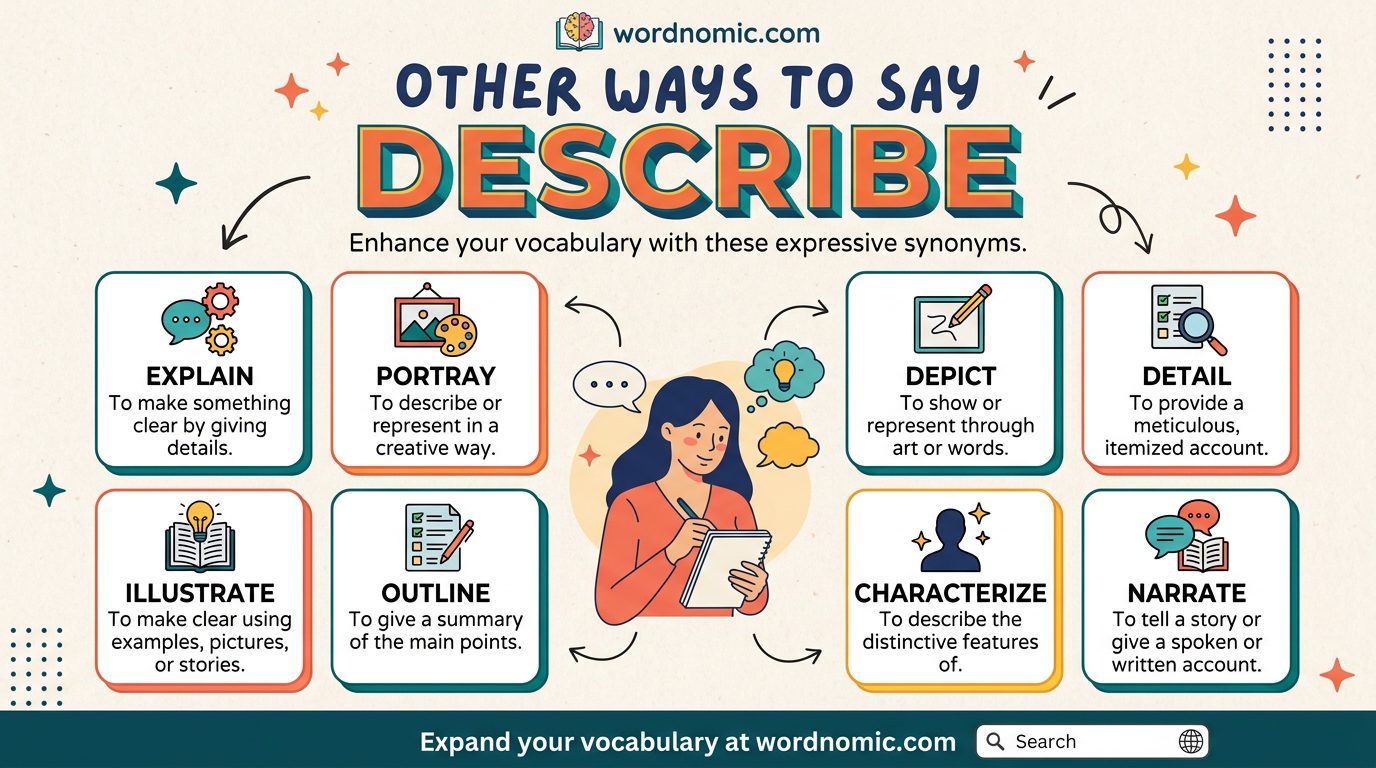
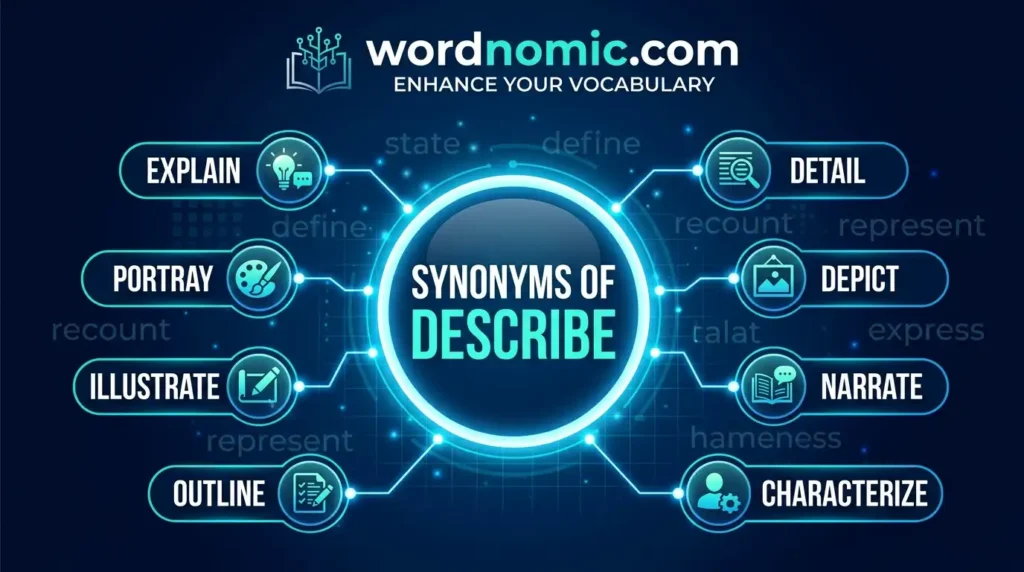
The most common synonyms of describe include explain, detail, depict, portray, outline, illustrate, characterize, present, define, and report.
The best synonym depends on the context:
- Explain: Make something easier to understand.
- Detail: Give specific information.
- Depict: Show or represent someone or something.
- Portray: Show what a person or thing is like.
- Outline: Give the main points without every detail.
- Illustrate: Explain or show something with examples or images.
- Characterize: Describe the qualities of a person or thing.
- Present: Give information in an organized way.
- Define: Explain the meaning of a word or idea.
- Report: Give information about an event or situation.
For everyday writing, explain and detail are useful alternatives. For stories and art, depict and portray may be better choices.
What Does Describe Mean?
The verb describe means to tell or write what someone or something is like. It can include details about appearance, behavior, features, events, or feelings.
For example:
- Please describe your best friend.
- Can you describe the house?
- The witness described what happened.
- She described her feelings in a letter.
In each example, the speaker gives information that helps another person understand something.
The word can be used in many settings. A student may describe a science experiment, a writer may describe a character, and a reporter may describe an event.
The exact meaning depends on the sentence. Sometimes, describe means giving a simple picture with words. In other cases, it means explaining details or reporting what happened.
40+ Synonyms of Describe and Their Meanings
Here are useful alternatives to describe, with simple meanings and examples.
1. Explain
Explain means to make something clear or easy to understand.
Example: The teacher explained how the machine works.
2. Detail
Detail means to give specific information about something.
Example: The report detailed the steps of the project.
3. Depict
Depict means to show or represent someone or something through words, pictures, or art.
Example: The painting depicts life in a small village.
4. Portray
Portray means to show what a person, character, or situation is like.
Example: The film portrays a family facing difficult times.
5. Outline
Outline means to give the main points of something without explaining every detail.
Example: She outlined her plan for the new business.
6. Illustrate
Illustrate means to explain or make something clear with examples, pictures, or other details.
Example: The teacher illustrated the idea with a simple example.
7. Characterize
Characterize means to describe the qualities or nature of a person, place, or thing.
Example: The author characterized the main hero as brave and kind.
8. Present
Present means to show or explain information to others.
Example: He presented the results of the study.
9. Define
Define means to state the meaning or nature of something clearly.
Example: The student defined the term in one sentence.
10. Report
Report means to give information about an event, fact, or situation.
Example: The journalist reported what happened at the meeting.
11. Depict in Words
This phrase means to use words to help someone imagine a person, place, or event.
Example: The writer depicted the busy market in words.
12. Portray in Detail
This phrase means to show the qualities or features of someone or something with care.
Example: The novel portrays the main character in detail.
13. Summarize
Summarize means to give the main points of something in a shorter form.
Example: Please summarize the story in five sentences.
14. Clarify
Clarify means to make something easier to understand.
Example: She clarified her statement after the meeting.
15. Specify
Specify means to state something clearly and exactly.
Example: Please specify the date and time of the event.
16. Identify
Identify means to recognize or state who or what someone or something is.
Example: The report identified the main cause of the problem.
17. Express
Express means to communicate a thought, feeling, or idea.
Example: He expressed his feelings through music.
18. Narrate
Narrate means to tell a story or explain a series of events.
Example: She narrated the events of her trip.
19. Recount
Recount means to tell what happened, often in the order it happened.
Example: He recounted his experience at the hospital.
20. State
State means to say something clearly.
Example: The letter stated the reason for the delay.
21. Mention
Mention means to refer to something briefly.
Example: She mentioned the problem during the call.
22. Discuss
Discuss means to talk or write about a subject in some detail.
Example: The students discussed the causes of climate change.
23. Elaborate
Elaborate means to give more information or explain something in greater detail.
Example: Could you elaborate on your answer?
24. Interpret
Interpret means to explain the meaning of something.
Example: The critic interpreted the poem in a new way.
25. Demonstrate
Demonstrate means to show how something works or provide evidence of something.
Example: The coach demonstrated the correct way to hold the racket.
26. Show
Show means to let someone see or understand something.
Example: The chart shows changes in temperature.
27. Reveal
Reveal means to make information known or visible.
Example: The investigation revealed new details about the case.
28. Convey
Convey means to communicate an idea, feeling, or message.
Example: The photograph conveys a sense of peace.
29. Capture
Capture means to represent or express the main qualities of a person, place, or moment.
Example: The photo captures the beauty of the sunset.
30. Summarize in Brief
This phrase means to present only the main ideas in a short form.
Example: The manager summarized the results in brief.
31. Record
Record means to write down or store information about something.
Example: The researcher recorded the changes in the sample.
32. Document
Document means to record information or evidence in a clear and organized way.
Example: The team documented each step of the process.
33. Classify
Classify means to place things into groups based on shared features.
Example: The scientist classified the plants by type.
34. Label
Label means to give a name or category to something.
Example: The diagram labels each part of the machine.
35. Portrayal
Portrayal is a noun that means the way someone or something is shown or represented.
Example: Her portrayal of the character was convincing.
Note: Portrayal is not a direct verb replacement for describe. Use portray when you need a verb.
36. Sketch
Sketch can mean to give a brief description of a person, idea, or situation.
Example: The speaker sketched the history of the town.
37. Paint a Picture
This phrase means to create a clear mental image through words.
Example: The author painted a picture of life in the countryside.
38. Set Out
Set out can mean to present information or ideas in an organized way.
Example: The document sets out the rules for the competition.
39. Sum Up
Sum up means to give the main points of something briefly.
Example: Can you sum up the main idea?
40. Characterize in Words
This phrase means to explain the qualities of a person or thing through language.
Example: The writer characterized the town in words that showed its charm.
41. Give an Account Of
This phrase means to tell what happened or provide information about an event.
Example: The witness gave an account of the accident.
42. Make Clear
This phrase means to explain something so that others can understand it.
Example: The diagram makes clear how the parts fit together.
Best Synonyms of Describe by Context
The right alternative depends on what you are describing.
| Situation | Best synonym | Example |
| Explaining an idea | Explain | She explained the process. |
| Giving exact details | Detail | He detailed the changes. |
| Writing about a scene | Depict | The poem depicts a quiet garden. |
| Writing about a character | Portray | The story portrays a brave child. |
| Giving a short plan | Outline | She outlined the main steps. |
| Using examples | Illustrate | The teacher illustrated the rule. |
| Reporting an event | Recount | He recounted the day’s events. |
| Making a point clear | Clarify | The note clarified the instructions. |
| Giving a short version | Summarize | She summarized the report. |
| Recording evidence | Document | The team documented the findings. |
Describe vs. Explain vs. Depict vs. Portray
These words are similar, but they do not always mean the same thing.
| Word | Main meaning | Example |
| Describe | Say what something is like | Describe the room. |
| Explain | Make something clear | Explain how it works. |
| Depict | Show or represent something | The picture depicts a village. |
| Portray | Show the qualities of someone or something | The film portrays a kind leader. |
Use describe when you want to give information about the features of something. Use explain when you want to help someone understand how or why something happens. Using depict for representation through words or images, and portray when showing a person’s qualities or the nature of a situation.
Describe vs. Outline vs. Summarize
These words can all relate to giving information, but they have different purposes.
- Describe: Give details about what something is like.
- Outline: Present the main points or structure.
- Summarize: Give the most important information in a shorter form.
Examples:
- Describe the new classroom.
- Outline the steps of the project.
- Summarize the meeting.
You can describe a classroom by explaining its size, color, furniture, and layout. You can outline a project by listing its main steps. They can summarize a meeting by stating the most important points.
Synonyms of Describe for Academic and Professional Writing
In school, research, and work, your choice of words should match the task.
Useful alternatives include:
- Explain: For ideas, reasons, and processes.
- Outline: For plans, methods, and main points.
- Detail: For specific facts or steps.
- Define: For the meaning of a term.
- Summarize: For the main points of a source.
- Document: For recording evidence or events.
- Report: For presenting findings or observations.
- Clarify: For removing confusion.
- Specify: For giving exact information.
- Illustrate: For supporting a point with examples.
Examples:
- Academic: The study describes the effects of heat.
- Alternative: The study details the effects of heat.
- Professional: The manager outlined the next steps.
- Research: The team documented the test results.
Remember that some alternatives change the meaning. For example, summarize does not mean the same as describe in detail. Choose the word that matches the work you are doing.
Synonyms of Describe for Creative Writing
Writers often need alternatives to describe to make scenes, characters, and events more engaging.
Consider these options:
- Depict: Show a scene or image.
- Portray: Show a person’s qualities or behavior.
- Capture: Express the feeling of a moment.
- Sketch: Give a brief picture of someone or something.
- Paint a picture: Help readers imagine a scene.
- Convey: Communicate a mood or feeling.
- Characterize: Explain a character’s traits.
Examples:
Instead of: The writer described the storm.
You could write: The writer depicted the storm as dark and frightening.
Instead of: The story describes a kind woman.
You could write: The story portrays a woman who helps everyone around her.
These alternatives can make your writing more specific. However, the simple word describe is often the clearest choice when no special meaning is needed.
10 Example Sentences Using Synonyms of Describe
- The teacher explained the lesson in simple words.
- The painting depicts a village near the sea.
- Please outline your plan for the project.
- The author portrays the hero as a brave person.
- The report details the causes of the delay.
- The chart illustrates how sales changed over time.
- The witness recounted what happened that night.
- The manager clarified the new rules.
- The student summarized the chapter in one paragraph.
- The researchers documented their findings.
Each word has a slightly different use, so pay attention to the meaning of the sentence.
Common Mistakes When Using Synonyms of Describe
1. Using “Summarize” When You Need Full Details
Summarize means to give the main points in a shorter form.
Less suitable: Summarize every feature of the building in detail.
Better: Describe every feature of the building in detail.
2. Using “Explain” for Every Description
Explain often focuses on how or why something happens. It may not fit when you only want to state what something looks like.
Example: Describe the color and shape of the flower.
3. Confusing “Depict” With “Define”
Depict means to represent or show something. Define means to state what something means.
Example: The painting depicts a forest. The dictionary defines the word “forest.”
4. Using “Outline” When Every Detail Is Needed
An outline gives the main points, not a complete explanation.
Example: Outline the main steps before writing the full report.
5. Treating “Mention” and “Describe” as Exact Synonyms
Mention usually means referring to something briefly. Describe normally gives more information.
Example: She mentioned the house but did not describe it.
Frequently Asked Questions
1. What is the best synonym for describe?
Explain, detail, depict, and portray are useful synonyms, but the best choice depends on the sentence. Use explain to make an idea clear, detail to give specific information, depict to represent a scene, and portray to show someone’s qualities.
2. What is another word for describe in an essay?
In an essay, you can use explain, outline, detail, illustrate, or characterize. Choose explain for reasons or processes, outline for main points, and illustrate when using examples to support an idea.
3. What is a formal word for describe?
Depict, characterize, delineate, and elucidate may fit some formal contexts. However, these words are not interchangeable. Elucidate means to make something clear, while depict means to represent it. Use the simplest word that fits your meaning.
4. What is the difference between describe and explain?
Describe tells what something is like. Explain makes something clear, often by giving reasons or showing how it works. For example, you describe a machine’s parts but explain how the machine operates.
5. What is another word for describe a story?
Depicting, portraying, characterizing, and painting a picture can work well in storytelling. Use depict to show a scene, portray to present a character or situation, and characterize to explain a person’s qualities.
6. Can illustrate be used as a synonym for describe?
Yes, in some contexts. Illustrate can mean to explain or make something clear through examples, images, or details. However, it does not replace describe in every sentence. For example, you can illustrate a point with an example, but describe a person’s appearance.
7. What is a simple alternative to describe?
Explain, tell, show, and talk about are simple alternatives in suitable contexts. For example, “Describe your day” could become “Tell me about your day.” The best option depends on the information you want someone to share.
Conclusion
There are many synonyms of describe, and choosing the right one can make your writing clearer and more natural. Words such as explain, detail, depict, portray, outline, and illustrate are among the most useful alternatives. Each word has its own purpose.
Use explain when you want to make an idea clear. Choose detail when you need to provide specific information. Use depict to represent a scene or image, and portray to show the qualities of a person or situation. If you only need to give the main points, outline or summarize may be more suitable.
For schoolwork and professional writing, words like define, report, document, and clarify can also help, depending on the task. For creative writing, capture, convey, and paint a picture can add more meaning to a sentence.
The key is to understand what each word means before replacing describe with it. A synonym should fit the sentence and keep the original meaning clear. You do not need to choose a difficult word to improve your writing. Often, the simplest and most accurate word is the best choice.