Have you ever wondered whether to use blatantly or bluntly in a sentence? These two words look similar and can both describe how someone does something. However, they have different meanings and are not always interchangeable.
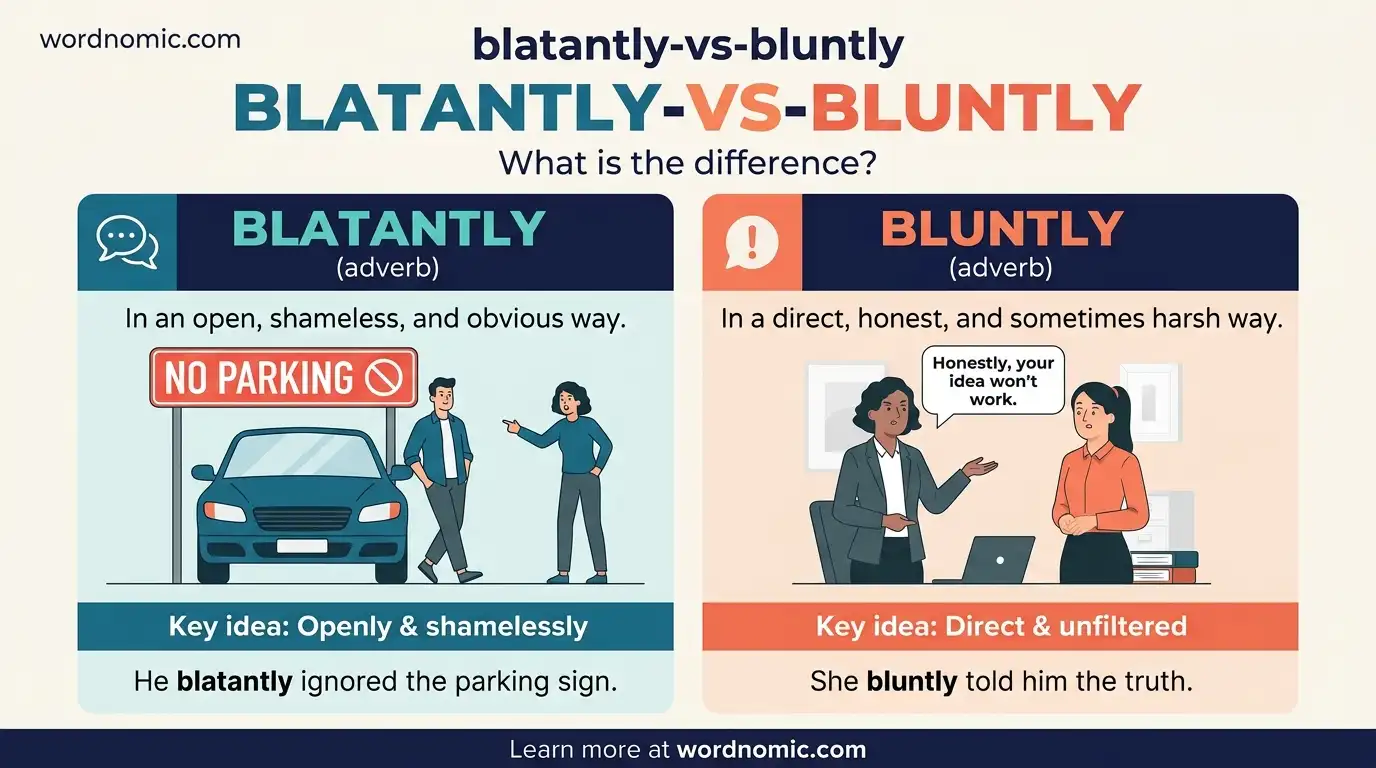
Blatantly means doing something openly and clearly, often in a way that is wrong, rude, or impossible to ignore. Bluntly means speaking in a direct and honest way without trying to make your words sound softer or more polite.
For example, if someone openly breaks a rule without trying to hide it, they blatantly break the rule. If someone tells you an unpleasant truth without softening their words, they speak bluntly.
Both words can describe actions or behavior, but the main difference is their focus. Blatantly often draws attention to something obvious or unacceptable, while bluntly usually describes a direct way of speaking.
In this guide, you will learn what blatantly and bluntly mean, how to use them in sentences, and how to choose the right word in everyday conversations and writing.
Blatantly vs Bluntly: Quick Answer
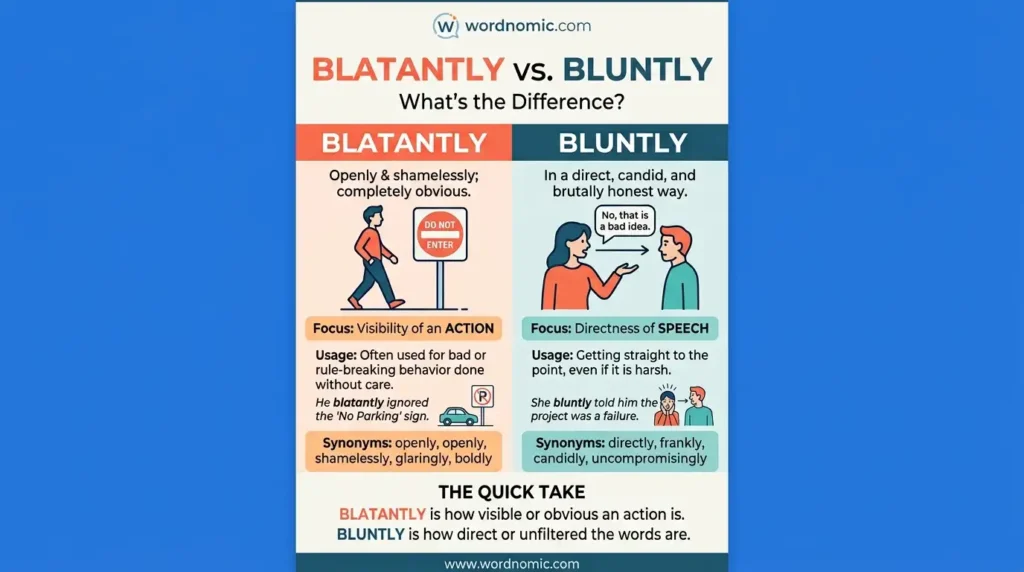
Blatantly means openly and obviously, often in a way that is wrong or unacceptable.
Bluntly means directly and honestly, without trying to make a statement sound softer.
| Word | Meaning | Example |
| Blatantly | Openly and obviously, often in a bad way | He blatantly ignored the rules. |
| Bluntly | Directly, without softening your words | She bluntly told me the truth. |
Use blatantly when you want to show that an action is obvious or done without hiding it.
Use bluntly when you want to describe someone speaking in a direct, plain, or sometimes harsh way.
What Does Blatantly Mean?
Blatantly is an adverb. It describes an action that is done openly or is so clear that people can easily notice it.
The word often has a negative meaning. It is commonly used when someone breaks a rule, ignores a fact, tells an obvious lie, or does something wrong without trying to hide it.
For example:
- He blatantly lied about what happened.
- The player blatantly broke the rules.
- She blatantly ignored my question.
- The company blatantly copied another brand’s design.
- He blatantly refused to follow the instructions.
In each sentence, the action is clear and noticeable. The person does not seem to be making much effort to hide the behavior.
Blatantly in Everyday Life
You can use blatantly when describing behavior that is obvious to other people.
For example, imagine that a student looks at another student’s answers during a test. The teacher sees the student doing it, and the student does not try to hide it.
You could say:
“The student blatantly cheated on the test.”
This sentence suggests that the cheating was open and easy to notice.
Here is another example:
“She blatantly ignored the warning sign.”
This means that she ignored the sign in an obvious way. It may also suggest that she knew about the warning but chose not to pay attention to it.
Does Blatantly Always Mean Something Bad?
Blatantly usually has a negative meaning, especially when it describes cheating, lying, breaking rules, or ignoring facts.
However, its meaning depends on the situation. The main idea is that something is open, obvious, or impossible to miss.
Examples:
- He blatantly disobeyed the order.
- They blatantly ignored the evidence.
- The mistake was blatantly obvious.
The phrase “blatantly obvious” is common. It means something is extremely clear or easy to see.
For example:
“It was blatantly obvious that he was upset.”
This means his feelings were very clear to the people around him.
What Does Bluntly Mean?
Bluntly is also an adverb. It describes speaking in a direct way without hiding your meaning or trying to make your words sound nicer.
A person who speaks bluntly may tell the truth clearly, even when the truth is uncomfortable. Blunt speech can be useful because it avoids confusion, but it can sometimes sound rude or hurtful.
For example:
- She bluntly told me that my plan would not work.
- He bluntly refused the offer.
- The manager bluntly explained the problem.
- I will speak bluntly because we need to solve this issue.
- She bluntly said that she did not agree.
In these sentences, bluntly describes the direct way someone speaks or responds.
Bluntly in Everyday Life
Imagine that you ask a friend for an opinion about your new business idea. Your friend thinks the idea needs a lot of work and says:
“Bluntly, I don’t think this plan will succeed.”
Your friend is expressing an opinion directly without trying to make it sound more pleasant.
The statement may feel uncomfortable, but it is clear.
Here is another example:
“He bluntly told his team that their work needed improvement.”
This means he spoke directly about the problem instead of using softer words.
Is Speaking Bluntly Always Rude?
No. Speaking bluntly does not always mean being rude.
Sometimes, people need to communicate clearly, especially when they are discussing a serious problem or making an important decision.
For example:
“I’ll speak bluntly: we need to finish this work today.”
This statement is direct and firm. It may not be especially polite, but it clearly explains what needs to happen.
However, blunt speech can hurt someone’s feelings when the speaker does not consider how the words will sound.
For example:
“Your idea is terrible, and you should give up.”
This is blunt and harsh. A more thoughtful way to express the same concern might be:
“I don’t think the idea will work in its current form. Let’s look at other options.”
Both statements communicate a concern, but the second is more considerate.
The Main Difference Between Blatantly and Bluntly
The biggest difference is what each word describes.
Blatantly focuses on how obvious or open an action is. Bluntly focuses on how directly someone speaks or expresses something.
Compare these sentences:
- He blatantly ignored the rules.
- He bluntly explained why he would not follow the rules.
In the first sentence, blatantly describes an action that is open and obvious.
In the second sentence, bluntly describes the direct way he explained his decision.
The words are not interchangeable because they focus on different things.
A Simple Comparison Table
| Feature | Blatantly | Bluntly |
| Main meaning | Openly and obviously | Directly and plainly |
| Common use | Actions, behavior, lies, mistakes, rule-breaking | Speech, answers, opinions, refusals |
| Usual tone | Often negative | Direct; may be honest or harsh |
| Focus | How obvious an action is | How directly something is expressed |
| Example | He blatantly cheated. | She bluntly criticized the plan. |
This table can help you choose the correct word when writing or speaking.
Blatantly vs Bluntly: Sentence Examples
The best way to understand these words is to see how they work in different sentences.
Examples With Blatantly
- He blatantly ignored the teacher’s instructions.
- The company blatantly copied the design.
- She blatantly lied about her role in the project.
- The driver blatantly ignored the traffic signal.
- They blatantly refused to consider the evidence.
- The player blatantly broke the rules during the game.
- He blatantly took credit for someone else’s work.
- The advertisement made a blatantly false claim.
- She blatantly disregarded the safety warning.
- His answer was blatantly incorrect.
Each example highlights something open, obvious, or difficult to ignore. Many of these sentences also suggest that the behavior is wrong.
Examples With Bluntly
- She bluntly told me that I was wrong.
- He bluntly rejected the proposal.
- The teacher bluntly explained why the answer was incorrect.
- I will bluntly tell you what I think.
- She bluntly asked him to leave.
- The manager bluntly discussed the team’s poor results.
- He bluntly admitted that he had made a mistake.
- My friend bluntly said that the movie was boring.
- The doctor bluntly explained the seriousness of the situation.
- She bluntly told her colleague to stop interrupting.
These sentences describe direct communication. Depending on the situation, the speaker may sound honest, firm, impatient, or rude.
Can Blatantly and Bluntly Be Used in the Same Sentence?
Yes. Both words can appear in one sentence when they describe different parts of an event.
For example:
“She blatantly ignored the rules, and the manager bluntly told her to stop.”
Here, blatantly describes the obvious way she ignored the rules. Bluntly describes the manager’s direct way of speaking.
Another example:
“He blatantly lied during the meeting, so his colleague bluntly challenged his statement.”
The first word describes the obvious dishonest action. The second describes the direct response.
These examples show why the words have different roles even though they can appear together.
Common Mistakes When Using Blatantly and Bluntly
Writers sometimes confuse these words because both can describe behavior that seems rude or unacceptable. However, choosing the wrong one can change the meaning of a sentence.
Mistake 1: Using Blatantly for Direct Speech
Incorrect or less natural:
“She blatantly told me that she disagreed.”
This may be understood, but it does not clearly express the idea of direct speech.
Better:
“She bluntly told me that she disagreed.”
Bluntly is a natural choice when the focus is on the direct way she spoke.
Mistake 2: Using Bluntly for an Obvious Rule Violation
Less natural:
“He bluntly cheated during the exam.”
Better:
“He blatantly cheated during the exam.”
Blatantly works better because the sentence focuses on an obvious act of cheating, not on the way someone speaks.
Mistake 3: Assuming Bluntly Always Means Honestly
Bluntly often describes direct speech, but it does not automatically mean that the statement is true.
For example:
“He bluntly accused me of stealing.”
The sentence tells us that he made the accusation directly. It does not prove that the accusation was correct.
Mistake 4: Assuming Blatantly Always Means Intentionally
Blatantly often suggests open or obvious behavior, and it can imply that someone knowingly did something wrong. However, the exact meaning depends on the sentence.
For example:
“The error was blatantly obvious.”
This describes how easy the error was to notice. It does not necessarily mean someone deliberately made the error.
Blatantly vs Bluntly in Professional Writing
Both words can appear in professional writing, but you should choose them carefully.
Blatantly is useful when discussing clear violations, dishonest actions, or obvious errors.
Examples:
- The report identified a blatantly false claim.
- The employee blatantly ignored the safety rules.
- The company was accused of blatantly copying a competitor’s work.
Because blatantly often sounds critical, it can make a statement feel strong or accusatory. In formal writing, make sure the evidence supports that tone.
Bluntly is useful when describing direct communication.
Examples:
- The director bluntly explained the financial problems.
- The report bluntly addressed the team’s weaknesses.
- The manager bluntly rejected the proposed changes.
In a professional setting, bluntly may suggest that the speaker did not soften the message. If you want a more neutral tone, you might use “directly” or “clearly” instead.
For example:
Instead of “The manager bluntly rejected the idea,” you could write, “The manager directly explained why the idea was not suitable.”
The second version sounds less harsh while keeping the message clear.
Similar Words for Blatantly
Several words have meanings close to blatantly, but their use can differ slightly.
- Obviously: In a way that is easy to see or understand.
- Openly: Without hiding what you are doing or thinking.
- Clearly: In a way that is easy to understand or notice.
- Flagrantly: In a way that openly and shockingly breaks a rule or standard.
- Noticeably: In a way that people can observe.
Examples:
- He blatantly ignored the rules.
- He openly ignored the rules.
- He flagrantly violated the rules.
These sentences are similar, but flagrantly often carries a stronger sense of serious wrongdoing.
Similar Words for Bluntly
You can use several words instead of bluntly, depending on the meaning you want.
- Directly: Without going around the point.
- Frankly: In an honest and open way.
- Plainly: In a simple and clear way.
- Candidly: Honestly and openly.
- Brusquely: In a short, abrupt, and sometimes rude way.
Examples:
- She bluntly explained the problem.
- She directly explained the problem.
- She frankly explained the problem.
These words are close in meaning, but they are not always exact replacements. Brusquely, for example, places more emphasis on an abrupt or unfriendly manner.
Easy Trick to Remember the Difference
Here is a simple way to remember the two words.
Blatantly = obvious behavior.
Think about an action that is open, clear, or difficult to ignore.
Example: “He blatantly broke the rules.”
Bluntly = direct speech.
Think about someone who says exactly what they mean without softening their words.
Example: “She bluntly told me the truth.”
A short memory tip is:
- Blatantly describes something obvious.
- Bluntly describes something direct.
This is a helpful guide, although context always matters.
Frequently Asked Questions
1. What is the difference between blatantly and bluntly?
Blatantly means openly and obviously, often when describing something wrong or unacceptable. Bluntly means directly and honestly, without softening what is said.
2. Does blatantly mean obviously?
Yes. Blatantly often means obviously or openly, especially when describing behavior that is wrong, dishonest, or difficult to ignore.
3. Does bluntly mean rudely?
Not always. Bluntly means speaking in a direct way. This can sound rude or harsh, but it can also be useful when someone needs to communicate clearly.
4. Can blatantly describe a person?
Yes. It can describe a person’s actions or behavior.
Example: “He blatantly ignored the warning.”
The word describes how he acted rather than simply describing his personality.
5. Can bluntly describe an action?
Yes, especially an action involving speech or communication.
Example: “She bluntly refused the offer.”
Here, bluntly describes the direct way she refused.
6. Is blatantly always negative?
Blatantly often has a negative meaning, especially when used with words such as lied, cheated, ignored, or violated. However, it can also emphasize that something is very obvious.
7. What is another word for bluntly?
Depending on the sentence, alternatives include directly, frankly, plainly, and candidly.
8. What is another word for blatantly?
Depending on the context, alternatives include obviously, openly, clearly, and flagrantly.
9. Can I use blatantly and bluntly together?
Yes. For example: “He blatantly ignored the instructions, and his boss bluntly told him to follow them.”
10. Which word should I use when someone tells the truth directly?
Use bluntly if you want to emphasize that the person expressed the truth in a direct way.
Example: “She bluntly told me what had happened.”
11. Which word should I use when someone openly breaks a rule?
Use blatantly.
Example: “The player blatantly broke the rules.”
12. Is blatantly obvious correct?
Yes. “Blatantly obvious” is a common expression meaning extremely obvious or easy to notice.
Example: “The mistake was blatantly obvious.”
Final Answer: Blatantly vs Bluntly
Blatantly and bluntly have different meanings.
Use blatantly when something is done openly or is extremely obvious, often in a negative way. For example, “He blatantly ignored the rules.”
Use bluntly when someone speaks directly without trying to make their words sound softer. For example, “She bluntly told me that my plan would not work.”
Remember this simple rule: blatantly means obvious, while bluntly means direct. Choosing the word that matches your meaning will help make your English clearer and more accurate.
Blatantly vs Bluntly: Meaning, Differences, and Examples
Have you ever wondered whether to use blatantly or bluntly in a sentence? These two words look similar and can both describe how someone does something. However, they have different meanings and are not always interchangeable.
Blatantly means doing something openly and clearly, often in a way that is wrong, rude, or impossible to ignore. Bluntly means speaking in a direct and honest way without trying to make your words sound softer or more polite.
For example, if someone openly breaks a rule without trying to hide it, they blatantly break the rule. If someone tells you an unpleasant truth without softening their words, they speak bluntly.
Both words can describe actions or behavior, but the main difference is their focus. Blatantly often draws attention to something obvious or unacceptable, while bluntly usually describes a direct way of speaking.
In this guide, you will learn what blatantly and bluntly mean, how to use them in sentences, and how to choose the right word in everyday conversations and writing.
Blatantly vs Bluntly: Quick Answer
Blatantly means openly and obviously, often in a way that is wrong or unacceptable.
Bluntly means directly and honestly, without trying to make a statement sound softer.
| Word | Meaning | Example |
| Blatantly | Openly and obviously, often in a bad way | He blatantly ignored the rules. |
| Bluntly | Directly, without softening your words | She bluntly told me the truth. |
Use blatantly when you want to show that an action is obvious or done without hiding it.
Use bluntly when you want to describe someone speaking in a direct, plain, or sometimes harsh way.
What Does Blatantly Mean?
Blatantly is an adverb. It describes an action that is done openly or is so clear that people can easily notice it.
The word often has a negative meaning. It is commonly used when someone breaks a rule, ignores a fact, tells an obvious lie, or does something wrong without trying to hide it.
For example:
- He blatantly lied about what happened.
- The player blatantly broke the rules.
- She blatantly ignored my question.
- The company blatantly copied another brand’s design.
- He blatantly refused to follow the instructions.
In each sentence, the action is clear and noticeable. The person does not seem to be making much effort to hide the behavior.
Blatantly in Everyday Life
You can use blatantly when describing behavior that is obvious to other people.
For example, imagine that a student looks at another student’s answers during a test. The teacher sees the student doing it, and the student does not try to hide it.
You could say:
“The student blatantly cheated on the test.”
This sentence suggests that the cheating was open and easy to notice.
Here is another example:
“She blatantly ignored the warning sign.”
This means that she ignored the sign in an obvious way. It may also suggest that she knew about the warning but chose not to pay attention to it.
Does Blatantly Always Mean Something Bad?
Blatantly usually has a negative meaning, especially when it describes cheating, lying, breaking rules, or ignoring facts.
However, its meaning depends on the situation. The main idea is that something is open, obvious, or impossible to miss.
Examples:
- He blatantly disobeyed the order.
- They blatantly ignored the evidence.
- The mistake was blatantly obvious.
The phrase “blatantly obvious” is common. It means something is extremely clear or easy to see.
For example:
“It was blatantly obvious that he was upset.”
This means his feelings were very clear to the people around him.
What Does Bluntly Mean?
Bluntly is also an adverb. It describes speaking in a direct way without hiding your meaning or trying to make your words sound nicer.
A person who speaks bluntly may tell the truth clearly, even when the truth is uncomfortable. Blunt speech can be useful because it avoids confusion, but it can sometimes sound rude or hurtful.
For example:
- She bluntly told me that my plan would not work.
- He bluntly refused the offer.
- The manager bluntly explained the problem.
- I will speak bluntly because we need to solve this issue.
- She bluntly said that she did not agree.
In these sentences, bluntly describes the direct way someone speaks or responds.
Bluntly in Everyday Life
Imagine that you ask a friend for an opinion about your new business idea. Your friend thinks the idea needs a lot of work and says:
“Bluntly, I don’t think this plan will succeed.”
Your friend is expressing an opinion directly without trying to make it sound more pleasant.
The statement may feel uncomfortable, but it is clear.
Here is another example:
“He bluntly told his team that their work needed improvement.”
This means he spoke directly about the problem instead of using softer words.
Is Speaking Bluntly Always Rude?
No. Speaking bluntly does not always mean being rude.
Sometimes, people need to communicate clearly, especially when they are discussing a serious problem or making an important decision.
For example:
“I’ll speak bluntly: we need to finish this work today.”
This statement is direct and firm. It may not be especially polite, but it clearly explains what needs to happen.
However, blunt speech can hurt someone’s feelings when the speaker does not consider how the words will sound.
For example:
“Your idea is terrible, and you should give up.”
This is blunt and harsh. A more thoughtful way to express the same concern might be:
“I don’t think the idea will work in its current form. Let’s look at other options.”
Both statements communicate a concern, but the second is more considerate.
The Main Difference Between Blatantly and Bluntly
The biggest difference is what each word describes.
Blatantly focuses on how obvious or open an action is. Bluntly focuses on how directly someone speaks or expresses something.
Compare these sentences:
- He blatantly ignored the rules.
- He bluntly explained why he would not follow the rules.
In the first sentence, blatantly describes an action that is open and obvious.
In the second sentence, bluntly describes the direct way he explained his decision.
The words are not interchangeable because they focus on different things.
A Simple Comparison Table
| Feature | Blatantly | Bluntly |
| Main meaning | Openly and obviously | Directly and plainly |
| Common use | Actions, behavior, lies, mistakes, rule-breaking | Speech, answers, opinions, refusals |
| Usual tone | Often negative | Direct; may be honest or harsh |
| Focus | How obvious an action is | How directly something is expressed |
| Example | He blatantly cheated. | She bluntly criticized the plan. |
This table can help you choose the correct word when writing or speaking.
Blatantly vs Bluntly: Sentence Examples
The best way to understand these words is to see how they work in different sentences.
Examples With Blatantly
- He blatantly ignored the teacher’s instructions.
- The company blatantly copied the design.
- She blatantly lied about her role in the project.
- The driver blatantly ignored the traffic signal.
- They blatantly refused to consider the evidence.
- The player blatantly broke the rules during the game.
- He blatantly took credit for someone else’s work.
- The advertisement made a blatantly false claim.
- She blatantly disregarded the safety warning.
- His answer was blatantly incorrect.
Each example highlights something open, obvious, or difficult to ignore. Many of these sentences also suggest that the behavior is wrong.
Examples With Bluntly
- She bluntly told me that I was wrong.
- He bluntly rejected the proposal.
- The teacher bluntly explained why the answer was incorrect.
- I will bluntly tell you what I think.
- She bluntly asked him to leave.
- The manager bluntly discussed the team’s poor results.
- He bluntly admitted that he had made a mistake.
- My friend bluntly said that the movie was boring.
- The doctor bluntly explained the seriousness of the situation.
- She bluntly told her colleague to stop interrupting.
These sentences describe direct communication. Depending on the situation, the speaker may sound honest, firm, impatient, or rude.
Can Blatantly and Bluntly Be Used in the Same Sentence?
Yes. Both words can appear in one sentence when they describe different parts of an event.
For example:
“She blatantly ignored the rules, and the manager bluntly told her to stop.”
Here, blatantly describes the obvious way she ignored the rules. Bluntly describes the manager’s direct way of speaking.
Another example:
“He blatantly lied during the meeting, so his colleague bluntly challenged his statement.”
The first word describes the obvious dishonest action. The second describes the direct response.
These examples show why the words have different roles even though they can appear together.
Common Mistakes When Using Blatantly and Bluntly
Writers sometimes confuse these words because both can describe behavior that seems rude or unacceptable. However, choosing the wrong one can change the meaning of a sentence.
Mistake 1: Using Blatantly for Direct Speech
Incorrect or less natural:
“She blatantly told me that she disagreed.”
This may be understood, but it does not clearly express the idea of direct speech.
Better:
“She bluntly told me that she disagreed.”
Bluntly is a natural choice when the focus is on the direct way she spoke.
Mistake 2: Using Bluntly for an Obvious Rule Violation
Less natural:
“He bluntly cheated during the exam.”
Better:
“He blatantly cheated during the exam.”
Blatantly works better because the sentence focuses on an obvious act of cheating, not on the way someone speaks.
Mistake 3: Assuming Bluntly Always Means Honestly
Bluntly often describes direct speech, but it does not automatically mean that the statement is true.
For example:
“He bluntly accused me of stealing.”
The sentence tells us that he made the accusation directly. It does not prove that the accusation was correct.
Mistake 4: Assuming Blatantly Always Means Intentionally
Blatantly often suggests open or obvious behavior, and it can imply that someone knowingly did something wrong. However, the exact meaning depends on the sentence.
For example:
“The error was blatantly obvious.”
This describes how easy the error was to notice. It does not necessarily mean someone deliberately made the error.
Blatantly vs Bluntly in Professional Writing
Both words can appear in professional writing, but you should choose them carefully.
Blatantly is useful when discussing clear violations, dishonest actions, or obvious errors.
Examples:
- The report identified a blatantly false claim.
- The employee blatantly ignored the safety rules.
- The company was accused of blatantly copying a competitor’s work.
Because blatantly often sounds critical, it can make a statement feel strong or accusatory. In formal writing, make sure the evidence supports that tone.
Bluntly is useful when describing direct communication.
Examples:
- The director bluntly explained the financial problems.
- The report bluntly addressed the team’s weaknesses.
- The manager bluntly rejected the proposed changes.
In a professional setting, bluntly may suggest that the speaker did not soften the message. If you want a more neutral tone, you might use “directly” or “clearly” instead.
For example:
Instead of “The manager bluntly rejected the idea,” you could write, “The manager directly explained why the idea was not suitable.”
The second version sounds less harsh while keeping the message clear.
Similar Words for Blatantly
Several words have meanings close to blatantly, but their use can differ slightly.
- Obviously: In a way that is easy to see or understand.
- Openly: Without hiding what you are doing or thinking.
- Clearly: In a way that is easy to understand or notice.
- Flagrantly: In a way that openly and shockingly breaks a rule or standard.
- Noticeably: In a way that people can observe.
Examples:
- He blatantly ignored the rules.
- He openly ignored the rules.
- He flagrantly violated the rules.
These sentences are similar, but flagrantly often carries a stronger sense of serious wrongdoing.
Similar Words for Bluntly
You can use several words instead of bluntly, depending on the meaning you want.
- Directly: Without going around the point.
- Frankly: In an honest and open way.
- Plainly: In a simple and clear way.
- Candidly: Honestly and openly.
- Brusquely: In a short, abrupt, and sometimes rude way.
Examples:
- She bluntly explained the problem.
- She directly explained the problem.
- She frankly explained the problem.
These words are close in meaning, but they are not always exact replacements. Brusquely, for example, places more emphasis on an abrupt or unfriendly manner.
Easy Trick to Remember the Difference
Here is a simple way to remember the two words.
Blatantly = obvious behavior.
Think about an action that is open, clear, or difficult to ignore.
Example: “He blatantly broke the rules.”
Bluntly = direct speech.
Think about someone who says exactly what they mean without softening their words.
Example: “She bluntly told me the truth.”
A short memory tip is:
- Blatantly describes something obvious.
- Bluntly describes something direct.
This is a helpful guide, although context always matters.
Frequently Asked Questions
1. What is the difference between blatantly and bluntly?
Blatantly means openly and obviously, often when describing something wrong or unacceptable. Bluntly means directly and honestly, without softening what is said.
2. Does blatantly mean obviously?
Yes. Blatantly often means obviously or openly, especially when describing behavior that is wrong, dishonest, or difficult to ignore.
3. Does bluntly mean rudely?
Not always. Bluntly means speaking in a direct way. This can sound rude or harsh, but it can also be useful when someone needs to communicate clearly.
4. Can blatantly describe a person?
Yes. It can describe a person’s actions or behavior.
Example: “He blatantly ignored the warning.”
The word describes how he acted rather than simply describing his personality.
5. Can bluntly describe an action?
Yes, especially an action involving speech or communication.
Example: “She bluntly refused the offer.”
Here, bluntly describes the direct way she refused.
6. Is blatantly always negative?
Blatantly often has a negative meaning, especially when used with words such as lied, cheated, ignored, or violated. However, it can also emphasize that something is very obvious.
7. What is another word for bluntly?
Depending on the sentence, alternatives include directly, frankly, plainly, and candidly.
8. What is another word for blatantly?
Depending on the context, alternatives include obviously, openly, clearly, and flagrantly.
9. Can I use blatantly and bluntly together?
Yes. For example: “He blatantly ignored the instructions, and his boss bluntly told him to follow them.”
10. Which word should I use when someone tells the truth directly?
Use bluntly if you want to emphasize that the person expressed the truth in a direct way.
Example: “She bluntly told me what had happened.”
11. Which word should I use when someone openly breaks a rule?
Use blatantly.
Example: “The player blatantly broke the rules.”
12. Is blatantly obvious correct?
Yes. “Blatantly obvious” is a common expression meaning extremely obvious or easy to notice.
Example: “The mistake was blatantly obvious.”
Final Answer: Blatantly vs Bluntly
Blatantly and bluntly have different meanings.
Use blatantly when something is done openly or is extremely obvious, often in a negative way. For example, “He blatantly ignored the rules.”
Use bluntly when someone speaks directly without trying to make their words sound softer. For example, “She bluntly told me that my plan would not work.”
Remember this simple rule: blatantly means obvious, while bluntly means direct. Choosing the word that matches your meaning will help make your English clearer and more accurate.

Emily Carter is an English grammar writer based in Portland, Oregon, with 7+ years of experience turning tricky grammar rules into simple, easy lessons.