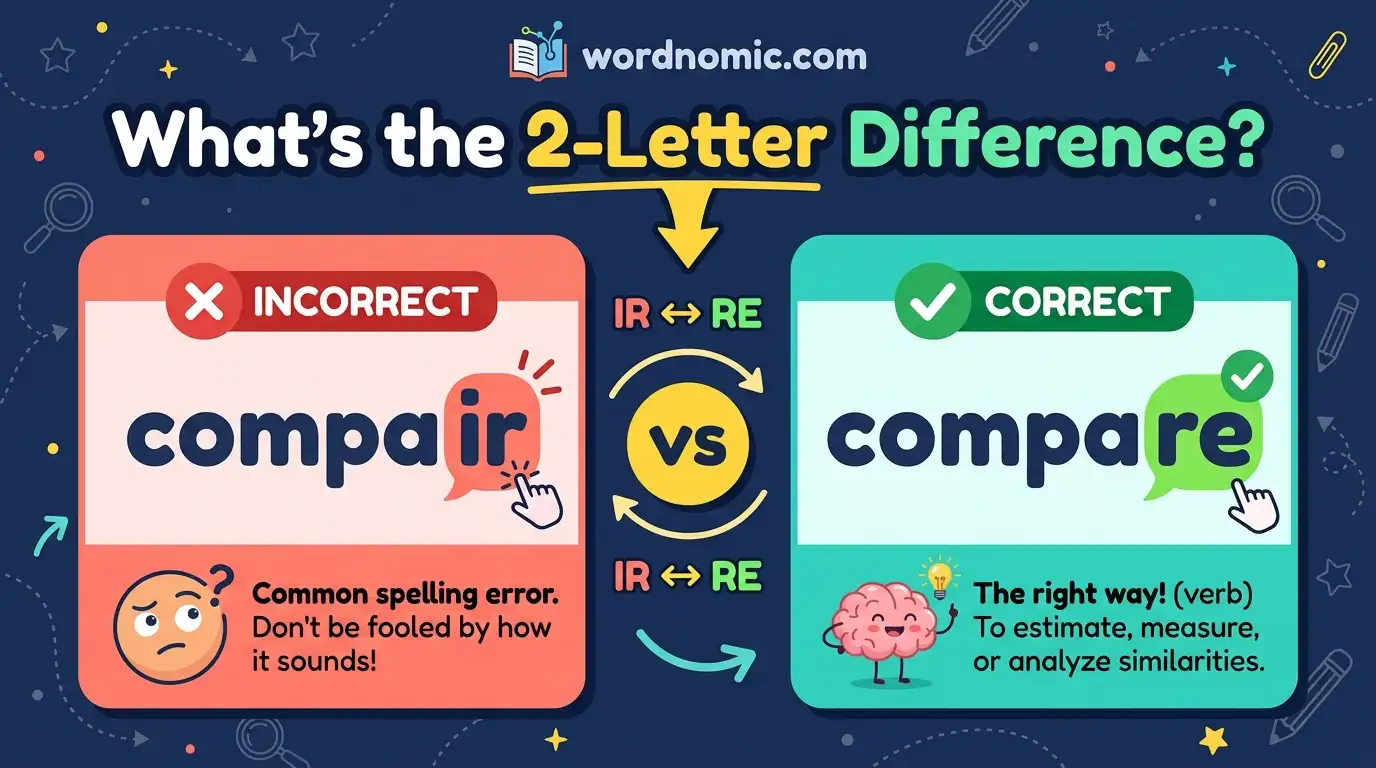
Have you ever wondered whether the correct spelling is compair or compare? These two spellings may look similar, and they can sound almost the same when spoken. However, only one is correct in standard English when you want to talk about finding similarities and differences between things.
The correct spelling is compare. The spelling compair is a common spelling mistake. If you are writing a school assignment, an email, a report, or a message, you should use compare.
For example, you can compare two phones to see which one has a better camera. You can compare prices before buying a product. You can also compare two stories to understand how they are alike and how they are different.
Although the correct answer is simple, understanding the meaning and use of compare can help you avoid similar mistakes in the future.
In this guide, you will learn the difference between compair and compare, the meaning of compare, correct sentence examples, related words, spelling tips, and common mistakes. You will also find answers to frequently asked questions about these spellings.
Compair vs Compare: Quick Answer
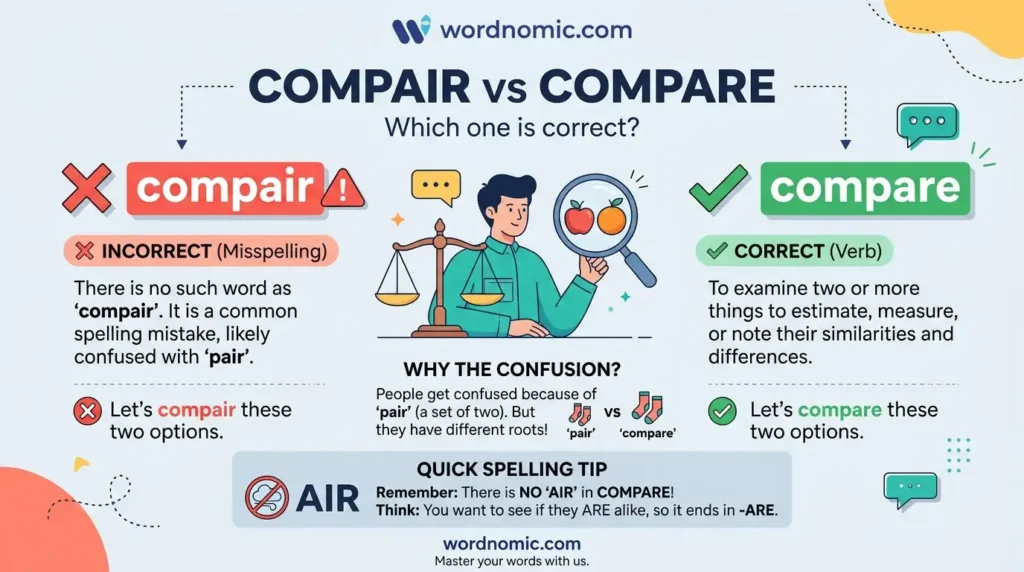
Compare is the correct spelling. Compair is a misspelling when used to mean examining two or more things for similarities and differences.
| Word | Is it correct? | Meaning |
| Compare | Yes | To examine things and find similarities or differences |
| Compair | No, not for this meaning | A common misspelling of compare |
Examples:
- Correct: I want to compare these two laptops.
- Incorrect: I want to compair these two laptops.
- Correct: We compared the prices before shopping.
- Incorrect: We compaired the prices before shopping.
The same rule applies whether you are writing a short message, a school essay, or a professional document. When you mean to examine two or more things, always choose compare.
What Does Compare Mean?
Compare is a verb. It means to look at two or more people, things, ideas, or situations to discover what is similar or different about them.
You might compare two products to see which one offers better value. A student might compare two characters in a story. A teacher might ask students to compare different answers to a question.
Comparing things helps people understand their choices and make decisions.
Here are some simple examples:
- I compare prices before buying a phone.
- She wants to compare two dresses.
- The teacher asked us to compare two poems.
- We compared the results of both tests.
- He likes to compare different football players.
In each example, compare means examining more than one thing. The goal may be to find similarities, differences, or both.
Compare in Everyday Life
People compare things almost every day, even when they do not think about it.
When you buy shoes, you may compare their prices, sizes, and comfort. When you choose a university, you may compare its courses, fees, and location. you watch a sports match, you may compare the performances of two teams.
Comparing is also useful when you need to solve a problem. Looking at two choices side by side can help you understand which one better suits your needs.
For example:
“I compared three internet packages before choosing one.”
This sentence means that the speaker looked at three packages and examined their differences before making a choice.
Is Compair a Correct English Word?
In standard English, compair is not the correct spelling of compare. If you use compair in a sentence about examining two or more things, it will usually be treated as a spelling mistake.
People may write compair because they remember how the word sounds but not how it is spelled. English pronunciation does not always make spelling easy, so this mistake is understandable.
However, knowing why a mistake happens does not make the spelling correct.
Look at these examples:
| Incorrect sentence | Correct sentence |
| I will compair the prices. | I will compare the prices. |
| Can you compair these phones? | Can you compare these phones? |
| We need to compair the results. | We need to compare the results. |
| She likes to compair books. | She likes to compare books. |
| They compaired the two plans. | They compared the two plans. |
Notice that the correct form changes depending on the sentence. The present form is compare, while the past form is compared.
If you see compair in a text, check whether the writer intended to use compare. In most ordinary writing situations, that is the correction needed.
Why Do People Confuse Compair and Compare?
There are several reasons why people may confuse these spellings. Understanding these reasons can help you remember the correct form.
1. The Words Sound Similar
One major reason is pronunciation. The ending of compare may sound like “pair” to some English learners. When people write a word based on its sound, they may choose the wrong letters.
However, compare ends with -pare, not -pair.
This small difference matters when you write the word. You cannot always work out the correct spelling simply by listening to how a word sounds.
2. English Spelling Can Be Difficult
English has many words with similar sounds but different spellings. For example, “pair” and “pear” sound alike in many accents, but they have different meanings.
Words like these can make English spelling confusing. Someone who knows the sound of compare but has not learned its spelling may write compair by mistake.
The best solution is to learn the correct spelling and use it regularly.
3. People Type Quickly
Typing quickly can lead to spelling errors. Someone might write compair in a message without noticing the mistake.
This can happen to native English speakers and English learners alike. A quick spelling check can help you catch these errors before sending a message or publishing an article.
4. People Remember the Sound Instead of the Letters
Sometimes, people remember a word from a conversation rather than from reading it. They know what the word means but are unsure how to spell it.
If you have heard compare many times but rarely seen it written, compair may seem reasonable.
Reading correct examples can help you connect the word’s meaning with its spelling.
How to Use Compare in a Sentence
The word compare works in many different situations. You can use it when discussing products, people, places, ideas, results, or experiences.
Here are examples from everyday life.
Compare Prices
People often compare prices before buying something. This helps them see which store offers the best deal.
Examples:
- I compare prices before buying a new phone.
- We should compare the prices of these two laptops.
- She compared prices at three different shops.
- They want to compare the cost of both products.
In these sentences, compare means checking the prices of different items.
Compare Products
You can compare products by looking at their features, quality, price, or usefulness.
Examples:
- I want to compare these two washing machines.
- He compared two headphones before choosing one.
- We need to compare the features of both cameras.
- She likes to compare different brands before shopping.
The purpose is to understand which product may be the better choice.
Compare People
Compare can also be used when discussing people. You might compare their skills, experiences, opinions, or achievements.
Examples:
- The coach compared the performances of two players.
- It is not always fair to compare children with each other.
- The manager compared the results of both teams.
- The students compared their answers after the test.
When comparing people, remember that differences do not always mean one person is better than another. The context matters.
Compare Ideas
People compare ideas when they want to understand different opinions or possible solutions.
Examples:
- We compared our ideas during the meeting.
- The class compared two possible answers.
- She compared both plans before making a decision.
- The team will compare the results of different methods.
This use is common in school, research, and work.
Compare Places
You can compare cities, countries, schools, hotels, or other locations.
Examples:
- They compared two hotels before booking a room.
- I want to compare the cost of living in two cities.
- We compared the facilities at both universities.
- She compared the weather in two countries.
These comparisons help people understand the differences between places.
Compare vs Compair: Common Spelling Mistakes
A common mistake is to use compair in place of compare. Another is to change the spelling when using a different form of the word.
The correct forms include compare, compares, compared, comparing, and comparison.
| Correct word | Example |
| Compare | Compare the two answers. |
| Compares | He compares prices before shopping. |
| Compared | We compared the two books. |
| Comparing | She is comparing the products. |
| Comparison | The comparison helped us decide. |
Do not write “compairs,” “compaired,” or “compairing” when you mean the standard forms of compare, compares, compared, and comparing.
For example:
- Incorrect: She is compairing the phones.
- Correct: She is comparing the phones.
- Incorrect: He compairs the prices.
- Correct: He compares the prices.
- Incorrect: We made a compairison.
- Correct: We made a comparison.
Learning the full word family makes it easier to use compare correctly in different sentences.
Compare, Compared, Comparing, and Comparison
These words are related, but they do not all perform the same job in a sentence.
Compare
Compare is the base form of the verb.
Example: “Please compare these two answers.”
The speaker is asking someone to examine both answers.
Compares
Compares is used with a singular third-person subject in the simple present tense, such as he, she, or it.
Example: “She compares prices before buying anything.”
The action is a habit or something that happens regularly.
Compared
Compared is the past form and past participle of compare.
Example: “We compared the two plans yesterday.”
The comparison took place in the past.
Comparing
Comparing is the -ing form of compare.
Example: “He is comparing two laptops.”
The action is happening now.
Comparison
Comparison is a noun. It refers to the act or result of comparing things.
Example: “The comparison showed a clear difference in price.”
A noun names the activity or result rather than describing the action itself.
Comparable
Comparable is an adjective. It describes things that are similar enough to be compared in a useful way.
Example: “The two products have comparable features.”
Learning these forms helps you avoid mistakes beyond the original compair vs compare question.
Compare With vs Compare To
You may also wonder whether to write “compare with” or “compare to.” Both expressions can be correct, but they are often used with slightly different purposes.
Compare with is commonly used when examining similarities and differences between things.
Example: “Compare this phone with the older model.”
The sentence asks you to look at both phones and identify their similarities and differences.
Compare to is often used when saying that one thing is similar to another or when making a comparison for explanation or effect.
Example: “The writer compared the busy city to a beehive.”
The writer is using a comparison to help the reader imagine how busy the city is.
In everyday English, the difference is not always strict. Both expressions can overlap, and the best choice depends on the meaning and sentence.
The important point is that the spelling remains compare in both expressions. You should not write “compair with” or “compair to” when using the standard English verb.
Compare vs Contrast
Compare and contrast are related words, but they do not mean exactly the same thing.
Contrast usually means looking closely at differences.
For example:
- Compare the two phones to examine their features.
- Contrast the two phones to focus on how their features differ.
Teachers often ask students to “compare and contrast” two stories, characters, or ideas. This means students should discuss both what is similar and what is different.
For example, if you compare two books, you might explain that both have the same theme. If you contrast them, you might explain that one has a happy ending while the other has a sad ending.
Neither compare nor contrast is spelled compair.
Easy Ways to Remember Compare
If you often forget whether to write compair or compare, try these simple methods.
1. Remember the Correct Ending
The word compare ends in -pare.
Think of this spelling whenever you need to use the word. Do not replace the final “e” pattern with “air.”
2. Learn a Short Sentence
Remember this sentence:
“I compare two products before choosing one.”
It uses the correct spelling in a simple situation. You can repeat it whenever you need a reminder.
3. Write the Word Several Times
Writing a word correctly can help you remember its letters.
Try writing:
- Compare prices.
- Compare two books.
- Compare the results.
- Compare both options.
Focus on the spelling each time.
4. Read Before You Publish
If you write articles, reports, or schoolwork, check the spelling before submitting your work.
A spell-checking tool may catch compair, but you should still review your writing. Spell-checkers can miss errors when a word is also a valid word in another context.
5. Learn Related Forms
Remembering comparison, compared, and comparing can strengthen your understanding of the spelling pattern.
For example, when you know that the noun is comparison, it becomes easier to recognize that the base verb is compare.
Examples of Compare in Different Situations
Here are more examples showing how compare appears in different kinds of writing.
At School
- The teacher asked us to compare two poems.
- I compared my answers with those of my classmates.
- Students compare different characters in the story.
- We will compare the results of both experiments.
At Work
- The manager will compare the reports.
- We compared the sales figures from last month.
- Please compare both proposals before the meeting.
- The team is comparing different solutions to the problem.
While Shopping
- Compare the prices before you buy.
- She compared two pairs of shoes.
- We should compare the quality of both products.
- He compares phone features before choosing a model.
In Technology
- I want to compare two computer processors.
- They compared the battery life of both devices.
- We compared different software programs.
- She is comparing the camera quality of two phones.
In Daily Conversations
- You cannot compare these two situations easily.
- Let us compare our experiences.
- I compared the two routes before leaving.
- They often compare their favorite films.
All these examples use compare or one of its correct forms.
A Short Practice Test
Test your understanding by choosing the correct spelling in each sentence.
- I want to (compair / compare) the prices.
- She (compairs / compares) two products before buying.
- We (compaired / compared) the results yesterday.
- He is (compairing / comparing) two phones.
- The (compairison / comparison) helped us choose.
Answers:
- Compare
- Compares
- Compared
- Comparing
- Comparison
If you answered all five correctly, you understand the basic spelling rule. If you made a mistake, review the examples and try the test again.
Frequently Asked Questions
1. Is it compair or compare?
Compare is the correct spelling when you mean to examine two or more things for similarities or differences. Compair is a misspelling for this meaning.
2. How do you spell compare?
The correct spelling is C-O-M-P-A-R-E: compare.
3. What does compare mean in simple words?
Compare means to look at two or more things and see how they are alike or different.
4. Why do people spell compare as compair?
People may write compair because the word sounds similar to “pair.” It may also be a typing mistake or a spelling error.
5. Is compair ever correct?
Compair is not the standard English spelling of the verb compare. In ordinary writing, use compare when discussing similarities and differences.
6. What is the past tense of compare?
The past tense is compared.
Example: “We compared the prices before buying the product.”
7. What is the -ing form of compare?
The -ing form is comparing.
Example: “She is comparing two books.”
8. What is the noun form of compare?
The noun form is comparison.
Example: “The comparison helped us understand the differences.”
9. Is compare a verb or a noun?
Compare is mainly a verb. Comparison is the related noun.
10. What is the difference between compare and contrast?
Compare can refer to examining similarities and differences. Contrast usually focuses on differences.
11. Can I use compare in academic writing?
Yes. Compare is common in academic writing. Students may compare theories, research findings, historical events, books, or scientific results.
12. Is compare used in American and British English?
Yes. Compare is the standard spelling in both American and British English. There is no standard American-versus-British spelling difference between compair and compare.
13. How can I remember the spelling of compare?
Remember that compare ends with “-pare,” not “-pair.” Reading and writing the word in example sentences can also help.
14. What is the difference between compare and comparison?
Compare is a verb that describes an action. Comparison is a noun that names the act or result of examining things.
Example: “We compare the prices.”
Example: “Our comparison showed a difference.”
15. Can compare be used for people?
Yes. You can compare people’s skills, ideas, experiences, or performances. However, it is helpful to consider the context and avoid unfair judgments.
Final Answer: Compair or Compare?
The correct spelling is compare. It is a verb that means to examine two or more things and find their similarities or differences.
Compair is a common misspelling and should not be used as a replacement for compare in standard English writing.
Remember these examples:
- Correct: Compare the two products.
- Correct: We compared the prices.
- Correct: She is comparing the results.
- Correct: The comparison was useful.
- Incorrect: Compair the two products.
Whether you are writing a school assignment, an email, a report, or a website article, use compare when you mean to examine things. Learning this simple spelling rule will help you write more clearly and avoid a common English mistake.











