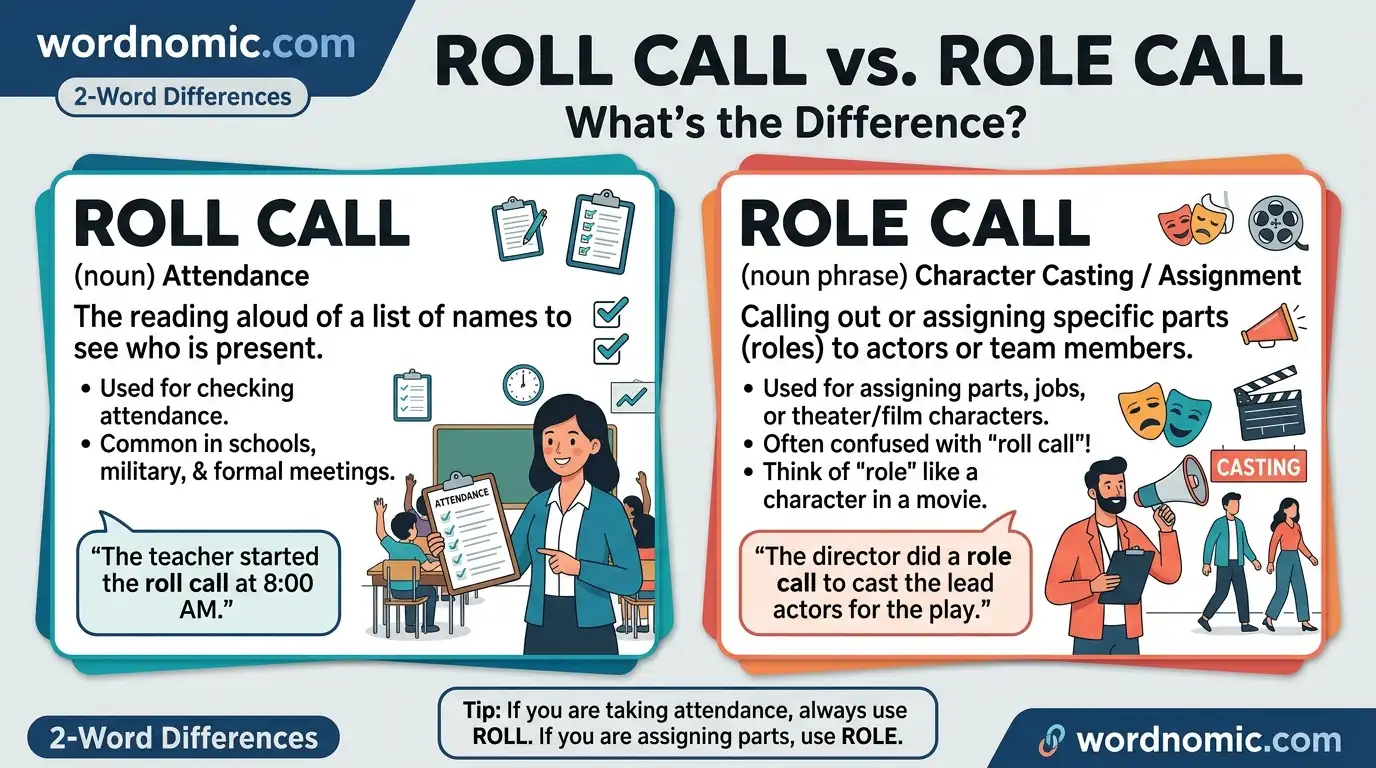
If you have ever written “role call” instead of “roll call,” you are not alone. These two phrases sound the same, so it is easy to mix them up. But they do not have the same meaning.
Roll call is the correct phrase when a teacher checks which students are present, a manager checks who has arrived, or a group confirms who is there. Role call is usually a mistake when you mean this kind of attendance check.
The confusion comes from two words with different meanings. A roll can mean a list of names. A role means a part someone plays in a job, story, or activity. Both words sound alike, but you use them in different ways.
In this guide, you will learn the difference between roll call and role call, see simple examples, and find out which phrase to use at school, at work, and in formal writing. You will also learn an easy way to remember the correct spelling.
Roll Call or Role Call: Quick Answer
Roll call is the correct phrase for checking attendance or calling the names of people on a list. Role call is not the standard phrase for this meaning.
Here is the main difference:
- Roll call: A teacher calls students’ names to check who is present.
- Role: A part someone plays in a story, job, team, or event.
- Role call: Usually a spelling mistake when someone means an attendance check.
Example: “The teacher took roll call before the lesson began.”
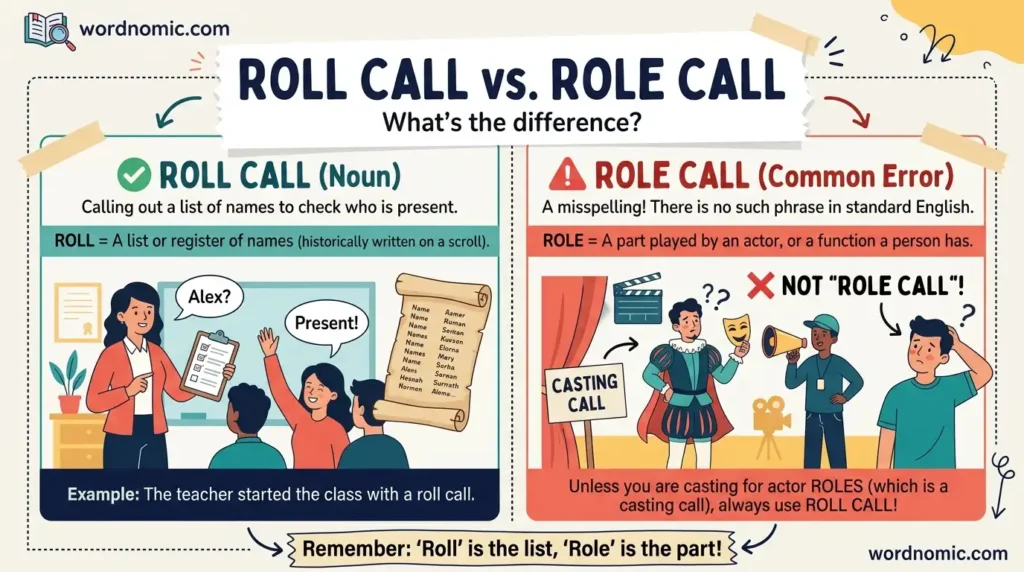
Remember this simple rule: if you are checking who is present, write roll call.
What Does Roll Call Mean?
Roll call is the act of calling names from a list to check who is present. People use it in schools, offices, meetings, the military, and other groups.
A person calls each name, and the person named answers. They may say “Here,” “Present,” or “Yes.”
For example:
- A teacher checks which students have arrived.
- A team leader checks who has joined a meeting.
- An officer checks which members of a unit are present.
- A meeting organizer checks who has arrived before starting.
Roll call can also refer to the process of naming people one by one, even when the main goal is not simply to record attendance.
Examples of roll call in sentences
- The teacher started roll call at 8 a.m.
- Please wait until roll call is over.
- The coach took roll call before practice.
- We must complete roll call before the meeting starts.
In each example, roll call refers to checking or naming people on a list.
What Does Role Mean?
The word role means the part, duty, or function that someone has in a situation. It does not mean an attendance list.
People use role in many settings, including work, school, theater, films, and daily life.
For example:
- A teacher plays an important role in a student’s learning.
- An actor has a leading role in a film.
- A manager’s role includes helping the team.
- Parents play a key role in raising children.
You can also use role when talking about a task or responsibility.
Example: “Her role is to welcome guests at the event.”
Here, role means her duty. It has nothing to do with checking attendance.
Main Differences Between Roll Call and Role Call
The main difference is the meaning of the word roll compared with role.
Roll call
Correct for attendance
Calling names from a list to check who is present.
Example: The teacher took roll call.
Role
A part, duty, or function that someone performs.
Example: She has a major role in the play.
Roll vs. role
| Word | Meaning | Example |
| Roll | A list of names or a record | The class roll has 30 students. |
| Roll call | Calling names to check attendance | We had roll call this morning. |
| Role | A person’s part or duty | His role is to lead the team. |
| Role call | Not the standard term for attendance | Write “roll call” instead. |
Origin and History of Roll Call
The phrase roll call comes from the word roll, which has long been used for a list or record of names. In the past, records could be kept on long sheets or rolls of paper.
Calling names from such a list became known as a roll call. The phrase is now common in schools, workplaces, public meetings, and military settings.
The word role has a different history. It came into English through French from a word connected with a roll or scroll used in theater. Over time, it came to mean a character’s part and later a person’s function or duty.
Although the words have related historical roots, their modern meanings differ. That is why roll call is the standard phrase for attendance, while role refers to a part or duty.
British English vs. American English
There is no important British and American spelling difference for this phrase. Both varieties use roll call when referring to attendance.
| Situation | British English | American English |
| Checking attendance | Roll call | Roll call |
| Calling names in class | Roll call | Roll call |
| A person’s duty | Role | Role |
| A character’s part | Role | Role |
You may see differences in other attendance-related terms. For example, some schools use register or take the register, especially in British English. American schools often use attendance or take attendance.
However, these differences do not make role call correct. If you are writing about calling names to check who is present, use roll call in both British and American English.
Which One Should You Use?
Choose the phrase based on what you want to say.
Use roll call when checking attendance
Use roll call when someone calls names from a list or checks who has arrived.
Examples:
- The teacher began roll call.
- We have roll call every morning.
- The captain called roll before the trip.
- Please stay quiet during roll call.
Use role when talking about a duty
Use role when you mean a task, function, or responsibility.
Examples:
- My role is to manage the office.
- He plays the role of a doctor in the film.
- Teamwork plays a major role in success.
Use role in school and work writing
The word role often appears in job descriptions, school projects, and reports.
For example: “The main role of the class monitor is to help the teacher.”
Do not change role to roll in this sentence. The sentence refers to a duty, not attendance.
Use roll in formal writing
If you are writing a report, email, school notice, or meeting record about attendance, use roll call.
For example: “All staff members must attend the morning roll call.”
In some settings, attendance check or attendance record may sound more natural. You can use those phrases if they better fit your sentence.
Common Mistakes With Roll Call and Role Call
These are common errors to watch for when writing about attendance and responsibilities.
1. Writing role call for attendance
Incorrect: The teacher started role call.
Correct: The teacher started roll call.
Use roll call when a teacher calls students’ names to check who is present.
2. Using roll instead of role
Incorrect: My roll is to help new workers.
Correct: My role is to help new workers.
The sentence describes a duty, so role is the right word.
3. Using role when calling names
Incorrect: The manager called role before the meeting.
Correct: The manager called roll before the meeting.
Here, called roll means the manager checked the list of people present.
4. Mixing up the words in a school notice
Incorrect: Role call will begin at 9 a.m.
Correct: Roll call will begin at 9 a.m.
A school notice should use the standard phrase so students and staff understand it clearly.
5. Using roll when talking about a character
Incorrect: She played the main roll in the film.
Correct: She played the main role in the film.
An actor plays a role, not a roll.
6. Assuming the words have the same meaning
Incorrect: His roll in the project is to guide the team.
Correct: His role in the project is to guide the team.
Although the words sound alike, their meanings differ. Check the meaning before choosing the spelling.
7. Using role call in a formal email
Incorrect: Please join us for the staff role call.
Correct: Please join us for the staff roll call.
Use roll call when the purpose is to check who has arrived. If you mean a meeting about job duties, explain that purpose clearly instead.
10 Everyday Examples of Roll Call and Role
Here are natural examples that show how to use both words correctly.
- School: Our teacher takes roll call every morning.
- Office: The manager checked attendance during roll call.
- Sports: The coach called roll before the team left.
- Meeting: We waited for roll call to finish before we began.
- Military: The officer checked the unit during roll call.
- Film: She played the role of a brave young girl.
- Work: His role is to train new employees.
- Family: Parents play an important role in a child’s life.
- School project: Each student had a different role in the project.
- Event: My role was to welcome guests at the door.
Notice that roll call refers to names and attendance. Role refers to a person’s part or duty.
How People Use Roll Call in Real Life
At school
Teachers often use roll call at the start of a class. They call each student’s name and mark who is present or absent.
Example: “Please answer when I call your name during roll call.”
At work
A manager may use roll call to check whether team members have arrived. This can be useful before a shift, training session, or group activity.
Example: “We will complete roll call before the morning shift begins.”
In meetings
A meeting organizer may call names to confirm which members have joined. In some workplaces, people use the term attendance check instead.
Example: “Let’s take roll call before we review the agenda.”
In emails and notices
Use the correct phrase when giving instructions about attendance.
Example:
“Morning roll call will begin at 8:30 a.m. Please arrive on time.”
For a notice about duties, use role instead.
Example:
“Please review your role before the event begins.”
In online conversations
People sometimes write role call in a message because they hear no difference between the words. If the message is about attendance, correct it to roll call.
A simple correction is enough: “The correct phrase is roll call.”
Related Questions About Roll Call or Role Call
Is role call ever correct?
Role call is not the standard phrase for checking attendance. In ordinary writing, use roll call for that meaning. The two words can appear next to each other in a special context, but that does not make role call an alternative spelling of the attendance phrase.
Is roll call one word or two?
Roll call is written as two words. Both words are needed to form the standard phrase for calling names to check attendance.
Example: “The teacher took roll call before the exam.”
Do not write rollcall as one word in normal prose.
What does roll call mean at school?
At school, roll call means checking which students are present. A teacher calls names from the class list, and students respond when they hear their names.
Some schools use terms such as attendance or register for the same general task.
What does role mean in a sentence?
Role means the part or duty someone has in a situation. It can describe a character in a film, a worker’s responsibility, or a person’s place in a group.
Example: “Her role is to organize the school event.”
Why do people confuse roll and role?
People confuse them because roll and role sound the same in many English accents. Their meanings and spellings differ, however. Reading the sentence for meaning helps you choose the right word.
Is roll call used in British English?
Yes. Roll call is understood in both British and American English. British schools may also say take the register, while American schools often say take attendance. The best choice depends on the setting.
How do you remember roll call or role call?
Think of roll as a list of names. If someone calls names from a list to check attendance, use roll call. Think of role as a job or part someone plays. If you mean a duty or character, use role.
Usage and Search Trends
People often search for “roll call or role call” because the phrases sound alike. They want to know which spelling is correct, especially when writing school assignments, emails, meeting notes, or workplace notices.
The main search intent is informational. Readers usually want a quick answer, a clear difference between the two phrases, and examples they can use in their own writing.
Common related searches include:
- Is it roll call or role call?
- What does roll call mean?
- What is the difference between roll and role?
- How do you use roll call in a sentence?
- Is role call a spelling mistake?
No verified search-volume or trend figures are included here. The questions above are relevant search variations, not a claim about their popularity or ranking.
Roll Call vs. Role Call: Comparison Table
| Phrase or word | Meaning | Correct use | Example |
| Roll call | Checking attendance by calling names | Schools, meetings, and workplaces | We started roll call at nine. |
| Role | A part, task, or duty | Jobs, films, and daily life | My role is to help the team. |
| Roll | A list or record of names | Attendance records | Her name is on the class roll. |
| Role call | Not the standard attendance phrase | Usually a spelling error in this context | Write “roll call” instead. |
| Take attendance | Check who is present | Common school and workplace language | The teacher took attendance. |
| Take the register | Record who is present | Common in British school settings | The teacher took the register. |
FAQs About Roll Call or Role Call
1. Which is correct, roll call or role call?
Roll call is correct when you mean calling names to check attendance. Role refers to a person’s part or duty. If you are writing about a teacher checking students or a manager checking staff, use roll call.
2. Is roll call the same as taking attendance?
Yes, in most everyday situations, roll call is a way to take attendance. A person calls names from a list and records who is present. However, attendance can also be recorded through a sign-in sheet, an electronic system, or another method.
3. What is the difference between roll and role?
Roll can mean a list of names or a record. Role means a part, function, or responsibility. For example, a student may be on the class roll, while the student’s role in a group project may be to give a presentation.
4. Can I write role call in an email?
If you mean an attendance check, write roll call. For example, “Staff roll call begins at 8 a.m.” If you mean a discussion of job duties, use a phrase such as role review or team responsibilities meeting to make the meaning clear.
5. How do you use roll call in a sentence?
You can write, “The teacher took roll call before the exam.” Another example is, “Please arrive early for the morning roll call.” In both sentences, the phrase refers to checking or calling the names of people who should be present.
6. Is roll call formal or informal?
Roll call works in both formal and informal settings. You can use it in school notices, workplace instructions, meetings, and everyday conversation. In some settings, attendance check or take attendance may sound more natural.
7. Does roll call have a hyphen?
No. In standard writing, roll call is written as two separate words without a hyphen. The usual phrase is “We took roll call,” not “We took roll-call” or “We took rollcall.”
Conclusion
The correct phrase for checking attendance is roll call, not role call. Use it when a teacher calls students’ names, a manager checks which workers have arrived, or an organizer confirms who is present at a meeting.
The key is to understand the difference between roll and role. A roll can be a list or record of names. A role is a part, task, or duty that someone performs.
For example, “The teacher took roll call” is correct because the teacher is checking attendance. “Her role is to help the team” is also correct because it describes her duty.
Both words sound alike, which makes this mistake easy to make. However, their meanings are different, and the right spelling makes your writing clearer.
Remember this simple tip: roll call means checking names, while role means a duty or part. Use roll call in school records, office notices, meeting notes, and other writing about attendance. This rule works in both British and American English.











