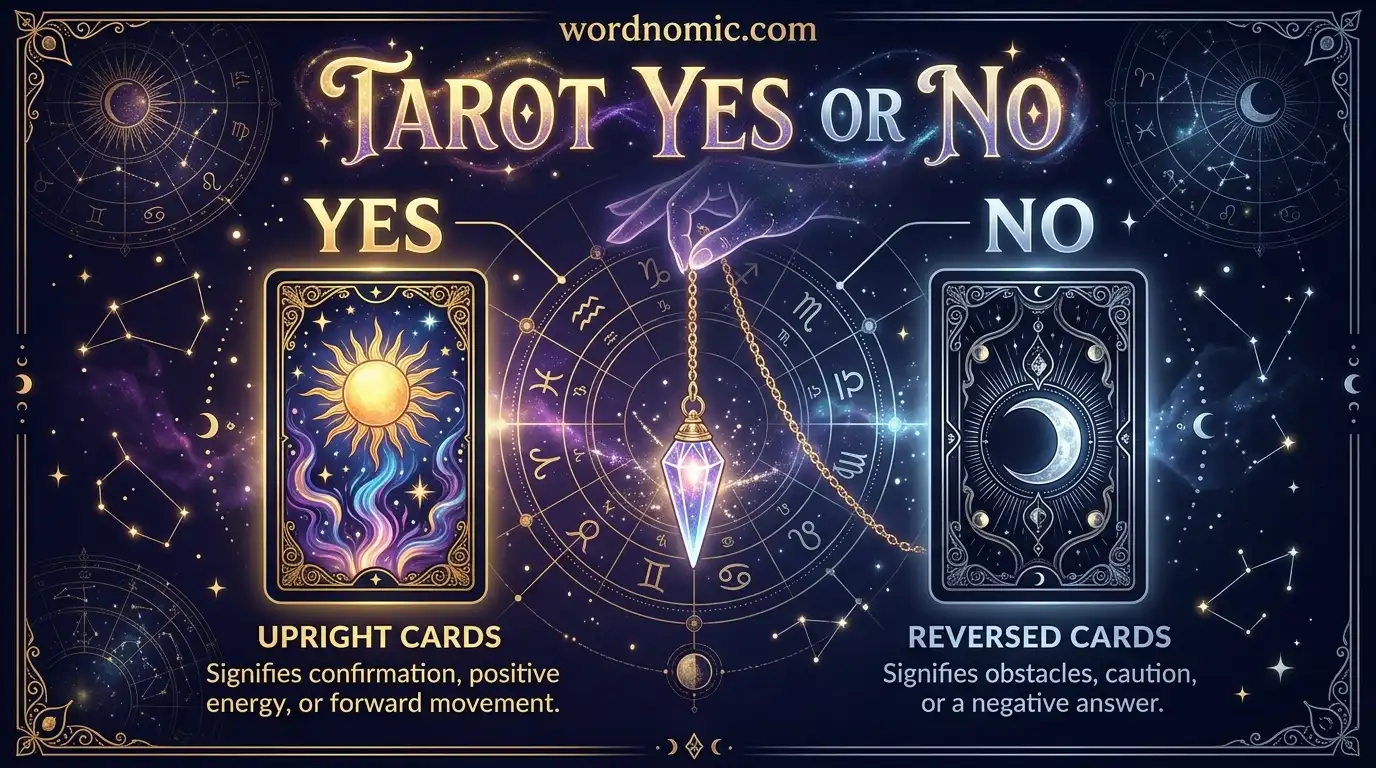
Sometimes, people have a question and want a simple answer. They may want to know if a new job is right for them, if they should send a message, or if they are making the right choice. This is why many people search for tarot yes or no readings.
A yes-or-no tarot reading is a simple way to use tarot cards to think about a question. You ask a question, choose a card, and look at its meaning. Depending on the card, the answer may lean toward yes, no, or maybe.
You do not need to be an expert to try this type of reading. You can start with one card and learn its basic meaning. However, tarot cards cannot prove what will happen in the future. Their meanings depend on the reading method and the person reading them.
In this guide, you will learn how yes-or-no tarot works, how to do a reading, which cards may mean yes or no, and how to ask better questions. You will also learn when it is better to use facts and your own judgment instead of relying on a card.
What Is Tarot Yes or No?
Tarot yes or no is a type of tarot reading that gives a short answer to a clear question. Most readings use one card, but some people use three cards for more detail.
A tarot deck usually has 78 cards. Each card has pictures and meanings that people use to think about different parts of life. Some cards are linked with success, hope, and new chances. Others are linked with problems, delays, or change.
In a yes-or-no reading, a person looks at the card and decides whether its meaning supports a yes, a no, or a maybe answer.
For example, you might ask, “Should I apply for this job?” You then draw one card and read its meaning. The card may help you think about your choice, but it cannot tell you for certain whether you will get the job.
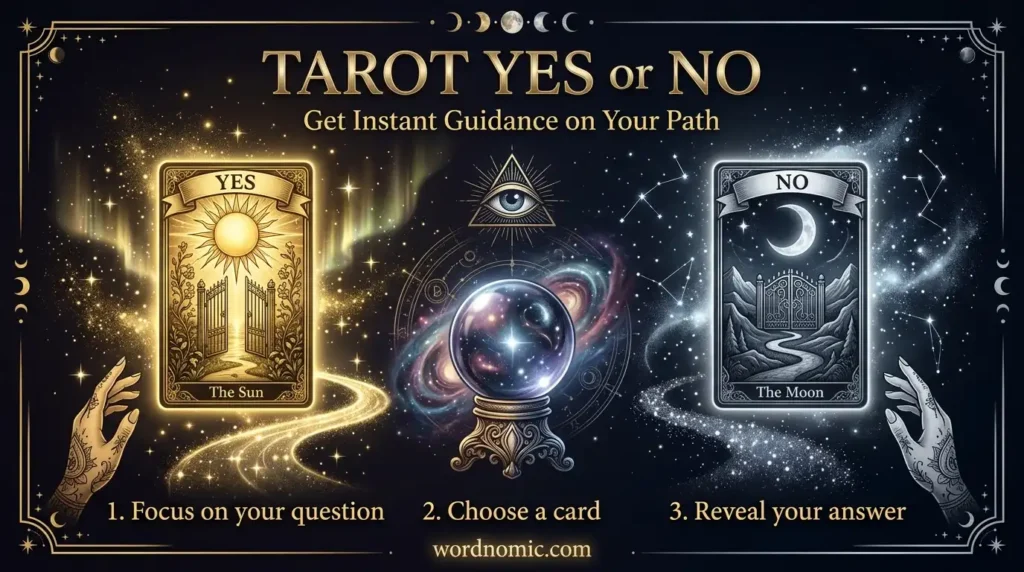
Simple meaning: Tarot yes or no is a way to explore a question by using the meanings of tarot cards.
How Does a Yes or No Tarot Reading Work?
A yes-or-no reading starts with one clear question. You then shuffle your cards and choose one. After turning the card over, you look at its meaning and how it relates to your question.
There are three common types of answers:
- Yes: The card may point toward a good chance or a helpful next step.
- No: The card may point toward a problem, a risk, or a reason to stop and think.
- Maybe: The answer may depend on more details, a change in plans, or information you do not have yet.
Not every tarot reader uses the same rules. One reader may see a card as yes, while another may read it as maybe. This is why it helps to choose a reading method before you start.
Remember that the answer is an interpretation, not a fact about the future.
How to Do a Tarot Yes or No Reading
You can try a simple reading at home if you have a tarot deck. Follow these steps to keep the process clear.
Step 1: Choose One Clear Question
Think about the one thing you want to understand. Try to ask a question that can be answered with yes or no.
For example, “Should I send this message today?” is clear. “Will my whole life be better soon?” is too broad because it covers many parts of life.
Step 2: Take a Moment to Focus
Sit somewhere quiet and think about your question. You do not need a special room or any extra items. The main goal is to slow down and focus on what you want to ask.
Step 3: Shuffle the Cards
Shuffle your tarot deck while keeping the question in mind. You can shuffle in a way that feels easy and comfortable.
There is no need to repeat the question many times or follow a complex routine.
Step 4: Choose One Card
Pick one card from the deck and turn it over. If you are new to tarot, one card is enough to begin.
Step 5: Read the Card’s Meaning
Look at the card’s common meaning. Does it suggest hope, action, delay, worry, or change? Think about how that meaning relates to your question.
Step 6: Think About the Answer
Decide whether the card leans toward yes, no, or maybe under the method you chose.
Do not draw more cards again and again just because you dislike the first answer. Instead, use the card as a reason to think about your choices.
Which Tarot Cards Mean Yes?
Some tarot cards are often seen as positive signs in yes-or-no readings. Their meanings may point toward hope, success, growth, or a fresh start.
These cards are not a promise that everything will work out. They simply tend to lean toward yes in some tarot reading methods.
1. The Sun
The Sun is often linked with joy, success, and clear thinking. In a yes-or-no reading, it is commonly read as yes.
For example, if you ask whether a plan has promise, The Sun may suggest that you feel hopeful and can see a clear way forward.
2. The Star
The Star is linked with hope, calm, and a fresh sense of trust. It may suggest that a situation has room to improve.
In a yes-or-no reading, it often leans toward yes, especially when the question is about hope or a new chance.
3. The World
The World is linked with reaching a goal, finishing a task, or completing a stage of life. It is often read as a positive card.
If you ask whether you are close to finishing a project, this card may point toward progress or a sense of completion.
4. The Ace of Cups
The Ace of Cups is linked with new feelings, care, and emotional growth. It may lean toward yes in questions about love, friendship, or a new bond.
However, it cannot prove that another person loves you or will return to a relationship.
5. The Ace of Wands
The Ace of Wands is linked with new ideas, energy, and action. It may point toward a fresh start or a chance to try something new.
If you are asking about starting a project, this card may encourage you to look at the idea and plan your next step.
Which Tarot Cards Mean No?
Some cards are linked with loss, conflict, fear, or sudden change. In some yes-or-no reading methods, these cards may lean toward no or suggest that you should pause.
Their meaning depends on the question and the reading method.
1. The Tower
The Tower is linked with sudden change and the loss of something that once seemed stable. It may suggest that a plan needs to be checked carefully.
In a yes-or-no reading, some readers take it as no or as a warning to rethink the situation.
2. Ten of Swords
The Ten of Swords is often linked with a painful ending, stress, or feeling worn out. It may point toward a need to accept that something is not working.
It does not mean that a bad event must happen. Its meaning can be used as a reason to look at the facts and consider other choices.
3. Five of Pentacles
The Five of Pentacles is linked with money worries, feeling left out, or going through a hard time. In some readings, it may suggest that a plan needs more support or a safer approach.
4. Three of Swords
The Three of Swords is often linked with sadness, hurt feelings, or a hard truth. It may suggest that a choice needs more care, especially in a close relationship.
It cannot tell you for certain what another person thinks or feels.
5. Five of Swords
The Five of Swords is often linked with fights, tension, and trying to win at a cost. It may suggest that a choice could lead to more problems than benefits.
In a yes-or-no reading, you might use it as a reason to pause and think about what you could lose.
What Does Maybe Mean in Tarot?
Not every question has a clear yes-or-no answer. Sometimes, a card may point toward doubt, waiting, or missing details.
For example, The Moon is often linked with confusion and things that are not yet clear. The High Priestess may point toward patience and careful thought. Two of Swords is often linked with a hard choice or a lack of clear information.
Depending on the reading method, these cards may mean maybe, not yet, or that you need to learn more before making a choice.
If you get a maybe answer, ask yourself:
- Do I have all the facts?
- Am I rushing to make a choice?
- Is there something I need to ask or check first?
- Can I wait until the situation becomes clearer?
A maybe answer can be useful because it reminds you that you do not always need to decide right away.
Should You Read Reversed Tarot Cards?
A reversed tarot card is a card that appears upside down. Some readers use reversed cards, while others read every card in its normal position.
In yes-or-no readings, a reversed card may be read as a delay, a block, or a need to look at the situation in a new way.
For example, The Sun is often a positive card when upright. If it appears reversed, some readers may read it as a slower result or a reason to look at what is stopping progress.
However, a reversed card does not always mean no. The meaning depends on the card and the method you use.
If you are a beginner, you can start by reading all cards upright. Once you know their basic meanings, you can decide whether you want to include reversed cards.
The most important thing is to use one method each time instead of changing the rules to get the answer you want.
How to Ask Better Yes or No Tarot Questions
The way you ask a question can make your reading easier to understand. A clear question gives you a clear topic to think about.
Here are some simple tips.
Ask About One Thing
Avoid putting two or three questions together.
Instead of asking, “Should I leave my job and move to another city?” ask about each choice on its own.
Use a Clear Time Frame
A question about the next week is easier to focus on than a question about your whole future.
For example, you could ask, “Should I apply for this job this week?”
Keep the Question Simple
Use normal words. You do not need to make the question sound special or complex.
For example, “Should I talk to my friend about this problem?” is easy to understand.
Ask About Your Own Choices
Questions about what you can do are often more useful than questions about what another person secretly thinks.
Instead of asking, “Does this person miss me?” you could ask, “Would it be helpful for me to reach out to this person?”
Be Ready to Think About the Answer
Do not treat the card as an order. Think about the real situation, your needs, and the choices you have.
Examples of Yes or No Tarot Questions
Here are some questions people may use for a simple tarot reading.
Love and Relationships
- Should I talk honestly with my partner?
- Should I reach out to someone I have not spoken to in a while?
- Is this a good time to discuss a problem in my relationship?
- Should I take more time before making a choice about love?
Work and Study
- Should I apply for this job?
- Should I start learning a new skill?
- Is this a good time to work on my project?
- Should I ask for more information before accepting an offer?
Personal Choices
- Should I try a new hobby?
- Would taking a break help me think more clearly?
- Should I ask someone for advice?
- Is there more information I need before making this choice?
These questions can help you focus on one topic. The cards do not replace careful thought, honest talks, or real facts.
Can You Do a Free Tarot Yes or No Reading Online?
Yes, many websites offer free online tarot readings. Some let you think of a question, choose a card on the screen, and read its meaning.
These tools may be useful if you want to learn about tarot cards or try a simple reading without buying a deck.
Before using an online reading, keep a few things in mind:
- Check how the website explains its method.
- Remember that different websites may give different answers.
- Do not pay for a service just because it promises a sure result.
- Do not share private details that are not needed.
- Use the reading as a way to think, not as proof of what will happen.
A free reading can be fun, but it cannot confirm the future or make a decision for you.
Is Tarot Yes or No Accurate?
There is no reliable proof that tarot cards can predict future events with certainty. Tarot readings use card meanings and personal interpretation, so different readers may reach different answers.
Some people use tarot as part of their spiritual beliefs. Others use it as a way to think about feelings, choices, and problems from a new point of view.
A reading may help you notice how you feel about a choice. For example, if you receive a no and feel disappointed, that reaction may help you understand how much you want something.
Still, your feelings are only one part of a decision. You should also look at the facts, possible risks, and results of each choice.
For important matters involving health, money, legal issues, or personal safety, use trusted information and seek qualified help when needed. Do not let a tarot card decide these matters for you.
Common Mistakes to Avoid in Yes or No Tarot
1. Asking the Same Question Again and Again
Drawing cards again until you get a yes can make the reading confusing. Choose your method before you start and give yourself time to think.
2. Expecting Every Card to Give a Clear Answer
Some cards may suggest a delay or a need for more information. It is fine to accept that the answer is unclear.
3. Treating a Card as a Promise
A positive card does not guarantee success, love, money, or a job. Real results depend on many things.
4. Ignoring Real Facts
Do not ignore clear warning signs because a card looks positive. Look at the real situation before you make a choice.
5. Using Tarot for Every Decision
You do not need a card to decide every small thing. Sometimes, making a list of the good and bad points is more helpful.
Frequently Asked Questions
1. What is tarot yes or no?
Tarot yes or no is a simple reading that uses tarot cards to explore a question with a possible yes, no, or maybe answer.
2. How many cards do you need for a yes-or-no reading?
One card is enough for a basic reading. Some readers use three cards when they want more detail.
3. Which tarot card is the strongest yes?
The Sun is often seen as a strong yes card because it is linked with joy, success, and clear thinking. However, card meanings can change with the question and reading method.
4. Which tarot card means no?
The Tower is sometimes read as no because it is linked with sudden change and problems. Other cards may also lean toward no, depending on the method.
5. What if my tarot answer is maybe?
A maybe answer can mean that more information is needed or that the situation is not clear. Take time to think before making your choice.
6. Do reversed cards always mean no?
No. Some readers see reversed cards as a sign of delay, a block, or a different way to understand the card. The meaning depends on the card and the method.
7. Can tarot tell me what another person is thinking?
Tarot cannot confirm another person’s private thoughts or feelings. If you need to know something important, a respectful and honest talk is more reliable.
8. Can I trust a free online tarot reading?
You can use a free reading to learn about tarot or think about a question. However, it should not be treated as a sure prediction of the future.
9. Should I keep drawing cards until I get yes?
It is better to avoid doing this. Repeatedly drawing cards may make you more confused. Take the first reading as a chance to think about the question.
Conclusion
Tarot yes or no is a simple way to explore a question with the help of tarot cards. You can start by asking one clear question, shuffling your deck, choosing one card, and reading its meaning. Some cards, such as The Sun and The Star, often lean toward yes. Cards such as The Tower may lean toward no, while others may suggest waiting or learning more.
There is no single rule that every tarot reader follows. The meaning of a card can depend on the question and the method used. Most importantly, a tarot reading cannot guarantee what will happen in the future.
Use the cards as a way to think about your feelings and choices. Look at real facts before making important decisions, and remember that you are responsible for your own actions. A card may give you a new point of view, but it should not control your life

Emily Carter is an English grammar writer based in Portland, Oregon, with 7+ years of experience turning tricky grammar rules into simple, easy lessons.










