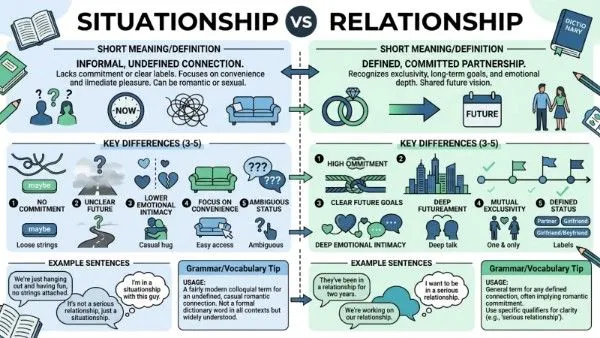
Have you ever spent a lot of time with someone but still asked, “What are we?” You talk every day. You go out together. You care about each other. But you are not sure if you are a couple. This is where situationship vs relationship can get confusing.
People search for this topic because dating is not always simple. Two people can act like a couple without calling it a relationship. They may spend time together, share feelings, and even make plans. But they may not talk about being together.
A situationship and a relationship can look much alike. The main difference is how clear the bond is. A relationship usually has a clear name and clear rules. A situationship often does not.
This guide explains the difference in very simple English. You will learn what each word means, where the words come from, how to use them, and when each word fits best. You will also see easy examples, common mistakes, and answers to common questions.
Situationship vs Relationship – Quick Answer
A situationship is a close connection between two people that feels like dating, but the two people have not clearly said they are in a relationship.
A relationship is a clear bond between two people who agree that they are together.
Here is a simple example:
Situationship:
“We see each other every week, but we have not said what we are.”
Relationship:
“We are together, and we both know we are a couple.”
The key difference is clarity.
In a situationship, you may not know:
- If you are a couple
- If you can date other people
- Where the bond is going
- What the other person wants
- What you can expect from each other
In a relationship, these things are often more clear.
| Point | Situationship | Relationship |
| Clear name | Often no | Usually yes |
| Dating | Often yes | Usually yes |
| Feelings | Can be strong | Can be strong |
| Commitment | Not always clear | Usually clear |
| Future plans | Often unclear | More common |
| Rules | May not be set | Often discussed |
| Couple status | Unclear | Usually clear |
A situationship is not always bad. Some people like having less pressure. Others want a clear relationship. What matters is that both people want the same thing.
The Origin of Situationship vs Relationship
The word relationship is much older than situationship.
The word relationship comes from relation. It has been used for many years to talk about a link or bond between people or things.
For example:
- A family relationship
- A work relationship
- A close relationship
- A romantic relationship
The word can describe many kinds of bonds.
The word situationship is much newer.
It joins the words situation and relationship. People began using it to describe a bond that feels like a relationship but does not have a clear name.
The word became more common as online dating and social media grew. People needed a simple word for a type of dating that did not fit the old labels.
For example, two people may:
- Talk every day
- Go on dates
- Spend nights together
- Care about each other
- Meet each other’s friends
But they may still not call each other boyfriend, girlfriend, partner, or couple.
The word situationship helps explain this kind of bond.
Why Was the Word Created?
Dating has changed a lot.
People now meet through dating apps and social media. Some people want a serious relationship. Others want something more casual.
Some people also want a close bond without a clear label.
The word situationship gives this type of bond a simple name.
It is now common in online talk about dating and love.
British English vs American English Spelling
There is good news here.
Situationship is spelled the same in British and American English.
Relationship is also spelled the same in both forms of English.
So, you do not need to change these words for readers in the US or UK.
| Word | American English | British English |
| Situationship | situationship | situationship |
| Relationship | relationship | relationship |
| Dating | dating | dating |
| Romantic | romantic | romantic |
| Commitment | commitment | commitment |
For example:
American English:
“They are in a situationship.”
British English:
“They are in a situationship.”
The spelling does not change.
Some other English words do have spelling changes.
For example:
| American English | British English |
| Color | Colour |
| Favorite | Favourite |
| Center | Centre |
| Behavior | Behaviour |
| Traveling | Travelling |
But you do not need to worry about these changes when using situationship or relationship.
Which Spelling Should You Use?
Use situationship in both American and British English.
Use relationship in both American and British English.
Your choice does not depend on where your readers live.
If you write for US readers, you can write:
“She is in a situationship.”
If you write for UK readers, you can write:
“She is in a situationship.”
Both are correct.
The same rule applies to relationship.
For a Global Audience
If your website has readers from many countries, you can use either word without changing the spelling.
However, think about the type of writing.
Relationship works well in both casual and formal writing.
Situationship is more casual.
You will often see it in:
- Social media posts
- Dating blogs
- Text messages
- Online talks
- Dating apps
In formal writing, it may help to explain the word.
For example:
“A situationship is a close romantic bond without a clear relationship label.”
This helps readers who have never heard the word before.
Common Mistakes with Situationship vs Relationship
People often mix up these words because both can describe dating.
Here are some common mistakes.
Mistake 1: Thinking They Mean the Same Thing
They do not always mean the same thing.
A situationship usually has less clear rules.
A relationship usually has a clear name and clear plans.
Wrong idea:
“A situationship is just another word for a relationship.”
Better:
“A situationship can feel like a relationship, but it may not have a clear name or plan.”
Mistake 2: Thinking a Situationship Has No Feelings
This is not true.
People in a situationship can have strong feelings.
They may care a lot about each other. They may even love each other.
The main problem may be that they do not know what the bond means.
Mistake 3: Thinking Every Casual Date Is a Situationship
Not every casual date is a situationship.
If two people go on one date, that does not mean they are in a situationship.
A situationship usually lasts longer and has more of a bond.
Mistake 4: Thinking Every Relationship Is Serious
A relationship can be serious or casual.
It can last for a short time or many years.
The main point is that both people usually know that they are together.
Mistake 5: Using Situationship in Formal Writing Without Explaining It
The word is common, but it is still more casual than relationship.
In formal writing, explain it first.
For example:
“A situationship is a romantic bond that does not have a clear name or level of commitment.”
After that, you can use the shorter word.
Situationship vs Relationship in Everyday Examples
The best way to learn these words is to see them in real sentences.
In a Text Message
Situationship:
“I like you, but I do not know what we are.”
Relationship:
“I am happy that we are together.”
The first sentence shows doubt.
The second sentence shows a clear bond.
On Social Media
Someone might write:
“Why are situationships so hard?”
Here, the person is talking about a close bond that is not clear.
Another person might write:
“My partner and I have been in a relationship for three years.”
Here, the word relationship clearly shows the type of bond.
In an Email
You may not use situationship in a work email.
But you could use it in a personal email:
“I think we need to talk about our situationship.”
For a more formal message, you could write:
“I think we should talk about our relationship.”
In News
News stories about dating may use the word situationship.
For example:
“Situationships are changing the way some people date.”
The word works well in stories about new dating trends.
In Formal Writing
Relationship is the better choice for most formal writing.
For example:
“Good relationships help people build trust.”
If you use situationship, explain it when needed.
“The term situationship describes a romantic bond without a clear label.”
Situationship vs Relationship – Comparison Table
| Feature | Situationship | Relationship |
| Meaning | A close bond without a clear label | A clear bond between two people |
| Label | Often missing | Usually clear |
| Commitment | May be unclear | Usually clear |
| Feelings | Can be strong | Can be strong |
| Dating | Common | Common |
| Future plans | Often unclear | More likely |
| Rules | May not be set | Often discussed |
| Trust | Can be strong | Usually important |
| Status | Often unclear | Usually known |
| Use of word | More casual | More common and general |
Remember that these are general meanings.
Every bond is different.
A situationship can become a relationship. A relationship can also end. The words simply help us describe what the bond looks like.
Situationship vs Relationship – Google Trends & Usage Data
The word relationship has been used for a very long time. It is also used for many types of bonds.
People search for relationship topics about:
- Love
- Marriage
- Family
- Dating
- Friends
- Work
- Breakups
This gives relationship a much wider use.
The word situationship is newer. Its use is mostly linked to dating and modern love.
People often search for it when they want to know:
- What a situationship means
- Signs of a situationship
- Situationship vs relationship
- How to end a situationship
- How to turn a situationship into a relationship
The word has also become common on social media.
Where Are These Words Used?
Both words are used in English-speaking countries, such as:
- United States
- United Kingdom
- Canada
- Australia
- New Zealand
The word relationship is far more common because it has many uses.
The word situationship has a much smaller use. It mainly appears in dating and social media talk.
Search interest can change from year to year. It can also change when a dating topic becomes popular online.
For the latest search numbers, Google Trends is useful because it lets you compare search interest by country and time.
How Do You Know If You Are in a Situationship?
Ask yourself these simple questions.
Do you both call each other a couple?
If yes, you may be in a relationship.
Have you talked about what you want?
Clear talks can help you know where you stand.
Do you know if you are dating other people?
If you do not know, your bond may not be clear.
Do you make plans for the future?
Future plans can show that both people want to stay together.
Does the other person use the same label as you?
This is very important.
If you call the person your partner but they say you are “just seeing each other,” you may not see the bond in the same way.
The best way to know is to talk about it.
FAQs;
1. What is a situationship?
A situationship is a close romantic bond that does not have a clear relationship label. The two people may date and have strong feelings, but they may not agree that they are a couple.
2. What is a relationship?
A relationship is a clear bond between two people. In a romantic relationship, both people usually know they are together.
3. Can a situationship become a relationship?
Yes. A situationship can become a relationship if both people talk about what they want and agree to be together.
4. Can you love someone in a situationship?
Yes. A person can have strong feelings in a situationship. The word does not mean that the feelings are not real.
5. Is a situationship bad?
Not always. Some people are happy with a less clear or less serious bond. But problems can happen when the two people want different things.
6. Which is better, a situationship or a relationship?
Neither is always better. It depends on what you want. If you want clear plans and commitment, a relationship may be a better fit.
7. Are situationship and relationship spelled differently in the US and UK?
No. Both words have the same spelling in American and British English.
Conclusion;
The difference between a situationship and a relationship is mainly about how clear the bond is.
A situationship is often a close romantic bond without a clear name. Two people may talk every day, go on dates, and care about each other. But they may not know if they are a couple or what will happen next.
A relationship usually has a clearer name. Both people often know that they are together. They may also talk about rules, trust, dating other people, and future plans.
The words also have the same spelling in American and British English. You do not need to change them for US or UK readers.
If you are not sure what your connection means, talk to the other person. Ask simple questions. Find out what they want and what they expect.
In short, a situationship is often unclear, while a relationship is usually more clear. The right choice depends on what both people want.