A year sounds simple. It should start in January and end in December, right? Not always. In business, finance, insurance, contracts, and reports, you may also see the term rolling year. This can make dates and time periods confusing.
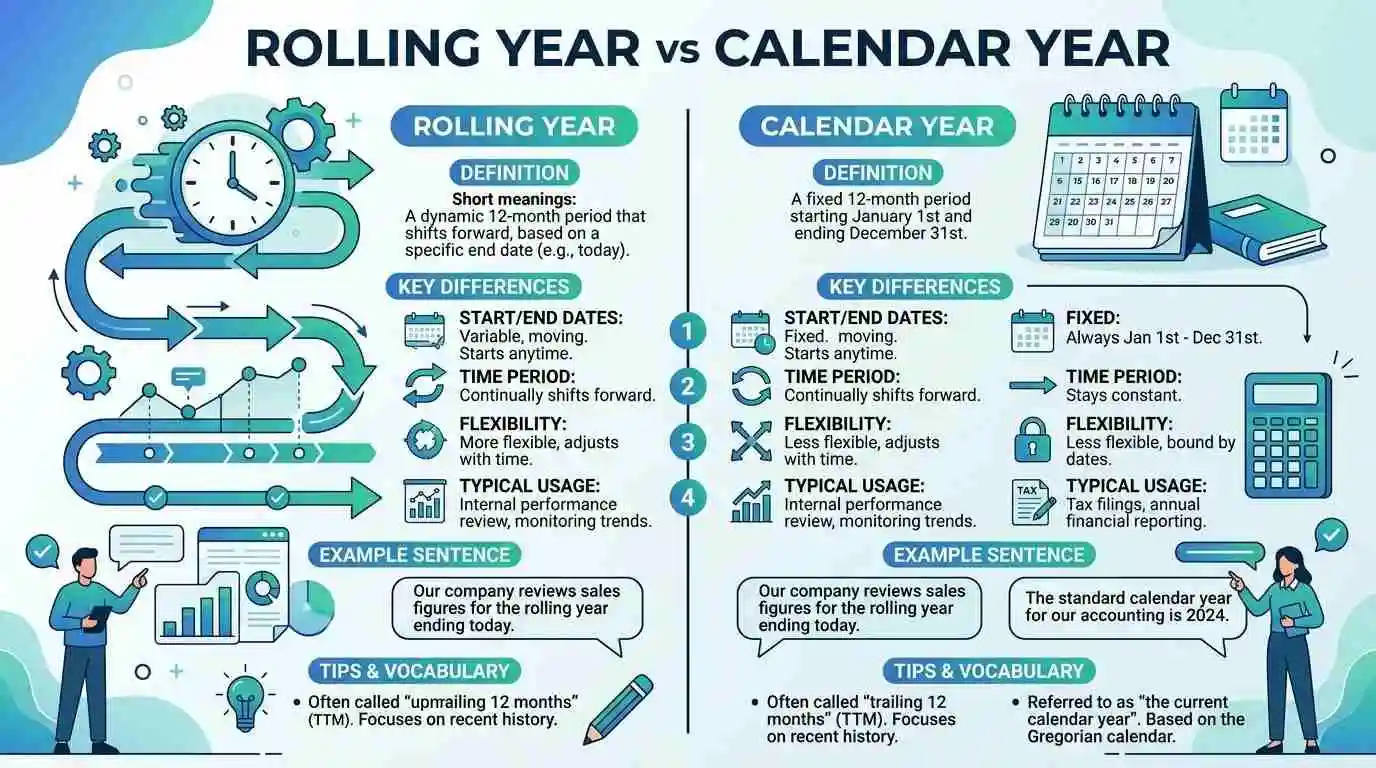
The difference between rolling year vs calendar year is simple once you know where the period starts. A calendar year always follows the same fixed dates: January 1 through December 31. A rolling year covers any 12-month period that moves forward as time passes.
For example, if a company checks sales for the calendar year 2026, it looks at January 1, 2026, through December 31, 2026. If it checks sales for a rolling year, it might look at the most recent 12 months, such as August 23, 2025, through August 22, 2026.
People search for this term because the two periods can produce very different results. Knowing the difference helps you understand reports, contracts, benefits, taxes, business targets, and other time-based rules.
This guide explains rolling year vs calendar year with simple examples, comparisons, common mistakes, and practical advice.
Rolling Year vs Calendar Year – Quick Answer
The key difference is how the 12-month period is set.
Calendar year
A calendar year always runs from:
January 1 to December 31
For example:
The calendar year 2026 runs from January 1, 2026, to December 31, 2026.
The dates stay fixed every year.
Rolling year
A rolling year covers a moving period of 12 months.
For example:
August 23, 2025, to August 22, 2026
The starting and ending dates can change as time moves forward.
Quick comparison
| Term | Meaning | Example |
| Calendar year | Fixed January-to-December period | Jan. 1–Dec. 31 |
| Rolling year | Any moving 12-month period | Aug. 23–Aug. 22 |
| Time period | Fixed by calendar dates | Same dates each year |
| Time period | Moves forward over time | Changes regularly |
Easy rule
Remember:
Calendar year = January to December
Rolling year = moving 12 months
The Origin of Rolling Year vs Calendar Year
The two terms come from simple ideas about measuring time.
The origin of calendar
The word calendar comes from Latin calendae, which referred to the first day of a Roman month.
Over time, the word came to mean a system for organizing days, weeks, months, and years.
Today, a calendar year usually means the standard year that begins on January 1 and ends on December 31.
The origin of rolling
The word rolling comes from the idea of something moving forward continuously.
When used with time, rolling means that a period keeps moving as new days arrive.
For example, a rolling 12-month period does not stay fixed.
If you check it today, it covers the latest 12 months. If you check it again next month, the period moves forward by about one month.
Why do these terms exist?
Different situations need different ways to measure time.
A calendar year works well for:
- Annual reports
- Tax records
- Yearly budgets
- Government statistics
- Year-end results
A rolling year works well when you want to see recent activity without waiting for January.
For example:
A company may use a rolling year to measure recent customer growth.
This can give a more current view than a fixed calendar year.
British English vs American English Spelling
There is no important British or American spelling difference between rolling year and calendar year.
Both British English and American English use the same terms.
British English
The figures cover a rolling year.
The report covers the calendar year.
American English
The figures cover a rolling year.
The report covers the calendar year.
The main difference is not spelling. It is the time period being described.
Comparison table
| Feature | British English | American English |
| Rolling year | Correct | Correct |
| Calendar year | Correct | Correct |
| Rolling 12 months | Correct | Correct |
| Calendar-year period | Correct | Correct |
| Spelling difference | None | None |
Which Term Should You Use?
Choose the term based on the period you mean.
Use calendar year for January to December
Use calendar year when your period follows the standard year.
Our sales increased during the calendar year 2025.
This means January 1, 2025, through December 31, 2025.
Use rolling year for a moving 12-month period
Use rolling year when the 12-month period moves forward.
The company reported a 10% increase over the past rolling year.
This means the latest 12 months, not necessarily January through December.
For business writing
Be clear about the dates.
Instead of:
Sales increased this year.
You could write:
Sales increased during the 2025 calendar year.
Or:
Sales increased over the latest rolling 12-month period.
This avoids confusion.
For global readers
The terms rolling year and calendar year are widely understood. However, it is still helpful to provide exact dates when the time period matters.
Common Mistakes with Rolling Year vs Calendar Year
Mistake 1: Thinking a rolling year always starts in January
Incorrect:
A rolling year always begins on January 1.
A rolling year can start on any date.
Correct:
A rolling year covers a moving 12-month period.
Mistake 2: Treating the two terms as identical
A calendar year and a rolling year can cover different dates.
For example:
Calendar year:
January 1, 2026–December 31, 2026
Rolling year:
August 23, 2025–August 22, 2026
They both cover 12 months, but they do not cover the same period.
Mistake 3: Using “last year” without explaining it
The phrase last year can create confusion.
Does it mean:
- The previous calendar year?
- The past 12 months?
- A company’s financial year?
For formal writing, use exact dates when possible.
Mistake 4: Confusing rolling year with fiscal year
A fiscal year is a defined 12-month accounting period. It does not always follow January through December.
A fiscal year may run from:
July 1 to June 30
A rolling year, however, keeps moving forward based on the dates being measured.
Mistake 5: Assuming every rolling period is exactly the same
A rolling period can be different lengths.
You may see:
- Rolling 30 days
- Rolling 90 days
- Rolling 6 months
- Rolling 12 months
So always check the number of months or days.
Rolling Year vs Calendar Year in Everyday Examples
These terms appear in many areas of life and work.
In business
Revenue increased by 12% during the calendar year.
This means January through December.
Revenue increased by 12% over the latest rolling year.
This means the latest 12 months.
In finance
A report may compare:
2025 calendar-year results
with:
The latest rolling 12-month results
These measurements can show different trends.
Insurance
A policy may limit a service to a certain number of uses in a rolling 12-month period.
The limit may not reset every January 1.
In employee benefits
A benefit may say:
Employees may use 20 days during a rolling year.
The exact dates depend on the policy.
In emails
Please note that this limit applies to a rolling 12-month period.
Or:
The figures are based on the 2025 calendar year.
News
The company recorded its strongest results in the calendar year.
On social media
I have traveled to 10 countries in the past rolling year.
In formal writing
The analysis compares calendar-year data with rolling 12-month data.
Rolling Year vs Calendar Year – Google Trends & Usage Data
Searches for rolling year vs calendar year often come from people dealing with dates, limits, records, and business reports.
The terms appear often in:
- Finance
- Business
- Insurance
- Healthcare
- Employee benefits
- Banking
- Government data
- Sales reports
- Contracts
- Membership rules
Calendar year searches
People often search for calendar year when they need to understand:
- Tax periods
- Annual reports
- Yearly budgets
- Government records
- Annual sales
- January-to-December data
Rolling year searches
People often search for rolling year when they need to understand:
- Benefit limits
- Insurance rules
- Recent sales
- Customer activity
- Performance data
- Usage limits
The term rolling 12 months is also common because it makes the meaning more specific.
Rolling Year vs Calendar Year – Comparison Table
| Feature | Rolling Year | Calendar Year |
| Length | Usually 12 months | 12 months |
| Start date | Can be any date | January 1 |
| End date | Moves forward | December 31 |
| Does it move? | Yes | No |
| Example | Aug. 23, 2025–Aug. 22, 2026 | Jan. 1–Dec. 31, 2026 |
| Best for | Recent activity | Annual records |
| Resets each January? | Not necessarily | Yes |
| Common phrase | Rolling 12 months | Calendar year |
Rolling Year vs Last 12 Months
These phrases are often used in similar ways.
A rolling year usually means a moving 12-month period.
Last 12 months often means the same thing, but it can be clearer in everyday writing.
For example:
We sold 5,000 products in the last 12 months.
This normally means the most recent 12 months from the date of measurement.
In formal documents, always check the definition given by the organization.
Rolling Year vs Fiscal Year
These terms are not the same.
A calendar year runs from January 1 to December 31.
A fiscal year is a fixed 12-month accounting period chosen by an organization or government.
A rolling year moves continuously.
| Period | Example |
| Calendar year | Jan. 1–Dec. 31 |
| Fiscal year | Apr. 1–Mar. 31 |
| Rolling year | Latest 12 months |
The exact meaning of a fiscal year can vary by organization or country.
FAQs;
1. What is the difference between a rolling year and a calendar year?
A calendar year runs from January 1 to December 31. A rolling year covers a moving 12-month period.
2. Does a rolling year start in January?
No. A rolling year can start on any date.
3. Is a rolling year the same as 12 months?
Usually, yes. A rolling year generally refers to a moving period of 12 months.
4. Does a rolling year reset every January?
No. A rolling year does not normally reset on January 1. It moves forward continuously.
5. What is a calendar year?
A calendar year is the standard year from January 1 through December 31.
6. Is a rolling year the same as a fiscal year?
No. A fiscal year is a fixed accounting period. A rolling year moves forward over time.
7. Which is better, a rolling year or calendar year?
Neither is always better. A calendar year works well for fixed annual reporting. A rolling year is useful for tracking recent activity.
8. Why do companies use rolling years?
Companies may use rolling years to measure recent performance without waiting for a new calendar year.
9. How do I know which period a company means?
Check the company’s definition or policy. If the period matters, look for exact start and end dates.
Easy Way to Remember Rolling Year vs Calendar Year
Think about the words.
Calendar = fixed dates
January → December
Rolling = moving dates
The period moves as time passes.
So:
Calendar year = fixed 12 months
Rolling year = moving 12 months
This simple trick can help you choose the right term.
Conclusion;
The difference between rolling year vs calendar year is mainly about where the 12-month period starts and ends. A calendar year always follows the same dates: January 1 through December 31. A rolling year covers a moving 12-month period that can start on any date.
For example, the 2026 calendar year runs from January 1, 2026, to December 31, 2026. A rolling year measured on August 23, 2026, may cover August 23, 2025, through August 22, 2026.
Both terms are useful. A calendar year works well for annual reports, taxes, budgets, and yearly records. A rolling year works well when you want to measure recent activity without being tied to January or December.
There is no British or American spelling difference to worry about. The important thing is to use the term that matches your time period.
When writing for work, business, or formal documents, give exact dates whenever possible. That small step can prevent major confusion.

Emily Carter is an English grammar writer based in Portland, Oregon, with 7+ years of experience turning tricky grammar rules into simple, easy lessons.