You read about a planet that might have life on it, and it says “habitable.” Then somewhere else, you see “inhabitable” used for what feels like the same idea. Wait, doesn’t adding “in” to a word usually flip its meaning? So shouldn’t these two words mean the opposite of each other?
This mix-up gets even careful readers, and it’s not really your fault. This word pair does not follow the normal pattern. Let’s make this simple.
Quick Answer
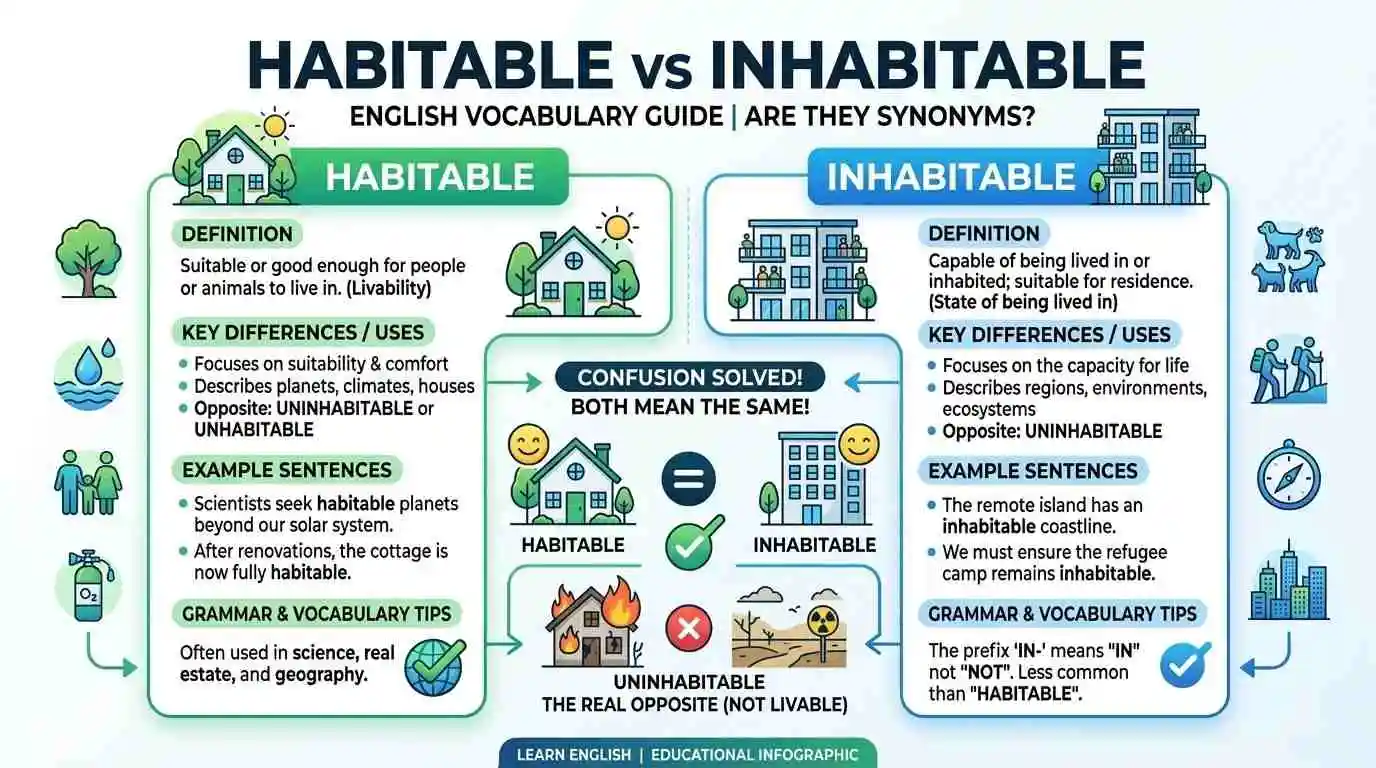
Habitable means a place is good enough for people or animals to live in. Example: “Scientists are looking for habitable planets.”
Inhabitable also means a place can be lived in, almost the same meaning as “habitable.” This one is odd, since “in” at the front usually means “not.”
Simple rule: for most cases, “habitable” is the safe, clear word. “Inhabitable” means close to the same thing, but it mixes people up so much that most writers just skip it.
Why This Word Pair Feels So Odd
Normally, adding “in” to the front of a word flips it to mean the opposite. Think about “in” plus “correct,” which gives you “incorrect,” meaning not correct. Or “in” plus “visible,” giving you “invisible,” meaning not able to be seen.
Based on that pattern, you would think “inhabitable” means “not able to be lived in,” the opposite of “habitable.” But that is not how this word grew at all.
“Inhabitable” does not come from adding “not” to “habitable.” Instead, it comes from the word “inhabit,” which means “to live in” a place. Add “able” to “inhabit,” and you get “inhabitable,” which means “able to be lived in,” basically the same idea as “habitable.”
So this word looks like it should mean the opposite, but it actually came from a totally different word, “inhabit,” not from adding “not” to “habitable.” That’s the real reason this word pair feels so backwards.
Breaking Down the Real Difference
| Habitable | Inhabitable | |
| What it means | Able to be lived in | Also able to be lived in, close to the same meaning |
| Comes from | The word “habitable” itself | The word “inhabit,” which means to live in |
| How common it is | Very common, used a lot | Rare, and often avoided |
| Chance of mix-up | Low, this one is clear | High, many people think it means the opposite |
A Simple Way to Handle This Word Pair
Since both words mean close to the same thing, the real trick here is not picking the “right” one, it’s picking the one that won’t confuse the reader.
Use “habitable” almost every time. It’s the word most people know and understand right away, without any second guess.
Skip “inhabitable” unless you’re sure your reader already knows about this odd word pair. Since so many people think it means “not able to be lived in,” using it can send the wrong message, even though it does not mean that at all.
Try It Yourself
Guess which word most writers would pick, based on what’s clear to read.
- A science article about planets that might have life. → habitable
- A home inspector’s report saying a house is safe to live in. → habitable
- A tricky word quiz about odd English words. → inhabitable (as the rare, tricky answer)
- A travel blog about a small but livable island. → habitable
- A news story about Mars maybe having life someday. → habitable
Notice that? “Habitable” wins almost every time in real life, since it’s clear and doesn’t confuse anyone.
When Each Word Actually Shows Up
Science writing about planets or space: Almost always “habitable.” Example: “Scientists found a maybe-habitable planet outside our solar system.”
Home safety reports: Always “habitable.” Example: “The building was said to be habitable after the repairs.”
Old-fashioned or very formal writing: “Inhabitable” might show up here, but it’s rare and often confuses more than it helps.
Word quizzes or trivia games: “Inhabitable” sometimes shows up here, exactly because it’s a strange, tricky word that breaks the usual “in” pattern.
Everyday writing and talk: Stick with “habitable.” It’s simply the clearer, safer word almost every time.
Common Mistakes People Make
Thinking “inhabitable” means “not able to be lived in.” This is the biggest mix-up with this word pair, and it happens a lot, since most other “in” words work the opposite way.
Using “inhabitable” to sound more fancy. It often backfires, since many readers will read it as meaning the opposite of what you wanted to say.
Not knowing both words are actually correct. Some people think “inhabitable” is simply wrong, but it is a real word, just a confusing and rare one.
Mixing this pair up with real opposite word pairs. Not every “in” word flips meaning the same way, and this pair is one of English’s trickiest little exceptions.
Seeing These Words in Real Life
A science news title: “New study finds another possibly habitable planet nearby.”
A home report: “The apartment was called habitable after the repairs were done.”
Old-style writing: “The far valley was found to be inhabitable, even with its harsh weather.”
A quiz question: “Which strange English word means almost the same as its opposite-looking twin?”
A casual chat: “Believe it or not, habitable and inhabitable mean almost the same thing.”
Why People Search This So Often
Students and writers search “habitable vs inhabitable” a lot while working on school reports, wanting to make sure they don’t send the wrong message by mistake.
People learning English search this pair too, since it breaks a rule they just learned, that adding “in” flips a word’s meaning. This makes the exception stand out and cause mix-ups.
Curious readers also search this after seeing both words used in a close way somewhere, wanting to know if it’s a mistake or a real, strange case in English.
A Few More Tricky “In” Word Pairs
| Pair | Expected Meaning | Real Meaning |
| Habitable / Inhabitable | Should be opposite | Both mean close to the same thing |
| Flammable / Inflammable | Should be opposite | Both mean able to catch fire |
| Valuable / Invaluable | Should be opposite | “Invaluable” actually means very valuable |
Common Questions
Is “inhabitable” a real word? Yes, it’s a real, correctly spelled word. It’s just rare and often mixed up, since it does not follow the usual pattern of “in” words meaning the opposite.
Why doesn’t “in” flip the meaning here like it usually does? Because “inhabitable” does not come from adding “not” to “habitable.” It comes from the word “inhabit,” which means to live in a place, and that’s why it ends up meaning close to the same thing.
Which word should I use to keep things clear? Almost always pick “habitable.” It’s the clear, well-known word, while “inhabitable” risks being read as the opposite.
Are there other English words that work this same strange way? Yes, “flammable” and “inflammable” are a lot like this. Both actually mean able to catch fire, even though “in” usually means the opposite.
Is “inhabitable” ever used the right way today? Yes, sometimes, mostly in older or more formal writing, but many writers today skip it since it’s so often misunderstood.
How can I remember which word is safer to use? Just remember, “habitable” is the safe, clear pick almost every time. Think of “inhabitable” as a rare word you probably don’t need in everyday writing.
Why does English have such a strange case here? Because “inhabitable” grew from a totally different word, “inhabit,” instead of just adding “not” to “habitable,” and that’s exactly why it breaks the usual pattern people expect.
Wrapping This Up;
“Habitable” and “inhabitable” are one of English’s strangest word pairs. They mean almost the same thing, even though most people expect “in” to flip the meaning to the opposite. The truth is, “inhabitable” grew from a different word, “inhabit,” not from adding “not” onto “habitable,” and that’s exactly why this pair breaks the normal rule.
For almost every case, “habitable” is the safer, clearer word to use. Save “inhabitable” for rare times, like quiz questions or very old-style writing, since it confuses far more people than it helps.
Once you know this small trick, you’ll never be caught off guard by this odd little word pair again, and you’ll always know which word keeps your writing clear.