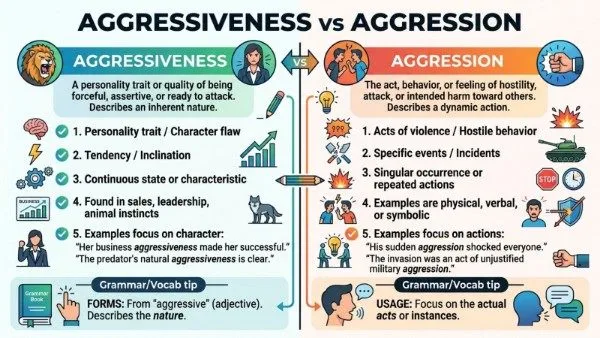
Aggressiveness vs aggression can be confusing because both words relate to forceful or hostile behavior. They are close in meaning, but they do not work in the same way.
Think about a person who often acts in a forceful way. You may describe that person as showing aggressiveness. Now think about one act, such as shouting at someone or trying to hurt them. You may call that aggression.
This small difference matters. The two words can appear in school work, news stories, health writing, sports, and daily talk. Using the wrong word can make a sentence sound unclear.
People often search for aggressiveness vs aggression because they want to know which word fits a sentence. They may also want to know if the words mean the same thing.
The easy answer is this: aggression is an act or form of hostile behavior, while aggressiveness is the quality or habit of being aggressive.
In this guide, you will learn the difference, see simple examples, and learn how to use both words with confidence.
Aggressiveness vs Aggression – Quick Answer
Aggression means forceful or hostile action.
Aggressiveness means the quality of being aggressive or often acting in an aggressive way.
Aggression
Use aggression when you are talking about an act, behavior, or type of force.
“The player showed aggression during the game.”
“The dog showed aggression toward the stranger.”
“The attack was an act of aggression.”
Aggressiveness
Use aggressiveness when you are talking about a person’s or animal’s tendency to act in an aggressive way.
“His aggressiveness made the other players nervous.”
“The dog’s aggressiveness was hard to control.”
“Her aggressiveness helped her win the debate.”
A simple way to remember the difference is:
Aggression = aggressive action or behavior
Aggressiveness = the quality of being aggressive
| Word | Simple Meaning | Example |
| Aggression | Hostile or forceful action | “His aggression caused a fight.” |
| Aggressiveness | A strong tendency to act aggressively | “His aggressiveness worried his parents.” |
| Aggressive | Acting in a forceful or hostile way | “He was aggressive.” |
The Origin of Aggressiveness vs Aggression
Both aggression and aggressiveness come from the word aggressive.
The word aggression comes from Latin roots linked to the idea of moving toward or attacking. It later came to describe hostile action or an attack.
The word became common in English as people used it to talk about force, attack, and hostile behavior.
Aggressive came from the same word family.
Later, English formed aggressiveness by adding -ness to aggressive.
The ending -ness often changes an adjective into a noun.
For example:
- Kind → kindness
- Dark → darkness
- Happy → happiness
- Aggressive → aggressiveness
So:
Aggressive → aggressiveness
The two words are related, but they focus on different things.
Aggression often points to the action itself.
Aggressiveness often points to the quality or habit behind the action.
Why Are There Two Words?
English often has several words from the same word family.
For example:
- Angry → anger
- Kind → kindness
- Active → activity
- Aggressive → aggression
- Aggressive → aggressiveness
These words let us talk about the same idea in different ways.
That is why both aggression and aggressiveness are useful.
British English vs American English Spelling
There is no major spelling difference between aggression and aggressiveness in British and American English.
Both forms use the same spelling:
- aggression
- aggressiveness
- aggressive
| Word | American English | British English |
| Aggression | aggression | aggression |
| Aggressiveness | aggressiveness | aggressiveness |
| Aggressive | aggressive | aggressive |
| Aggressively | aggressively | aggressively |
So, you do not need to change these words based on whether your readers are from the United States or the United Kingdom.
For example:
American English:
“His aggressiveness caused problems.”
British English:
“His aggressiveness caused problems.”
Both sentences are correct.
What About Other Words?
Some English words do have spelling differences.
For example:
| American English | British English |
| Color | Colour |
| Behavior | Behaviour |
| Favor | Favour |
| Center | Centre |
| Defense | Defence |
But aggression and aggressiveness do not change.
Which Spelling Should You Use?
You can use aggression and aggressiveness in both American and British English.
There is no need to choose a different spelling for US or UK readers.
If you write for an American audience, use:
“The coach was concerned about his aggressiveness.”
If you write for a British audience, you can use the same sentence:
“The coach was concerned about his aggressiveness.”
For a Global Audience
Both words are safe for a global English audience.
However, aggression is more common and more widely used.
It appears often in:
- News
- Sports
- Science
- School work
- Psychology
- Everyday speech
Aggressiveness is also correct, but it often describes a quality or repeated behavior.
For formal writing, choose the word that matches your meaning.
Use aggression for an act or type of hostile behavior.
Use aggressiveness for a quality, style, or tendency.
Common Mistakes with Aggressiveness vs Aggression
These words are easy to mix up. Here are some common mistakes.
Mistake 1: Using Aggression for a Person’s General Nature
You may want to describe someone who often acts in a forceful way.
Less clear:
“His aggression is very high.”
Better:
“His aggressiveness is very high.”
Here, aggressiveness describes a quality.
Mistake 2: Using Aggressiveness for One Act
If you are talking about one hostile act, aggression may fit better.
Less natural:
“The attack was an act of aggressiveness.”
Better:
“The attack was an act of aggression.”
Mistake 3: Thinking Aggression Always Means Physical Violence
Aggression does not always mean physical violence.
It can include:
- Threats
- Angry words
- Hostile actions
- Forceful behavior
- Attacks
For example:
“His verbal aggression upset the team.”
Mistake 4: Thinking Aggressiveness Is Always Bad
Not always.
In sports or business, people may use aggressiveness in a positive way.
For example:
“The team’s aggressiveness helped them win.”
Here, the word can mean strong and active behavior.
Mistake 5: Using Aggressive When You Need a Noun
Remember that aggressive is an adjective.
“He is aggressive.”
Aggression and aggressiveness are nouns.
“His aggression was a problem.”
“His aggressiveness was clear.”
Aggressiveness vs Aggression in Everyday Examples
These words appear in many types of writing.
In Emails
You may use aggression in a work email when talking about a problem.
“We need to address the aggression shown during the meeting.”
You may use aggressiveness when talking about someone’s style.
“His aggressiveness during the meeting made others uncomfortable.”
In News
News stories often use aggression.
“The country faced criticism for its aggression.”
Here, aggression refers to hostile action.
In Sports
Both words are common in sports.
Aggression:
“The team played with aggression.”
Aggressiveness:
“The team’s aggressiveness gave them an advantage.”
Both can work, but they focus on slightly different ideas.
On Social Media
People may write:
“I do not like his aggression.”
Or:
“Her aggressiveness is too much.”
These are informal uses, but both words are correct.
In Formal Writing
Both words can appear in formal writing.
For example:
“The study looked at aggression in young children.”
Or:
“The study measured levels of aggressiveness.”
The best choice depends on what the writer wants to describe.
Aggressiveness vs Aggression – Comparison Table
| Feature | Aggression | Aggressiveness |
| Part of speech | Noun | Noun |
| Main idea | Hostile or forceful action | Quality of being aggressive |
| Focus | Action or behavior | Trait or tendency |
| Can describe one act? | Yes | Usually less natural |
| Can describe a general trait? | Sometimes | Yes |
| Used in news | Very common | Less common |
| Used in sports | Common | Common |
| Used in formal writing | Common | Common |
| Example | “His aggression caused fear.” | “His aggressiveness was clear.” |
Easy Rule
Ask yourself:
Am I talking about an action?
Use aggression.
“The dog showed aggression.”
Am I talking about a quality or tendency?
Use aggressiveness.
“The dog’s aggressiveness worried the owner.”
This simple rule will help in most cases.
Aggressiveness vs Aggression – Google Trends & Usage Data
Aggression is much more common in English than aggressiveness.
This is because aggression has many uses.
People use it when talking about:
- War
- Violence
- Sports
- Animals
- Children
- Psychology
- Social behavior
- Politics
- News
For example:
“Aggression in sports”
“Aggression in children”
“Animal aggression”
The word aggressiveness has a narrower use.
It often appears when people talk about a person’s behavior or a person’s tendency to act in an aggressive way.
For example:
“Child aggressiveness”
“Male aggressiveness”
“Aggressiveness in sports”
Which Word Is More Popular?
Aggression is generally much more common.
It is an older word and has a wider range of uses.
Aggressiveness is still useful when you need to describe a trait or tendency.
Both words appear in English-speaking countries, including:
- United States
- United Kingdom
- Canada
- Australia
- New Zealand
Search interest can change by country and topic.
For the latest search numbers, Google Trends can help you compare the two words by country, date, and topic.
Aggression vs Aggressiveness: More Examples
Examples
Here are some simple examples to make the difference clear.
1
“The dog showed aggression.”
This means the dog acted in a hostile or threatening way.
2
“The dog’s aggressiveness worried the owner.”
This means the dog had a strong tendency to act in an aggressive way.
3
“The player used aggression during the game.”
This means the player acted with force and energy.
4
“The player’s aggressiveness helped the team.”
This describes the player’s strong style or tendency to act with force.
5
“The teacher noticed aggression between the students.”
This points to hostile behavior.
Example 6
“The teacher noticed a high level of aggressiveness in one student.”
This points to a repeated or strong tendency.
FAQs;
1. What is the difference between aggression and aggressiveness?
Aggression usually means a hostile or forceful act or type of behavior. Aggressiveness means the quality or tendency of being aggressive.
2. Is aggressiveness a real word?
Yes. Aggressiveness is a correct English word. It means the quality or state of being aggressive.
3. Is aggression more common than aggressiveness?
Yes. Aggression is more common because it has many uses in news, sports, science, and daily English.
4. Can aggression be positive?
Sometimes. In sports, aggression can mean strong and forceful play. However, in many other contexts, it has a negative meaning.
5. Can aggressiveness be positive?
Yes. For example, a sports team may use aggressiveness to describe strong and active play.
6. Are aggression and aggressiveness synonyms?
They are related, but they are not always exact synonyms. Aggression focuses more on action or behavior. Aggressiveness focuses more on a quality or tendency.
7. Do aggression and aggressiveness have different British and American spellings?
No. Both words are spelled the same in American and British English.
Conclusion;
Understanding aggressiveness vs aggression is easy once you know what each word focuses on.
Aggression usually means a hostile, forceful, or attacking action. It can describe one act or a type of behavior. For example, you can talk about aggression in sports, animals, children, or news events.
Aggressiveness usually means the quality or tendency to act in an aggressive way. It often describes a person’s or animal’s general behavior or style.
Both words are correct in American and British English. Their spelling does not change.
When choosing between them, ask a simple question: Am I talking about an action or a quality? If you mean an action or hostile behavior, aggression is often the better choice. If you mean a person’s tendency or style, aggressiveness is often better.
You do not need to avoid either word. Just match the word to your meaning. Once you understand this small difference, you can use aggression and aggressiveness with confidence in everyday and formal writing.

Emily Carter is an English grammar writer based in Portland, Oregon, with 7+ years of experience turning tricky grammar rules into simple, easy lessons.