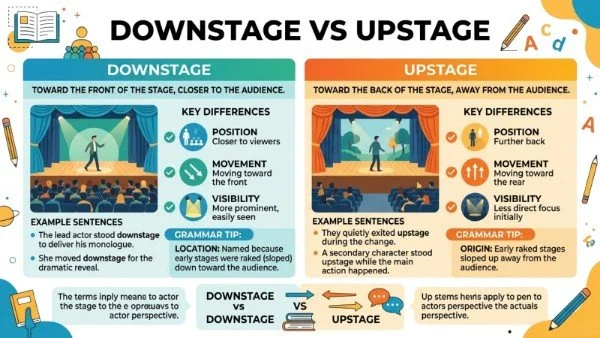
If you have ever watched a play, you may have heard a director say, “Move downstage” or “Go upstage.” But what do these words mean? If you are new to theater, downstage vs upstage can be hard to understand at first.
The good news is that the difference is simple. Downstage means the part of the stage that is closer to the audience. Upstage means the part of the stage that is farther from the audience.
These words can also be used outside theater. For example, upstage can mean to make someone else look less important. You may also see the words in dance, acting, stage work, and film talk.
People search for downstage vs upstage because the words seem like they should have a simple meaning, but the stage can make the directions confusing. If you stand on the stage, the front and back may not feel clear.
This guide explains both words in simple English. You will learn what they mean, where they came from, how to spell them, and how to use them correctly.
Downstage vs Upstage – Quick Answer
Downstage means the part of a stage that is closest to the audience.
Upstage means the part of a stage that is farthest from the audience.
Think of the stage like this:
Audience → Downstage → Middle of stage → Upstage
So:
- Downstage = near the audience
- Upstage = far from the audience
Example
Imagine an actor standing at the front of the stage.
The director might say:
“Move downstage.”
The actor should move closer to the audience.
If the director says:
“Move upstage.”
The actor should move farther away from the audience.
| Word | Simple Meaning | Where? |
| Downstage | Near the audience | Front of the stage |
| Upstage | Far from the audience | Back of the stage |
| Center stage | Middle of the stage | Center |
| Stage left | Actor’s left side | Left side |
| Stage right | Actor’s right side | Right side |
An Easy Way to Remember
Think of a stage that slopes downward toward the audience.
The part near the audience is lower.
That is downstage.
The part farther from the audience is higher.
That is upstage.
The Origin of Downstage vs Upstage
The words downstage and upstage come from the way old theater stages were built.
In the past, some stages were made with a slight slope. The stage was higher at the back and lower near the audience.
The part near the audience was called downstage because it went down toward the audience.
The part at the back was called upstage because it went up away from the audience.
This stage design also helped the audience see actors more clearly.
Over time, stages became flatter. But the words stayed.
Today, actors still use downstage and upstage, even when the stage has no slope.
Why Do We Still Use These Words?
Theater needs clear directions.
An actor may need to move to a certain part of the stage without turning around or pointing.
Instead of saying:
“Move toward the audience.”
A director can simply say:
“Move downstage.”
Instead of:
“Move toward the back.”
The director can say:
“Move upstage.”
These short words make stage directions easier.
Upstage Has Another Meaning
Upstage can also be a verb.
If someone upstages another person, they take attention away from that person.
For example:
“The singer upstaged the other performers.”
This means the singer got more attention than the other performers.
The word can also describe a person who tries to make someone else look less important.
British English vs American English Spelling
Downstage and upstage are spelled the same in American and British English.
There is no British spelling such as downstage and an American spelling such as downstage. The spelling stays the same.
| Word | American English | British English |
| Downstage | downstage | downstage |
| Upstage | upstage | upstage |
| Stage left | stage left | stage left |
| Stage right | stage right | stage right |
| Center stage | center stage | centre stage |
There is one useful spelling difference to know.
In American English, you will often see:
center stage
In British English, you may see:
centre stage
But downstage and upstage do not change.
Downstage Example
American English:
“The actor moved downstage.”
British English:
“The actor moved downstage.”
Both are correct.
Upstage Example
American English:
“She walked upstage.”
British English:
“She walked upstage.”
Again, the spelling is the same.
Which Spelling Should You Use?
Use downstage and upstage in both American and British English.
You do not need to change the spelling for your audience.
If you write for readers in the United States:
“Move downstage.”
If you write for readers in the United Kingdom:
“Move downstage.”
Both are correct.
The same rule applies to upstage.
For a Global Audience
These words are easy to use for a global audience.
They are common in:
- Theater
- Acting
- Dance
- Stage work
- Drama classes
- Theater reviews
- Acting books
If your readers do not know theater terms, it is helpful to explain them the first time.
For example:
“Downstage means the part of the stage closest to the audience.”
This gives readers the meaning right away.
Common Mistakes with Downstage vs Upstage
People who are new to theater often mix up these two words.
Here are some common mistakes.
Mistake 1: Thinking Downstage Means the Back
This is the most common mistake.
Some people think downstage means moving down toward the back.
In theater, that is not correct.
Downstage = toward the audience.
Upstage = away from the audience.
Mistake 2: Thinking Upstage Means Higher on Every Stage
Not always.
Modern stages are often flat.
The word upstage still means the area farther from the audience, even if the stage does not physically go up.
Mistake 3: Confusing Stage Left and Stage Right
Stage directions can also be confusing.
Stage right means the actor’s right side.
These directions are based on the actor’s view, not the audience’s view.
Mistake 4: Writing Down Stage as Two Words
When you mean the theater direction, write:
downstage
Not:
down stage
For example:
“The actor moved downstage.”
Mistake 5: Writing Up Stage as Two Words
The theater direction is usually written:
upstage
For example:
“The actor walked upstage.”
Mistake 6: Forgetting the Second Meaning of Upstage
Upstage can also mean taking attention away from another person.
For example:
“The guest upstaged the host.”
This does not mean the guest simply moved to the back of the stage.
Downstage vs Upstage in Everyday Examples
These words are most common in theater, but you can see them in many types of writing.
In Theater
“Please move downstage.”
This means move closer to the audience.
“The actor walks upstage.”
This means the actor moves farther from the audience.
In Acting Classes
A teacher might say:
“Start upstage and walk downstage.”
The actor starts at the back and walks toward the audience.
Emails
You may see these words in emails about a play or show.
For example:
“Please move downstage during the final scene.”
Or:
“The actors should stand upstage before the music starts.”
These uses are common in theater work.
In News
A theater news story might say:
“The actor moved downstage during the final scene.”
Here, downstage has its normal theater meaning.
A news story might also use upstage in its other sense:
“The young actor upstaged the star.”
Here, upstaged means the young actor got more attention.
On Social Media
A theater student might post:
“I finally learned the difference between downstage and upstage!”
Someone might also write:
“The child totally upstaged everyone at the show.”
The second example means the child became the center of attention.
In Formal Writing
Both words can be used in formal theater writing.
For example:
“The actor moves downstage before the final line.”
Or:
“The director asks the actor to remain upstage during the first scene.”
The words are clear and correct.
Downstage vs Upstage – Comparison Table
| Feature | Downstage | Upstage |
| Basic meaning | Closer to the audience | Farther from the audience |
| Stage position | Front | Back |
| Direction | Toward the audience | Away from the audience |
| Spelling | downstage | upstage |
| British spelling | downstage | upstage |
| American spelling | downstage | upstage |
| Main use | Theater and acting | Theater and acting |
| Other meaning | Rare | Can mean taking attention |
| Example | “Move downstage.” | “Move upstage.” |
Simple Stage Guide
Imagine you are standing on a stage.
Audience
↓
Downstage
↓
Center stage
↓
Upstage
So remember:
Downstage = front
Upstage = back
This is the easiest rule to remember.
Downstage vs Upstage – Google Trends & Usage Data
The words downstage and upstage are mainly used in theater and acting.
People search for these terms when they want to learn about:
- Theater
- Acting
- Stage directions
- Drama
- Dance
- Stage design
Upstage may have wider interest because it has another common meaning.
When someone says:
“He upstaged her.”
They mean he took attention away from her.
This meaning appears outside theater too.
For example:
“The guest upstaged the host.”
The word can also appear in news, entertainment, and social media.
Which Word Is More Common?
Upstage can be more common in general English because it has both a theater meaning and a social meaning.
Downstage is used more often when people are talking about stage position.
Both words are used in English-speaking countries, including:
- United States
- United Kingdom
- Canada
- Australia
- New Zealand
Search interest can change by country and by the type of content people are reading.
Google Trends can help compare current search interest for downstage and upstage by country and time.
Downstage vs Upstage: More Examples
Here are some easy examples to help you remember the difference.
Examples
1
“The actor moved downstage.”
The actor moved closer to the audience.
2
“The actor moved upstage.”
The actor moved farther from the audience.
3
“The singer walked downstage to sing the final song.”
The singer moved toward the front of the stage.
4
“The dancers moved upstage.”
The dancers moved toward the back of the stage.
5
“The child upstaged the main actor.”
The child got more attention than the main actor.
6
“The actor was standing downstage.”
The actor was standing near the audience.
FAQs About Downstage vs Upstage
1. What does downstage mean?
Downstage means the part of a stage that is closest to the audience. It can also mean moving toward the audience.
2. What does upstage mean?
Upstage means the part of a stage that is farthest from the audience. It can also mean moving away from the audience.
3. Why is it called downstage?
Old stages often had a slope. The front of the stage was lower than the back. The lower part became known as downstage.
4. Why is it called upstage?
The back of old stages was often higher than the front. This led to the word upstage.
5. Is downstage the front of the stage?
Yes. Downstage is the part closest to the audience, which is usually called the front of the stage.
6. Is upstage the back of the stage?
Yes. Upstage is the part farthest from the audience, which is usually called the back of the stage.
7. Are downstage and upstage spelled differently in British English?
No. Both words have the same spelling in British and American English.
Conclusion;
The difference between downstage vs upstage is simple once you know where the audience is.
Downstage means the front part of the stage, close to the audience. Upstage means the back part of the stage, far from the audience.
These words come from old theater stages that often had a slope. The front was lower, so it became known as downstage. The back was higher, so it became known as upstage. Today, many stages are flat, but the old terms are still used.
Both words have the same spelling in American and British English. You can use downstage and upstage for readers in either country.
Remember the easy rule:
Downstage = toward the audience.
Upstage = away from the audience.
Also remember that upstage has another meaning. If someone upstages another person, they take attention away from them.
Once you learn these two simple meanings, downstage vs upstage becomes easy to understand and use.