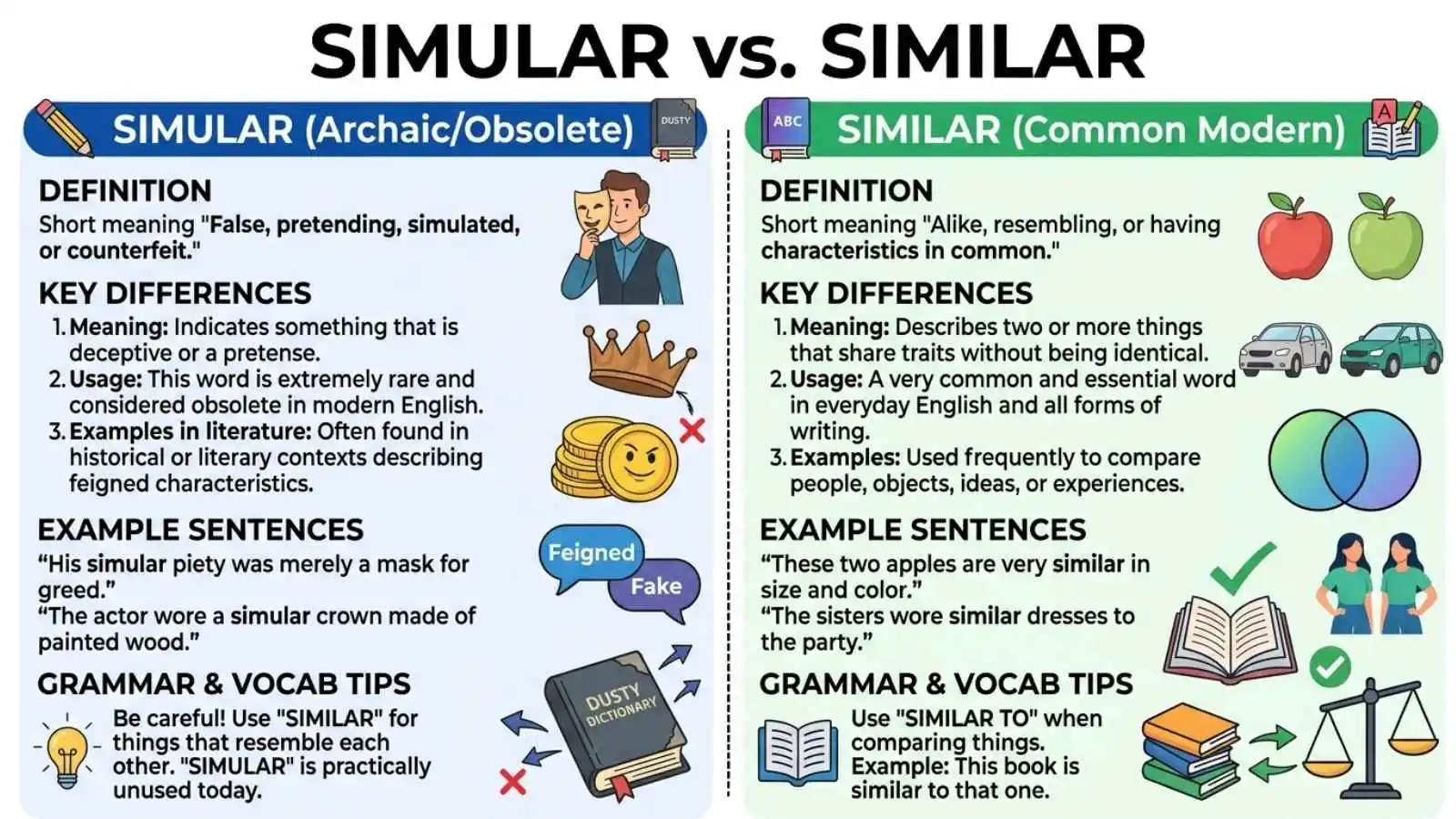
You are writing a sentence. they want to say two things are alike. You type “simular.” But it looks odd. Is that even a real word? Should it be “similar” instead?
This mix-up happens a lot. People search “simular or similar” because the two words sound almost the same when said out loud. This is not like British spelling versus American spelling. It is much simpler than that. One word is right. The other word is just a mistake.
This trips up many people. They see it spelled wrong in texts, posts, or even some emails. When you see a wrong spelling enough times, it can start to look normal. But that does not make it correct.
This guide will fix the confusion for good. You will learn:
- The quick, easy answer
- Where the word “similar” came from
- Why “simular” is not a real word
- How to stop making this mistake
- Real examples from daily life
By the end, you will never mix these up again. Let’s start.
Simular or Similar – Quick Answer
Here is the short answer.
“Similar” is the correct word. It means two or more things are alike in some way. They are not exactly the same, but they share something in common.
“Simular” is not a real word. It is just a common mistake when people try to spell “similar.”
Correct example: “Her dress is similar to mine.”
Wrong example: “Her dress is simular to mine.”
So the rule is easy:
- Always use similar.
- Never use simular. It is not in any dictionary. No type of English writing accepts it.
This is not like “color” and “colour,” where both spellings are correct in different places. With “similar,” there is only one right way to spell it. This is true in every country in the world.
The Origin of Similar
The word “similar” is very old. It comes from a Latin word, “similis.” This Latin word meant “like” or “the same in some way.”
From Latin, the word moved into French. It became “similaire.” English later borrowed the word from French, a long time ago, in the 1600s. Slowly, it turned into the word we use today: “similar.”
Over time, the spelling stayed the same. It has been spelled s-i-m-i-l-a-r for a very long time.
So where does “simular” come from? It has no real history at all. this is just a mistake. It happens because of how the word sounds. When people say “similar” fast, the middle part can sound a bit like “u.” This makes some people write “simular” by accident. But this spelling has no roots in Latin, French, or English history. It is simply wrong.
This kind of mistake happens with other words too. Some people write “definately” instead of “definitely.” It happens for the same reason: the word sounds a certain way, so people spell it the way it sounds, not the way it is supposed to look.
British English vs American English Spelling
This part is a little different from most words.
With many English words, American and British spelling split into two correct forms. Think of “color” versus “colour.” Or “organize” versus “organise.” Both forms are correct. They are just used in different places.
“Similar” does not work this way. Both American English and British English spell it the exact same way: s-i-m-i-l-a-r. There is no British way to spell it as “simular.” There is no American way either. Every English-speaking country agrees on one spelling.
Here is a simple table to show this clearly:
| Word | American Spelling | British Spelling | Is It Correct? |
| Similar | similar | similar | Yes, in both |
| Simular | simular | simular | No, in both |
| Color / Colour | color | colour | Yes, both are right |
| Organize / Organise | organize | organise | Yes, both are right |
This table shows something important. Unlike real British versus American word pairs, “simular” is not a true second option. It is just wrong, no matter where you live or what rules you follow.
Which Spelling Should You Use?
The answer is the same no matter who reads your writing.
- If you write for people in the US: Use “similar.” There is no other accepted spelling.
- If you write for people in the UK or other Commonwealth countries: Use “similar.” The same rule applies there too.
- If you write for readers all over the world: Use “similar.” This word does not change based on where someone lives.
There is no choice to make here based on your audience. Every dictionary says the same thing. Every spell-checker agrees too. “Similar” is the only correct spelling. “Simular” should never show up in your writing, no matter who is reading it.
Common Mistakes with Similar
Let’s look at the most common errors people make with this word.
- Spelling it “simular.” This is the biggest mistake people make. Always slow down and check this word if you are typing fast.
- Mixing it up with “simulate” or “simulation.” Some people confuse “similar” with “simulate,” which means to copy or act out something, often using a model or a computer. These words look a bit alike but mean very different things. “Similar” means alike. “Simulate” means to copy or fake something.
- Forgetting the word “to” after “similar.” Many sentences need “to” right after this word. Wrong: “This is similar that one.” Right: “This is similar to that one.”
- Using “similar” too many times in one piece of writing. Some writers repeat this word over and over. Try using other words too, like “alike,” “close to,” or “comparable.” This makes your writing sound more natural.
- Trusting autocorrect too much. Some phone keyboards and chat apps do not always catch “simular” as a mistake. Even if your phone does not flag it, always check important writing yourself.
- Saying the word out loud and trusting your ear too much. Since this word can sound like it has a “u” in the middle, your ear can trick you. Trust the spelling rule, not just the sound.
Similar in Everyday Examples
Let’s look at how this word shows up in daily writing. It is always spelled the same correct way, no matter the setting.
In a casual email: “Thanks for sending the report. I made something similar last year for our team.”
In a news article: “Both companies gave similar statements about the new deal this week.”
On social media: “Just tried a recipe similar to one my grandma used to make. So good!”
In a formal report: “The results from this study are similar to the results from last year’s study.”
a text message: “Lol that’s so similar to what happened last week, can’t believe it.”
In a product description: “This model has similar features to our top model, but costs less.”
a school essay: “Both characters face similar problems, even though their stories happen in different times.”
In a job listing: “We are looking for someone with similar experience in customer service.”
Every single example uses “similar,” spelled the exact same way. This is one of those rare words in English where the spelling never, ever changes.
Simular or Similar – Google Trends & Usage Data
A lot of people search “simular or similar” online every day. This shows just how common this mix-up really is.
Search data shows that people from many countries type “simular” by accident while trying to spell “similar.” It is not tied to just one country. It happens everywhere, simply because of how the word sounds.
Search engines like Google are smart about this mistake. When someone types “simular,” Google often shows results for “similar” instead. It may even show a small note, like “Showing results for similar.” This tells us that search engines already know “simular” is a typo, not a real word choice.
Even with all these searches for “simular,” it never shows up in real books, newspapers, or official papers. It mostly shows up in fast, casual writing, like text messages and social media posts, where people are not checking their spelling closely.
Keyword Variation Comparison Table
| Word Form | Is It Correct? | Where It Shows Up |
| Similar | Yes | Books, news, formal writing, daily use |
| Simular | No | Typos in texts, social media, fast chats |
| Similarly | Yes | The adverb form, used in formal and casual writing |
| Similarity | Yes | The noun form, used to talk about being alike |
| Simulate | Yes, but a different word | Means to copy or act something out |
FAQs
1. Is “simular” ever a correct spelling? No. “Simular” is not a real word in standard English. It is always a mistake when someone tries to spell “similar.”
2. Why do so many people type “simular” by mistake? It happens because of how “similar” sounds when said fast. The middle part can sound like it has a “u,” even though it really has an “i.”
3. Is this a British versus American spelling difference? No. This is not like “color” and “colour.” There is only one correct spelling here: “similar.” Both British English and American English agree on this.
4. What does “similar” really mean? It means two or more things share something in common, even if they are not exactly the same. For example, two sisters might look similar but not look exactly alike.
5. Is “simular” related to the word “simulate”? Not really, even though the two words look close. “Simulate” means to copy or act out something, often with a computer or a model. “Similar” simply means alike. They are two different words with two different meanings.
6. Will spell-checkers always catch the word “simular”? Most spell-checkers and search engines will catch “simular” and fix it or flag it. But some quick chat apps may miss it. It is smart to check your own spelling, just to be safe.
7. What other words get mixed up with “similar”? Some people mix up “similar” with “similarly,” which is the adverb form, or “similarity,” which is the noun form. All three words are correct, but each one works a little differently in a sentence.
8. Is it okay to use “simular” in casual texts, since everyone understands it? It is best to avoid it everywhere, even in casual writing. Getting into the habit of spelling it correctly will help you avoid mistakes in more formal writing later, like emails, school work, or job applications.
Conclusion
Let’s wrap up everything we learned today.
“Similar” is the only correct spelling. “Simular” is not a real word in any type of English, in any country. This is different from true British versus American word pairs, like “color” and “colour,” where both spellings are correct depending on where you live. With “similar,” there is just one right answer, everywhere in the world.
The mix-up mostly comes from how the word sounds out loud. The middle part can trick your ear, making “simular” feel like it might be okay, even though it is not. Knowing this one simple fact can help you avoid the mistake for good.
Going forward, the rule is easy to remember: always use “similar.” Slow down and check your spelling if you are typing fast or trusting autocorrect too much.