You are typing a text. they want to say goodbye to a friend. You type “buy.” Wait, that’s not right. Should it be “bye”? Or maybe even “by”?
This mix-up happens a lot. People search “buy or bye” because these words sound exactly the same when spoken out loud. But they do not mean the same thing at all. This is not a British versus American spelling issue, like “color” and “colour.” This is something different. These are three separate words that just happen to sound alike.
This kind of word is called a homophone. Homophones sound the same but have different spellings and different meanings. “Buy,” “bye,” and “by” are a perfect example of this mix-up.
This guide will clear up the confusion for good. You will learn:
- The quick, easy answer
- Where each word came from
- Why these words sound the same but mean different things
- How to use each one the right way
- Real examples from daily life
By the end, you will know exactly which word to use, every time. Let’s get started.
Buy or Bye – Quick Answer
Here is the short answer.
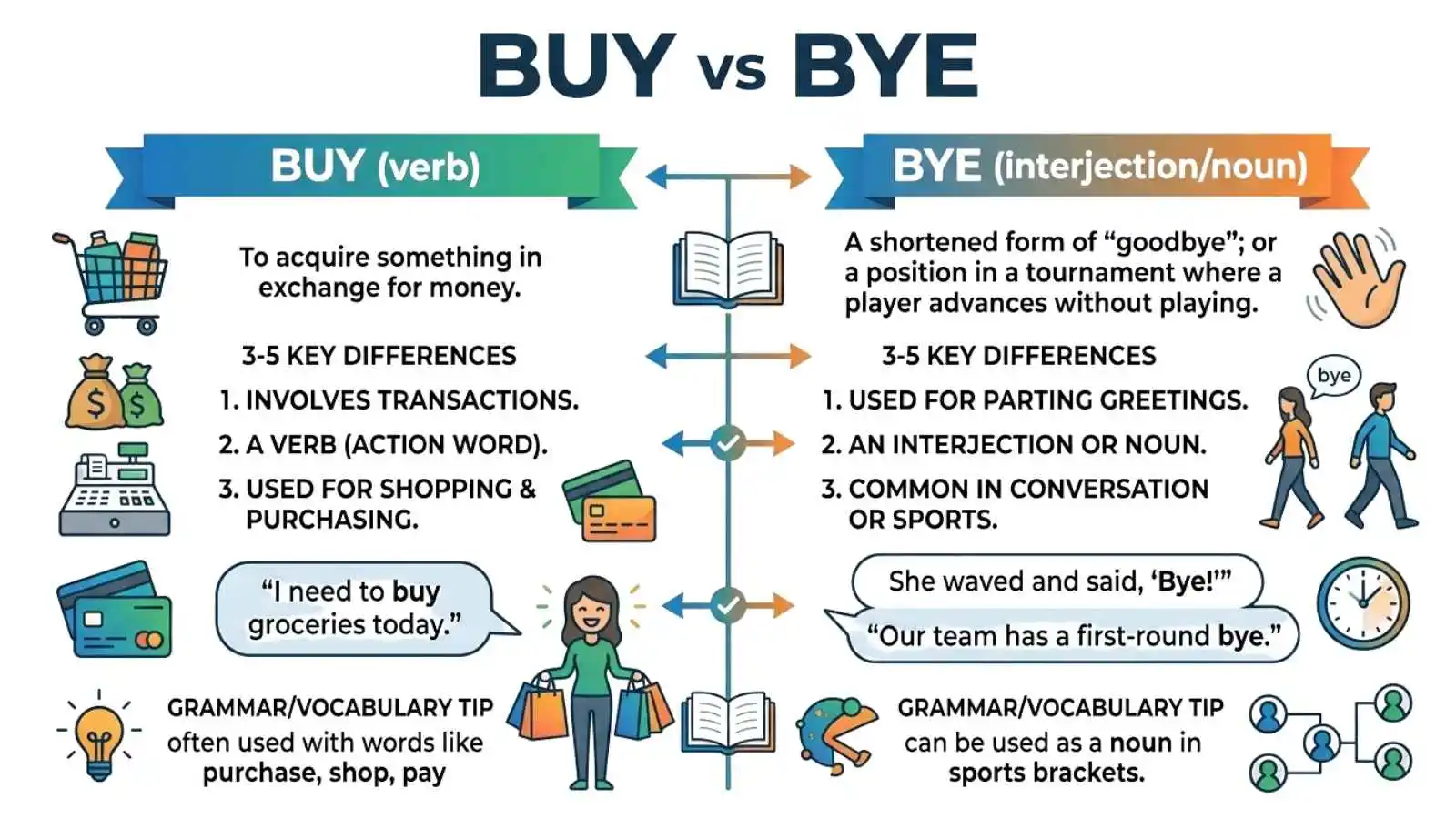
“Buy” means to get something with money. Example: “I need to buy milk today.”
“Bye” is a short way to say goodbye. Example: “Bye! See you tomorrow.”
“By” is a small word used to show closeness, time, or who did something. Example: “She sat by the window.” Or, “This book was written by her.”
So the easy rule is:
- Talking about spending money? Use buy.
- Saying goodbye? Use bye.
- Talking about closeness, time, or who did something? Use by.
All three words sound the same. But each one has a different job in a sentence.
The Origin of Buy or Bye
These three words have very different histories, even though they sound the same today.
“Buy” comes from an old English word, “bycgan.” This word meant to pay for something or to get something using money. Over hundreds of years, the spelling changed step by step until it became “buy,” the word we use now.
“Bye” has a much simpler story. It comes from the word “goodbye.” A long time ago, people said “God be with you” as a way to say farewell. Over time, this phrase got shorter and shorter. It slowly turned into “godbwye,” then “goodbye,” and people later started using just “bye” as a quick, casual way to say the same thing.
“By” is also a very old word. It comes from Old English too, from a word that meant “near” or “next to.” This word has stayed close to its old meaning. We still use “by” today to show closeness, like “by the door,” or to show who did something, like “written by an author.”
So these three words grew from totally different roots. They just happened to end up sounding the same after hundreds of years of change in English.
British English vs American English Spelling
This is where these words are a little different from many other tricky English words.
With many words, American and British English use two different correct spellings. Think of “color” versus “colour,” or “favorite” versus “favourite.” Both forms are correct, just used in different places.
“Buy,” “bye,” and “by” do not work this way. All three words are spelled the exact same way in both American English and British English. There is no British version of “buy” that looks different. There is no American version of “bye” either. Every English-speaking country uses the same three spellings.
Here is a simple table to show this clearly:
| Word | American Spelling | British Spelling | Meaning |
| Buy | buy | buy | To get something with money |
| Bye | bye | bye | A short way to say goodbye |
| By | by | by | Shows closeness, time, or who did something |
This table shows something important. Unlike real British versus American word pairs, these three words do not change at all based on country. The only thing that changes is which word fits the sentence.
Which Spelling Should You Use?
Since spelling does not change here, the real question is which word fits your sentence.
- If you are talking about money or getting something: Use “buy.” Example: “I want to buy a new phone.”
- If you are saying goodbye to someone: Use “bye.” Example: “Bye, talk to you soon!”
- If you are talking about location, time, or who did something: Use “by.” Example: “The store is by the park.” Or, “This song was written by a famous artist.”
This rule stays the same no matter where you live, whether you are in the US, the UK, Australia, or anywhere else in the world. The choice depends only on the meaning of your sentence, not your country.
Common Mistakes with Buy or Bye
Let’s look at the most common errors people make with these words.
- Writing “buy” instead of “bye” when saying goodbye. Wrong: “Okay, buy! See you later.” Right: “Okay, bye! See you later.”
- Writing “bye” instead of “buy” when talking about shopping. Wrong: “I need to bye some groceries.” Right: “I need to buy some groceries.”
- Mixing up “by” with “buy” in sentences about location or time. Wrong: “She lives buy the lake.” Right: “She lives by the lake.”
- Using “bye” instead of “by” in phrases like “by the way.” Wrong: “Bye the way, did you see that movie?” Right: “By the way, did you see that movie?”
- Typing fast and trusting autocorrect too much. Many phones and chat apps do not always catch this mistake, since all three words are spelled correctly on their own, just used wrong. Always double-check, especially in important messages or emails.
- Forgetting that “buy” can also be used as a noun. Example: “That phone was a good buy.” Here, “buy” means a good deal or purchase, not the act of buying.
Buy or Bye in Everyday Examples
Let’s look at how these words show up in daily life. Each one has its own clear job.
In a casual text message: “Can’t talk now, gotta run. Bye! Don’t forget to buy milk on your way home.”
In a formal email: “Thank you for your time. Please let us know if you wish to buy the product by Friday.”
In a news headline: “Local Shop Sees Rise in Sales as Shoppers Buy More During Holiday Season”
On social media: “Bye 2025! It’s been a wild year. Can’t wait to buy some new goals for next year too
In a formal report: “The report was written by a team of researchers who studied buying habits by region.”
In a customer service chat: “You can buy the item online or by visiting our store. Bye for now, have a great day!”
Notice how each word does its own job. “Buy” always means getting something with money. “Bye” always means saying goodbye. “By” always shows closeness, time, or who did something.
Buy or Bye – Google Trends & Usage Data
Many people search “buy or bye” online because of how often this mistake happens, especially in fast typing or casual chats.
Search data shows that this mix-up happens all over the English-speaking world. It is common in the United States, the United Kingdom, Canada, Australia, and many other places. The mistake is not tied to one country. It happens simply because all three words sound exactly the same when spoken.
People often search this term after seeing the wrong word used in a text, social media post, or even a sign at a store. Many shops use the word “buy” in big sales signs, like “Buy One, Get One Free.” If someone is unsure how to spell it, they may search to double-check, especially before writing something for school or work.
Search engines like Google handle this well. If someone types “bye milk” by mistake, search engines are often smart enough to still show shopping results, since they understand context. But this does not mean the spelling is correct. It just means search engines can guess what someone means.
Keyword Variation Comparison Table
| Word | Part of Speech | Common Use | Example Sentence |
| Buy | Verb or noun | Getting something with money, or a good deal | “I’ll buy the tickets tonight.” |
| Bye | Short exclamation | Saying goodbye | “Bye! See you next week.” |
| By | Preposition | Showing closeness, time, or who did something | “We’ll be there by noon.” |
| Buying | Verb form (ongoing action) | The act of purchasing something | “She is buying a new car.” |
| Bought | Past tense of buy | Something purchased in the past | “He bought a new laptop yesterday.” |
FAQs:
1. Do “buy,” “bye,” and “by” sound exactly the same? Yes. All three words are pronounced the same way. This is why people often mix them up when writing quickly.
2. Is there a British or American difference between these words? No. All three words are spelled the same way in every English-speaking country. The only difference is which word fits the meaning of your sentence.
3. What is the easiest way to remember which word to use? Think about the meaning. Spending money? Use “buy.” Saying goodbye? Use “bye.” Talking about closeness or time? Use “by.”
4. Can “buy” be used as a noun? Yes. “Buy” can mean a good deal or purchase, like in the sentence, “That was a smart buy.”
5. Why do people often type the wrong word by mistake? Since all three words sound the same, it is easy to type the wrong one, especially when typing fast on a phone or relying on autocorrect.
6. Is “by the way” spelled with “by” or “bye”? It is spelled “by the way.” This phrase uses “by” because it does not relate to money or saying goodbye.
7. Are there other words that sound like “buy,” “bye,” and “by”? These three are the most common ones, but some people also briefly mix them up with the letter “B” itself, especially in fast typing or texting shortcuts.
8. Will spell-checkers catch this mistake? Not always. Since “buy,” “bye,” and “by” are all real, correctly spelled words, spell-checkers may not flag the mistake. You have to check the meaning yourself.
Conclusion:
Let’s wrap up everything we covered today.
“Buy,” “bye,” and “by” are three different words that just happen to sound the same. This is not a British versus American spelling issue, like “color” and “colour.” Instead, these are homophones, which means they sound alike but have totally different meanings and uses.
“Buy” means to get something with money. “Bye” is a short way to say goodbye. “By” shows closeness, time, or who did something. Since spell-checkers often miss this mistake, it is important to slow down and think about the meaning of your sentence before choosing the right word.
Going forward, the rule is simple: picture what you are trying to say. If money is involved, use “buy.” wheather you are saying farewell, use “bye.” If you are talking about location, time, or who did something, use “by.” With a little practice, you will never mix these up again, no matter how fast you are typing.

Welcome to the official author page of Clara Wordsmith, grammar writer at Wordnomic. Clara specializes in explaining confusing English words, grammar rules, spelling differences, and vocabulary topics with clear examples and beginner-friendly explanations.