You are writing about sorting books or items into a list. You type “cataloguing.” Then you see “cataloging” somewhere else. Now you wonder which one is right.
This mix-up happens a lot. People search “cataloguing or cataloging” because both spellings show up online, in books, and at work. This is not like “obay” and “obey,” where one spelling is just wrong. Both of these words are right. The only thing that changes is where you live and what type of English you use.
This trips up a lot of people, especially those who work with lists, like in libraries, museums, or stores, where sorting items is part of the job.
This guide will make it clear. You will learn:
- The quick, easy answer
- Where this word came from
- How British and American spelling differ
- Which spelling fits your writing
- Common mistakes to avoid
- Real examples from daily life
By the end, you will know just which spelling to use, every time. Let’s start.
Cataloguing or Cataloging – Quick Answer
Here is the short answer.
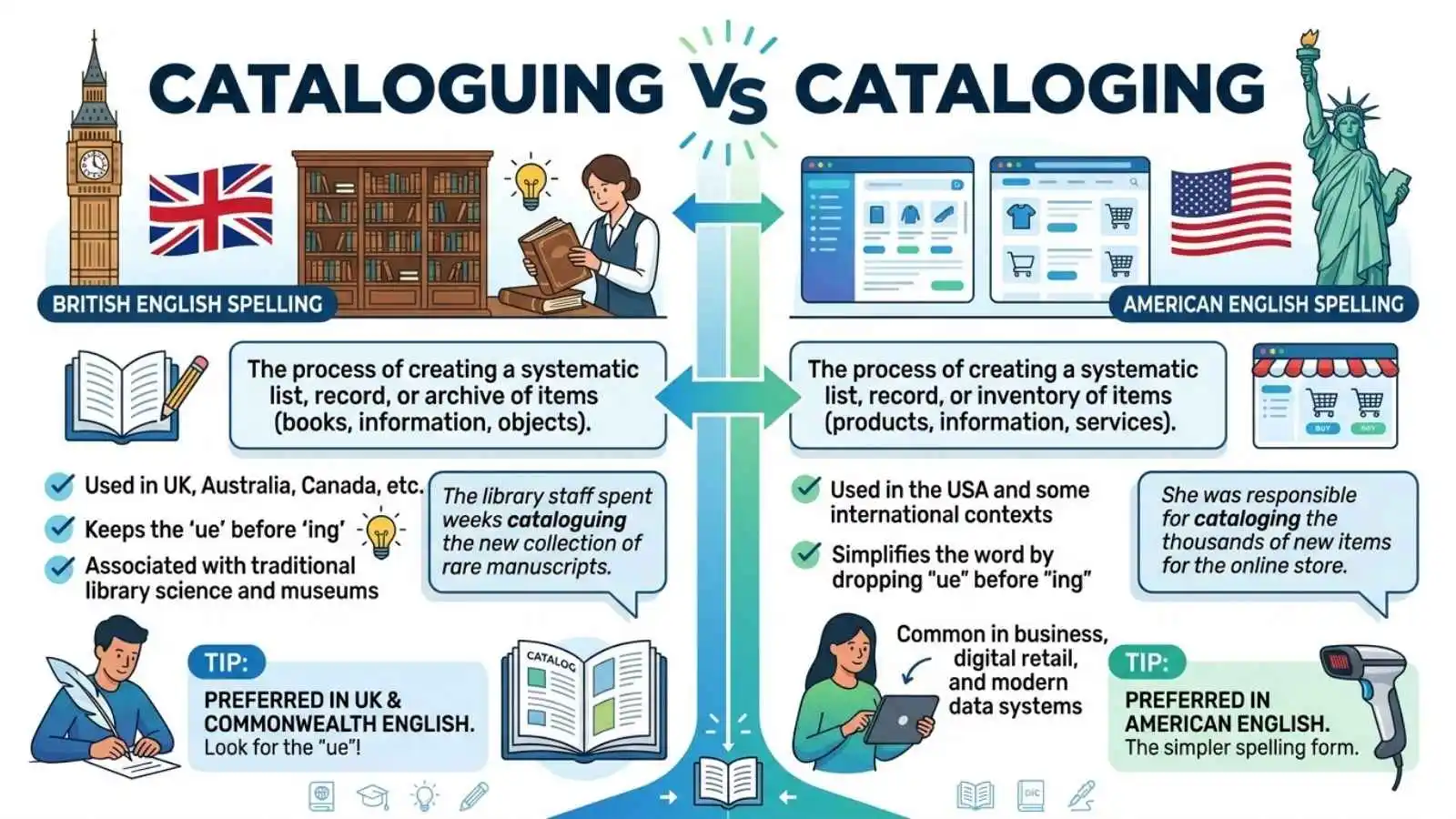
Both “cataloguing” and “cataloging” are correct. They mean the same thing: putting items into a list, often by name, topic, or number.
“Cataloguing” is the British spelling.
“Cataloging” is the American spelling.
Example, British: “She spent the day cataloguing old photos for the museum.”
Example, American: “She spent the day cataloging old photos for the museum.”
So the easy rule is:
- Writing for a UK reader? Use cataloguing.
- Writing for a US reader? Use cataloging.
Both spellings mean the exact same thing. The only thing that changes is the type of English you use.
The Origin of Cataloguing or Cataloging
This word comes from an older word: “catalogue,” or “catalog” in American English.
The word goes back to a Greek word, “katalogos.” This word had two small parts. “Kata” meant “down” or “fully.” “Legein” meant “to count” or “to speak.” Put together, the word painted a picture of listing things one by one, all the way through.
From Greek, the word moved into Latin, then into French as “catalogue.” English took the word from French a long time ago, in the 1400s. For a long time, all English writers used the spelling “catalogue,” in the French style.
Later, American English began to make many French-based words shorter. This is part of a bigger pattern. Words like “dialogue” became “dialog” for some American writers. “Catalogue” became “catalog” too, mostly in the 1900s.
When you add “-ing” to these words, the spelling change carries over. “Catalogue” becomes “cataloguing.” “Catalog” becomes “cataloging.” Both follow the normal spelling rule for their own form of the word.
British English vs American English Spelling
This is a true spelling split, much like “colour” and “color.”
British English likes to keep older French-based spellings. This is why “catalogue” keeps its full ending in British English. And “cataloguing” keeps the “u” before “ing.”
American English often makes these old spellings shorter. This is why “catalog” drops the extra letters. And “cataloging” follows that same short form.
Here is a simple table to show this:
| Word | British Spelling | American Spelling |
| Catalogue / Catalog | catalogue | catalog |
| Cataloguing / Cataloging | cataloguing | cataloging |
| Dialogue / Dialog | dialogue | dialog |
| Analogue / Analog | analogue | analog |
See the pattern? British English keeps the “ue” ending. American English often drops it. This same rule shows up in other English words too, not just “catalogue.”
Which Spelling Should You Use?
The right spelling depends on who is reading your writing.
- If you write for people in the US: Use “cataloging.” This matches American rules, US libraries, and US workplaces.
- If you write for people in the UK or other places like Australia, Ireland, or New Zealand: Use “cataloguing.” This matches British rules and most UK libraries and museums.
- If you write for readers all over the world: Pick one spelling and stay with it the whole way through your writing. Many global sites use American spelling, since more people search for it. But British spelling is just as correct for UK readers.
One small note: Canada sometimes uses both spellings, based on the company or school. If you write for Canada, check their rules first, since both forms show up there.
Common Mistakes with Cataloguing or Cataloging
Let’s look at the most common errors people make with this word.
- Mixing both spellings in one piece of writing. Using “cataloguing” in one part and “cataloging” in another looks messy. Pick one spelling and use it the whole way through.
- Forgetting that the base word changes too. If you use “cataloguing,” your base word should be “catalogue.” If you use “cataloging,” your base word should be “catalog.” Mixing these is not consistent.
- Spelling it wrong, like “catologing” or “catologuing.” Both miss the right letters. Always check the spelling closely, especially where the “a” and “o” go.
- Thinking only one spelling is “real.” Some people think only the American spelling counts, since it shows up more in search results. Both spellings are fully correct, just used in different places.
- Switching spelling out of habit, not based on your reader. Writers sometimes use whatever spelling they learned first, even when writing for a different group of readers. Always think about who is reading before you pick your spelling.
Cataloguing or Cataloging in Everyday Examples
Let’s look at how this word shows up in real life. The spelling changes by region, but the meaning stays the same.
US library report: “Our team is currently cataloging over 2,000 new books added this year.”
In a UK museum report: “Our team is currently cataloguing over 2,000 new items added this year.”
casual email (American): “Just a heads up, I’m cataloging the old files today, should be done by Friday.”
In a casual email (British): “Just a heads up, I’m cataloguing the old files today, should be done by Friday.”
news headline (US style): “Local Library Begins Cataloging Rare Historical Docum
news headline (UK style): “Local Library Begins Cataloguing Rare Historical Documents”
On social media: “Spent all day cataloging my book collection, finally feels organized! 📚”
In a job posting: “Seeking a part-time helper for cataloging and sorting our items.”
Notice how the spelling changes cleanly between American and British forms, while the meaning never changes at all.
Cataloguing or Cataloging – Google Trends & Usage Data
Search interest for “cataloging” is highest in the United States and Canada, where American spelling is common in libraries, schools, and work.
“Cataloguing” gets more searches in the United Kingdom, Ireland, Australia, and New Zealand, where British spelling rules are normal in schools and most jobs.
Around the world, “cataloging” gets more total searches overall. This is mostly because the US has a very large number of people online who write in English. But within the UK, “cataloguing” stays the spelling people expect and search for the most.
This word gets searched a lot by people who work in libraries, museums, schools, and jobs that deal with large lists of items. Many job posts, training guides, and computer tools use this word too, which adds to how often it gets searched in many fields.
Keyword Variation Comparison Table
| Word Form | Region | Common Use |
| Cataloging | US, Canada | Libraries, schools, work writing |
| Cataloguing | UK, Ireland, Australia, New Zealand | Libraries, schools, work writing |
| Catalog | US | The noun form, a list of items |
| Catalogue | UK | The noun form, a list of items |
| Cataloged / Catalogued | US / UK | Past tense forms, following the same rule |
FAQs:
1. Is “cataloguing” or “cataloging” the correct spelling? Both are correct. “Cataloguing” is British English. “Cataloging” is American English.
2. Why do these two spellings exist? British English kept the older French spelling, “catalogue.” American English later made it shorter, “catalog,” which changed the “-ing” form too.
3. Which spelling should I use for readers all over the world? Pick one spelling and stay with it the whole way through your writing. American spelling reaches more search traffic, but British spelling is just as correct for UK readers.
4. Does Canada use the American or British spelling? Canada often uses both, based on the company or school. Always check local rules if you write for Canada.
5. Is one spelling more “correct” than the other? No. Both spellings are fully correct English. The difference is just regional, like “color” and “colour.”
6. What is the difference between “catalog” and “catalogue”? “Catalog” is the American spelling of the noun, meaning a list of items. “Catalogue” is the British spelling of the same word. Both mean the same thing.
7. Can I switch spellings inside the same piece of writing? It is best not to. Mixing spellings in one piece of writing looks messy. Always pick one spelling and stick with it.
8. Are there other words like this one? Yes. Words like “dialogue/dialog” and “analogue/analog” follow this same British versus American pattern.
Conclusion
Let’s wrap up everything we learned today.
“Cataloguing” and “cataloging” are both correct words. The only difference is where you live, just like “colour” and “color.” British English kept the older French-based spelling with the “ue.” American English made it shorter over time, dropping those extra letters.
Knowing which spelling to use comes down to your reader. Use “cataloguing” for UK, Irish, Australian, or other Commonwealth readers. Use “cataloging” for American readers. If you write for readers all over the world, just pick one spelling and stay with it the whole way through.
This same pattern shows up in other words too, like “catalogue/catalog” and “dialogue/dialog.” Learning this one rule can help you with several other words too.