You are talking about a big old house. Or maybe you are talking about how someone acts. You type the word. Then you stop. Is it “manor” or “manner”? One letter is missing or added, and now you are not sure.
This mix-up happens a lot, especially in writing. The two words sound almost the same when you say them fast. Their spelling is also very close, just one letter apart. But their meanings are very different. A “manor” is a big house. A “manner” is a way of doing something or acting.
People search “manor or manner” because spell-check often misses this mistake. Both words are real and spelled correctly on their own. The error is about meaning, not typing. Many people also mix up the two because both words show up in formal writing, like stories about old houses or notes about someone’s behavior.
This guide gives you the easy answer first. It explains where each word comes from. It shows you how to use each one the right way. By the end, you will never mix them up again.
Manor or Manner – Quick Answer
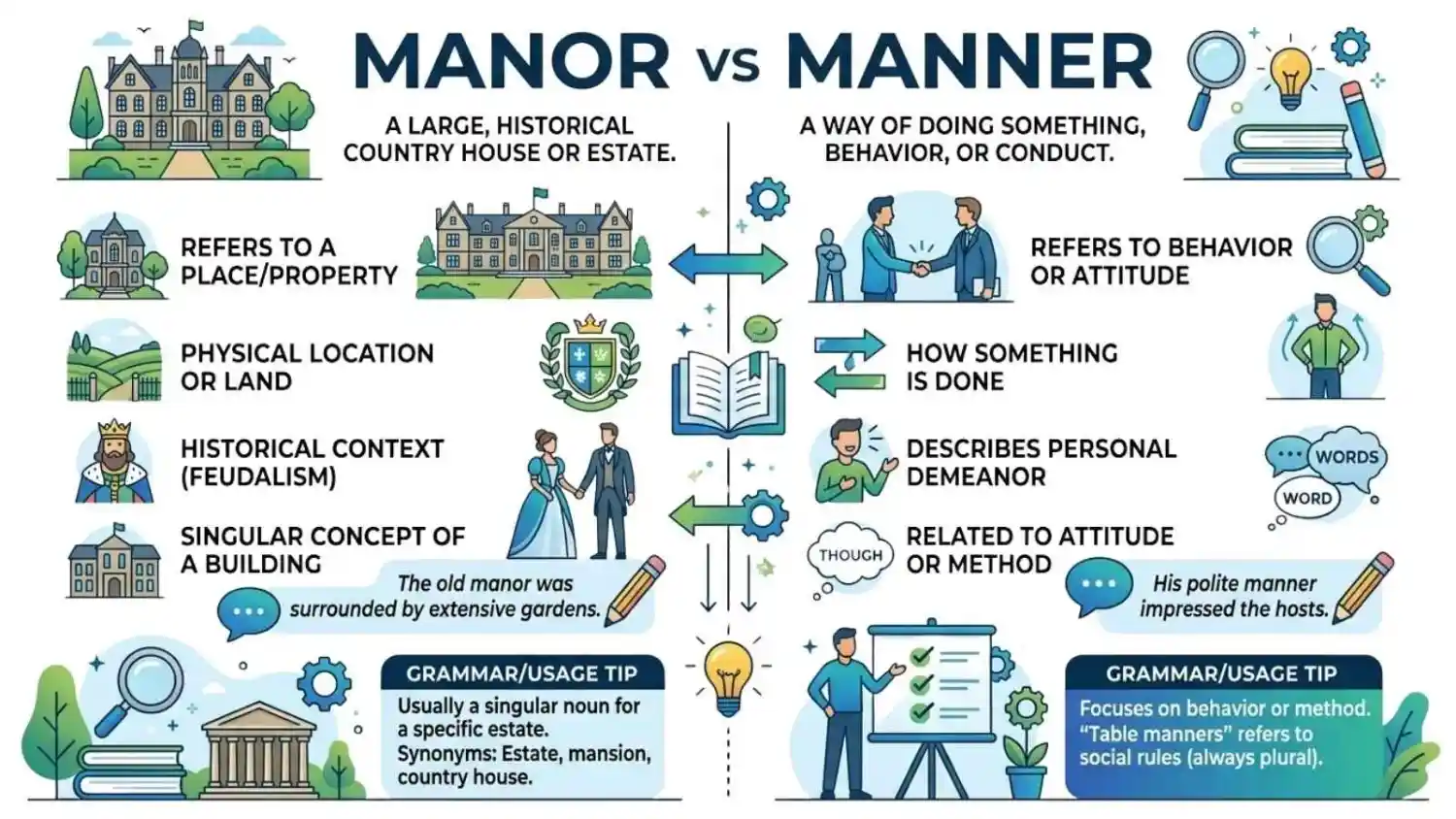
Manor is a noun. It means a large house, often part of a big property or estate. It often has a long history.
- “The family has lived in the manor for three generations.”
- “They visited an old English manor on their trip.”
Manner is a noun too. It means a way of doing something. It can also mean a person’s behavior, especially in its plural form, “manners.”
- “She spoke in a calm manner.”
- “His manners impressed everyone at dinner.”
One extra letter turns a house into a way of acting.
Where Do These Words Come From?
Manor comes from an old French word, “manoir.” It meant “home” or “place to live.” That word came from a Latin word, “manere,” meaning “to stay” or “to live somewhere.” A manor was first the main house on a piece of land. It was where a landowner or lord lived and managed the farms around it. The word kept this meaning tied closely to land and property.
Manner comes from a different old French word, “maniere.” That word came from a Latin word, “manus,” meaning “hand.” The first meaning was about how something was done by hand, almost like saying “by hand” today. Over time, the word grew to mean a way of doing something. Later, it also came to mean a person’s behavior, especially when used in its plural form, “manners.”
Both words came into English through French. Both trace back to Latin in the end. But they come from two completely different Latin words. “Manere” means to stay or live somewhere. “Manus” means hand or handling. This is why the two words look alike today, even though they have no real connection in meaning.
It also helps to know that “manor” almost always connects to a place. “Manner” almost always connects to an action or behavior. Once you remember this small fact, the two words feel much easier to tell apart.
Is the spelling Different in British and American English?
No. Both words are spelled the same way everywhere.
- “Manor” stays the same in the US, the UK, and every other English-speaking country.
- “Manner” also stays the same everywhere, even in its plural form, “manners.”
| Word | British English | American English |
| Manor (house/estate) | Manor | Manor |
| Manner (way of behaving) | Manner | Manner |
| Plural form | Manners | Manners |
You may notice “manor” shows up more in British writing. That is simply because manor houses are a common part of British history and culture, not because the spelling changes in any way. The word itself stays exactly the same.
Which Word Should You Use?
Use “manor” when you mean a large house or estate. This is correct in every English-speaking country, whether you are describing a historic British home or any other grand house around the world.
Use “manner” when you mean a way of behaving or doing something. This is also correct everywhere, in casual writing, formal writing, and everything in between.
Not sure which one fits? Ask yourself: Am I talking about a building or a piece of land? Or am I talking about behavior or a way of doing something? That answer tells you which word to use, no matter where your reader lives.
Common Mistakes with Manor or Manner
- Wrong: “She greeted us in a polite manor.”
- Right: “She greeted us in a polite manner.”
- Wrong: “They bought an old English manner outside London.”
- Right: “They bought an old English manor outside London.”
- Wrong: Thinking “manor” and “manner” are just two ways to spell the same word. Right: They are two separate words with two separate meanings and two separate histories.
- Wrong: Using “manor” to describe someone’s behavior.
- Right: Use “manner” for behavior, attitude, or a way of doing something.
- Wrong: Forgetting that “manners,” in plural form, means politeness.
- Right: “Manners” describes good, polite behavior, like saying “please” and “thank you.”
- Wrong: Trusting spell-check to catch this mistake every time.
- Right: Spell-check often misses this error, since both words are spelled correctly on their own. Always read your sentence again.
- Wrong: Mixing up the two words in travel or history writing, where both topics often appear close together.
- Right: Pause and check: are you describing a house, or describing behavior?
Everyday Examples
In an email: “Thank you for handling the situation in such a professional manner.”
In a news headline: “Historic Manor House Restored After Decades of Neglect”
On social media: “Visited the most beautiful manor today, straight out of a period drama 🏰”
In formal writing: “The committee addressed the complaint in a calm and respectful manner.”
parenting or etiquette content: “Teaching children good manners starts with simple daily habits.”
travel blog: “Our tour included a stop at a 200-year-old manor with beautiful gardens.”
In a workplace note: “Please respond to client concerns in a friendly and timely manner.”
Notice the pattern. “Manor” shows up with houses, land, and property. “Manner” shows up with behavior, attitude, and style. The two words rarely overlap in real writing. This makes the mix-up easy to catch once you know the difference.
How Often Do People Search This?
Search interest in “manor or manner” stays fairly steady through the year. It rises a little around historical TV shows, real estate stories, and etiquette topics. Most people search this because they are:
- Writing about a historic house, estate, or property and want to check the spelling.
- Describing someone’s behavior or attitude and unsure which word fits.
- Catching a typo in their own writing before sending or posting it.
- Reading or writing about manners and polite behavior for school or parenting content.
Here is how each word tends to show up:
- “Manor” appears most in real estate listings, travel content, and stories about old houses, especially British country estates.
- “Manner” appears most in everyday writing, business messages, and notes about behavior and attitude.
- People often confuse the two after watching period dramas, where “manor houses” and “good manners” are both common topics, sometimes even in the same scene.
| Keyword Variation | Meaning | Typical Context | Region |
| Manor | Large house or estate | Real estate, history, travel | Global, especially UK |
| Manner | Way of behaving or doing something | Everyday writing, etiquette | Global |
| Manners | Politeness, social behavior | Parenting, etiquette guides | Global |
| Manor house | A specific kind of grand home | Historical and travel writing | UK, Commonwealth |
FAQs:
1. Is “manor” just “manner” with a missing letter? No. They are two separate words. “Manor” means a house or estate. “Manner” means a way of behaving or doing something.
2. How many n’s does “manner” have? Two. “Manner” always has a double “n.”
3. How many n’s does “manor” have? One. “Manor” always has a single “n.”
4. Why do these words look so close to each other? Both came into English through French and Latin, but they come from two different Latin words. “Manor” comes from “manere,” meaning to stay. “Manner” comes from “manus,” meaning hand.
5. Does British English spell “manor” differently than American English? No. Both spell it the same way, with one “n,” everywhere.
6. What does “manners” mean when used in plural form? “Manners” means polite, well-behaved actions, like being kind, saying thank you, and treating others with respect.
7. Is a “manor house” different from a regular manor? Not really. “Manor house” just puts more focus on the actual building. “Manor” can mean the house, the land, or the whole estate together.
8. Can “manner” ever describe a place instead of behavior? No. “Manner” always relates to behavior, style, or the way something is done. It never describes a building or piece of land.
Conclusion:
“Manor or manner” comes down to one small letter with two very different meanings. “Manor” describes a large house or estate, often tied to history and land. It is spelled with a single “n.” “Manner” describes a way of behaving or doing something. It is spelled with a double “n.” Both words came from French and Latin, but they grew from two completely different root words. That is why they look alike but mean something totally different.
There is no real British-versus-American spelling differ ence here. Both words stay exactly the same in every English-speaking country. The mix-up usually comes from how close the words sound when spoken quickly, plus how often both show up in formal or historical writing.
Remember this easy rule: talking about a house or estate? Use “manor,” with one “n.” Talking about behavior or style? Use “manner,” with two n’s. Keep this small rule in mind, and you will always pick the right word with confidence.