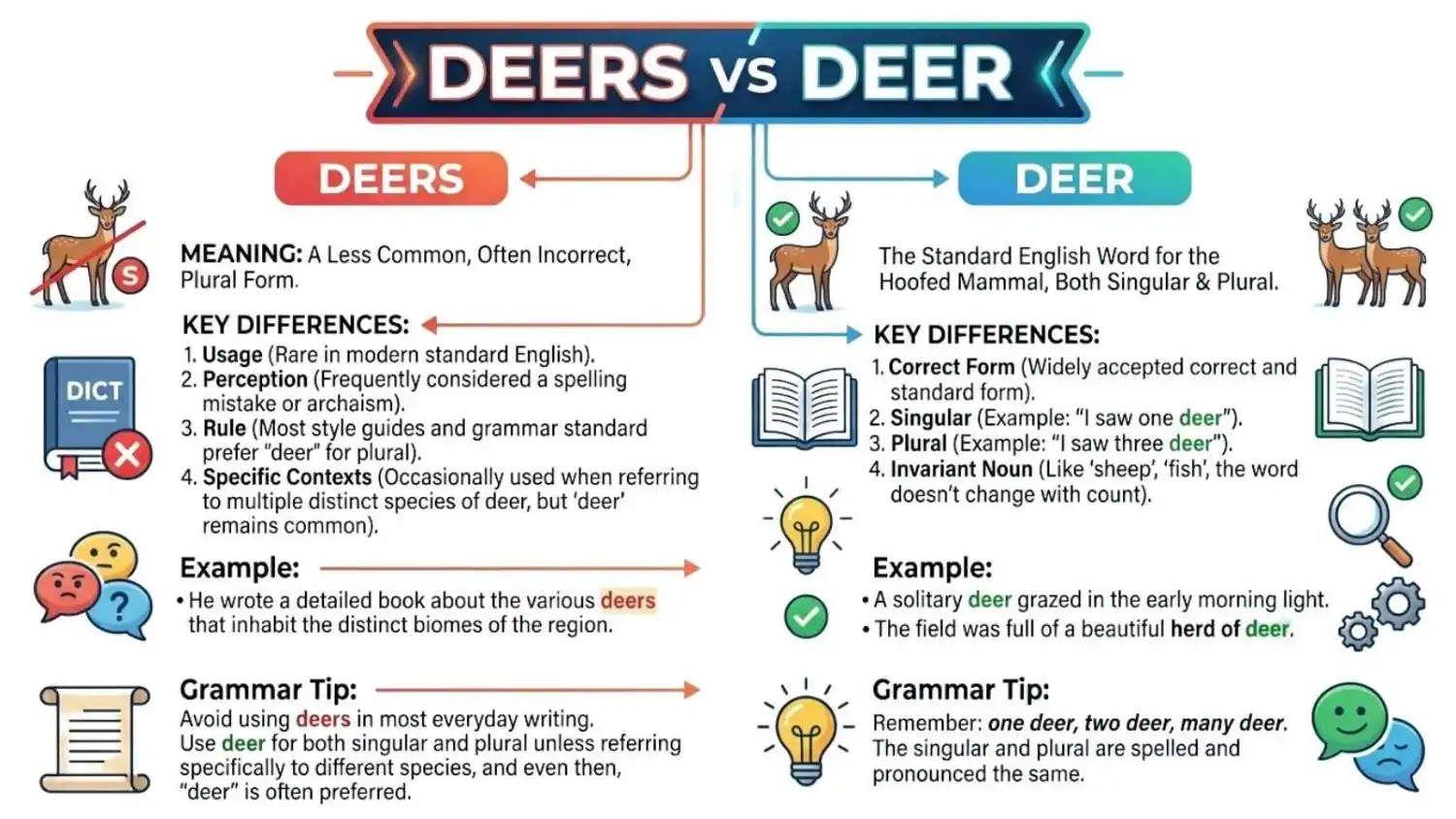
Have you ever wondered whether you should write deers or deer? Many people ask this question because English usually adds -s to make words plural. For example, one cat becomes two cats, and one dog becomes two dogs. Because of this pattern, many learners think one deer should become two deers.
However, English has some special nouns that do not follow the usual plural rules. The word deer is one of them. In most cases, deer is correct for both one animal and many animals. The word deers exists, but people rarely use it in everyday English.
This confusion often appears in school writing, emails, social media posts, and conversations. Many writers want to know which form is correct and when they should use it.
By the end, you will know exactly which word to use with confidence.
Deers or Deer – Quick Answer
The simple answer is:
Deer is correct for both singular and plural use.
You can say:
- I saw one deer in the forest.
- I saw three deer in the forest.
- Many deer live in this area.
Most people should use deer in both situations.
The word deers appears only in rare scientific discussions about different species of deer. In normal English, people almost always use deer.
Table #1: Quick Comparison
| Word | Correct? | Common Usage | Notes |
| Deer | Yes | Very Common | Singular and plural |
| Deers | Rarely | Very Rare | Limited scientific use |
What Does Deer Mean?
The word deer refers to a hoofed animal that lives in forests, grasslands, and other natural areas.
English uses deer for both one animal and more than one animal.
Examples:
- A deer crossed the road.
- The deer ran into the woods.
- We saw several deer near the lake.
- Deer often search for food at night.
This rule makes deer different from many other English nouns.
Because the same word works for singular and plural, writers do not need to add -s.
What Does Deers Mean?
The word deers is rare.
Most people never use it in daily conversation or writing.
For example, a researcher might discuss several kinds of deers from different regions.
However, this use is uncommon.
In normal English, schools, businesses, newspapers, and websites prefer deer.
That is why most learners should avoid deers.
The Origin of Deers or Deer
The word deer comes from Old English.
Long ago, it referred to many types of wild animals, not just the animal we know today.
Over time, the meaning became more specific.
English kept the same form for both singular and plural.
Several old English animal names followed a similar pattern.
As a result, people continued using deer for one animal and many animals.
The rare form deers appeared later in special contexts, but it never became common.
Today, modern English still prefers deer.
Why Deer Stays the Same in Singular and Plural
Some English nouns do not change when they become plural.
The word deer belongs to this group.
Other examples include:
- sheep
- moose
- fish (in some situations)
Examples:
- One sheep
- Five sheep
- One moose
- Two moose
- One deer
- Ten deer
These words follow special grammar rules that English has preserved for many years.
Table #2: Singular and Plural Comparison
| Singular | Plural |
| Deer | Deer |
| Sheep | Sheep |
| Moose | Moose |
| Fish | Fish |
Which Word Should You Use?
You should almost always use deer.
School Writing
Teachers expect students to write deer.
Example:
- We saw many deer in the national park.
Business Writing
Professional documents should use deer.
Academic Writing
Most academic writing also uses deer.
Website Content
Websites usually prefer deer because readers recognize it immediately.
Everyday Communication
People naturally say and write deer.
Unless you are discussing scientific classifications, choose deer.
Common Mistakes with Deers or Deer
Many learners make mistakes because most English nouns add -s in the plural form.
Common mistakes include:
- ❌ Three deers crossed the road.
- ✅ Three deer crossed the road.
- ❌ We photographed many deers.
- ✅ We photographed many deer.
- ❌ Several deers lived near the river.
- ✅ Several deer lived near the river.
- ❌ The deers entered the field.
- ✅ The deer entered the field.
The easiest rule is simple:
If you are talking about one deer or many deer, use deer.
Deers or Deer in Everyday Examples
Emails
- We spotted several deer during our trip.
News Articles
- Local residents reported deer near the highway.
Social Media
- Look at the deer we saw today!
School Assignments
- Deer live in many parts of the world.
Business Writing
- Deer activity increased in the area.
Everyday Conversation
- We saw deer while driving home.
These examples show that deer works naturally in many situations.
Deers or Deer – Usage Trends and Popularity
The word deer is much more popular than deers.
People use deer in:
- Books
- News articles
- Schools
- Websites
- Conversations
The word deers appears only occasionally.
Most native English speakers never use it.
Because of this, deer remains the preferred choice in modern English.
Table #3: Usage by Context
| Context | Deer | Deers |
| School Writing | Very Common | Rare |
| News Articles | Common | Rare |
| Social Media | Common | Rare |
| Business Writing | Common | Rare |
| Scientific Writing | Common | Sometimes |
Deers or Deer Comparison Table
Table #4: Detailed Feature Comparison
| Feature | Deer | Deers |
| Meaning | Animal | Same Meaning |
| Correctness | Standard Form | Rare Form |
| Popularity | Very High | Very Low |
| Formal Writing | Accepted | Rare |
| Everyday Use | Common | Rare |
| Academic Use | Common | Limited |
| School Use | Common | Rare |
| Recommended Choice | Yes | No |
Easy Trick to Remember the Difference
Here are some simple memory tips:
- Deer follows the same pattern as sheep.
- One deer and many deer use the same word.
- Do not add -s in normal writing.
- If you feel unsure, choose deer.
This simple rule works almost every time.
FAQs:
Is deers a real word?
Yes, deers exists, but people rarely use it. Most writers and speakers prefer deer.
Is deer singular or plural?
Deer is both singular and plural. The same spelling works for one deer and many deer.
Why doesn’t deer become deers?
English keeps some nouns unchanged in the plural form. Deer is one of those special nouns.
Can I say two deer?
Yes. Two deer is the correct form.
Is deers ever correct?
Sometimes scientists use deers when discussing different species. However, everyday English rarely uses it.
What animals have the same singular and plural form?
Examples include deer, sheep, moose, and sometimes fish.
Which word should students use?
Students should almost always use deer because it is the standard form.
Is deer correct in formal writing?
Yes. Deer is correct in formal, academic, business, and everyday writing.
Conclusion:
The difference between deers or deer is simple once you know the grammar rule. Although many English nouns add -s to form a plural, deer does not follow that pattern. The same word works for both one animal and many animals.
The word deers exists, but people rarely use it. Most dictionaries, schools, businesses, and professional writers prefer deer. In everyday English, using deer will almost always be the correct choice.
If you write an email, school assignment, article, report, or social media post, choose deer. Readers will understand it immediately, and your writing will sound natural.
A simple rule can help you remember: just like sheep, the plural of deer stays deer. Follow this rule, and you will avoid one of the most common English grammar mistakes.