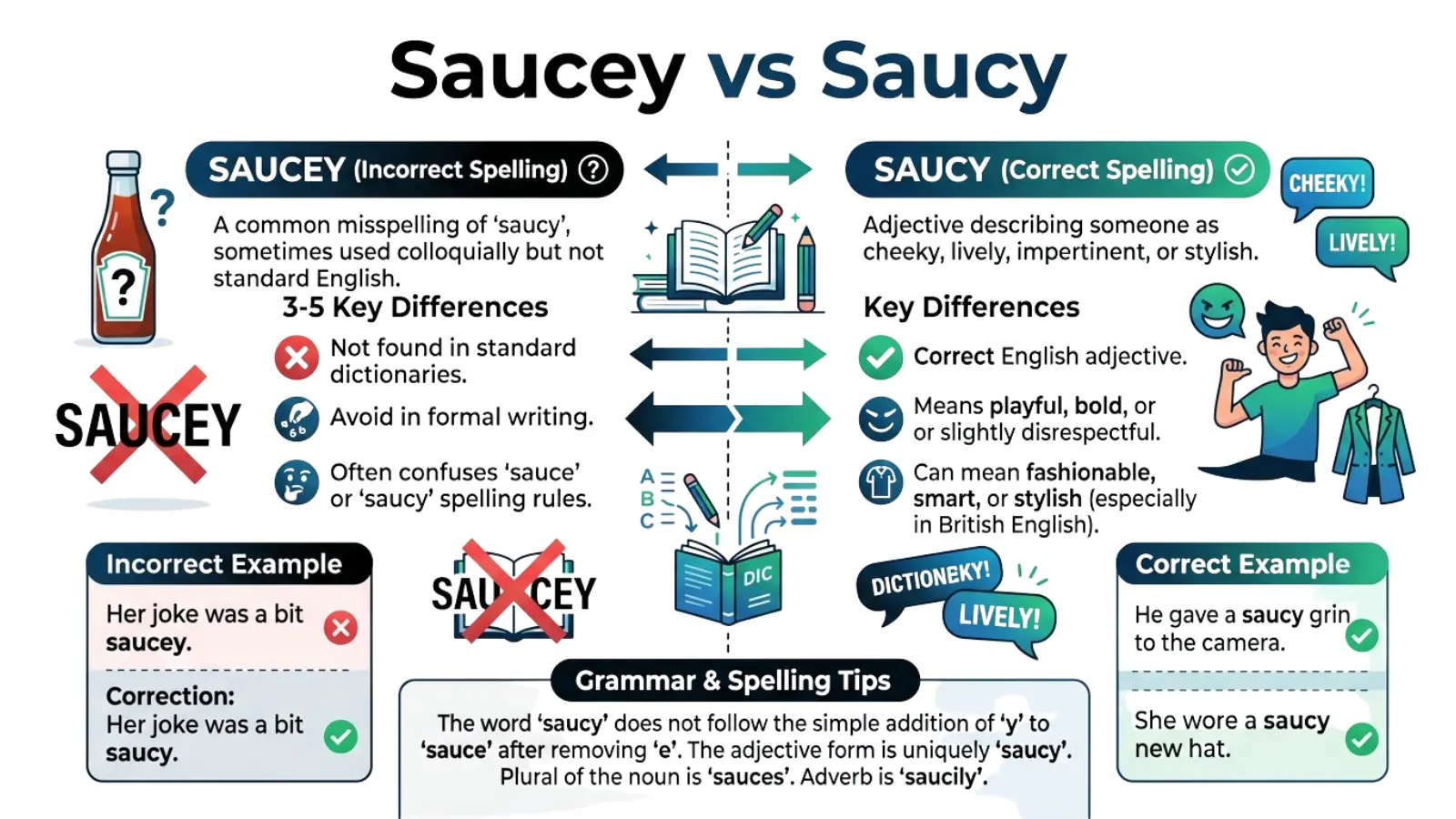
Have you ever typed a word and then stopped? You stare at it. Something looks wrong. This happens a lot with the word “saucy.” Some people write “saucey” instead. Which one is right?
This small spelling problem confuses many people every day. They search online to check before they send an email, post on social media, or write a school paper. Nobody wants to look careless over one word.
The confusion happens because the word sounds the same both ways when spoken out loud. But only one spelling is correct in standard English. The other spelling is a common mistake that many people make without knowing it.
In this article, we will give you a clear answer right away. Then we will explain why this mix-up happens. We will also show you real examples, a comparison table, and tips so you never get confused again. By the end, you will know exactly which spelling to use and why.
Saucy or Saucey – Quick Answer
The correct spelling is “saucy.” There is no “e” before the “y.”
“Saucey” is not a correct word in standard English. It is a common misspelling.
Here are some quick examples using the correct word:
- She gave a saucy reply to her boss.
- The waiter had a saucy attitude.
- His texts were a little too saucy for work.
Remember this simple rule: drop the silent “e” from “sauce” before adding “y.” So “sauce” becomes “saucy,” not “saucey.”
The Origin of Saucy
The word “saucy” comes from the word “sauce.” Long ago, “sauce” meant a tasty liquid added to food. Over time, people started using “sauce” to describe a person’s attitude. A “saucy” person was someone with a bold, sharp, or flirty manner, almost like a strong flavor added to plain food.
This use of “saucy” became common in English by the 1500s. Writers used it to describe people who were bold, rude, or playful in a clever way. Today, the word still carries that same feeling. It can mean playful and flirty, or it can mean bold and a little rude, depending on how it is used.
Many English words drop the silent “e” before adding “y.” This is a normal spelling pattern. For example:
- “Spice” becomes “spicy.”
- “Ice” becomes “icy.”
- “Lace” becomes “lacy.”
“Sauce” follows this same pattern and becomes “saucy.” The spelling “saucey” likely happens because people think they need to keep the “e” to protect the sound of the word. But English spelling rules do not work that way here.
British English vs American English Spelling
Many English words have different spellings in British and American English. Think of “colour” versus “color,” or “favourite” versus “favorite.” This makes people wonder if “saucy” also has two versions.
It does not. Both British English and American English spell the word the same way: “saucy.”
This is one of the few words where there is no difference between the two systems. The “e” is dropped in both versions when forming the adjective.
| Word Form | British English | American English |
| Base word | Sauce | Sauce |
| Adjective | Saucy | Saucy |
| Comparative | Saucier | Saucier |
| Superlative | Sauciest | Sauciest |
| Adverb | Saucily | Saucily |
As you can see, every form of the word matches in both spelling systems. This makes “saucy” an easy word once you remember the basic rule.
Which Spelling Should You Use?
Since both British and American English agree, the answer is simple no matter where you live.
If you are in the United States: Use “saucy.”
you are in the United Kingdom or Commonwealth countries (like Canada, Australia, or India): Use “saucy.”
If you write for a global audience: Use “saucy.”
There is no situation where “saucey” is the better choice. It is not a regional spelling. this is not an older form of the word. It is simply incorrect. You can use “saucy” safely in any English-speaking context, including business writing, casual chats, and creative writing.
Common Mistakes with Saucy
Here are frequent errors people make with this word, along with the correct fix.
Mistake: “Her saucey comment made everyone laugh.” Correction: “Her saucy comment made everyone laugh.”
Mistake: “The sauceyest dish on the menu is the chicken wings.” Correction: “The sauciest dish on the menu is the chicken wings.”
Mistake: “He spoke very sauceyly to the manager.” Correction: “He spoke very saucily to the manager.”
A common pattern in these mistakes is keeping the “e” from “sauce” in every form of the word. Remember: drop the “e,” then add the ending you need (-y, -ier, -iest, -ily).
Saucy in Everyday Examples
emails: “Thanks for the saucy joke, it made my whole morning.”
news headlines: “Comedian Known for Saucy Humor Returns to Stage Tonight”
social media posts: “This sauce is so good, it deserves a saucy caption.
formal writing: “The novel’s saucy dialogue gives the characters a sharp, witty edge.”
Notice how “saucy” works in many settings. It can describe humor, food, personality, or tone. But the spelling never changes, no matter how casual or formal the writing is.
Saucy – Google Trends & Usage Data
Search data shows that “saucy” is searched far more often than “saucey” across the world. The United States, United Kingdom, Australia, and Canada all show strong search volume for “saucy,” especially related to food, humor, and personality.
Searches for “saucey” do happen, but they are much smaller in number. Most of these searches come from people checking their spelling, often right before writing an email, message, or social post. This confirms that “saucey” is a misspelling people stumble into, not an accepted alternative.
Interest in “saucy” often spikes around food content, cooking shows, and pop culture moments where someone is described as bold or flirty.
| Spelling | Correct? | Common Region | Search Volume |
| Saucy | Yes | US, UK, Global | High |
| Saucey | No | Misspelling, all regions | Low |
| Saucier (comparative) | Yes | US, UK, Global | Low to Moderate |
| Saucily (adverb) | Yes | US, UK, Global | Low |
FAQs:
1. Is “saucey” ever correct? No. “Saucey” is not a recognized spelling in any major English dictionary.
2. Why do people spell it “saucey”? People often keep the “e” from “sauce” because they think it changes the pronunciation. But the “y” ending already creates the correct sound.
3. Is “saucy” British or American spelling? It is the same in both. There is no separate British or American version.
4. What does “saucy” mean? It can mean bold, playful, flirty, or slightly rude, depending on the context.
5. How do you spell the comparative form? The comparative form is “saucier,” and the superlative is “sauciest.”
6. Can “saucy” describe food? Yes. It can describe food with a strong, tasty sauce, or food that has bold flavor.
7. Is “saucy” formal or informal? It is mostly informal or conversational, though it appears in articles, books, and reviews too.
Conclusion:
The word “saucy” often confuses writers because of how it sounds and where it comes from. But the rule is simple: always drop the silent “e” from “sauce” before adding “y.” This gives you “saucy,” the only correct spelling in both British and American English.
There is no regional version of this word. Whether you live in the United States, the United Kingdom, or anywhere else, “saucy” is the spelling to use. The same rule applies to related forms like “saucier,” “sauciest,” and “saucily.”
“Saucey” is a common mistake, not an accepted alternative. Many people search for it simply to double-check their spelling before sending a message or publishing content. Now you have a clear answer.
Use “saucy” with confidence in emails, social media, articles, and everyday writing. One small rule, once learned, removes all the guesswork.











