You are typing a word. It means “happening every year.” You write “anual.” Then you stop. Something feels wrong. You look at it again. Is there a missing letter? Should there be two “n”s instead of one?
This small mix-up happens to a lot of people. The word shows up everywhere. You see it on calendars. they see it in school reports. You see it in work emails about yearly meetings or yearly events. Because people use this word so often, they want to make sure they spell it the right way.
The confusion happens because the wrong spelling, “anual,” still looks like it could be correct. It almost looks like a normal English word. But only one spelling is the real one. The other spelling is a common mistake that many people type without even noticing.
In this article, we will give you a fast, clear answer right away. Then we will explain why people get mixed up. We will show you real examples, a simple table, and easy tips. By the end, you will always know which spelling to use, every time you write it.
Annual or Anual – Quick Answer
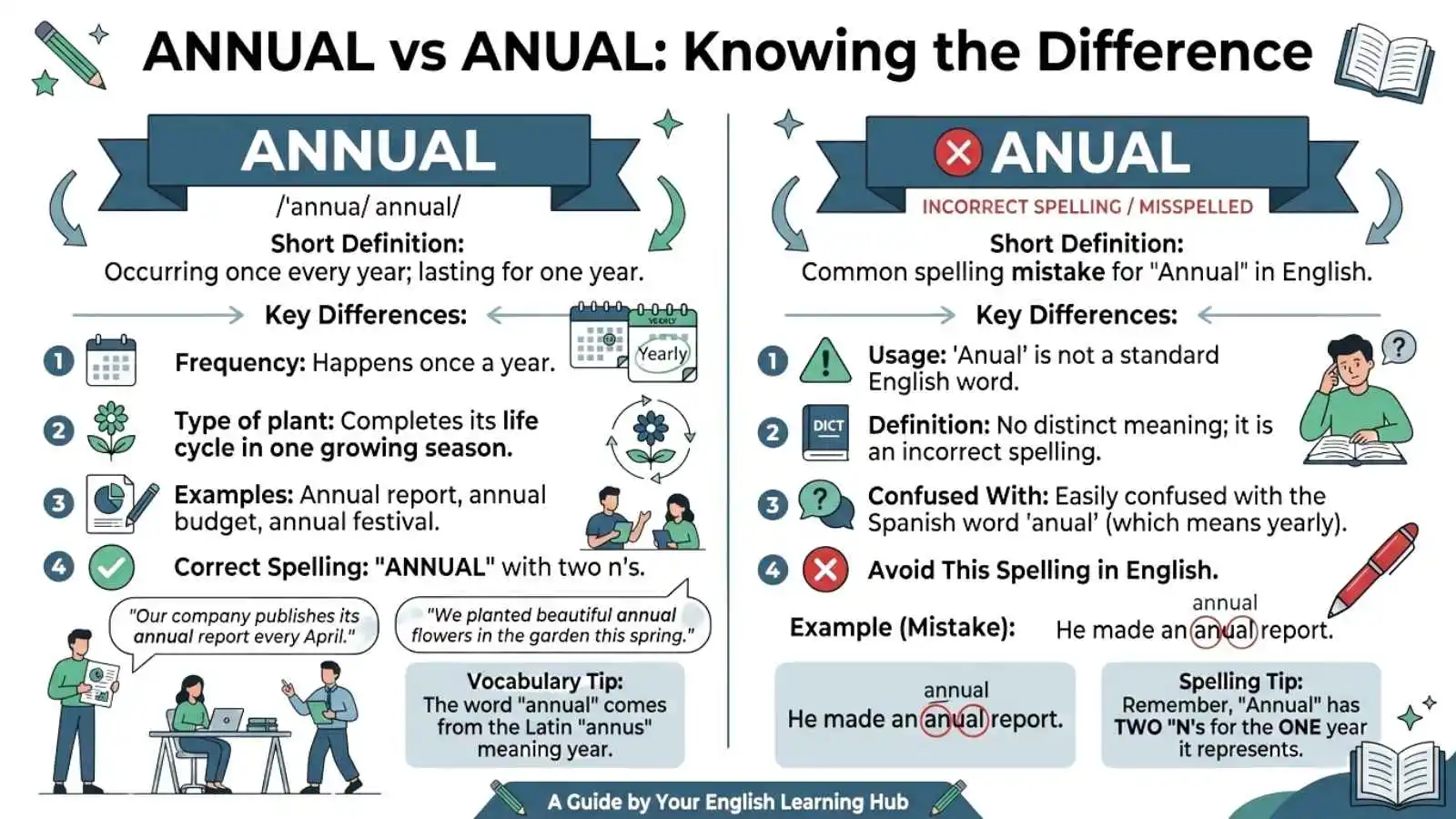
The correct spelling is “annual.” It has two letters “n” in the middle.
“Anual” is not correct. It is a common spelling mistake.
Here are some simple examples using the right word:
- We go to the annual family picnic every summer.
- The company holds an annual meeting every year.
- She gets an annual check-up at the doctor.
A simple way to remember this: think of the word “annual” as having a double letter, just like the word “summer” has a double “m.” Two letters “n” sit together in the middle of the word.
The Origin of Annual
The word “annual” comes from an old Latin word called “annus.” This word meant “year.” Long ago, Latin words traveled into French, and then from French into English. As the word moved through different languages, it kept the double “n” from its Latin root.
Because the word “annus” means “year,” the word “annual” naturally came to mean “happening once every year” or “yearly.” This is why we use “annual” for things that repeat one time per year, like a birthday, a holiday, or a yearly report.
Many other English words also come from the same Latin root “annus.” Some examples are:
- “Anniversary,” which means the yearly date something special happened.
- “Annuity,” which means money paid out every year.
- “Per annum,” which is a phrase meaning “per year.”
All of these words keep the double “n” because they all come from the same Latin word. This is also why “anual,” with only one “n,” does not match the word’s true history. The double “n” is part of the word’s root, not an extra letter that got added by mistake.
British English vs American English Spelling
Many English words change spelling between British English and American English. Words like “colour” and “color,” or “organise” and “organize,” show this difference clearly.
But “annual” is not one of those words. Both British English and American English spell it the exact same way: “annual,” with two letters “n.”
There is no British version and no American version. This word stays the same no matter where you are in the world.
| Word Form | British English | American English |
| Base word | Annual | Annual |
| Adverb | Annually | Annually |
| Related word | Anniversary | Anniversary |
| Related phrase | Per annum | Per annum |
As shown above, every form of the word matches across both spelling systems. This makes “annual” an easy word to remember once you know the simple rule about the double “n.”
Which Spelling Should You Use?
Since both British and American English agree on this word, the answer stays the same no matter where you live.
If you are in the United States: Use “annual.”
you are in the United Kingdom or Commonwealth countries (such as Canada, Australia, or India): Use “annual.”
If you are writing for a global audience: Use “annual.”
There is no situation where “anual” becomes correct. It is not a regional spelling. thisis not an old or alternate form of the word. It is simply a typing mistake. You can safely use “annual” in any kind of writing, from school papers to business reports to casual messages.
Common Mistakes with Annual
Here are some common mistakes people make with this word, along with the correct way to fix them.
Mistake: “We will hold the anual sports day next month.” Correction: “We will hold the annual sports day next month.”
Mistake: “Please send your anual report by Friday.” Correction: “Please send your annual report by Friday.”
Mistake: “He gets a small bonus anually.” Correction: “He gets a small bonus annually.”
A common pattern in these mistakes is leaving out one of the two letters “n.” People often type fast and forget the double letter. Slowing down and remembering the Latin root word “annus” can help you avoid this mistake every time.
Annual in Everyday Examples
emails: “Don’t forget, our annual team meeting is next Tuesday.”
news headlines: “City Announces Date for Annual Summer Festival”
social media posts: “So excited for our annual trip to the mountains this year!
formal writing: “The company’s annual report shows strong growth this year.”
Notice how “annual” fits smoothly into many different settings. It can describe events, reports, payments, or traditions. No matter the setting, the spelling never changes.
Annual – Google Trends & Usage Data
Search data shows that “annual” is searched far more often than “anual” across the world. Countries like the United States, the United Kingdom, Canada, India, and Australia all show steady, high search numbers for “annual,” especially when tied to topics like yearly events, annual reports, and yearly checkups.
Searches for “anual” still happen, but in much smaller numbers. Most of these searches come from people who are simply checking their spelling before sending a message, writing a report, or posting online. This shows that “anual” is a common typing slip, not an accepted version of the word.
Interest in “annual” often goes up at certain times of the year, such as around tax season, school report periods, and end-of-year company meetings, since the word connects so closely to yearly routines.
| Spelling | Correct? | Common Region | Search Volume |
| Annual | Yes | US, UK, Global | High |
| Anual | No | Misspelling, all regions | Low |
| Annually (adverb) | Yes | US, UK, Global | Moderate |
| Annum (in “per annum”) | Yes | US, UK, Global | Low to Moderate |
FAQs:
1. Is “anual” ever correct in English? No. “Anual” is not found in standard English dictionaries. It is a common misspelling.
2. Why do people spell it “anual” by mistake? People often miss the double letter “n” because they are typing quickly or do not know the word’s Latin root.
3. Is “annual” spelled differently in British and American English? No. Both versions of English use the exact same spelling: “annual.”
4. What does “annual” mean? It means something that happens once every year, like a yearly event, payment, or report.
5. How do you spell the adverb form of “annual”? The adverb form is “annually,” which also keeps the double letter “n.”
6. Is “anual” used in Spanish or other languages? Yes, “anual” is actually a correct word in Spanish, meaning “yearly.” This might be one reason some English speakers get confused and drop the second “n.”
7. Can “annual” be used to describe plants? Yes. In gardening, an “annual” plant is one that grows, blooms, and dies within a single year.
Conclusion
The word “annual” trips people up because the wrong spelling, “anual,” still looks like it might be a real word. But the truth is simple: “annual” always has two letters “n,” and there is no correct way to spell it with just one.
This word comes from the old Latin word “annus,” meaning “year.” That Latin root is also why related words like “anniversary,” “annuity,” and “per annum” all keep the same double “n.” Knowing this history makes the spelling much easier to remember.
There is no British versus American difference here. The word stays exactly the same everywhere in the world. Whether you are writing a school report, a work email, or a casual post, always use “annual” with the double “n.”
Now that you know the simple reason behind the spelling, you will never have to second-guess this word again. Just remember: two letters “n,” one easy rule, and you are always correct.

Welcome to the official author page of Clara Wordsmith, grammar writer at Wordnomic. Clara specializes in explaining confusing English words, grammar rules, spelling differences, and vocabulary topics with clear examples and beginner-friendly explanations.