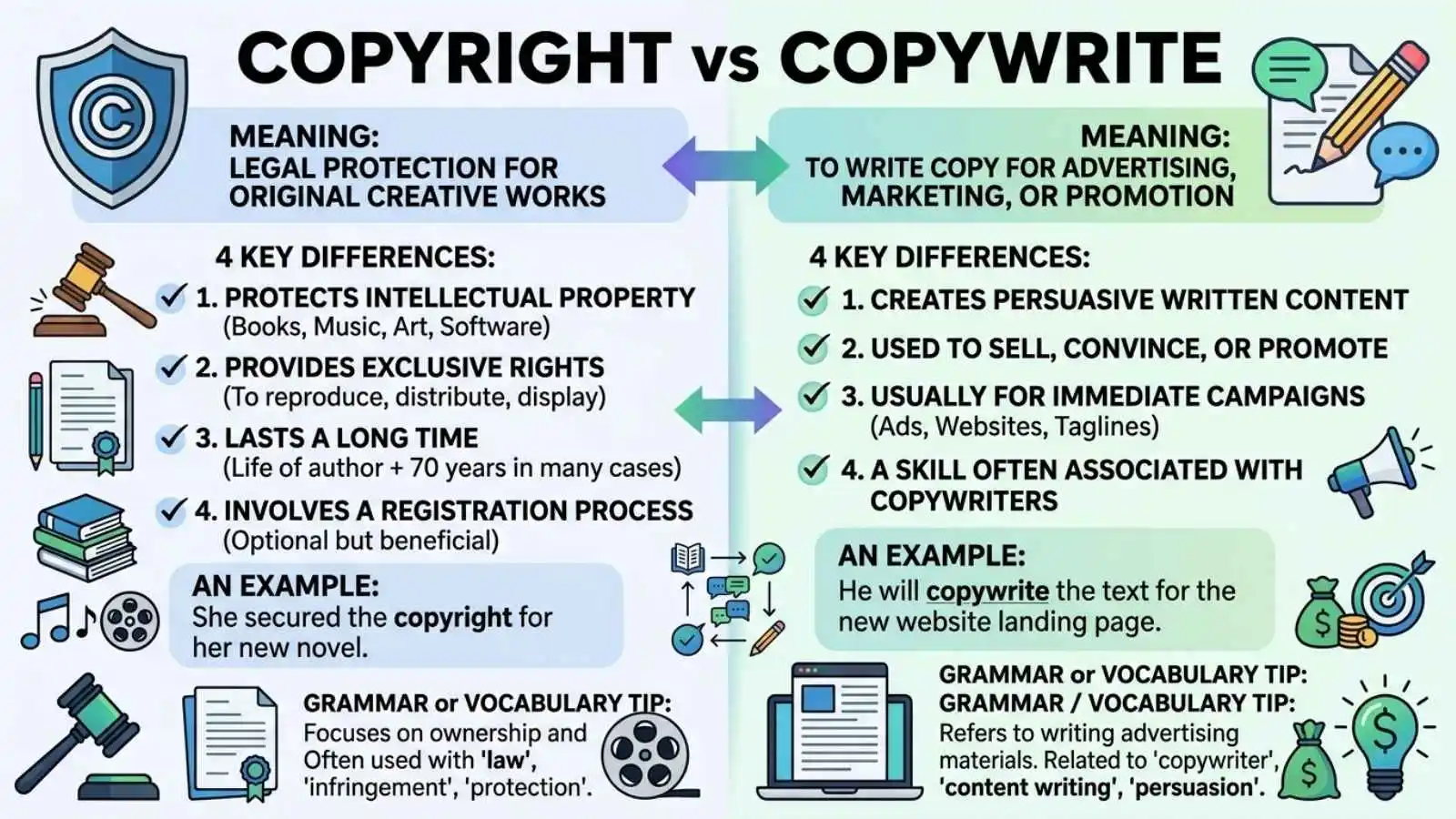
You are writing a sentence about a song, a book, or a photo. they want to say it is protected by law. You type “copywrite.” Then you pause. Something feels off. Is it “copyright” instead?
This mix-up happens to a lot of people. The two words look almost the same. They sound almost the same too. But they do not mean the same thing at all. This makes people stop and search online before they finish their sentence.
The confusion grows because both words feel related to writing. One word has “write” inside it, which makes people think it must be about writing something down. But that guess leads to a common mistake. Only one of these words is about legal protection. The other word is about a totally different job.
In this article, we will give you a clear answer right away. Then we will explain why this mix-up happens. We will show you simple examples, a comparison table, and easy tips. By the end, you will know exactly which word to use and you will never mix them up again.
Copyright or Copywrite – Quick Answer
The correct word for legal protection is “copyright.”
“Copyright” means the legal right to own and control creative work, like a book, song, movie, or photo. It stops other people from copying that work without permission.
“Copywrite” is not a standard word for that meaning. People often create it by mistake, mixing up “copyright” with the job of writing ads, which is called “copywriting.”
Examples using the correct word:
- This song is protected by copyright law.
- You cannot use that photo because of copyright rules.
- The company owns the copyright to the movie.
Remember this simple rule: when you talk about legal protection of creative work, always use “copyright,” not “copywrite.”
The Origin of Copyright
The word “copyright” comes from two simple parts: “copy” and “right.” “Copy” means to make another version of something. “Right” means a legal permission or power someone has.
When you put these two words together, “copyright” means the legal right to control copies of something. This word became common in English law during the 1700s, when governments started creating rules to protect writers, artists, and inventors. The goal was to stop people from copying someone else’s work and selling it without paying or asking the creator.
Now let’s talk about “copywrite.” This word is not built the same way. It comes from blending “copy” with “write,” and it relates to a different job entirely: writing words for ads, websites, or marketing.
So while “copyright” is about legal ownership, “copywriting” is about writing persuasive content, like ads or slogans. The word “copywrite” by itself, used as a verb meaning “to protect legally,” is simply incorrect. People create it by accident because the two real words, “copyright” and “copywriting,” sound so close together.
British English vs American English Spelling
Many English words change spelling between British English and American English. Words like “colour” and “color,” or “organise” and “organize,” show this clearly.
But “copyright” is not one of those words. Both British English and American English spell it the exact same way: “copyright.” There is no British version and no American version.
| Word Form | British English | American English |
| Base word | Copyright | Copyright |
| Verb form | Copyright (to copyright something) | Copyright (to copyright something) |
| Related job | Copywriting | Copywriting |
| Person doing that job | Copywriter | Copywriter |
As shown above, every form of the word matches across both spelling systems. The real issue is not regional spelling. It is mixing up two different words that simply sound alike.
Which Spelling Should You Use?
Since both British and American English agree on this word, the answer stays the same everywhere.
If you are in the United States: Use “copyright” when talking about legal protection of creative work.
For user in United Kingdom or Commonwealth countries (like Canada, Australia, or India): Use “copyright” as well.
If you are writing for a global audience: Always use “copyright” for legal protection.
If you are talking about writing ads or marketing content: Use “copywriting” or “copywriter,” not “copyright.”
There is no situation where “copywrite” is the correct choice. If you mean legal protection, write “copyright.” If you mean writing ads or marketing text, write “copywriting.”
Common Mistakes with Copyright
Here are frequent errors people make, along with the correct fix.
Mistake: “This image is protected by copywrite.” Correction: “This image is protected by copyright.”
Mistake: “I want to copywrite my new book.” Correction: “I want to copyright my new book.”
Mistake: “She works as a copyright for a marketing agency.” Correction: “She works as a copywriter for a marketing agency.”
A common pattern in these mistakes is swapping “copyright” and “copywriting” because they sound alike.
Copyright in Everyday Examples
emails: “Please make sure we have copyright permission before using this photo.”
news headlines: “New Copyright Law Could Change How Musicians Get Paid”
social media posts: “Reminder: this design is under copyright, please don’t repost without asking!
formal writing: “The publisher holds the copyright to all chapters in this book.”
Notice how “copyright” fits naturally into legal, creative, and business topics. It never changes form to fit the writing style, formal or casual.
Copyright – Google Trends & Usage Data
Search data shows that “copyright” is searched far more often than “copywrite” across the world. Countries like the United States, the United Kingdom, Canada, India, and Australia all show strong, steady search volume for “copyright,” especially tied to music, movies, photos, and online content.
| Spelling | Correct? | Common Region | Search Volume |
| Copyright | Yes | US, UK, Global | High |
| Copywrite | No (common mix-up) | All regions | Low to Moderate |
| Copywriting | Yes (different meaning) | US, UK, Global | High |
| Copywriter | Yes (different meaning) | US, UK, Global | High |
FAQs:
1. Is “copywrite” ever a correct word? No. “Copywrite” is not a standard English word. People usually mean either “copyright” or “copywriting.”
2. What does “copyright” actually protect? It protects original creative work, such as books, music, films, art, and photos, from being copied without permission.
3. Is “copyright” spelled differently in British and American English? No. Both versions of English use the exact same spelling: “copyright.”
4. What is the difference between “copyright” and “copywriting”? “Copyright” is a legal protection for creative work. “Copywriting” is the job of writing text for ads, websites, or marketing.
5. Can “copyright” be used as a verb? Yes. You can say someone “copyrighted” their book, meaning they registered or secured legal protection for it.
6. Why do people confuse these two words so often? Because “copyright” and “copywriting” sound almost the same when spoken, and both relate loosely to written or creative work..
Conclusion
The mix-up between “copyright” and “copywrite” happens because the words sound alike and both connect to creative work. But only “copyright” is a real, standard English word. It means the legal right to control and protect creative work, like books, music, and photos.
“Copywrite” is not a real word on its own. The confusion usually comes from mixing it up with “copywriting,” which is the job of writing ads and marketing content. These are two very different ideas: one is about legal protection, and the other is about a writing career.
There is no British versus American spelling difference here either. The word “copyright” stays exactly the same everywhere in the world.Now that you understand the difference clearly, you can use these words with full confidence, every single time. A simple trick to remember: think of “copyright” as a shield that protects work, and “copywriting” as a pen that creates ads. Once you picture it this way, you will never mix them up again.