Here it is.
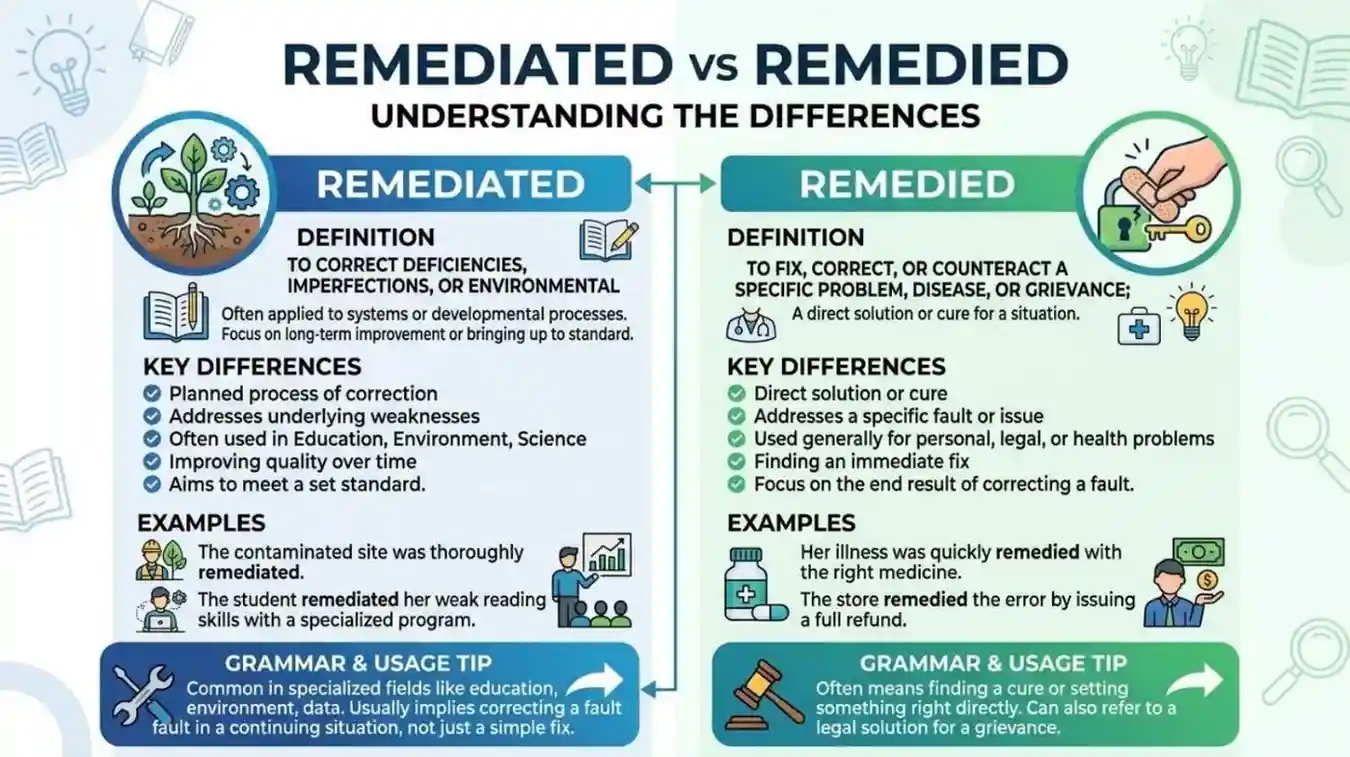
Remedied means a problem was fixed. It comes from the word “remedy,” which means a fix or a cure.
Remediated means a problem was fixed too. But this word is more formal. It’s often used for big fixes, like cleaning up pollution or fixing a computer problem.
Easy examples:
- “The doctor remedied the issue with new medicine.” (a normal fix)
- “The company remediated the dirty soil at the old factory.” (a big fix)
Both words mean “to fix.” But one feels small and simple. The other feels big and formal.
Why People Mix These Up
Both words share the same root idea: making something right again after it went wrong. Since they look close and mean almost the same thing, it’s easy to grab the wrong one.
The mix-up grows since “remediated” shows up a lot in work writing, like reports about the environment, computer safety, or legal papers. “Remedied” shows up more in daily talk. Since most people don’t read work reports every day, “remediated” can feel less familiar, even though it’s a normal word.
Where These Words Came From
Both words go back to an old Latin word that meant “a cure” or “a way to heal.” From this root, English built the word “remedy,” meaning a fix to a problem.
Remedied is just the past form of “remedy.” It follows the normal path most English words take. It adds “-ed” to show something happened in the past.
Remediated grew from a slightly different word: “remediate.” This word built on the same root too. But it took on a more formal feel over time. It became common in fields like the environment, computer safety, and law. In these fields, a “problem” often means something big, like dirty land or a data leak.
So both words share the same root idea. But “remedied” stayed small and simple. “Remediated” grew into a formal cousin word.
A Closer Look at Each Word
Remedied works well for small, daily problems. A sore throat, a small mistake at work, or an error in a report can all be “remedied.” It’s the normal, simple pick for most daily writing and talk.
Remediated works best for bigger, more serious problems. Think safety, health, land, or computer issues. Cleaning up a chemical spill, fixing a computer safety flaw, or fixing damaged land are all cases where “remediated” fits well.
Both words mean fixing a problem. But the size and the setting of the problem points you to the right word.
Side-by-Side Table
| Word | Type | Best Used For | Example |
| Remedied | Action word, past | Small, daily problems | “The error was quickly remedied.” |
| Remediated | Action word, past | Big, formal problems | “The dirty site was remediated.” |
| Remedy | Thing or action | A fix or cure | “There’s no easy remedy for this.” |
| Remediation | Thing | The full process of fixing a big issue | “The remediation took months.” |
A Simple Way to Remember
Try this trick: remedied is short, just like the small, daily problems it fixes.
Remediated is longer, just like the big, formal problems it fixes.
Easy rule: small, daily fix? Use “remedied.” Big, formal fix? Use “remediated.”
Common Mistakes People Make
Mistake 1: Wrong: “The small typo was remediated before the email went out.”
Fix: “The small typo was remedied before the email went out.” (A small fix should use “remedied.”)
Mistake 2: Wrong: “The dirty river was remedied after years of cleanup work.”
Fix: “The dirty river was remediated after years of cleanup work.” (A big fix should use “remediated.”)
Mistake 3: Wrong: Using “remediated” for daily writing just to sound more formal.
Fix: Save “remediated” for real work or legal use, since using it too much can make simple writing feel stiff.
Mistake 4: Wrong: Thinking “remediated” is a typo of “remedied.”
Fix: Both words are correct. They are just used for problems of different sizes.
Everyday Examples
In a text message: “Good news, the billing mix-up got remedied super fast!”
In a report about the environment: “The cleanup team fully remediated the contaminated soil at the site.”
Work email: “We’ve remedied the login issue, and the system is working fine now.”
In a legal or work paper: “The team has remediated all the safety issues identified in this report.”
Search Trends and Usage Data
People search “remediated or remedied” for a few clear reasons.
- Business and legal writers: Many people search this while writing formal reports. They want to check the right word for a fixed issue.
- Computer safety workers: This field uses “remediated” a lot, mostly in reports about fixed safety problems. This leads many workers to double-check the word in their writing.
- Environment workers: Cleanup jobs almost always use “remediated,” since this word is the normal term in this field.
- Daily writers: Some people just want to check that “remedied” works fine for small, daily problems, without needing the more formal word.
Both words stay in steady use. But they show up in very different types of writing, based on how big or formal the problem is.
Why Getting This Right Matters
In daily writing, mixing these words up rarely causes real confusion. Most readers still get the point either way. But in formal or legal writing, using the wrong word can change how serious a problem sounds.
Picture a report that says a data leak was “remedied” instead of “remediated.” A careful reader, mostly in tech or legal fields, might read this as making a serious issue sound smaller than it was. In fields where trust matters a lot, this small word choice can shape how serious a claim seems.
Frequently Asked Questions
1. Can I always swap “remediated” and “remedied”? Not really. They share a close meaning, but “remediated” is saved for bigger, formal problems. “Remedied” fits smaller, daily issues.
2. Which word do people use more in daily talk? “Remedied” is far more common in daily talk, since most small problems don’t need such formal wording.
3. Can a small mistake ever be “remediated”? It can, but it would sound too formal for a small issue. “Remedied” is the more normal pick for small, daily problems.
4. What is the noun form of “remediated”? “Remediation” is the noun form. It’s often used to talk about the full, formal process of fixing a big problem.
5. Is there a British vs American English split here? No. Both words work the same way in both American and British English. The split is about formality, not region.
6. Why does English have two words for almost the same idea? This often happens when a formal, work-based word grows next to a simple, daily word. This lets writers match their word choice to how serious a problem really is.
The Bottom Line:
Remediated or remedied? Both words mean “fixed.” But they serve different jobs. Remedied fits small, daily problems and simple, casual writing. Remediated fits bigger, more serious, and more formal problems, mostly in fields like the environment, computer safety, and law.
Next time you’re not sure which one to use, think about how big and formal the problem really is. Small and daily? Use “remedied.” Big and formal? Use “remediated.” That one quick check will help you pick the right word, every single time.