A Quick Story First
Mia wrote a review of a school play. She wrote, “The actors were amazing onstage.” Her teacher marked it. She wrote a note: “Try ‘on stage’ here instead.” Mia was confused. She thought both were the same word.
This mix-up happens a lot. Both forms look close. Both sound the same too. But they are used in slightly different ways.
Why This Word Confuses People
Many English words can be written as one word or two words. This depends on how the word is used in a sentence. This makes people unsure which form to pick.
You will see this word in reviews. They will see it in event posts. You will see it in school papers too.
Picking the wrong form is a small mistake. But it can make your writing look less polished, especially in reviews or formal writing.
In this guide, you will get a quick answer first. Then we will look at why this mix-up happens. We will look at common mistakes too. By the end, you will always pick the right form.
Onstage or On Stage – The Simple Answer
Here is the easy answer.
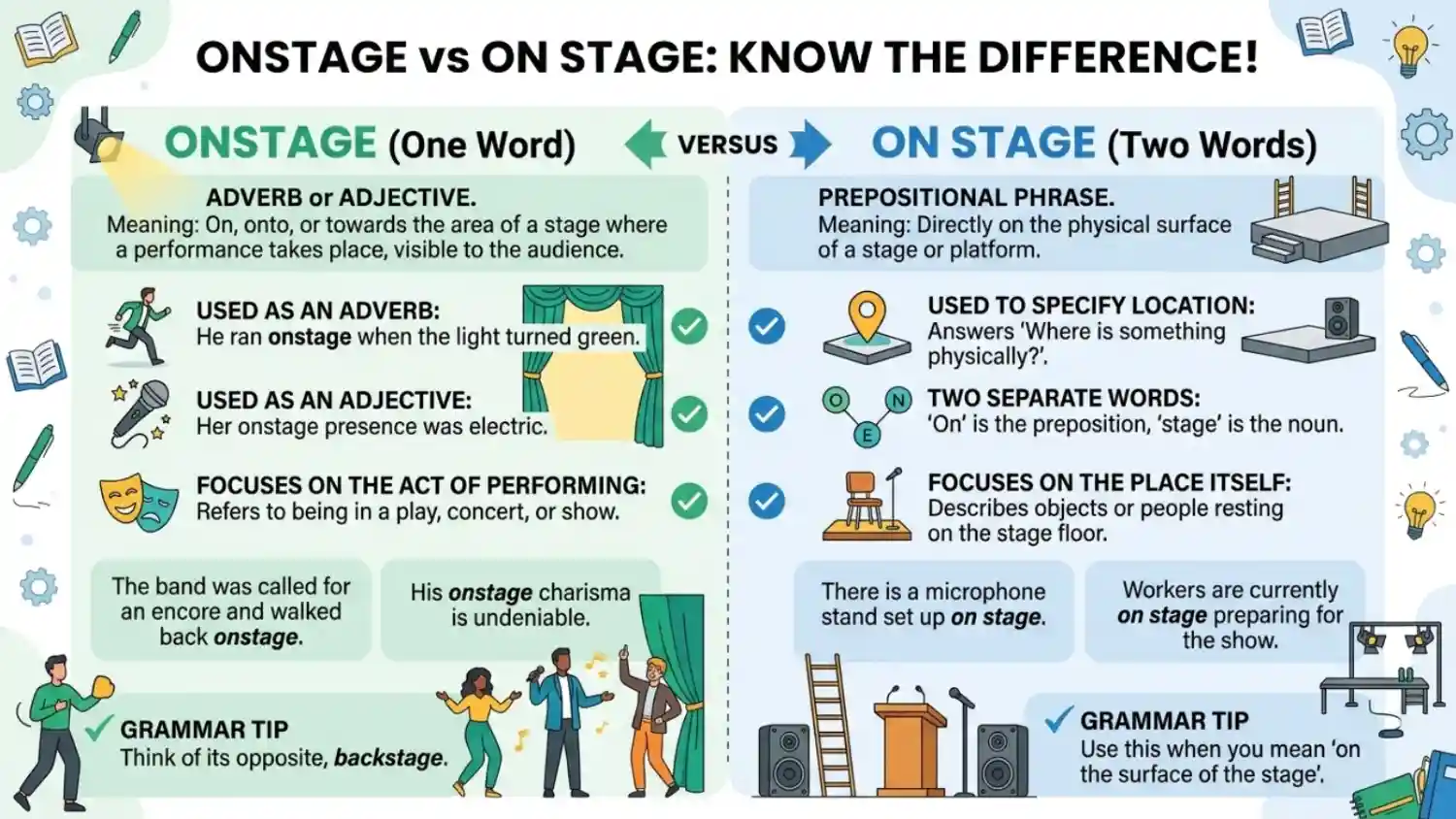
Onstage is one word. It works as an adjective. This means it describes a noun.
On stage is two words. It works as an adverb phrase. This means it tells you where an action happens.
Example: “She has an onstage role in the new play.” (Describes the role.)
Example: “She will sing on stage tonight.” (Tells you where she will sing.)
So use “onstage” before a noun. Use “on stage” after a verb, to show location.
Where This Word Comes From
The word “stage” comes from an old French word. That word meant a raised platform, often used for shows or speeches. English speakers used “stage” for hundreds of years to talk about this kind of platform.
Over time, writers began joining “on” and “stage” together for certain uses. This matched a common pattern in English, where short phrases sometimes become one word when used to describe something, like “onstage” describing a role or moment.
But when the phrase simply shows where something happens, writers kept the two words apart, like “on stage.” This split grew slowly over many years of writing and print.
Good and Bad Points of Knowing This Rule
Knowing the Correct Form – The Good Points:
- Your writing looks more careful and clear.
- Reviews and event posts feel more polished.
- Readers notice the small, correct details.
Knowing the Correct Form – The Bad Points:
- There are no real downsides. It’s a small rule that’s easy to learn.
Not Knowing the Rule – The Risks:
- Your writing may feel slightly off to careful readers.
- School papers or reviews may lose small points for style.
- It can make your writing feel less smooth to read.
British English vs American English
Good news here. “Onstage” and “on stage” are used the same way in both British English and American English. There is no country-based rule change for this word pair.
In both the UK and the US, writers use “onstage” before a noun, and “on stage” after a verb, to show location. The rule stays the same no matter where you are writing from.
| Form | British English | American English | Common Use |
| Onstage | Onstage | Onstage | Describing a noun |
| On stage | On stage | On stage | Showing location |
Which Form Should You Use?
Since the rule stays the same everywhere, this is about the sentence, not the country.
Use “onstage” when: The word comes right before a noun, like “onstage role” or “onstage presence.”
Use “on stage” when: The word comes after a verb, showing where the action happens, like “walked on stage” or “sang on stage.”
If you are unsure: Try reading the sentence out loud. Since the word describes a noun, use “onstage.” If it shows where something happened, use “on stage.”
You are writing casually: Many readers won’t notice a small mix-up, but using the correct form still helps your writing feel more polished.
A Real Life Example
Carlos wrote a blog post about a music show. He wrote, “The singer had a strong on stage presence.” A reader left a comment, gently pointing out that it should be “onstage presence,” since it was describing the singer’s presence, not showing a location.
Carlos looked closer at his post. He found two more small mistakes with the same word. He fixed all of them and felt proud of how much cleaner the post looked after the small fix.
Common Mistakes with Onstage and On Stage
Here are common mistakes. Here is how to fix them.
Mistake 1: “She walked onstage to start the show.”
Fix: “She walked on stage to start the show.” (This shows where she walked, so it should be two words.)
Mistake 2: “He has great on stage energy.”
Fix: “He has great onstage energy.” (This describes his energy, so it should be one word.)
Mistake 3: Thinking the two forms can always be swapped freely.
Fix: Check if the word describes a noun, or shows where an action happens. This tells you which form to use.
Mistake 4: Using “onstage” every time, without checking the sentence.
Fix: Slow down and check if a noun follows right after the word. If not, “on stage” may fit better.
Onstage and On Stage in Everyday Life
Let’s look at how these forms show up in real life.
In reviews: “The band’s onstage energy kept the crowd dancing all night.”
In event posts: “Doors open at 7, and the show starts on stage at 8.”
On social media: “Loved her onstage outfit tonight! So bold. ” “Can’t wait to see them perform on stage this weekend.”
In school papers: “The main actor’s onstage presence stood out the most.” “The students practiced walking on stage before the big show.”
These examples show how each form fits its own clear role in a sentence.
What People Search Online
People search “onstage vs on stage” a lot while writing reviews, school papers, or event posts. Many people are unsure which form fits their sentence.
Search interest often rises around award shows, concerts, and school plays, since these events bring up this word often in reviews and posts.
This topic is searched in every English-speaking country, since shows, plays, and concerts happen everywhere, all year long.
Onstage vs On Stage Comparison Table
| Feature | Onstage | On Stage |
| Word Type | One word (adjective) | Two words (location phrase) |
| Used Before | A noun | After a verb |
| Example | “Onstage role” | “Walked on stage” |
| Common In | Reviews, descriptions | Event details, action sentences |
Frequently Asked Questions
1. Are onstage and on stage always interchangeable? No. Onstage is used before a noun, while on stage is used to show where an action happens.
2. How can I remember the difference quickly? Check if a noun comes right after the word. If yes, use “onstage.” If the sentence shows a location, use “on stage.”
3. Is one form more formal than the other? No. Neither form is more formal. The choice depends only on how the word is used in the sentence.
4. Is there a British spelling difference for onstage or on stage? No. Both forms are used the same way in British English, American English, and other English-speaking places.
5. Can “onstage” ever be used to show location? It is best kept for describing something, like a role or presence. For showing location, “on stage” is the safer choice.
6. Does this rule apply to similar words, like “offstage”? Yes. “Offstage” follows the same pattern, often used as one word before a noun, and can be written as two words to show location.
7. Will using the wrong form confuse readers? It may not confuse most readers, but it can make writing look less polished, especially in reviews or formal writing.
Wrapping It All Up;
Onstage and on stage both relate to the same idea, a stage where shows and events happen. But they are used in different ways. Onstage works as one word, describing a noun, like an “onstage role.” On stage works as two words, showing where an action happens, like “singing on stage.” Both forms grew from the same old root word for a raised platform, but they split into two clear uses over time.
The easy rule to remember is simple. If a noun follows right after, use “onstage.” If it shows where something happens, use “on stage.”
Now that you know the difference, you can write reviews, posts, and papers with more confidence. Whether you’re writing about a school play or a big concert, you’ll always pick the right form. Keep this guide close, and you’ll never mix up onstage and on stage again.

Emily Carter is an English grammar writer based in Portland, Oregon, with 7+ years of experience turning tricky grammar rules into simple, easy lessons.