Ravi read a news story. It called a young chess player a “genius.” His friend called the same kid a “prodigy.” Ravi got confused. Weren’t these two words the same thing?
This mix-up happens a lot. Both words point to someone very talented. But they do not mean the exact same thing.
Why This Word Confuses People
Both words describe amazing skill. Both are used to praise someone. This makes it easy to think they mean the same thing.
You will see these words in news stories. They will see them in movies. You will see them in everyday talk too.
Using the wrong word will not upset anyone. But knowing the real difference can help you understand a story better, or use the right word at the right time.
In this guide, you will get a quick answer first. Then we will look at where these words come from. We will look at common mix-ups too. By the end, you will know exactly how they differ.
Genius or Prodigy – The Simple Answer
Here is the easy answer.
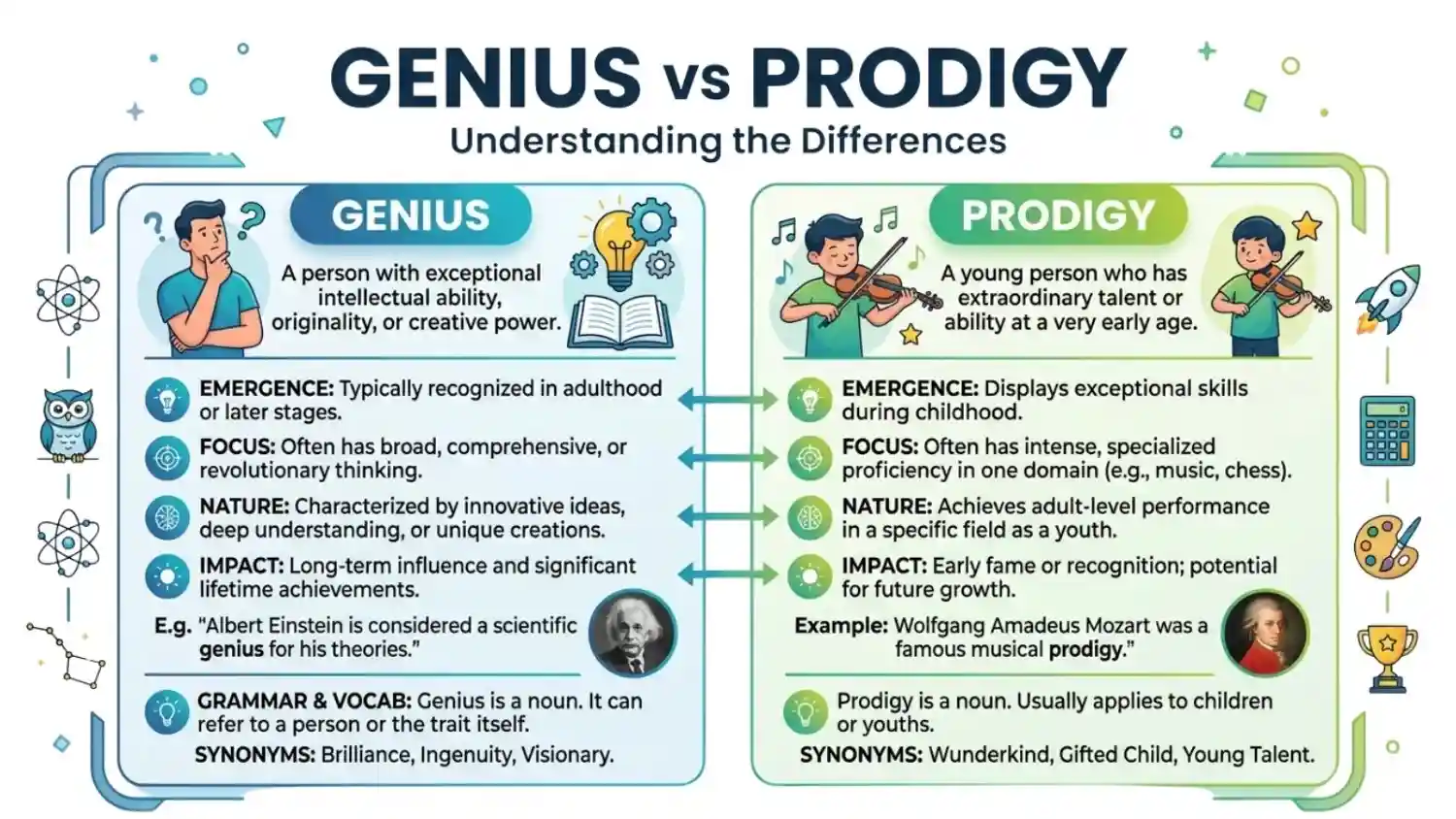
Genius means someone has very high skill or very high intelligence. This can happen at any age. It does not depend on how young someone is.
Prodigy means a child or young person shows amazing skill far beyond others their age. This word is almost always tied to being young.
Example: “Albert Einstein is often called a genius for his ideas in science.”
Example: “The eight-year-old piano prodigy amazed the whole audience.”
So genius is about high skill or intelligence, no matter your age. Prodigy is about amazing skill shown at a young age.
Where These Words Come From
Genius comes from the Latin word “genius.” In ancient Rome, this word meant a guiding spirit. People believed each person had a genius, or spirit, that shaped who they became. Over time, English speakers changed the meaning. It came to mean someone with very high natural talent or intelligence.
Prodigy comes from the Latin word “prodigium.” This word meant a sign or a wonder, often something unusual or amazing. Over time, the word grew to describe a young person with skills far beyond what is normal for their age, like a wonder to watch.
Both words trace back to ideas about something unusual or special. But genius grew to mean a high level of skill at any age. Prodigy stayed closely tied to being young.
Good and Bad Points of Each Label
Being Called a Genius – The Good Points:
- It shows deep respect for someone’s skill or mind.
- It can apply at any age, from a child to an older adult.
Being Called a Genius – The Bad Points:
- It can create high pressure to always perform at a high level.
- Some people may feel it sets an unfair standard for others to compare to.
Called a Prodigy – The Good Points:
- It highlights amazing skill shown early in life.
- It often brings support and chances to grow that skill further.
Being Called a Prodigy – The Bad Points:
- It can bring pressure at a very young age.
- Some prodigies feel stress trying to keep up with early fame.
British English vs American English
Good news here. “Genius” and “prodigy” are spelled the same way in both British English and American English. There is no spelling change between countries for these words.
Both words are used the same way in the UK and the US. News stories, movies, and books in both places use these words to describe amazing talent.
| Word | British English | American English | Common Use |
| Genius | Genius | Genius | High skill or intelligence, any age |
| Prodigy | Prodigy | Prodigy | Amazing skill shown at a young age |
Which Word Should You Use?
Since spelling never changes, this comes down to age and meaning.
Use genius when: You are talking about high skill or intelligence, no matter the person’s age.
Use prodigy when: You are talking about a young person showing amazing skill far beyond others their age.
If the person is an adult with amazing skill: Genius usually fits better, since prodigy is tied closely to youth.
If the person is a child showing rare talent: Prodigy usually fits better, especially if the skill is far beyond other kids their age.
A Real Life Example
Anna wrote an article about a ten-year-old math student. The student solved problems most adults find hard. Anna first wrote, “This young genius amazes her teachers.”
Her editor suggested a small change. He said “prodigy” would fit better, since the article was about a child showing rare skill for her age. Anna changed the word.
Later, in the same article, Anna also wrote about the student’s older mentor, a well-known math professor. For him, she used the word “genius,” since he was not young, but still very skilled. This helped both parts of the article feel more accurate.
Common Mistakes with Genius and Prodigy
Here are common mistakes. Here is how to fix them.
Mistake 1: Calling an older adult with high skill a “prodigy.”
Fix: Use “genius” instead, since prodigy usually points to a young person.
Mistake 2: Thinking every talented child is a “genius.”
Fix: If the child’s skill stands out far beyond their age group, “prodigy” may fit better.
Mistake 3: Believing both words mean the exact same level of skill.
Fix: Both describe amazing talent, but genius can apply at any age, while prodigy is tied to youth.
Mistake 4: Using “prodigy” for someone who is simply smart, without amazing, rare skill.
Fix: Save “prodigy” for truly rare cases of skill far beyond a child’s age group.
Genius and Prodigy in Everyday Life
Let’s look at how these words show up in real life.
In news stories: “The scientist is often called a genius for her breakthrough research.” “A twelve-year-old violin prodigy stunned the crowd last night.”
In movies and shows: “The main character is portrayed as a math genius who solves impossible problems.” “The film follows a young chess prodigy on his rise to fame.”
On social media: “This guy is a genius, his ideas always blow my mind. ” “Can’t believe this kid is only 9 and already a piano prodigy!”
In everyday talk: “My uncle is a genius when it comes to fixing cars.” “Her daughter is a real prodigy, reading full books by age five.”
These examples show how each word fits naturally with the person’s age and the type of talent they describe.
What People Search Online
People search “genius vs prodigy” a lot after reading news stories about young, talented people. They want to know the real difference between the two words.
Search interest often rises after big events, like a young chess player winning a major title, or a young musician performing on a large stage.
People in every English-speaking country search for this topic because rare talent stories attract attention everywhere.
Genius vs Prodigy Comparison Table
| Feature | Genius | Prodigy |
| Age Focus | Any age | Almost always young |
| Meaning | High skill or intelligence | Amazing skill shown early in life |
| Word Origin | Latin “genius” (guiding spirit) | Latin “prodigium” (a sign or wonder) |
| Example | “He’s a genius at solving puzzles.” | “She’s a prodigy on the violin.” |
Frequently Asked Questions
1. Can a genius also be a prodigy? Yes.A child who shows amazing skill can have both qualities, especially when that skill grows into rare talent later in life.
2. Is prodigy only used for children?
People almost always use prodigy for children or very young people because the word describes skills far beyond their age.
3 Can an older adult be called a prodigy?
People rarely use prodigy for older adults because the word usually describes a very talented young person.
4. Does genius always mean someone is book-smart? No. Genius can apply to many types of skill, like art, music, science, or even fixing things, not just book learning.
5. Is there a British spelling difference for genius or prodigy? No. Both words are spelled the same in British English, American English, and all other English-speaking places.
6. Why do people mix up these two words so often? Both words describe amazing talent, which makes them feel similar. But one focuses on skill level, while the other focuses on age.
7. Which word fits better for a young music star? “Prodigy” usually fits best, since it highlights amazing skill shown at a young age, which is common in early music talent stories.
Wrapping It All Up;
Genius and prodigy both describe amazing talent, but they focus on different things. Genius points to high skill or intelligence, and it can apply at any age. Prodigy points to amazing skill shown by a young person, far beyond others their age. Both words trace back to old ideas about something rare or special, but they grew into slightly different meanings over time.
The easy rule to remember is simple. Genius can happen at any age. Prodigy is almost always about being young.
Now that you know the difference, you can read stories and talk about talent with more confidence. Whether you’re reading about a young music star or an award-winning scientist, you’ll know exactly which word fits. Keep this guide close, and you’ll never mix up genius and prodigy again.