A Quick Story First
Kayla read an old book. It used the word “divers.” She thought it was a typo. She thought the writer meant “diverse.” But the word “divers” was correct, just in an old way.
This mix-up happens a lot. The two words look close. But one is common today. The other is mostly old and rare.
Why This Word Confuses People
Both words share most of the same letters. Both are linked to the idea of many different things. This makes them easy to mix up.
You will see “diverse” often in daily talk. You will see “divers” mostly in old books, old laws, or a few special uses. This gap in how often they are used adds to the confusion.
Using the wrong word can make your writing feel off. That is why it helps to know the real difference.
In this guide, you will get a quick answer first. Then we will look at where these words come from. We will look at common mix-ups too. By the end, you will know which one fits.
Diverse or Divers – The Simple Answer
Here is the easy answer.
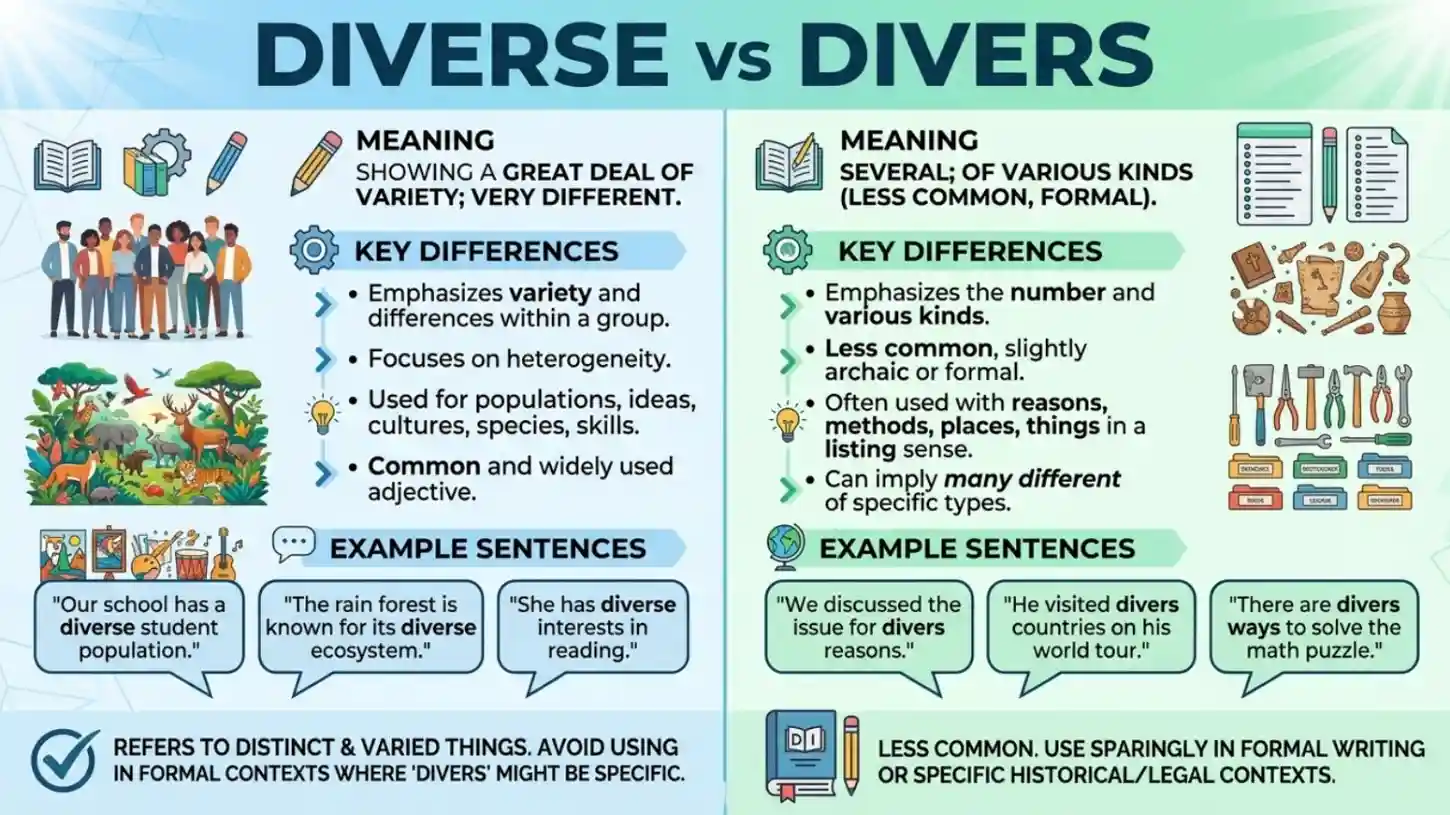
Diverse means made up of many different kinds. It is the common, modern word used today.
Divers is an old word. It means “several” or “various.” It is rarely used in modern writing, except in old texts or certain legal papers.
Example: “The city has a diverse group of people from many countries.”
Example: “The old law spoke of divers goods sold at the market.”
So diverse is the word you should use in daily writing. Divers is mostly a word from the past.
Where These Words Come From
Diverse comes from the Latin word “diversus.” That word meant “turned in different directions.” Over time, English speakers used it to describe something made up of many different types or kinds.
Divers comes from the same Latin root. In fact, it is an older form of the same idea. Hundreds of years ago, English writers used “divers” the way we use “diverse” or “several” today. Over time, “diverse” became the more common word, while “divers” faded out of daily use.
This is why the two words feel so linked. They are truly from the same root, but one grew into modern use, while the other stayed mostly in old writing.
Good and Bad Points of Knowing the Difference
Knowing the Difference – The Good Points:
- You avoid sounding old-fashioned by mistake.
- Your writing feels clear and modern.
- You understand old texts better when you come across the word “divers.”
Knowing the Difference – The Bad Points:
- There are no real downsides. It’s simply useful knowledge once learned.
Not Knowing the Difference – The Risks:
- You may think “divers” is a typo when reading old texts.
- You may use “divers” by mistake in modern writing, which can confuse readers.
- Legal or old documents may feel harder to understand without this knowledge.
British English vs American English
Good news here. “Diverse” and “divers” are spelled the same way in both British English and American English. There is no country-based spelling change for these two words.
Both words show up in old British and American texts. “Diverse” is the common word used in both places today. “Divers” is rare in both places, mostly kept in old writing or certain legal terms.
| Word | British English | American English | Common Use |
| Diverse | Diverse | Diverse | Modern daily writing |
| Divers | Divers | Divers | Old texts, rare legal use |
Which Word Should You Use?
Since spelling never changes, this is about knowing when each word fits.
Use diverse when: You are describing something made up of many different kinds, in normal, modern writing.
Use divers when: You are reading or studying old texts, or working with certain old legal papers where this word may still appear.
If you are writing for school or work: Always use “diverse.” It is the modern, expected word.
If you are reading an old book or document: Don’t be surprised to see “divers.” It simply means “several” or “various” in that older style.
A Real Life Example
Ethan studied old English texts for a class project. He kept seeing the word “divers” and thought it was a spelling mistake every time. It almost wrote a note about it in his report.
He decided to look it up first. They learned that “divers” was a normal word long ago, close in meaning to “diverse” or “several.” This small bit of research helped him understand his old texts much better, and he avoided making a mistake in his final report.
Common Mistakes with Diverse and Divers
Here are common mistakes. Here is how to fix them.
Mistake 1: Thinking “divers” is always a typo for “diverse.”
Fix: In old texts, “divers” is often correct and simply means “several” or “various.”
Mistake 2: Using “divers” in modern writing by mistake.
Fix: Use “diverse” instead, since it is the word expected in modern English.
Mistake 3: Thinking both words are used equally today.
Fix: “Diverse” is common today. “Divers,” in this old sense, is rare and mostly found in old writing.
Mistake 4: Confusing “divers” with the word for people who swim underwater. Fix: “Divers” can also mean people who dive underwater. This is a different, common use of the same spelling, so always check the context.
Diverse and Divers in Everyday Life
Let’s look at how these words show up in real life.
In modern writing: “Our team is diverse, with members from many different backgrounds.”
In old texts: “The merchant sold divers goods brought from far lands.”
On social media: “Love how diverse this city feels, so many cultures in one place!”
In legal or old documents: “The report mentions divers items found at the site.”
These examples show how “diverse” fits modern life, while “divers,” in this old sense, stays mostly in older writing.
What People Search Online
People search “diverse vs divers” a lot when reading old books, old laws, or historical texts. They want to know if “divers” is a real word or simply a typo.
Search interest also comes from students studying old English texts, since this word can be confusing without some background.
This topic is searched in every English-speaking country, since old texts and historical writing are read and studied everywhere.
Diverse vs Divers Comparison Table
| Feature | Diverse | Divers (old meaning) |
| Meaning | Made up of many different kinds | Several, various (old use) |
| Common Today? | Yes, very common | No, mostly found in old texts |
| Word Root | Latin “diversus” | Latin “diversus” (same root) |
| Example | “A diverse group of students.” | “Divers goods were sold.” |
Frequently Asked Questions
1. Is “divers” a made-up word? No. It is a real, old English word. It means “several” or “various” in older writing.
2. Should I ever use “divers” in modern writing? Not in this old sense. Use “diverse” instead, since it is the word expected in modern English.
3. Can “divers” mean something else today? Yes. Today, “divers” often refers to people who dive underwater, which is a separate, common meaning.
4. Why did “divers” fall out of common use? Over time, English speakers shifted to using “diverse” for this meaning, and “divers” slowly became rare outside of old texts.
5. Is there a British spelling difference for diverse or divers? No. Both words are spelled the same in British English, American English, and other English-speaking places.
6. Where might I still see “divers” used in its old sense? You may see it in old books, historical papers, or certain old legal documents.
7. Is diverse always about people from different backgrounds? Not always. It can also describe other things, like a diverse range of products, ideas, or plants and animals.
Wrapping It All Up;
Diverse and divers share the same old root, but they are used very differently today. Diverse is the common, modern word, used to describe something made up of many different kinds. Divers, in its old sense, means “several” or “various,” and it mostly appears in old texts or certain legal papers today. This word pair shows how English can shift over time, with one form staying common, while the other fades into older writing.
The easy rule to remember is simple. Use “diverse” in modern writing. Only expect to see “divers,” in this old sense, in older texts.
Now that you know the difference, you can read old texts and write modern content with more confidence. Whether you’re studying history or writing for today, you’ll know exactly which word fits. Keep this guide close, and you’ll never feel confused between diverse and divers again.