Someone texts you “bruh” and you’re not sure if they’re mad, shocked, or just saying hi. Then someone else says “bro” in the same spot, and it feels totally different. Same word at the start, but they clearly don’t mean the same thing now. So what’s going on?
This isn’t just in your head. “Bro” and “bruh” really have grown into two different words with their own jobs, even though “bruh” started out as just a quick way of saying “bro.” Young people didn’t just make the word shorter for fun, they gave it a whole new job.
Let’s break down how these two words work today, so you stop guessing and start using them right.
Quick Answer
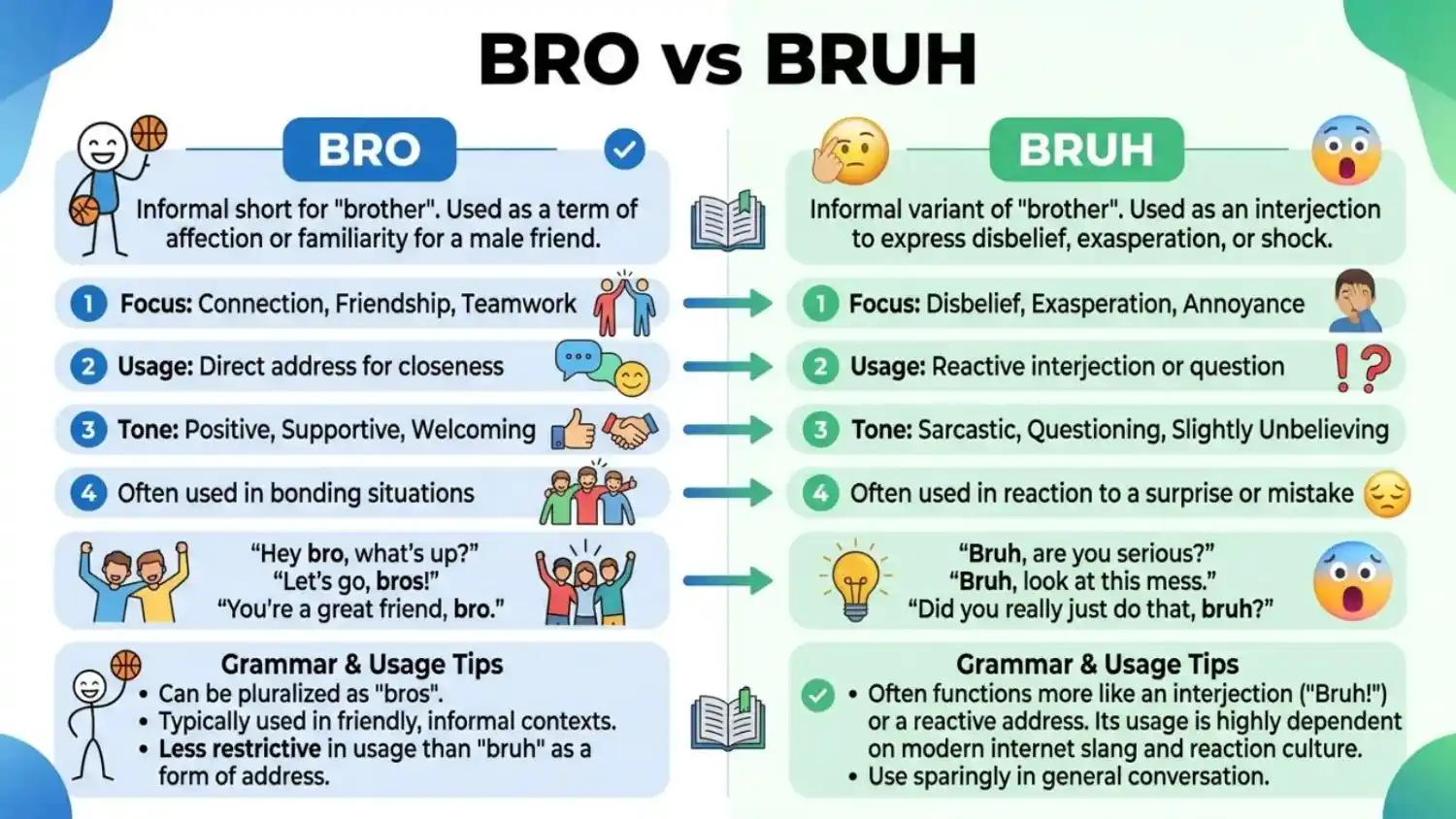
Bro is a way to talk to someone, most times a close friend, in a friendly, easy way. Example: “Hey bro, you free this weekend?”
Bruh works more like a sound you make. You drop it into a sentence to show shock, disbelief, or “oh no” type feelings. Example: “Bruh, I can’t believe he actually said that.”
Simple way to think about it: “bro” is a nickname you call someone. “Bruh” is more like a reaction word, closer to “wow” or “ugh” than a name for a person.
How One Word Split Into Two
“Bro” has been around for a long time, short for “brother,” used in a friendly way to talk to a buddy since the mid-1900s. Nothing tricky there.
“Bruh” started as just a fast, lazy way to say “bro,” the kind of thing that happens when people talk quickly. But over time, mostly through the internet, memes, and funny videos, “bruh” broke off and became its own thing.
Instead of staying as a name you call a friend, “bruh” turned into its own reaction, something you say (or type) when something is surprising, annoying, or just plain silly. Think of it like a sigh you can text.
This kind of split happens more than people think in slang words. A word gets used so much in one certain way that it slowly earns its own new meaning, even while the old word keeps doing its old job too.
Breaking Down the Real Difference
| Bro | Bruh | |
| What it does | Names or talks to a person | Shows a feeling or reaction |
| Feels like | A nickname | A word like “wow” or “ugh” |
| Example | “Bro, come over later.” | “Bruh, that’s wild.” |
| Can stand alone? | Not really, needs a sentence | Yes, often used all by itself |
| Feeling behind it | Friendly, easy | Shock, upset, funny, or annoyed |
A Simple Way to Tell Them Apart
Ask yourself this: am I talking to a person, or reacting to something that just happened?
If you’re talking straight to someone, like calling their name, you want “bro.” “Bro, pass the remote” works the same way “hey, pass the remote” would.
If you’re reacting to something surprising, funny, or annoying, “bruh” almost always fits better. You could send just the word “bruh” by itself, and it would still make full sense.
Try It Yourself
Guess which word fits before you check the answer.
- “___, did you see that game last night?” → Bruh (a reaction)
- “___, can you help me move this couch?” → Bro (talking to a person)
- “___. I just failed my test.” → Bruh (a sad reaction)
- “Thanks for the help, ___.” → Bro (talking to a person)
- “___, why would you do that?” → Bruh (a shocked reaction)
If most of these felt easy, you already get this better than you thought.
When Each Word Actually Fits
Talking straight to a close friend: Use “bro.” Example: “Yo bro, what’s the plan for tonight?”
Reacting to something you didn’t expect, funny or annoying: Use “bruh.” Example: “Bruh, my phone just died at 1%.”
Feeling embarrassed for someone else: “Bruh” almost always wins here. Example: “Bruh, he tripped in front of the whole class.”
Ending a sentence in a soft, casual way: “Bro” fits this relaxed role. Example: “That was wild, bro.”
Texting just one word, with nothing else: “Bruh” stands alone easily. Just texting “bro” by itself can feel like you forgot to finish your sentence.
Common Mistakes People Make
Using “bruh” to talk straight to someone. It happens sometimes, but “bruh” doesn’t feel as friendly and personal as “bro” when you’re speaking right to someone.
Thinking both words mean the exact same thing. They come from the same word, but their jobs in a sentence are different now. Swapping one for the other doesn’t always sound right.
Thinking this is slang with no real pattern. It actually follows a pretty clear pattern once you see it, even though no one ever wrote an official rule for it.
Using “bruh” too much in serious or work writing. Both words are casual, but “bruh” feels even more relaxed than most slang. Save it for texts and chats, not emails or reports.
Seeing These Words in Real Life
A text between friends: “Bro, you still coming tonight?”
A reaction to a video: “Bruh, how did he not see that coming.”
Casual goodbye: “Alright, catch you later, bro.”
A moment of shock: “Bruh. I literally just said that.”
A group chat message: “Bruh who left the group chat, that’s cold.”
Why People Search This So Often
A lot of parents and teachers search “bro vs bruh” just trying to understand how their kids or students talk, since slang changes so fast these days.
People learning English also search this a lot, since school books rarely teach casual internet slang, leaving a gap between school English and how people actually text.
Writers and content creators search this pair too, trying to get the right tone for scripts, captions, or talk that should sound real and current, not stiff or old.
Slang Word Pairs Like This One
| Pair | Old Word | New Meaning That Grew From It |
| Bro / Bruh | Bro (short for brother) | Bruh (a reaction word) |
| Literally / Figuratively | Literally (exactly true) | Now often used just to add stress, even when not fully true |
| Sick / Sick | Sick (not feeling well) | Also means impressive or cool |
| Salty / Salty | Salty (a taste) | Also means upset about something small |
Common Questions
Is “bruh” a real word you’d find in a dictionary? Some big dictionaries have added it in recent years, calling it a word people say to show shock or upset feelings, which matches how people really use it.
Can “bro” and “bruh” be used by anyone, not just guys? Yes, both have become pretty open in casual use. Many people use them with friends no matter their gender, most of all online.
Is “bruh” rude? Not most of the time. It’s casual, but not rude on its own. How you say it matters more than the word itself.
Which one shows up more online? “Bruh” shows up a lot in reaction posts, memes, and comments, while “bro” shows up more in direct messages and casual talk between friends.
Did “bruh” come from one video or meme? It’s hard to point to just one starting point, but internet culture, most of all reaction videos from the 2010s, helped push “bruh” into the word it is today.
Should I use these words in work writing? No, save both for texting, social media, or casual talk. Neither fits well in emails, reports, or anything meant to sound formal.
Will “bruh” fade away like other slang? Maybe someday, slang always changes over time. But right now, “bruh” is well known enough that it’s likely to stick around a while longer, even as new slang keeps showing up too.
Wrapping This Up;
“Bro” and “bruh” come from the same root word, but they’ve split into two words with different jobs. “Bro” is your go-to for talking straight to a close friend. “Bruh” is your go-to reaction word, great for shock, upset feelings, or those embarrassing moments we’ve all had.
A simple way to check yourself: if you’re talking to someone, use “bro.” If you’re reacting to something that just happened, “bruh” almost always fits better.
Once this clicks, texting and casual talk start to feel a lot more natural, and you’ll stop guessing which one fits the moment.