You ask a friend, “Want to go for a bike ride?” Then later you write, “I bought a new bicycle.” Same thing, right? Most people think so. But if you stop and think about it, why do we have two words for the exact same item?
This is one of those small questions that sits in the back of people’s minds. It feels like it should have a clear answer, but most people just use both words without ever really checking if there’s a real difference.
Let’s clear this up in plain, easy words.
Quick Answer
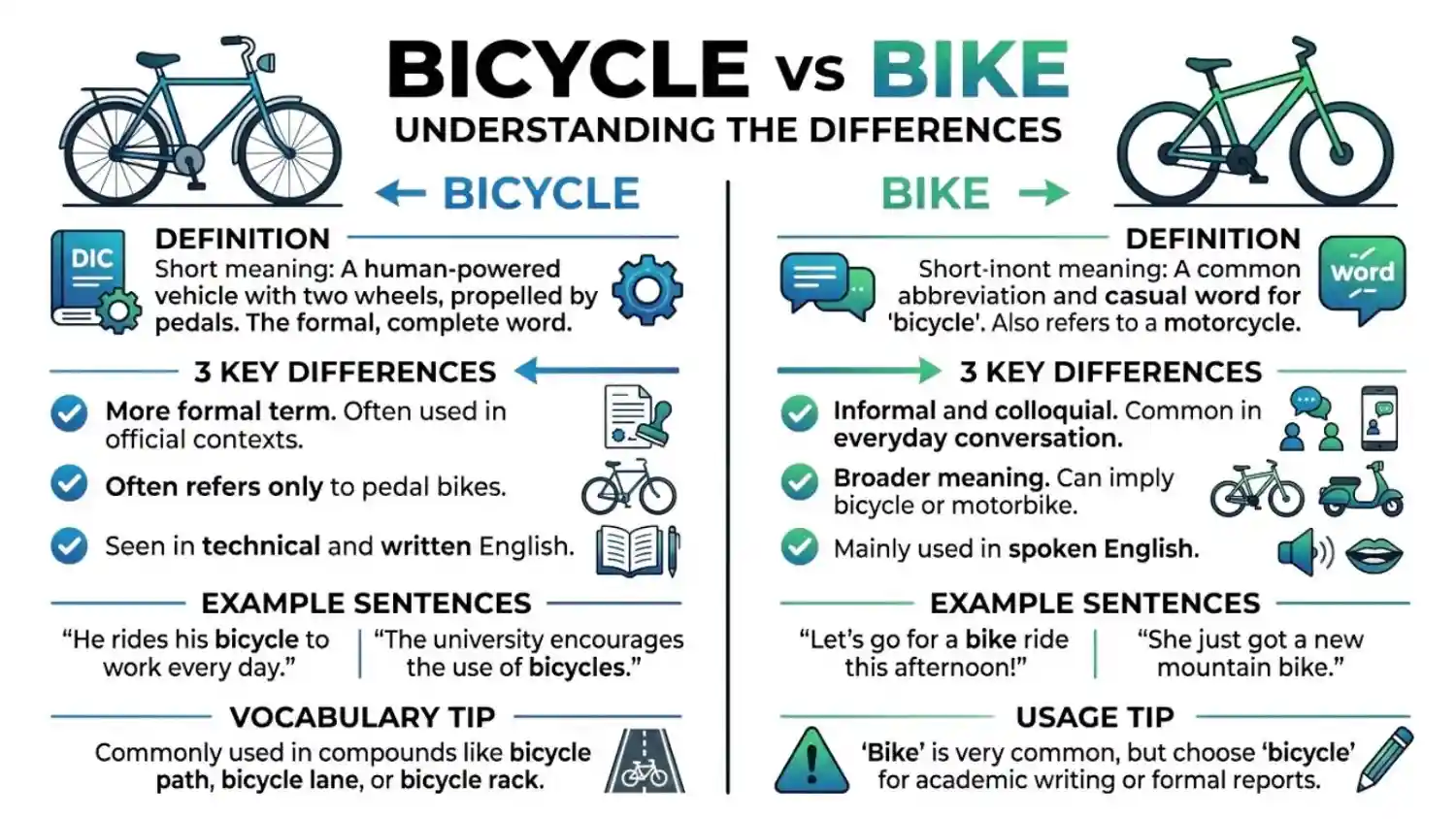
Bicycle is the full, proper word for the two-wheeled machine you pedal to move forward. It’s the word you’ll find in dictionaries, rulebooks, and formal writing.
Bike is just the short, everyday way people say “bicycle.” Same exact object, just a shorter word for it.
Simple way to remember it: bicycle is the full name. Bike is the nickname. There’s no real difference in what they mean, just how formal or casual the moment feels.
Where These Two Words Come From
“Bicycle” comes from two old word parts put together. “Bi” means two, and “cycle” comes from an old word for wheel or circle. So “bicycle” simply means “two wheels,” which makes total sense once you think about it.
“Bike” showed up later, in the late 1800s, as a shorter, easier way to say “bicycle.” People just naturally started cutting the word down while talking fast, the same way “television” turned into “TV” over time. It wasn’t invented by any one person, it just grew out of everyday talking.
So really, “bike” isn’t a different word with its own meaning. It’s just “bicycle,” trimmed down for speed and ease, the same object the whole time.
Breaking Down the Difference
| Bicycle | Bike | |
| What it means | The full name for a two-wheeled pedal machine | The short, everyday name for the same thing |
| Used in | Formal writing, rulebooks, official signs | Everyday talk, texts, casual writing |
| Feels like | A bit more formal | Relaxed and casual |
| Example | “Please walk your bicycle across the crosswalk.” | “I rode my bike to school today.” |
A Quick Way to Check Yourself
Ask this: am I writing something formal, or just talking casually?
If it’s a sign, a rule, a safety notice, or something official, “bicycle” usually fits better. Think “Bicycle Lane” signs or store product listings.
If you’re just chatting, texting, or writing something relaxed, “bike” almost always feels more natural. Nobody texts “I rode my bicycle today,” it just sounds a little stiff.
Try It Yourself
Guess which word fits better before checking the answer.
- “Watch out for the ___ lane while driving.” → Bicycle
- “I love riding my ___ on weekends.” → Bike
- “The store sells kids’ ___ starting at size 12 inches.” → Bicycles
- “Wanna go for a ___ ride later?” → Bike
- “Please register your ___ at the front desk.” → Bicycle
If those felt easy, you already had a good sense of this before reading a single line.
Which Word Should You Use?
Writing something formal, like a store listing or a safety sign: Use “bicycle.” It reads more proper and complete.
Texting a friend or writing something casual: Use “bike.” It just feels more natural and relaxed.
Talking about motorcycles too: Careful here, “bike” is sometimes used for motorcycles as well, depending on context. “Bicycle” always means the pedal-powered kind, never a motorcycle.
Writing for kids or beginner readers: “Bike” tends to be the easier, more familiar word for younger audiences.
Writing a formal report or official document: Stick with “bicycle” for that clean, complete feel.
Common Mistakes People Make
Thinking “bike” only means motorcycle. It doesn’t, not by default. “Bike” can mean either a bicycle or a motorcycle depending on the sentence, so context matters a lot here.
Assuming “bicycle” is somehow more correct. It’s not more correct, just more formal. Both words are fully proper English, just suited to different moods of writing.
Overusing “bicycle” in casual writing. It can come across as a little stiff or overly formal in texts or social posts, where “bike” fits the tone much better.
Forgetting “bike” can also be a verb. “I like to bike on weekends” uses “bike” as an action, not just a noun. “Bicycle” can technically work as a verb too, but it’s rarely used that way in real life.
Seeing These Words in Everyday Life
A text to a friend: “Let’s bike to the park later.”
A store sign: “Bicycles for sale, starting at $150.”
Safety notice: “Cyclists must wear a helmet while riding a bicycle on this trail.”
A kid’s birthday wish: “All I want is a new bike for my birthday!”
A news headline: “City adds new bicycle lanes downtown.”
Why People Search This So Often
A lot of parents and teachers search this pair while helping kids with schoolwork, since young readers often wonder if these are actually two separate things.
Shoppers searching online for bike gear or accessories bump into both spellings constantly, sometimes wondering if one search term will find different products than the other.
Writers and content creators search it too, mostly trying to figure out which word fits the tone of what they’re working on, formal or casual.
A Few More Word Pairs Like This
| Pair | Full Word | Short, Casual Version |
| Bicycle / Bike | Bicycle | Bike |
| Television / TV | Television | TV |
| Refrigerator / Fridge | Refrigerator | Fridge |
| Photograph / Photo | Photograph | Photo |
Common Questions
Is “bike” considered slang? Not really. It’s informal, but it’s a fully accepted, standard English word, not slang like some newer internet terms.
Can “bike” mean motorcycle too? Yes, sometimes. It depends on the sentence. “Bicycle” always means the pedal kind, but “bike” can go either way.
Which word should kids learn first? Most kids naturally learn “bike” first, since it’s shorter and used more in everyday talk around them.
Is one word more popular than the other? “Bike” is used far more often in daily speech and writing, mostly because it’s quicker and feels more natural in casual settings.
Do other countries use one word more than the other? Not really by country, more by setting. Formal writing worldwide tends to use “bicycle,” while casual talk almost everywhere leans toward “bike.”
Why did “bike” become so much more common than “bicycle”? Shorter words are just easier and faster to say, and over time, people naturally drift toward whatever feels quickest in everyday conversation.
Is there ever a wrong time to use either word? Not really wrong, just less fitting. Using “bicycle” in a text might feel a bit stiff, and using “bike” in a very formal document might feel slightly too casual, but neither is a real mistake.
Wrapping This Up
“Bicycle” and “bike” are the exact same thing, just dressed differently depending on the moment. “Bicycle” is the full, proper word, fitting for formal writing and official use. “Bike” is the short, everyday version, perfect for casual talk and quick texts.
There’s no real right or wrong here, just a matter of tone. Formal setting, reach for “bicycle.” Casual chat, “bike” almost always feels right.
Once you notice this small difference, picking between the two becomes second nature, and you’ll never second-guess yourself over it again.

Emily Carter is an English grammar writer based in Portland, Oregon, with 7+ years of experience turning tricky grammar rules into simple, easy lessons.