Have you ever stopped while writing because you were unsure whether to use layed or laid? You are not alone. Both spellings may look right, especially if you know that many English verbs form the past tense by adding -ed.
However, when you mean the past tense or past participle of the verb lay, the correct standard spelling is laid. For example, you should write, “She laid the book on the table,” not “She layed the book on the table.”
The confusion also comes from another verb, lie. When lie means to rest or recline, its past tense is lay. This can make words such as lay, laid, and lain hard to tell apart.
Knowing the difference will help you write better sentences in school assignments, emails, work documents, and everyday messages. This guide explains the correct spelling, the history behind the words, the difference between British and American English, and common mistakes to avoid.
Layed or Laid: Quick Answer
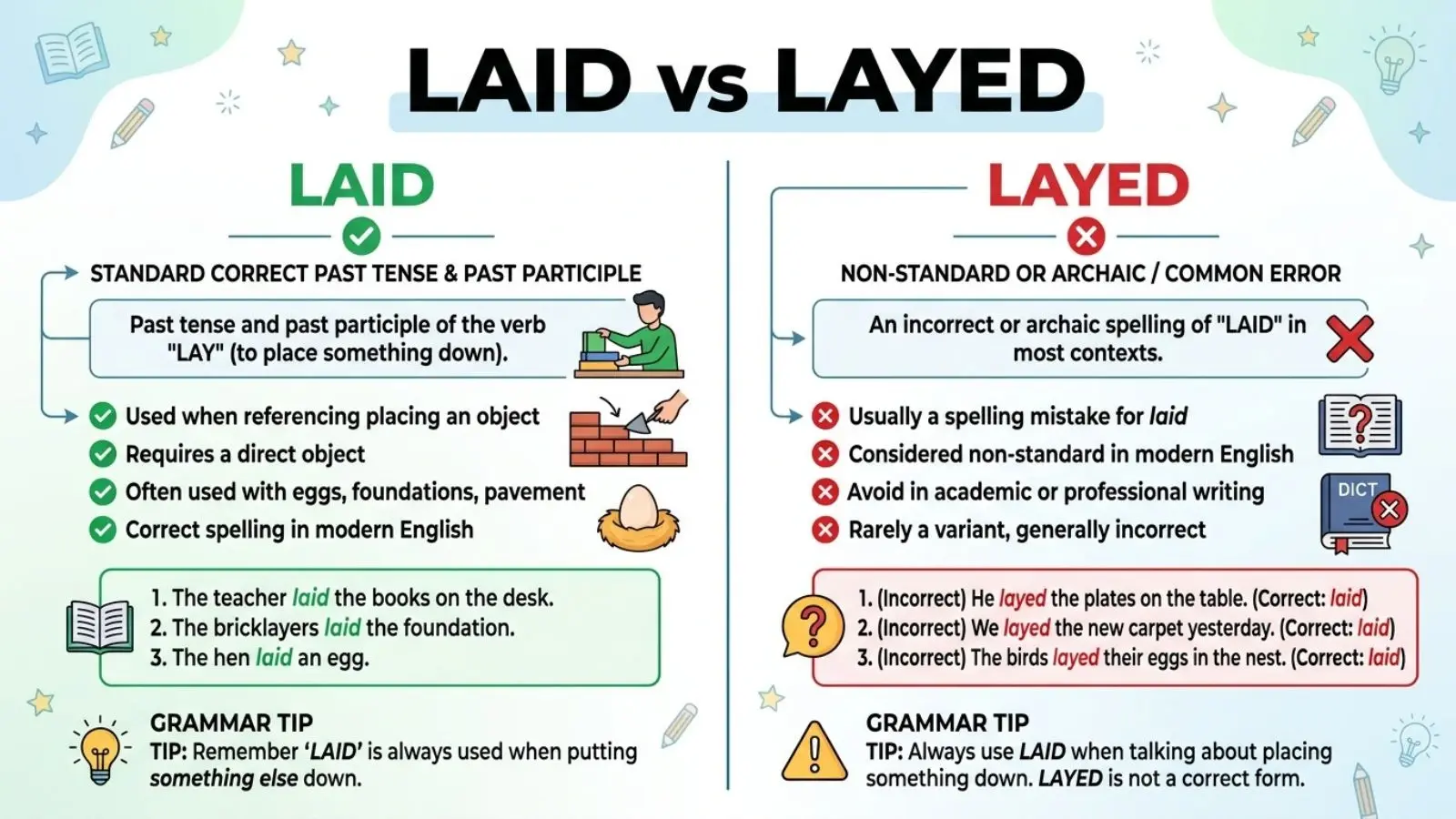
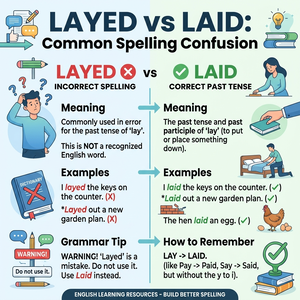
Laid is the correct standard spelling. Layed is generally incorrect when used as the past tense or past participle of lay.
The verb lay means to put or place something somewhere.
Examples:
- Correct: She laid her phone on the desk.
- Incorrect: She layed her phone on the desk.
- Correct: They laid the new tiles yesterday.
- Incorrect: They layed the new tiles yesterday.
The correct verb forms are:
| Verb form | Correct word | Example |
| Present | Lay | I lay the book on the desk. |
| Past tense | Laid | I laid the book on the desk yesterday. |
| Past participle | Laid | I have laid the book on the desk. |
| Present participle | Laying | I am laying the book on the desk. |
Cambridge Dictionary confirms that laid is the past tense and past participle of lay.
Cambridge Dictionary
Remember this simple rule: lay → laid → laid.
The Origin of Layed and Laid
The difference between layed and laid comes from the way English verbs change over time.
Many English verbs are regular. They form the past tense by adding -ed.
For example:
- Walk → walked
- Play → played
- Clean → cleaned
- Open → opened
This pattern makes layed look like a possible spelling. A writer may think that because play becomes played, lay should become layed.
But English also has irregular verbs. These verbs do not always follow the usual pattern. The verb lay is one of them. Its standard past tense and past participle are both laid.
Other familiar irregular verbs include:
- Say → said
- Pay → paid
- Make → made
- Buy → bought
- Teach → taught
The spelling laid is the established form used in standard modern English. Although layed has appeared as a variant spelling, it is not the normal form to use in careful writing today.
Washington State University
+1
Why Does the Mistake Happen?
The main reason is that people apply a spelling rule that works for many other verbs.
For example, someone who knows the words played, stayed, and prayed may assume that layed follows the same rule. The mistake becomes more likely when the writer is unsure about the difference between lay and lie.
Compare these examples:
- Today, I lay the keys on the desk.
- Yesterday, I laid the keys on the desk.
- Yesterday, I lay on the sofa.
The first two sentences use lay to mean “put or place something.” The third uses lay as the past tense of lie, meaning “rest or recline.”
This is why learning the verb forms is more useful than simply memorizing one spelling.
British English vs American English Spelling
There is no standard British-versus-American spelling difference between laid and layed.
British and American English both use laid as the past tense and past participle of lay. The spelling does not change based on the country where you are writing.
| Feature | British English | American English |
| Correct past tense of lay | Laid | Laid |
| Correct past participle | Laid | Laid |
| Standard form in formal writing | Laid | Laid |
| Nonstandard form | Layed | Layed |
| Example | She laid the book down. | She laid the book down. |
For example, a writer in London would write, “The workers laid the new floor.” A writer in New York would use the same sentence and spelling.
Other words do have British and American spelling differences. For instance, colour is common in British English, while color is standard in American English. But laid is not one of those words.
If you write for an audience in the United Kingdom, the United States, Canada, Australia, or another English-speaking country, use laid when you mean the past tense of lay.
What Is the Difference Between Lay, Laid, Lie, and Lain?
This is one of the most useful grammar points to learn because these words often cause more confusion than layed alone.
Lay: To Put or Place Something
The verb lay means to put or place something somewhere. It normally takes an object, which is the person or thing being placed.
Examples:
- I lay the book on the table.
- She lays her clothes on the bed.
- Please lay the papers here.
In these sentences, the book, clothes, and papers are the objects.
Laid: The Past Form of Lay
Use laid when the action happened in the past or when you need the past participle.
Examples:
- I laid the book on the table yesterday.
- She laid her clothes on the bed.
- They have laid the papers in order.
Lie: To Rest or Recline
The verb lie means to rest or put your body in a flat position. It does not need an object.
Examples:
- I lie on the sofa after work.
- The dog lies beside the door.
- I need to lie down.
Lay: The Past Tense of Lie
Here is the confusing part. When lie means to rest or recline, its past tense is lay.
Examples:
- Yesterday, I lay on the sofa.
- The dog lay beside the door.
- She lay in bed for an hour.
Lain: The Past Participle of Lie
The past participle of lie in this meaning is lain.
Examples:
- I have lain here for an hour.
- The dog has lain beside the door all morning.
This form can sound formal in everyday conversation, but it is part of standard English grammar. Cambridge explains the difference between lay and lie in its grammar guide.
Cambridge Dictionary
Here is the easiest way to remember the forms:
| Meaning | Present | Past | Past participle |
| Put or place something | Lay | Laid | Laid |
| Rest or recline | Lie | Lay | Lain |
| Say something untrue | Lie | Lied | Lied |
Notice that lied is correct when you mean telling an untruth. It is not the same as laid.
Which Spelling Should You Use?
For almost all normal writing, choose laid, not layed, when you mean the past tense or past participle of lay.
For American Readers
Use laid in schoolwork, emails, reports, articles, and social media posts.
Example: “He laid his bag beside the chair.”
For British and Commonwealth Readers
Use the same spelling. British English follows the same standard verb form.
Example: “The builders laid the new floor last week.”
Academic Writing
Use laid when describing a past action or an action completed before another event.
Example: “The researchers laid out their findings in the report.”
For Business Writing
Use laid in expressions such as laid off, laid out, and laid the groundwork.
Examples:
- The company laid off several workers.
- The manager laid out the plan.
- The team laid the groundwork for the project.
For Online Writing
Use laid in blog posts, captions, comments, and messages when you want standard spelling.
You might see layed online, but seeing a spelling on social media does not make it the standard form.
The main advice is simple: unless you are copying a direct quotation or discussing a nonstandard spelling itself, use laid.
Common Mistakes with Layed and Laid
Learning a few common mistakes can help you use these words correctly.
1. Writing “Layed the Book”
Incorrect: She layed the book on the table.
Correct: She laid the book on the table.
Why? Laid is the standard past tense of lay when it means to put or place something.
2. Writing “I Laid Down” When You Mean You Rested
Incorrect in standard grammar: I laid down after lunch.
Correct: I lay down after lunch.
Why? When you mean that you rested or reclined, the verb is lie. Its past tense is lay.
However, laid down is correct when you place something down.
Example: She laid down her phone.
3. Confusing “Laid” with “Lain”
Incorrect: I have laid on the bed all morning.
Correct: I have lain on the bed all morning.
Why? In standard grammar, lain is the past participle of lie when it means to rest or recline.
4. Writing “Layed Off”
Incorrect: The company layed off ten workers.
Correct: The company laid off ten workers.
Why? The standard expression is laid off. It means that an employer ended someone’s job, often because of business needs.
5. Writing “The Hen Layed an Egg”
Incorrect: The hen layed an egg this morning.
Correct: The hen laid an egg this morning.
Why? The past tense of lay, when talking about producing or placing an egg, is laid.
6. Using “Laid” When You Mean “Told a Lie”
Incorrect: He laid to his parents.
Correct: He lied to his parents.
Why? The past tense of lie meaning “to say something untrue” is lied. It is a different verb from lie meaning to rest.
7. Adding “-Ed” to Every Verb
Incorrect: I layed the blanket on the bed.
Correct: I laid the blanket on the bed.
Why? Not every verb forms its past tense by adding -ed. Learn the irregular forms instead of guessing from the spelling of another word.
Layed or Laid in Everyday Examples
Here are examples of laid in different situations. These show how the word works in daily life, online writing, and formal communication.
Everyday Life
- I laid my keys on the kitchen counter.
- She laid the baby gently in the crib.
- He laid his jacket over the chair.
- We laid a blanket on the grass.
- The workers laid new tiles in the hallway.
Emails and Work Messages
- I have laid out the steps for the new project.
- The manager laid down the rules during the meeting.
- Our team laid the groundwork for the new plan.
News and Formal Writing
- The builders laid the foundation for the new school.
- The company laid off several employees last month.
- The committee laid out its plans in a public report.
- The agreement laid the foundation for future talks.
Social Media and Casual Messages
- I laid everything out before the trip.
- She laid her phone down and went outside.
- We laid the cards on the table and started the game.
In every example, laid is the correct form of lay. The meaning changes with the sentence, but the spelling stays the same.
Layed or Laid: Google Trends and Usage Data
People search for layed or laid because the two spellings look similar, and the usual past-tense rule can be misleading. The search also connects to questions about lay, lie, laid down, and laid off.
Grammar references confirm that laid is the standard form in modern English. For example, Cambridge Dictionary gives laid as the past form of lay, and Washington State University’s Common Errors guide also recommends laid.
Usage by Country
The standard spelling remains the same across major English-speaking regions.
| Region | Standard spelling | Common reason for checking |
| United States | Laid | Grammar and proofreading |
| United Kingdom | Laid | Spelling and word use |
| Canada | Laid | English writing |
| Australia | Laid | Grammar and editing |
| Pakistan | Laid | English learning and schoolwork |
| India | Laid | English learning and professional writing |
This table explains the standard spelling. It does not show measured search volume by country.
What About Google Trends?
Google Trends can help compare search interest for phrases such as layed or laid over a selected period and region. However, search interest is not the same as correct usage, and it can change over time.
Without a verified Trends report for a defined date range and location, it would be misleading to claim exact search numbers or say which country searches the phrase most often.
The practical lesson does not depend on search volume: laid is the standard spelling. People may type layed when they are unsure, but that does not make it the preferred form in edited English.
Comparison Table: Layed vs Laid
| Feature | Laid | Layed |
| Standard modern spelling | Yes | No, for this verb form |
| Past tense of lay | Correct | Incorrect |
| Past participle of lay | Correct | Incorrect |
| Example | She laid the book down. | She layed the book down. |
| Formal writing | Use it | Avoid it |
| British English | Standard | Nonstandard |
| American English | Standard | Nonstandard |
| Recommended choice | Yes | No |
The table shows the main spelling rule. If you mean “put” or “place” something, use laid for the past tense and past participle.
Frequently Asked Questions
1. Is it laid or layed?
Laid is the correct standard spelling when you use the past tense or past participle of lay, meaning to put or place something. For example, “She laid the keys on the desk.” The spelling layed is generally considered nonstandard in this use, so avoid it in schoolwork, professional writing, and everyday messages.
2. Is layed ever correct?
Layed has appeared as a variant spelling in historical and nonstandard writing, but it is not the normal modern form of the verb lay. In ordinary English sentences, use laid. If you see layed in an old text, a name, or a creative work, consider its specific context rather than treating it as the standard spelling.
3. What is the past tense of lay?
The past tense of lay is laid when the verb means to put or place something. For example, “I lay the book here every day” describes a present action, while “I laid the book here yesterday” describes a past action. The past participle is also laid, as in “I have laid the book here.”
4. Is it laid down or layed down?
Use laid down when you mean that someone placed something down. For example, “He laid down his phone.” But if you mean that someone reclined, the standard past-tense form is “He lay down.” The correct choice depends on whether the person placed an object or rested their body.
5. Is laid correct in both British and American English?
Yes. British and American English both use laid as the standard past tense and past participle of lay. There is no regional spelling rule that makes layed correct in one variety and laid correct in the other.
6. What is the difference between lay and lie?
Lay means to put or place something and usually takes an object. Lie means to rest or recline and does not need an object. Their past forms are different: lay becomes laid, while lie meaning recline becomes lay in the past tense and lain in the past participle.
7. Is it “the hen laid an egg” or “the hen layed an egg”?
The correct sentence is “The hen laid an egg.” The verb lay is used when a hen produces an egg, and its past tense is laid. The sentence “The hen layed an egg” uses a nonstandard spelling. Remembering this common example can help you recall the correct form.
Conclusion: Layed or Laid?
When choosing between layed and laid, use laid in standard modern English. It is the correct past tense and past participle of lay when the verb means to put, place, or set something somewhere.
For example, write “She laid the book on the table,” “They laid the foundation,” and “The company laid off several workers.” Do not write layed in these sentences.
The confusion often comes from the common rule of adding -ed to form the past tense. While that rule works for words such as played and cleaned, lay is an irregular verb. Its correct forms are lay, laid, and laid.
Also remember the difference between lay and lie. If you mean to rest or recline, the past tense of lie is lay, and its past participle is lain. This distinction helps you avoid errors such as “I laid down” when you mean “I lay down.”
The same spelling rule applies in British and American English. For school assignments, emails, articles, business documents, and social media posts, choose laid. It is the clear, standard choice.











