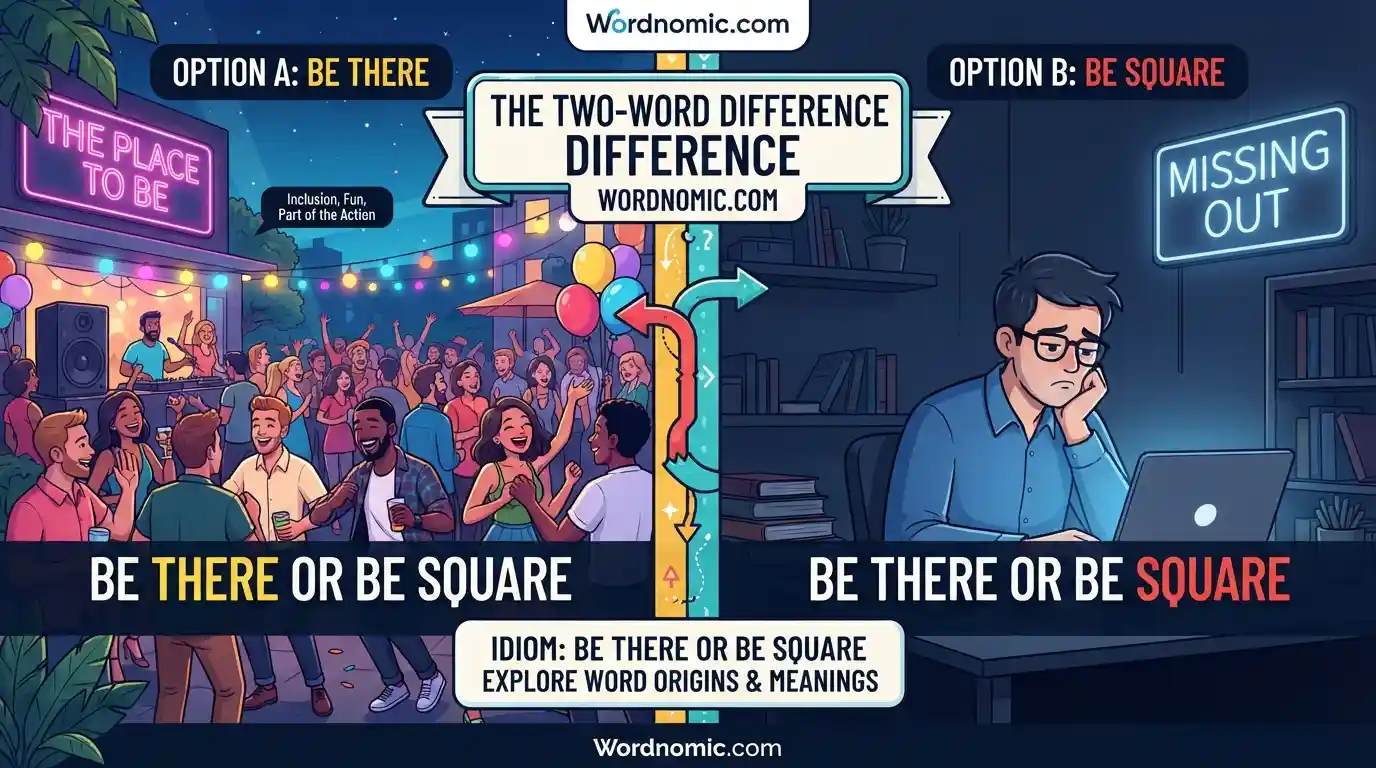
Have you ever received an invitation that says, “Be there or be square”? You may wonder what the word square has to do with a party, a meeting, or a fun event. The phrase can sound strange if you take every word literally.
“Be there or be square” is a playful way to tell someone to attend an event. It suggests that people who do not show up will miss the fun or seem boring and old-fashioned. Friends often use it when inviting others to parties, birthdays, games, or other social events.
The phrase is informal, so it works best with friends and people you know well. It is not a spelling choice like color versus colour. Instead, it is an English idiom with a meaning that goes beyond its individual words.
People search for this phrase to understand its meaning, learn where it came from, or find out how to use it in a sentence. This guide explains the phrase in simple English, shares natural examples, explores its history, and shows when it is suitable to use.
Be There or Be Square: Quick Answer
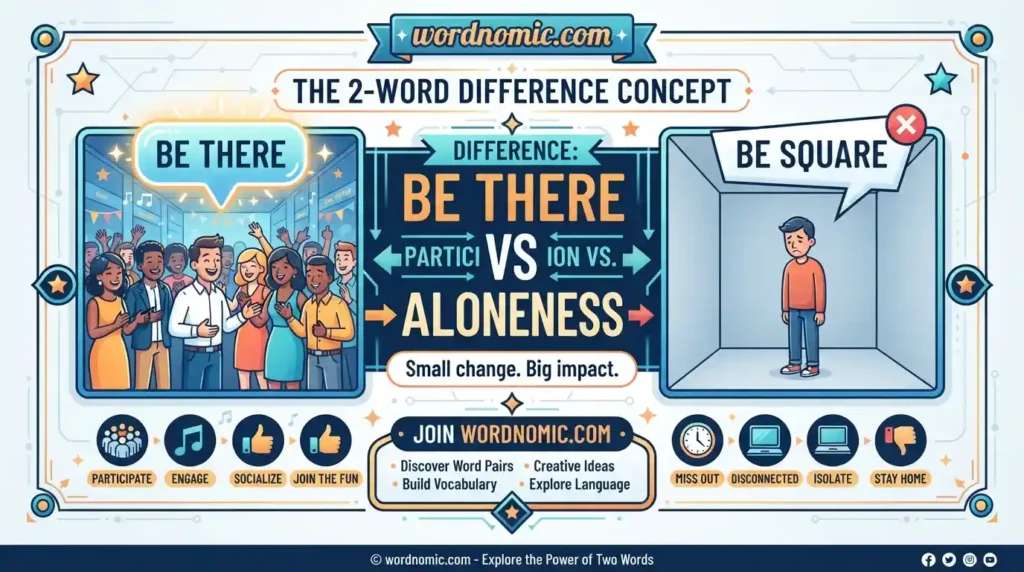
“Be there or be square” means “Come to the event, or you will be considered uncool or boring.” It is a humorous, informal expression used to encourage someone to attend.
For example:
- “My birthday party is on Saturday. Be there or be square!”
- “We are watching the big game tonight. Be there or be square!”
- “The school dance starts at seven. Be there or be square!”
The phrase is not meant to be taken literally. A person will not turn into a square if they miss an event. The word square is old slang for someone seen as dull, conventional, or out of touch with what is popular.
Meaning & Origin Of The Phrase
+1
The rhyme between there and square makes the phrase catchy and easy to remember. It is usually friendly teasing, not a serious warning.
What Does “Be There or Be Square” Mean?
The phrase has two parts, and each part helps explain the full meaning.
What Does “Be There” Mean?
“Be there” means to attend or show up at a place or event.
For example:
- Be there at six.
- I hope you can be there.
- Be there for the team.
In the full phrase, it encourages someone to come and join in the fun.
What Does “Be Square” Mean?
In this expression, square is not a shape with four equal sides. It is an informal slang word for a person who seems boring, old-fashioned, or not interested in new trends.
For example, someone might say, “Don’t be such a square,” to tease a friend who does not want to join an activity.
The word can sound rude in some situations, but in “be there or be square,” it is often used as a joke.
What Does the Full Phrase Suggest?
The full expression puts these ideas together: attend the event and join the fun, or risk being teased for missing out.
For example, if your friend invites you to a game night and says, “Be there or be square,” they are likely trying to make the invitation sound fun and exciting.
You do not need to take the words as an insult. The tone and the relationship between the speakers help show whether the phrase is friendly or unkind.
The Origin of “Be There or Be Square”
The phrase is commonly linked to American slang from the middle of the 20th century, especially the jazz culture of the 1940s and 1950s. However, the exact first use of the full expression is not firmly established.
Meaning & Origin Of The Phrase
+1
To understand its history, it helps to look at the word square.
How “Square” Became Slang
The word square has long referred to a shape. It can also describe something fair, direct, or proper, as in “a square deal.”
But in American slang around the 1940s, square took on another meaning. It could describe someone who did not understand or enjoy the latest music, ideas, or social trends. Jazz fans used it for people they saw as conventional or out of touch.
By the 1950s, the expression “be there or be square” was associated with invitations and social events. Its rhyme made it easy to repeat and helped it spread.
Meaning & Origin Of The Phrase
+1
Why Is There No Clear First Use?
Popular sayings often spread through speech before anyone records them in print. People may use a phrase for years before it appears in a book, newspaper, or dictionary.
For that reason, it is safer to say that the expression became popular around the 1950s than to claim a specific person invented it on a specific day.
The meaning has stayed much the same over time. Today, the phrase can sound playful, nostalgic, or a little old-fashioned, depending on who says it and where it appears.
British English vs American English
“Be there or be square” is most closely linked to American slang, but English speakers in other countries can understand and use it too. The phrase does not have a different spelling in British and American English.
The words there and square stay the same in both varieties. The main difference is cultural: the phrase grew out of American slang, so it may sound more familiar to some American speakers.
| Feature | American English | British English |
| Phrase | Be there or be square | Be there or be square |
| Spelling | Same | Same |
| Meaning | Attend or be seen as uncool | Attend or be seen as uncool |
| Tone | Informal and playful | Informal and playful |
| Best use | Casual invitations | Casual invitations |
You can use the phrase when inviting friends to a party in the United States, the United Kingdom, Canada, Australia, or other English-speaking places.
For formal invitations, however, a clear and polite line is often better. For example, “We hope you can join us” sounds more suitable for a work event than “Be there or be square!”
Which Form Should You Use?
The usual expression is “be there or be square.” Use this wording when you want to invite someone in a playful way.
For Friends and Family
This is where the phrase fits best. It can make an invitation sound lively and fun.
Example: “We’re having a movie night on Friday. Be there or be square!”
For Social Media
You can use it in a post or caption to invite people to a casual event.
Example: “Game night starts at 7 p.m. Be there or be square!”
For School Events
It may work for an informal school dance, club meeting, or game night, depending on the audience.
Example: “The school talent show is on Thursday. Be there or be square!”
For Business and Formal Events
Use care in professional settings. The phrase can sound too casual for a formal invitation, a client email, or an official notice.
Instead of writing “Be there or be square,” you could write:
- “We hope you can attend.”
- “Join us for the event.”
- “We look forward to seeing you there.”
The best choice depends on your audience and the tone you want to set.
Common Mistakes with “Be There or Be Square”
Here are some mistakes to avoid when using or explaining this phrase.
1. Taking the Phrase Literally
Incorrect understanding: A person will become a square if they do not attend.
Correct meaning: The phrase jokingly suggests that someone who misses the event will seem boring or uncool.
2. Using It in Every Formal Invitation
Poor fit: “Dear clients, be there or be square.”
Better: “We invite you to join us for our annual meeting.”
The phrase is informal. A polite invitation is usually better for clients, senior staff, and official events.
3. Thinking It Is a Grammar Rule
The phrase is an idiom, not a special rule about English grammar or spelling. Its meaning comes from common use.
4. Assuming “Square” Always Means Boring
The word square has several meanings. It can refer to a shape, a public open area, or something fair and direct. The meaning “boring or old-fashioned” applies to the slang use in this phrase.
5. Treating It as a Serious Threat
The phrase is usually playful. It does not normally mean someone will face a real punishment for not attending.
6. Changing the Words Without Understanding the Effect
“Be there or be square” is a set phrase. Changing square to another word may remove the rhyme and make the expression less familiar.
7. Assuming It Is Only Used in America
The expression has American roots, but it can be understood and used elsewhere. It is not limited to people in the United States.
“Be There or Be Square” in Everyday Examples
These examples show how people might use the expression in different settings.
In Conversations
- “We’re going bowling tonight. Be there or be square!”
- “The concert starts at eight, so be there or be square.”
- “We’re trying the new café on Sunday. Be there or be square!”
In Text Messages
- “Movie night at my place, 7 p.m. Be there or be square!”
- “Don’t forget the match tomorrow. Be there or be square.”
- “We’re having a game night this weekend. Come join us!”
The final example has a similar purpose but uses a more direct invitation.
On Social Media
- “Birthday party this Saturday. Be there or be square!”
- “The team is meeting at the park at noon. Be there or be square!”
- “Our club’s big event is finally here. Be there or be square!”
In School and Clubs
- “The drama club is putting on a show Friday. Be there or be square!”
- “Join us for the school dance. Be there or be square!”
- “The chess club meets after class. Come along if you can!”
In Work and Formal Writing
- Casual team chat: “We’re grabbing lunch at noon. Be there or be square!”
- Work email: “We hope you can join us for Friday’s team lunch.”
- Formal notice: “All staff are invited to attend the annual meeting.”
The first example uses the idiom in a relaxed setting. The other two show how a more neutral tone can be better at work.
“Be There or Be Square”: Google Trends and Usage Data
People search for this phrase to learn its meaning, understand its history, or check whether it is suitable for an invitation. It also appears in discussions of slang, idioms, old sayings, and casual English.
The phrase is associated with American culture, especially slang from the jazz era of the mid-20th century. It remains recognizable today, although some speakers may find it dated or humorous.
Meaning & Origin Of The Phrase
Is the Phrase More Popular in America?
Its history points to American English, but that alone does not prove that people in the United States search for it more often today. Reliable country-by-country search figures would be needed to make that claim.
Google Trends can compare interest in the phrase across locations and periods. It reports relative search interest rather than exact search counts. Without a specific, verified Trends comparison, it is better not to give invented numbers or rankings.
Where Is the Phrase Used Today?
You may see it in:
- Casual party invitations
- Text messages among friends
- Social media captions
- Retro-themed events
- Explanations of English idioms and slang
It is most useful when the goal is to sound playful rather than formal. If your audience may not know the expression, add a clear invitation so the message is easy to understand.
Comparison Table: Phrase Variations
The standard wording is “be there or be square.” You may see small changes in punctuation or sentence style, but these do not usually change the meaning.
| Phrase or variation | Meaning | Best use |
| Be there or be square! | Come along, or you’ll be seen as uncool | Playful invitation |
| Be there, or be square! | Same meaning, with a pause for emphasis | Casual message |
| Don’t be a square! | Don’t be boring or old-fashioned | Friendly teasing |
| Come if you can! | A simple invitation without teasing | General use |
| Don’t miss out! | Encourages someone to join an event | Casual or promotional writing |
| We hope you can attend. | A polite invitation | Formal writing |
The first version is the familiar idiom. The other phrases are alternatives, not different spellings of the same idiom.
Frequently Asked Questions
1. What does “be there or be square” mean?
It means you should attend an event, or people may jokingly see you as boring or uncool for missing it. Friends often use it to make invitations sound fun. It is not meant to be taken literally, and it usually carries a playful tone rather than a serious warning.
2. Is “be there or be square” an idiom?
Yes. It is an informal idiomatic expression because its full meaning goes beyond the literal meanings of the words. The phrase encourages someone to attend an event and uses square as slang for someone who seems dull or old-fashioned.
3. Where did “be there or be square” come from?
The phrase is commonly linked to American slang from the 1940s and 1950s, especially jazz culture. The slang word square described someone considered conventional or out of touch. The exact first use of the full phrase is uncertain, so it is best not to name a definite inventor.
4. Is “be there or be square” rude?
It is usually meant as friendly teasing, especially among friends. However, the word square can sound insulting if the speaker uses it to mock someone. Consider your audience and relationship before using the phrase.
5. Can I use “be there or be square” in a formal email?
It is usually better to avoid it in formal emails, official invitations, or messages to clients. The phrase is casual and playful. Use a line such as “We hope you can attend” or “We look forward to seeing you there” for a more professional tone.
6. Is “be there or be square” used in British English?
Yes, English speakers in the UK can understand and use the phrase. It has American slang roots, but the spelling and basic meaning remain the same. It is informal in both British and American English.
7. Does “square” mean a shape in this phrase?
No. In this expression, square is slang for someone who seems boring, conventional, or out of touch with trends. The phrase uses this slang meaning for a playful effect. In other contexts, square can still mean a shape or have other meanings.
Conclusion: How to Use “Be There or Be Square”
“Be there or be square” is a catchy, informal phrase that encourages someone to attend an event. It suggests that anyone who misses the fun may be seen as boring or uncool. The expression is usually playful, so it works best among friends, classmates, and people who enjoy casual jokes.
The phrase is linked to American slang from the 1940s and 1950s, when square could describe someone who seemed old-fashioned or out of touch. Its exact origin is not fully known, but its meaning is clear in modern use.
You can use it in text messages, party invitations, social media captions, and casual conversations. The spelling is the same in British and American English. There is no need to treat it as a spelling comparison or a grammar rule.
For professional emails and formal invitations, choose a more polite line, such as “We hope you can join us.” This keeps your message clear and fits the setting.
In short, when someone says “Be there or be square,” they are giving you a fun nudge to show up and join in. You do not need to take the phrase literally. Understand the tone, know your audience, and use it when a little humor fits.

Emily Carter is an English grammar writer based in Portland, Oregon, with 7+ years of experience turning tricky grammar rules into simple, easy lessons.