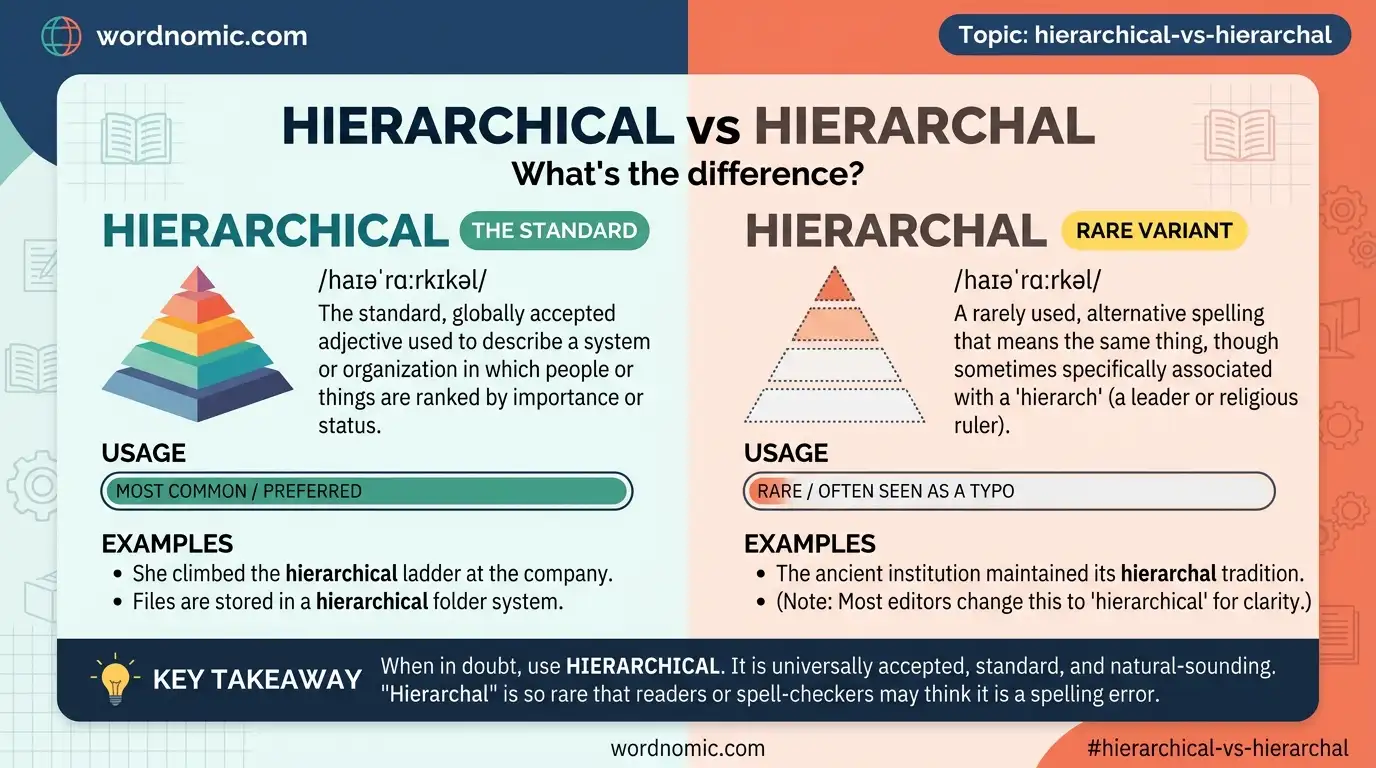
When comparing hierarchical vs hierarchal, the main difference is how commonly each spelling is used. Hierarchical is the standard and widely preferred spelling in modern English. Hierarchal is also a recognized word, but it is much less common.
Both words relate to a hierarchy, which is a system that arranges people, things, or ideas into levels. For example, a company may have workers, managers, and directors at different levels. This type of arrangement can be described as a hierarchical structure.
Although the two spellings have similar meanings, they are not equally common in everyday writing. If you are writing an essay, business report, school assignment, or professional document, hierarchical is usually the safer choice.
This guide explains both spellings, their meanings, how they are used, and how to choose the right word for your sentence.
What Does Hierarchical Mean?
Hierarchical is an adjective that describes something arranged in levels or ranks. These levels may show authority, importance, power, or order.
A hierarchy can include people, ideas, tasks, computer systems, or groups. When something follows this type of arrangement, you can describe it as hierarchical.
For example, a company may have employees at the bottom level, supervisors above them, and senior managers at the top. Each level has its own duties and responsibilities.
You could describe this arrangement as a hierarchical company structure.
Here are a few more examples:
- The school has a hierarchical system of leadership.
- The company uses a hierarchical management structure.
- The website has a hierarchical menu with several levels.
- The report follows a hierarchical order.
- The organization has a clear hierarchical system.
In each sentence, hierarchical describes an arrangement that has different levels.
The word is common in business, education, technology, science, and formal writing. It can also describe how information is organized.
For example, a computer may store files inside folders and subfolders. This creates a structure with different levels. You can describe that arrangement as hierarchical.

What Does Hierarchal Mean?
Hierarchal is a less common adjective with a meaning similar to hierarchical. It relates to a hierarchy or an arrangement based on levels or ranks.
Although the word exists in English, many readers are more familiar with hierarchical. Dictionaries and modern writing often use hierarchical as the main form.
For example, someone might write:
“The organization follows a hierarchal structure.”
The meaning is understandable, but many writers would choose this version instead:
“The organization follows a hierarchical structure.”
The second sentence uses the more familiar and widely accepted form.
You may still see hierarchal in some published texts, older documents, or specialized writing. Its presence does not automatically mean the sentence is incorrect. However, it is less common and may look unusual to some readers.
For most everyday and professional situations, it is better to use hierarchical unless you have a specific reason to keep the alternative spelling.
Hierarchical vs Hierarchal: Key Differences
The two words have closely related meanings, but their use differs.
| Feature | Hierarchical | Hierarchal |
| Part of speech | Adjective | Adjective |
| Meaning | Arranged in levels or ranks | Related to a hierarchy |
| Commonness | Widely used | Much less common |
| Modern writing | Preferred in most situations | Less familiar to many readers |
| Academic writing | Usually the better choice | Use only when appropriate for the source or style |
| Business writing | Standard choice | Uncommon choice |
| Technology writing | Frequently used | Rarely preferred |
| General recommendation | Use in most cases | Recognize it, but use carefully |
The most important point is that the difference is mainly about usage and preference, not a major difference in meaning.
If you want your writing to sound natural to most English readers, choose hierarchical.
Is Hierarchal Incorrect?
Not necessarily. Hierarchal is a real word, so it is not always correct to label it as a spelling mistake.
The problem is that it is much less common than hierarchical. Readers may understand it, but they are more likely to expect the longer form.
Think about the difference between a word that exists and a word that is normally preferred. English has many words that are recognized but rarely used in everyday writing. Knowing these alternatives can help you understand what you read, but it does not mean you should choose them in every sentence.
For example, if you are writing a university assignment about organizational behavior, hierarchical structure is the more familiar expression. It is also the wording most readers will expect.
If you are quoting a book or copying the exact wording of a source that uses hierarchal, you may keep the original spelling. Otherwise, there is usually no reason to choose it over hierarchical.
A useful rule is simple: do not treat hierarchal as automatically wrong, but prefer hierarchical in your own writing.
Examples of Hierarchical in Sentences
The best way to understand a word is to see how people use it in different situations.
Here are examples of hierarchical in everyday and professional English.
1. Business and Management
Businesses often arrange employees according to their roles and authority. This can create a hierarchical structure.
Examples:
- Our company has a hierarchical management system.
- The hierarchical structure places the director above the managers.
- A hierarchical organization may have several levels of leadership.
- Employees must follow the company’s hierarchical reporting system.
- The business changed its hierarchical structure last year.
In these sentences, hierarchical explains how authority or responsibility is arranged.
2. Education
Schools, colleges, and universities may also have levels of authority.
Examples:
- The university has a hierarchical system of administration.
- A hierarchical structure separates teachers, department heads, and senior leaders.
- The school uses a hierarchical approach to decision-making.
- Students learned how hierarchical systems work in society.
The word helps explain the relationship between different roles or levels.
3. Computers and Technology
In technology, information is often arranged in levels. Files, folders, menus, and data systems may follow a hierarchy.
Examples:
- The computer stores files in a hierarchical folder system.
- The website uses a hierarchical navigation menu.
- Developers designed a hierarchical database structure.
- The application organizes information in a hierarchical format.
- The system follows a hierarchical model for managing data.
Here, the word describes how information is grouped and organized.
4. Science and Research
Researchers may use hierarchical models to organize information or study relationships between different levels.
Examples:
- The researchers developed a hierarchical model.
- The report explains the hierarchical classification of the samples.
- The study examines hierarchical relationships between groups.
- The scientist used a hierarchical approach to organize the data.
In research, the exact meaning depends on the subject. However, the basic idea remains an arrangement with levels.
5. Everyday Situations
You do not need to work in an office or study technology to use the word.
Examples:
- The game has a hierarchical ranking system.
- The family discussed its hierarchical traditions.
- The website’s hierarchical menu makes the pages easier to organize.
- The team uses a hierarchical system to assign duties.
- The book explains hierarchical relationships in simple language.
These examples show that hierarchical can describe many kinds of arrangements.
Examples of Hierarchal in Sentences
Although hierarchal is less common, you may encounter it in writing.
Here are examples that show its intended meaning:
- The group followed a hierarchal structure.
- The author described a hierarchal system of leadership.
- The report examined hierarchal relationships within the organization.
- The document discussed a hierarchal arrangement of ideas.
- The researchers studied a hierarchal model of classification.
In these examples, the writer uses hierarchal to describe something related to a hierarchy.
However, if you are creating your own article, report, or assignment, the following versions will generally sound more familiar:
- The group followed a hierarchical structure.
- The author described a hierarchical system of leadership.
- The report examined hierarchical relationships within the organization.
- The document discussed a hierarchical arrangement of ideas.
- The researchers studied a hierarchical model of classification.
The meanings remain similar, but the preferred spelling changes.
These examples are intended to demonstrate how the less common word may be used. They do not suggest that hierarchal is the best choice for every context.
Why Is Hierarchical More Common?
One reason is established usage. Hierarchical is the familiar adjective formed from hierarchy, and it appears widely in modern writing.
You will often see it in dictionaries, educational materials, research papers, business documents, and technical explanations.
For example, writers commonly use expressions such as:
- Hierarchical structure
- Hierarchical organization
- Hierarchical model
- Hierarchical classification
- Hierarchical system
- Hierarchical database
These expressions are easy for many readers to recognize.
By comparison, hierarchal appears less often in ordinary modern English. Because readers see it less frequently, some may assume it is a typo.
That does not prove the word is invalid. It simply means that the longer spelling is the more practical choice for clear communication.
When two words have similar meanings, their frequency and familiarity can matter. Choosing the more common form helps readers understand your writing without stopping to question the spelling.
Hierarchy, Hierarchical, and Hierarchically
Understanding the related word forms can make the difference easier to remember.
Hierarchy
Hierarchy is a noun. It refers to a system in which people, objects, or ideas are arranged into levels.
Example: “The company has a clear hierarchy.”
Here, hierarchy names the system itself.
Hierarchical
Hierarchical is an adjective. It describes something that follows or relates to a hierarchy.
Example: “The company has a hierarchical structure.”
Here, hierarchical describes the structure.
Hierarchically
Hierarchically is an adverb. It describes how something is arranged or organized.
Example: “The files are organized hierarchically.”
Here, hierarchically explains how the files are organized.
You can remember the relationship this way:
| Word | Word type | Example |
| Hierarchy | Noun | The hierarchy is clear. |
| Hierarchical | Adjective | It is a hierarchical system. |
| Hierarchically | Adverb | The information is arranged hierarchically. |
Learning these three forms is more useful than memorizing the alternative spelling alone.
Common Mistakes to Avoid
Writers sometimes confuse hierarchical and hierarchal because the words look similar. A few simple habits can help you avoid mistakes.
Mistake 1: Assuming Both Forms Are Equally Common
The words have similar meanings, but they are not equally common.
Better approach: Use hierarchical in normal writing unless a reliable source or specific style guide gives you a reason to use hierarchal.
Mistake 2: Using Hierarchal in Formal Writing Without Checking
A reader may understand hierarchal, but it can look unusual in a formal report or academic assignment.
Better approach: Review the sentence and replace it with hierarchical if you are not following a particular source’s wording.
Mistake 3: Confusing Hierarchy With Hierarchical
These words are related, but they have different grammatical roles.
Incorrect: “The company has a hierarchical of managers.”
Correct: “The company has a hierarchy of managers.”
Also correct: “The company has a hierarchical management structure.”
Use hierarchy when you need a noun. Use hierarchical when you need an adjective.
Mistake 4: Adding Unnecessary Words
Sometimes a sentence becomes harder to read because the writer uses a complex expression when a simple one would work.
For example:
“The organization has a hierarchical arrangement of management authority.”
A clearer version might be:
“The organization has a hierarchical management structure.”
Choose the wording that explains your meaning with the least effort.
Mistake 5: Changing a Direct Quote
If you quote a book, article, or historical document, do not silently change its wording just because it uses hierarchal.
Better approach: Keep the original spelling in a direct quotation. In your own explanation, use hierarchical when it fits.
Should You Use Hierarchical or Hierarchal in Academic Writing?
For most academic writing, hierarchical is the better choice.
University essays, research papers, reports, and dissertations need clear and consistent language. Using a familiar spelling helps readers focus on your ideas instead of questioning your word choice.
Consider these examples:
- “The researchers used a hierarchical model to study the results.”
- “The theory describes a hierarchical relationship between the groups.”
- “The paper explains the hierarchical structure of the system.”
These sentences use the standard, widely recognized form.
If you are editing a paper written by someone else, check whether the spelling is part of a direct quotation. You should not change quoted wording without following the rules for editing quotations.
If you are following a journal’s style guide, use its preferred terminology consistently. However, unless the guide or source requires otherwise, hierarchical is the sensible default.
Is Hierarchical Used in British and American English?
Hierarchical is used in both British and American English. It is a standard spelling in both varieties.
There is no general rule that says British writers should use hierarchal while American writers should use hierarchical. That is not a reliable way to decide between the two.
For example, both British and American writers can say:
- A hierarchical organization
- A hierarchical structure
- A hierarchical system
- A hierarchical model
If you are writing for a British or American audience, you can normally use hierarchical without changing the spelling.
The important distinction is the difference in commonness between the two forms, not a simple British-versus-American spelling rule.
A Simple Way to Remember the Correct Spelling
If you often forget which spelling to use, connect the adjective to the noun hierarchy.
The noun is hierarchy, and the standard adjective is hierarchical.
You can remember the word family like this:
- Hierarchy: the system
- Hierarchical: describing the system
- Hierarchically: describing how something is arranged
For example:
“The hierarchy has three levels.”
“The company has a hierarchical structure.”
“The employees are organized hierarchically.”
This small pattern can help you choose the correct form when writing quickly.
You can also use a simple editing trick. When you type hierarchal, pause and ask whether hierarchical would sound more familiar in the sentence. In most ordinary writing, it will be the better option.
Frequently Asked Questions
1. Is hierarchical or hierarchal correct?
Both spellings are recognized, but hierarchical is the standard and much more common choice in modern English. Use it for most school, work, academic, and everyday writing.
2. Is hierarchal a real word?
Yes. Hierarchal is a recognized but less common adjective related to a hierarchy. Its meaning is similar to hierarchical, although it is not the form most writers usually choose.
3. Do hierarchical and hierarchal mean the same thing?
They have very similar meanings. Both relate to a hierarchy or an arrangement based on levels or ranks. The main difference is that hierarchical is much more widely used.
4. Which spelling should I use in a school assignment?
Use hierarchical unless your teacher, textbook, or assigned source specifically requires another form. It is the more familiar spelling and is suitable for formal writing.
5. Which spelling is better for business writing?
Hierarchical is the better choice for business writing. Phrases such as “hierarchical structure” and “hierarchical management system” are common and clear.
6. Is hierarchical used in both British and American English?
Yes. Hierarchical is used in both varieties of English. You do not need to choose hierarchal based on whether your audience is British or American.
7. What is the noun form of hierarchical?
The noun form is hierarchy. For example, “The company has a clear hierarchy.” The adjective is hierarchical, as in “The company has a hierarchical structure.”
8. What is the adverb form of hierarchical?
The adverb is hierarchically. For example, “The information is organized hierarchically.” It describes how something is arranged according to levels.
9. Why does hierarchal look like a spelling mistake?
It looks unusual because it is much less common than hierarchical. Readers are more familiar with the longer spelling. However, hierarchal is recognized as an alternative form, so it is not automatically a typo.
10. Can I replace hierarchal with hierarchical?
In most sentences, yes. Since the meanings are very similar, replacing hierarchal with hierarchical will usually make the wording more familiar. Be careful when editing direct quotations or following a specific source’s terminology.
Final Verdict: Hierarchical vs Hierarchal
When choosing between hierarchical and hierarchal, the simplest rule is to use hierarchical in most situations.
Hierarchical is the widely preferred adjective for describing systems, organizations, relationships, or information arranged in levels. It works well in academic papers, business documents, technology articles, and everyday writing.
Hierarchal is also a recognized word, but it is much less common. You may encounter it in published writing, but there is usually no need to choose it when writing your own sentences.
Remember the difference this way: hierarchical is the standard choice, while hierarchal is a less common alternative.

Emily Carter is an English grammar writer based in Portland, Oregon, with 7+ years of experience turning tricky grammar rules into simple, easy lessons.










