
Creatine is a popular supplement for people who want to build muscle, improve strength, and get more from their workouts. But one question often causes confusion: should you take creatine before or after a workout?
The good news is that you do not need to worry too much about the exact time. For most healthy adults who use creatine monohydrate, taking it consistently each day matters more than choosing a perfect minute before or after exercise. Research has not clearly shown that one timing option is best for long-term muscle growth and strength.
You can take creatine before your workout if that fits your routine. You can also take it after training, perhaps with your meal or protein shake. Both are practical options.
However, timing is only one part of using creatine well. The type of creatine, daily amount, regular use, exercise plan, and overall diet also matter. It is also useful to know what creatine can and cannot do.
This guide explains when to take creatine, how much to use, whether you should take it on rest days, and which common mistakes to avoid. It also covers basic safety advice so you can make a more informed choice.
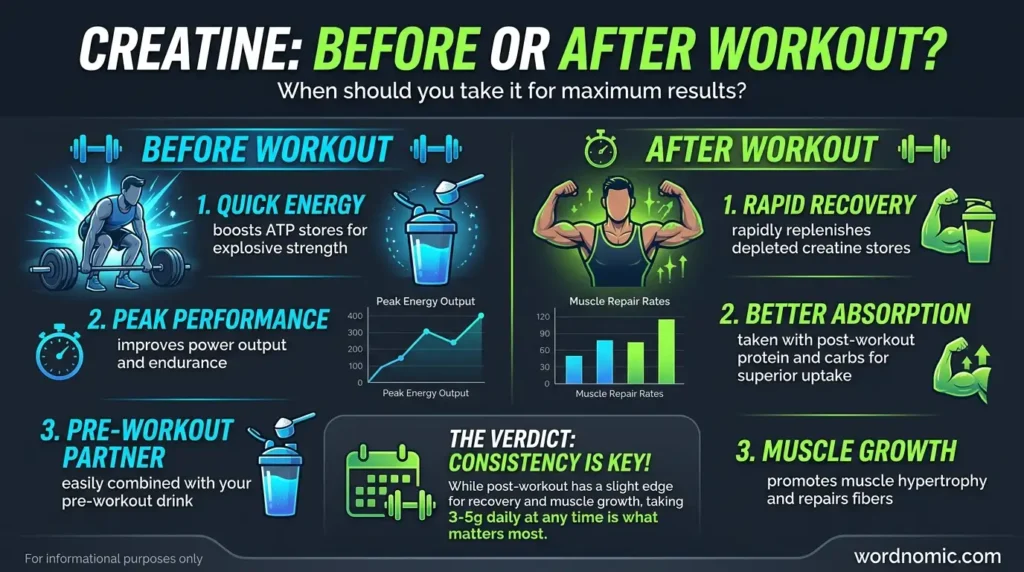
Creatine Before or After Workout: Quick Answer
You can take creatine before or after your workout. Neither option has been proven clearly superior for long-term muscle growth and strength.
For most healthy adults:
- Common daily amount: 3 to 5 grams of creatine monohydrate.
- Before a workout: A convenient option if you prefer taking it before training.
- After a workout: A convenient option with a meal or shake.
- On rest days: Continue taking your usual daily amount.
- Main goal: Take it regularly instead of worrying about exact timing.
Creatine works by increasing the amount of creatine stored in your muscles over time. It is not like caffeine, which people often take shortly before exercise for its immediate stimulating effect.
If you want one simple routine, take 3 to 5 grams every day at a time you can remember. Follow the product label, and ask a health professional for advice if you have a medical condition or take medicines that may affect your kidneys.
What Is Creatine?
Creatine is a substance your body makes naturally. You also get some creatine from foods such as meat and fish. Most of the creatine in your body is stored in your muscles.
Your muscles use energy during exercise. Creatine helps them quickly replace a small amount of energy called ATP. This is useful during short, hard efforts, such as lifting weights, sprinting, or performing repeated intense movements.
Creatine supplements can help some people improve strength, power, and their ability to perform repeated high-intensity exercise. When combined with regular strength training, creatine may also support increases in muscle mass over time.
However, creatine is not a magic muscle-building product. It does not replace a good training plan, enough food, protein, sleep, or recovery.
The most researched form is creatine monohydrate. It is generally the first option to consider when choosing a creatine supplement because there is strong research behind it.
Should You Take Creatine Before a Workout?
Taking creatine before exercise is a reasonable choice. Some people prefer it because it fits into their pre-workout routine.
You might mix your daily creatine serving with water and drink it before going to the gym. You can also take it with a snack or meal if that works better for you.
But there is one important point: creatine does not work like an instant energy drink. Taking it just before your first set does not mean you will suddenly feel stronger. Its main benefit comes from building up creatine stores in your muscles through regular use.
Benefits of Taking Creatine Before Exercise
Taking creatine before a workout may offer these practical benefits:
- It can be easy to remember if you already have a pre-workout routine.
- You can mix it into a drink you already have before training.
- It lets you take your daily amount before leaving home or going to the gym.
These are mainly benefits of convenience. They do not prove that pre-workout timing produces better long-term results.
A small 2026 pilot study reported better performance in some strength exercises when physically active men took a single dose of creatine before training. However, that study looked at short-term performance in a limited group. It does not establish that taking creatine before every workout leads to better long-term muscle growth than taking it afterward.
How Long Before a Workout Should You Take Creatine?
There is no proven time window that everyone needs to follow.
Some supplement labels suggest taking creatine 30 minutes before exercise. However, that does not mean 30 minutes is the ideal time for everyone or that waiting longer will reduce your results.
If you like taking it before training, choose a time that fits your schedule. If taking it on an empty stomach makes you feel uncomfortable, try taking it with food or use a different time of day.
The most useful habit is to take your normal daily amount consistently.
Should You Take Creatine After a Workout?
Taking creatine after exercise is also a good option. Many people take it with their post-workout meal, protein shake, or other daily supplements.
The main advantage is convenience. If you already eat or drink something after training, you can add your creatine to that routine.
Research has compared taking creatine before and after resistance training, but the evidence is limited. One eight-week study involving 34 trained athletes compared 5 grams of creatine before exercise with the same amount after exercise. It did not establish a clear, universal winner for strength and body-composition results.
Benefits of Taking Creatine After Exercise
Taking creatine after your workout may be useful because:
- You can take it with a meal or shake.
- It can fit easily into your daily routine.
- It may be easier to remember if you already have a post-workout habit.
- You do not need to rush to take it immediately after your final exercise.
You do not have to drink a protein shake to take creatine. Water is fine, too. A balanced diet and enough protein can support muscle growth, but the supplement does not have to be mixed with protein powder.
How Soon After a Workout Should You Take Creatine?
You do not need to take creatine the second you finish exercising. There is no strong evidence that missing a short post-workout window will ruin your results.
Take it after training if that is the easiest option for you. If you forget and take it later in the day, you can still maintain your regular routine.
For most people, a consistent daily habit is more useful than trying to time every serving perfectly.
Creatine Before vs After Workout: Main Differences
The two options are very similar when you use the same daily amount.
| Feature | Before workout | After workout |
| When to take it | Before training | After training |
| Common daily amount | 3 to 5 grams | 3 to 5 grams |
| Long-term muscle benefits | Can support training when used regularly | Can support training when used regularly |
| Proven overall winner | No clear winner | No clear winner |
| Easy routine | With your pre-workout drink or snack | With a meal or shake |
| Must be taken immediately? | No | No |
| Needed on rest days? | Yes, keep your daily routine | Yes, keep your daily routine |
The key difference is when you take it, not a proven difference in results. Choose the option that makes it easiest to take your daily serving.
How Much Creatine Should You Take Each Day?
For many healthy adults, 3 to 5 grams of creatine monohydrate per day is a common maintenance amount. This range is supported by sports-nutrition research.
You do not need to take a different amount before and after training. If your normal daily serving is 5 grams, taking 5 grams before your workout and another 5 grams afterward would give you 10 grams that day. Do not double your serving just because you want to use both timings.
Check the serving size on your product label. A scoop does not always equal the same amount across different brands.
Do You Need a Creatine Loading Phase?
A loading phase is an optional method some people use to increase muscle creatine stores more quickly. It often involves taking around 20 grams per day, divided into smaller servings, for 5 to 7 days, followed by a lower daily amount.
A loading phase is not required. You can start with a regular daily amount of 3 to 5 grams. This approach increases muscle creatine stores more gradually over several weeks.
If you choose to load, follow reliable professional guidance and the product directions. Larger amounts may cause stomach discomfort in some people. There is no need to load if a gradual approach suits you better.
Should You Take Creatine on Rest Days?
Yes, if you have chosen to use creatine daily, keep taking it on rest days.
Your muscles do not stop storing creatine just because you are not at the gym. Taking it on days without training helps you keep your routine steady.
For example, if you take 5 grams each day, you could follow this simple schedule:
| Day | Example routine |
| Monday | 5 grams with breakfast or around your workout |
| Tuesday | 5 grams before or after training |
| Wednesday | 5 grams with a meal on your rest day |
| Thursday | 5 grams before or after training |
| Friday | 5 grams at a convenient time |
| Saturday | 5 grams with a meal or drink |
| Sunday | 5 grams on your rest day |
This is only an example, not a personal medical prescription. The important point is that your usual daily amount does not need to change just because you are resting.
If you miss a dose, do not take extra servings to make up for it. Simply return to your normal schedule.
Does Creatine Work Immediately?
No. Creatine is not usually noticeable like a stimulant that you feel shortly after taking it.
Its main effect comes from increasing the amount stored in your muscles. With regular use, this can help support repeated high-intensity efforts and strength training. The time it takes to build up stores depends on your daily amount, whether you use a loading phase, and your starting muscle creatine levels.
Some people notice an increase in body weight after starting creatine. This can happen because muscles hold more water. An early increase on the scale does not automatically mean you have gained body fat.
Creatine also does not replace exercise. If you take it but do not follow a suitable training plan, you should not expect it to build significant muscle by itself.
Which Type of Creatine Should You Choose?
For most people looking for a well-studied option, creatine monohydrate is the sensible starting point.
It is the most widely studied form, and research supports its use for improving performance in repeated, high-intensity exercise.
You may see other forms sold with claims that they work faster or are better absorbed. Do not assume a more expensive form is more effective simply because its label sounds advanced.
When choosing a product, look for:
- Creatine monohydrate as the listed ingredient.
- A clearly stated amount per serving.
- A reputable manufacturer.
- Independent quality testing where available.
- No unnecessary ingredients that you do not want or need.
A simple product is often easier to use consistently than a complex blend.
Common Mistakes When Taking Creatine
A few common mistakes can make creatine use confusing. Avoid these simple errors.
1. Thinking Timing Matters More Than Daily Use
Mistake: Believing creatine only works if you take it immediately before or after exercise.
Better approach: Take your usual amount each day. Choose a time that fits your schedule.
Why it matters: Creatine builds up in muscle over time. A perfect timing routine is less important than regular use.
2. Taking Too Much
Mistake: Taking one serving before training and another after training because you think both are necessary.
Better approach: Follow your chosen daily amount and product directions. For many healthy adults, 3 to 5 grams daily is a common maintenance amount.
More is not automatically better, and larger servings can cause stomach problems.
3. Stopping on Rest Days
Mistake: Taking creatine only when you go to the gym.
Better approach: If you use it daily, keep taking your usual amount on rest days.
This helps maintain a consistent routine even when you are not training.
4. Expecting Instant Muscle Growth
Mistake: Expecting creatine to produce visible muscle growth after one serving.
Better approach: Combine regular use with suitable exercise, enough food, and enough rest.
Creatine can support training, but it does not replace the work needed to build muscle.
5. Buying a Product Only Because of Its Claims
Mistake: Assuming every product marketed as advanced or fast-acting is better than basic creatine.
Better approach: Consider plain creatine monohydrate first. Look for clear serving information and reliable quality testing.
6. Ignoring Stomach Discomfort
Mistake: Continuing to take a serving that causes ongoing stomach upset.
Better approach: Consider taking it with food and check that you are following the recommended amount. If symptoms continue, stop using it and seek advice from a health professional.
7. Ignoring Health Conditions
Mistake: Assuming a supplement is suitable for everyone because it is widely used.
Better approach: Speak with a health professional before using creatine if you have kidney disease, another significant medical condition, or take medicines that may affect kidney function. The advice may differ for people with specific health needs.
Real-Life Examples: When Should You Take Creatine?
The best timing is often the one that fits your daily habits.
If you train in the morning: You can take creatine with breakfast or before training if that is convenient.
If you train in the evening: You can take it after your workout with dinner, or earlier in the day.
If you already drink a protein shake: You can mix your daily creatine serving into the shake if the product instructions allow it.
If you train without eating first: You can take creatine with water, but consider having food if taking it on an empty stomach causes discomfort.
If you miss your usual pre-workout dose: You can take your normal serving later in the day. Do not double the amount to make up for a missed dose.
If you do not train that day: Take your usual daily serving at a convenient time.
These examples show why a strict before-or-after rule is not necessary for most users.
Is Creatine Safe?
Research supports the use of creatine monohydrate for many healthy adults when they take suitable amounts. However, no supplement is right for everyone.
Possible effects include:
- Weight gain due to increased water retention.
- Nausea or other stomach discomfort.
- Diarrhea, especially with larger servings.
The US National Institutes of Health notes that creatine can support certain types of exercise performance and that water retention is a common reason for weight gain.
Use the product as directed and maintain normal, adequate fluid intake, especially when you exercise or sweat heavily. You do not need to force excessive amounts of water.
If you have kidney disease, are pregnant or breastfeeding, are under 18, or take medicines that may affect your kidneys, seek advice from a qualified health professional before using creatine. People in these groups may need different guidance.
Creatine can also affect blood creatinine measurements, which doctors sometimes use when checking kidney function. Tell your health professional that you take creatine so they can interpret your results in context. Do not ignore an abnormal test result or assume it is harmless without medical advice.
Related Questions About Creatine Timing
Is it better to take creatine before or after a workout for muscle growth?
There is no clear evidence that one timing option consistently produces better long-term muscle growth. Taking creatine regularly, following a strength-training plan, eating enough protein and calories, and getting enough sleep are more important factors to focus on.
Can I take creatine without working out?
You can take creatine without training, but the benefits for muscle strength and growth are closely linked to exercise. If you are not exercising, do not expect creatine alone to build significant muscle. Ask a health professional whether supplementation makes sense for your goals.
Can I take creatine with protein powder?
Yes. Many people mix creatine monohydrate with a protein shake. You can also take it with water or another suitable drink. A protein shake is not required for creatine to work, so choose the method that fits your diet and routine.
Should I take creatine before cardio or weight training?
Creatine is best supported by evidence for repeated, high-intensity exercise, such as weightlifting and sprinting. It may offer less benefit for steady endurance exercise. If your routine includes both cardio and weights, you can still take your normal daily amount at a convenient time.
What happens if I forget to take creatine for one day?
Missing one serving is not usually a reason to worry. Return to your normal routine the next day. Do not take extra servings to make up for the missed dose. Consistency over time matters more than being perfect every single day.
Can I take creatine at night?
Yes. There is no strong evidence that you must avoid taking creatine at night. If an evening dose fits your schedule and does not cause discomfort, it can be a practical option. The most important thing is to follow your normal daily amount.
Do I need to take creatine with food?
No. You can take creatine with water or with food. If it upsets your stomach when taken alone, try taking it with a meal. There is no need to buy a special drink or supplement just to take creatine.
Conclusion: Creatine Before or After Workout?
When deciding whether to take creatine before or after a workout, either option is reasonable for most healthy adults. Current evidence does not establish one timing choice as the clear winner for long-term muscle growth and strength.
Taking creatine before exercise may fit your pre-workout routine. Taking it afterward may be easier if you already have a meal or protein shake. You can also take it at another time of day if that helps you stay consistent.
For many healthy adults, 3 to 5 grams of creatine monohydrate daily is a common maintenance amount. Continue your usual routine on rest days, too. A loading phase is optional, not required.
Remember that creatine supports your training. It cannot replace a good exercise plan, a balanced diet, enough protein, or proper sleep. Choose a well-studied product, follow its directions, and seek professional advice if you have a medical condition or take medicines that may affect your kidneys.
The simplest rule is to stop worrying about the perfect minute. Choose a convenient time, take your usual amount consistently, and focus on training well.