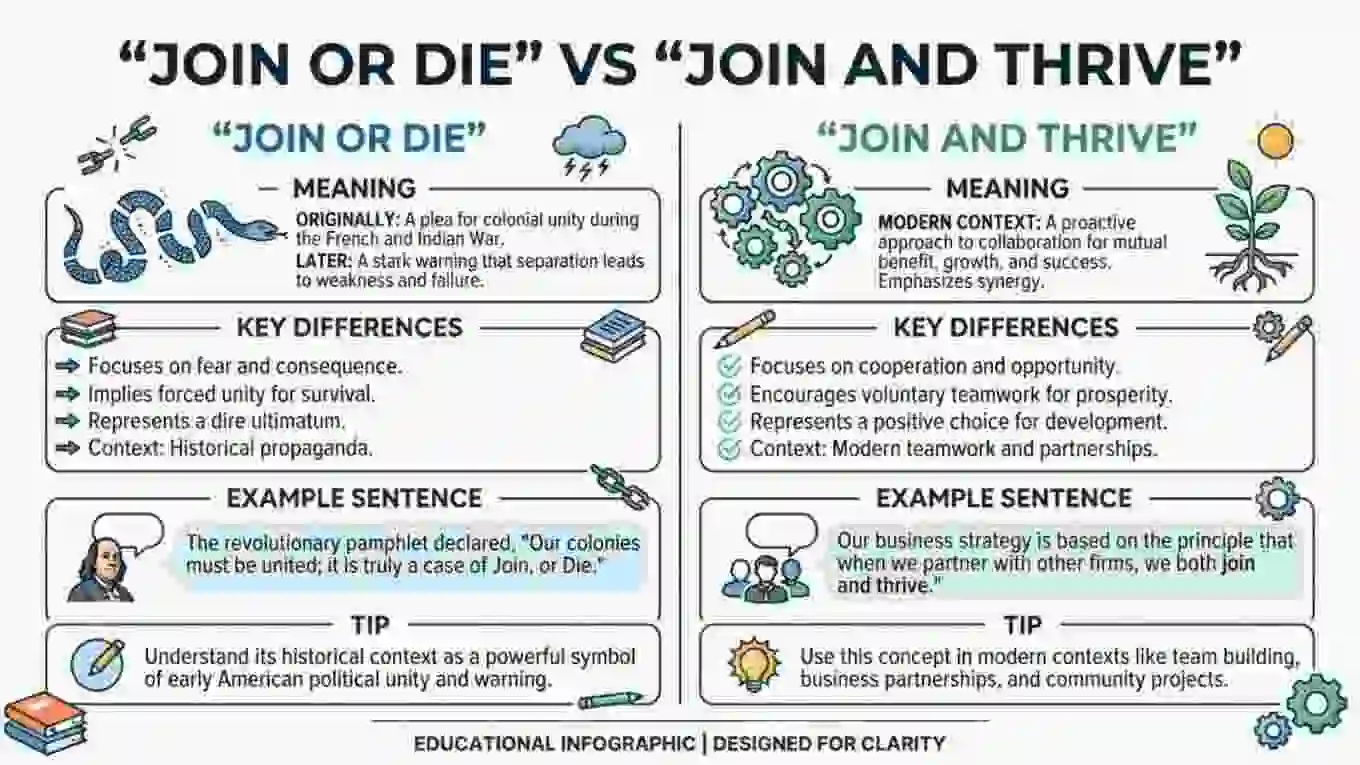
The phrase join or die is short, powerful, and easy to remember. You may have seen it in history books, political writing, school lessons, or online posts. But what does join or die really mean? Is it a normal phrase, a slogan, or a historical message?
Join or Die is a famous political slogan linked to Benjamin Franklin and the American colonial period. It first appeared in a 1754 political cartoon that showed a snake cut into parts. Each part represented a colony. The message was simple: the colonies needed to join together for safety and strength. If they stayed apart, they could face serious danger.
People often search for join or die because they want to know its meaning, history, symbol, or connection to American history. Some also see the phrase in games, books, clothing, or modern political content.
This guide explains join or die in simple words. You will learn where it came from, what it means, how to use it today, common mistakes, and why the phrase remains well known.
Join or Die – Quick Answer
Join or Die is a famous historical slogan that means people must unite or face serious danger or failure.
The phrase became famous because of a political cartoon published by Benjamin Franklin in 1754.
The cartoon showed a snake divided into sections. Each section stood for a British American colony.
The message was:
Join together, or face danger alone.
What does “join or die” mean?
In simple words:
Work together, or you may fail.
The word join means to come together or unite.
The word die means to stop living. In the historical slogan, it carried a strong warning about danger and survival.
Example
The leaders used the words Join or Die to call for unity among the colonies.
Today, people may also use the phrase in a wider way:
We need to join or die if we want to beat the competition.
In modern use, die may be used as a dramatic way to mean fail, lose, or face serious trouble.
The Origin of Join or Die
The phrase Join or Die has an important place in American history.
Benjamin Franklin published the famous “Join, or Die.” cartoon in his newspaper, the Pennsylvania Gazette, on May 9, 1754. The cartoon showed a snake divided into sections. Each section represented one or more British American colonies.
Franklin used the image during a time of growing conflict between Britain and France in North America.
The conflict soon became part of the French and Indian War.
Franklin wanted the colonies to understand the value of working together. His message was that separate colonies were weaker than united colonies.
The snake symbol
The snake was not shown as one complete animal.
Instead, it was divided into pieces.
Each section had letters linked to colonies.
The basic idea was:
Separate parts = weak
United parts = strong
The cartoon became one of the earliest and best-known examples of political cartooning in British America.
Why was the phrase important?
At the time, the colonies did not act as one united country.
They had their own governments and interests.
Franklin wanted them to work together for defense.
Years later, the slogan became connected with the growing idea of colonial unity during the American Revolution. The image was reused in newspapers and other political material.
So, Join or Die is much more than a short phrase. It became a symbol of unity in early American history.
British English vs American English Spelling
There is no British vs American spelling difference in join or die.
Both British English and American English use the same words:
Join or Die
The words join and die have the same spelling in both forms of English.
| English Type | Correct Form | Different Spelling? |
| American English | Join or Die | No |
| British English | Join or Die | No |
| Canadian English | Join or Die | No |
| Australian English | Join or Die | No |
| Global English | Join or Die | No |
Capitalization can change
You may see:
- Join or Die
- join or die
- Join, or Die
- Join, or Die.
The famous historical slogan is often written as Join, or Die.
Modern writers may leave out the comma:
Join or Die
Both forms can appear, depending on the source and style.
The spelling itself does not change.
Which Spelling Should You Use?
If you are writing about the famous historical slogan, the safest form is:
Join or Die
If you are quoting or discussing the original slogan, you may also see:
Join, or Die.
For US readers
Use Join or Die when writing a modern title or heading.
For a history article, you can explain that Franklin’s original slogan appeared as “Join, or Die.”
For UK readers
The same spelling works:
Join or Die
There is no British version such as joine or another spelling.
For global readers
Use Join or Die because it is easy to understand and closely matches the well-known historical name.
Should “Join” and “Die” be capitalized?
For a title:
Join or Die
For normal sentence use:
The phrase “join or die” became a call for unity.
Both styles are fine when used for the right purpose.
Common Mistakes with Join or Die
Mistake 1: Changing the spelling
Some people may think the phrase has a British or American spelling difference.
It does not.
❌ Joine or Die
✅ Join or Die
Mistake 2: Thinking it only means death
The historical phrase uses die as a strong warning.
Franklin’s message was about the danger of remaining divided.
So the deeper meaning is:
Unite for safety and strength.
Mistake 3: Thinking Franklin created the idea of unity from nothing
The phrase appeared during a specific historical conflict.
Franklin used the slogan to encourage the American colonies to work together against a common threat.
Mistake 4: Using the phrase without context
Today, join or die can sound very strong.
In a history article, it clearly connects to colonial unity.
In a casual conversation, it may sound dramatic or humorous.
Mistake 5: Confusing the slogan with a normal instruction
Join or Die is not usually a normal instruction such as:
Join the meeting at 5 PM.
It is a slogan with a strong message.
Join or Die in Everyday Examples
Although Join or Die began as a historical political slogan, people still use it today.
In History Articles
Benjamin Franklin used the Join or Die cartoon to encourage colonial unity.
This is the most common educational use.
In News Writing
The old Join or Die image has appeared again in discussions about political unity.
This use connects a modern issue with American history.
On Social Media
We have to work together. Join or Die!
Here, the phrase may be used in a dramatic or humorous way.
In Speeches
Our message is simple: join or die as a movement.
This uses the phrase as a strong call for unity.
In Formal Writing
The Join or Die cartoon became an important symbol of colonial unity.
This is a good style for school essays and history papers.
In Modern Culture
The phrase has appeared in books, games, artwork, clothing, websites, and political messages.
Its meaning can change with the context.
The historical meaning remains tied to unity, cooperation, and survival.
Join or Die – Google Trends & Usage Data
Search interest for join or die is closely linked to history, politics, education, and popular culture.
Unlike a spelling pair such as bear vs bare, this keyword is not mainly searched because people are unsure about spelling.
People usually search join or die because they want to learn:
- What does Join or Die mean?
- Who created Join or Die?
- What does the snake represent?
- Why did Benjamin Franklin use it?
- What does the Join or Die cartoon mean?
- When was Join or Die created?
- How is Join or Die connected to the American Revolution?
Search interest in the United States
The phrase has strong historical relevance in the United States because it is linked to Benjamin Franklin, the colonies, the French and Indian War, and the American Revolution.
Students may search for it while studying US history.
Search interest in other countries
People outside the US may search the phrase when studying:
- American history
- political cartoons
- colonial history
- Benjamin Franklin
- the American Revolution
Search context
The keyword often appears in these areas:
| Context | Why People Search |
| US History | Learn about colonial unity |
| Benjamin Franklin | Learn about Franklin’s cartoon |
| Political Cartoons | Understand the snake image |
| American Revolution | Study early calls for unity |
| School Work | Find a simple explanation |
| Popular Culture | Understand modern references |
Search interest can also rise when the phrase appears in current political or cultural discussions.
Because Google Trends numbers change over time, exact search levels should be checked for the specific country and date range you are targeting.
Join or Die: Comparison Table
| Version | Meaning | Correct? | Common Use |
| Join or Die | Unite or face serious danger | ✅ | Modern and historical use |
| Join, or Die | Historical slogan form | ✅ | Franklin’s slogan |
| join or die | Same phrase in lowercase | ✅ | Normal sentence use |
| Join and Die | Changes the meaning | ❌ | Not the original slogan |
| Joine or Die | Incorrect spelling | ❌ | Spelling mistake |
| Join or Dye | Wrong word | ❌ | Spelling mistake |
The key point is simple:
Join or Die is the standard modern form.
Join, or Die is the famous historical form connected with Franklin’s 1754 cartoon.
FAQs About Join or Die
1. What does Join or Die mean?
Join or Die means that people should unite and work together or face serious danger, weakness, or failure.
2. Who created Join or Die?
Benjamin Franklin published the famous Join, or Die political cartoon in 1754.
3. What does the Join or Die snake represent?
The divided snake represented the British American colonies. The separate sections showed the need for the colonies to unite.
4. When was Join or Die created?
The famous cartoon was published in 1754, before the American Revolution.
5. Is Join or Die a political slogan?
Yes. It began as a political message calling for unity among the colonies.
6. Is Join or Die still used today?
Yes. People still use the phrase in history, politics, popular culture, games, artwork, and social media.
7. Is there a British spelling of Join or Die?
No. Join or Die has the same spelling in British and American English.
8. What is the main lesson of Join or Die?
The main lesson is:
People are stronger when they work together.
9. Why did Benjamin Franklin use a snake?
Franklin used a divided snake as a visual way to show the colonies as separate parts. The image made his message of unity easy to understand.
Conclusion
The phrase Join or Die is one of the best-known slogans from early American history. Benjamin Franklin used the message in a famous political cartoon in 1754. The cartoon showed a snake divided into sections, with each section linked to British American colonies. The image called for the colonies to unite for safety and strength.
The phrase has no British or American spelling difference. Join or Die works in both forms of English. You may also see the historical form Join, or Die.
Today, the phrase can have a wider meaning. It can describe the need to work together, support a group, or act as one. The word die makes the slogan sound strong, so modern writers should use it with care.
If you are writing about Benjamin Franklin or American history, Join or Die is the clear and correct form. Remember its simple message:
Stay divided, and you may be weak. Join together, and you are stronger.

Emily Carter is an English grammar writer based in Portland, Oregon, with 7+ years of experience turning tricky grammar rules into simple, easy lessons.










