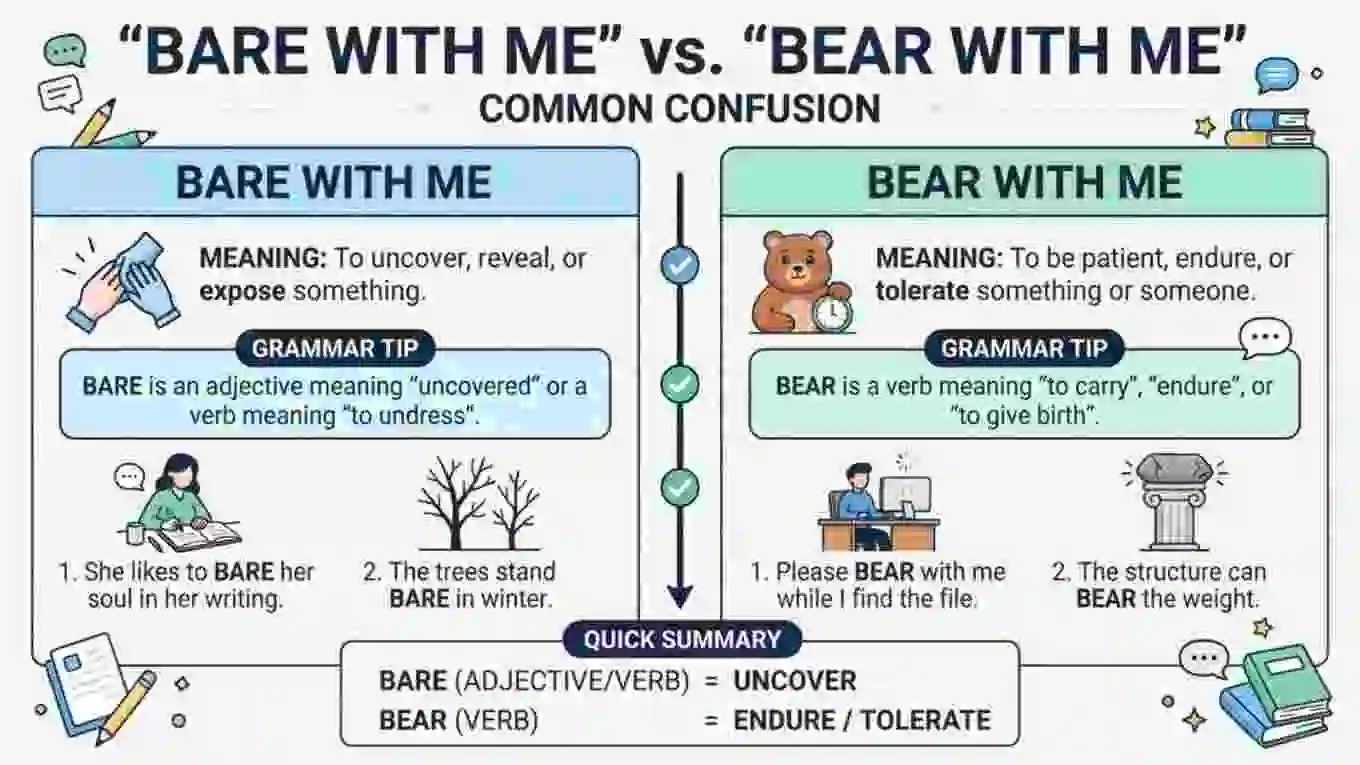
When you want to ask someone to wait or be patient, one small spelling choice matters: bear with me or bare with me? These phrases sound exactly the same, so it is easy to mix them up. But they do not have the same meaning.
The correct phrase is bear with me. It means “please be patient with me” or “please wait for a short time.” You can use it when you need more time to explain something, find information, fix a problem, or finish a task.
Bare with me is normally a spelling mistake. The word bare means uncovered, empty, or exposed. As a verb, it can mean “to uncover” or “to reveal.” That meaning does not fit the common phrase.
This guide explains the difference between bear with me or bare with me, where the phrase comes from, how to use it in British and American English, common mistakes, examples, and easy ways to remember the correct form.
Bear With Me or Bare With Me – Quick Answer
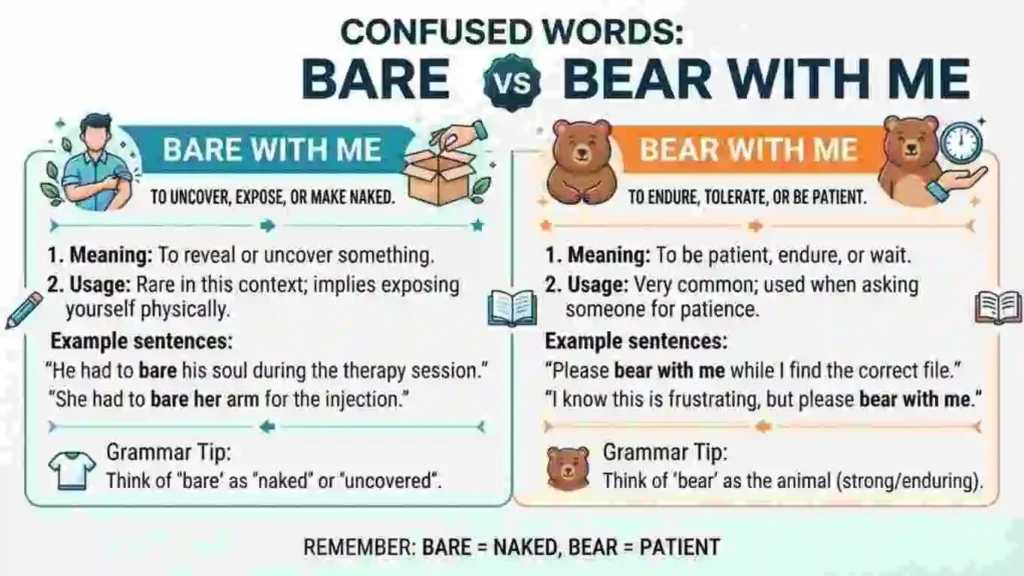
The correct phrase is:
✅ Bear with me
The incorrect form in normal use is:
❌ Bare with me
Bear with me means “please be patient with me” or “please wait for a moment.” It is common in both American and British English. There is no British vs American spelling difference here.
Examples
- Please bear with me while I check the file.
- Bear with me for a moment.
- Please bear with us while we fix the problem.
- Bear with me as I explain this step.
The word bear has an important meaning here. As a verb, bear can mean to carry, tolerate, or endure something. In this phrase, it asks someone to tolerate a short delay or difficulty.
Easy memory trick
Think:
Bear = Be patient
So:
Bear with me = Be patient with me
Do not use bare with me when you want to ask for patience.
The Origin of Bear With Me or Bare With Me
The phrase bear with me comes from the older meaning of the verb bear, which has long been used for ideas such as carrying, supporting, tolerating, and enduring. The expression developed from this sense of bearing or putting up with something. Sources trace the phrase back to Middle English and its use several centuries ago.
The word bear has also been used in other expressions where it means to tolerate or keep something in mind.
For example:
- Bear with me = be patient with me.
- Bear in mind = remember or keep something in mind.
- Bear the cost = accept or carry the cost.
- Bear the pressure = handle or tolerate pressure.
The confusion happens because bear and bare are homophones. Homophones are words that sound the same but have different spellings and meanings.
Bear
Bear can mean:
- carry
- tolerate
- endure
- support
Example:
Please bear with me while I find the answer.
Bare
Bare can mean:
- uncovered
- not covered
- empty
- exposed
As a verb, bare can mean to uncover or reveal something.
Examples:
- bare feet
- bare walls
- bare hands
- bare your feelings
Because bear and bare sound the same, writers often choose the wrong word when typing the phrase.
British English vs American English Spelling
Unlike many English spelling differences, bear with me does not change between British and American English.
| English Type | Correct Form | Incorrect Form |
| American English | bear with me | bare with me |
| British English | bear with me | bare with me |
| Canadian English | bear with me | bare with me |
| Australian English | bear with me | bare with me |
| Global English | bear with me | bare with me |
So, whether you write for readers in the US, UK, Canada, Australia, or other English-speaking areas, use bear with me when asking for patience.
Examples in both varieties
American English:
Please bear with me while I check your account.
British English:
Please bear with me while I check your details.
The phrase stays the same. The difference may appear in other words around it, but not in bear with me.
Which Spelling Should You Use?
The answer is simple:
For US readers
Use:
Bear with me
Example:
Please bear with me while I look into this issue.
For UK readers
Use:
Bear with me
Example:
Please bear with me while I check the details.
For Canadian and Australian readers
Use:
Bear with me
For global readers
Use:
Bear with me
There is no need to choose between a US and UK version. The correct phrase is the same in both.
Is “bare with me” ever possible?
In normal writing, bare with me is not the phrase you want. The wording could be understood literally because bare can mean “uncover,” but it would create a very different and often inappropriate meaning. (Scribbr)
That is why you should always use bear with me when asking someone to wait or be patient.
Common Mistakes with Bear With Me or Bare With Me
Mistake 1: Writing “bare with me”
❌ Please bare with me while I check the information.
✅ Please bear with me while I check the information.
The first sentence uses the wrong word.
Mistake 2: Thinking “bear” only means an animal
Many people know bear as the name of an animal.
But bear also works as a verb.
For example:
I cannot bear the noise.
Here, bear means tolerate or handle.
The same basic idea appears in:
Please bear with me.
Mistake 3: Writing “bare with us”
The same rule applies when you speak to a group.
❌ Please bare with us while we fix the website.
✅ Please bear with us while we fix the website.
Mistake 4: Writing “baring with me”
Baring is a real word, but it is not correct in this expression.
Baring means uncovering or exposing something.
For example:
He was baring his teeth.
But:
Please bear with me.
Mistake 5: Using “bare” because it sounds right
When you say the phrase aloud, bear and bare sound the same. That is why listening alone cannot help you choose the spelling.
Remember:
Bear = tolerate
Bare = uncover
Bear With Me or Bare With Me in Everyday Examples
You can use bear with me in many everyday situations.
In Emails
Correct:
Please bear with me while I gather the information you requested.
This sounds polite and professional.
Another example:
Bear with me while I check the latest figures.
In Customer Service
Please bear with us while we work to fix the issue.
This is useful when a company needs more time to solve a problem.
In Social Media
The website is getting a few updates today. Please bear with me!
This sounds friendly and casual.
In News or Public Messages
Please bear with us as we bring you more information.
It can be used when more information will come later.
In Formal Writing
Kindly bear with me as I explain the reasons for this decision.
This works in a formal setting.
In Everyday Speech
Bear with me for a second. I need to find my notes.
This is a natural way to ask someone to wait.
Bear With Me or Bare With Me – Google Trends & Usage Data
People search for bear with me or bare with me because the two words sound exactly the same. Search interest is therefore driven by spelling confusion rather than a real British vs American spelling difference.
Search and language-reference sources consistently identify bear with me as the standard phrase and bare with me as the common misspelling. (Scribbr)
Where does the confusion appear?
The phrase is used widely in:
- the United States
- the United Kingdom
- Canada
- Australia
- India
- other English-speaking regions
The key point is that the correct spelling does not change by country.
Why do people search for it?
People often search this phrase when:
- They are writing an email.
- They are unsure about the spelling.
- They heard the phrase but never saw it written.
- They are writing at work.
- They want to avoid an embarrassing mistake.
- They are learning English.
Historical text data also shows that the incorrect form bare with me appears in written material, which helps explain why people encounter both forms online. (Phrase Finder)
Search intent
The main search intent is simple:
“Which one is correct?”
The answer is:
Bear with me.
Bear With Me vs Bare With Me: Comparison Table
| Phrase | Correct? | Meaning | Example |
| Bear with me | ✅ Yes | Be patient with me | Please bear with me for a moment. |
| Bare with me | ❌ Usually no | Uncover with me | Not the normal intended phrase |
| Bear with us | ✅ Yes | Be patient with us | Please bear with us during the update. |
| Bare with us | ❌ No | Uncover with us | Not the normal phrase |
| Baring with me | ❌ No | Uncovering/exposing | Not correct for asking patience |
| Bear in mind | ✅ Yes | Remember | Bear in mind that times may change. |
The easiest rule is:
If you are asking for patience, use “bear.”
FAQs About Bear With Me or Bare With Me
1. Is it “bear with me” or “bare with me”?
Bear with me is correct when you mean “please be patient with me.” Bare with me is normally a spelling mistake.
2. What does “bear with me” mean?
It means “please be patient with me” or “please wait for a short time.”
3. Is “bare with me” ever correct?
Not in the normal expression asking for patience. Bare means uncovered or exposed, so it does not fit the intended meaning.
4. Is “bear with me” correct in American English?
Yes. Bear with me is the correct form in American English.
5. Is “bear with me” correct in British English?
Yes. British English also uses bear with me. There is no spelling change between British and American English.
6. Why do people confuse bear and bare?
They are homophones. They sound the same but have different spellings and meanings. This makes the mistake easy to make, especially when people learn the phrase by hearing it.
7. Is “please bear with me” polite?
Yes. Please bear with me is a polite way to ask someone for patience. It is common in emails, customer service, meetings, and everyday speech.
8. What is an easy way to remember it?
Think:
Bear = endure
If you need someone to endure a short wait, write:
Bear with me.
Conclusion
When you are choosing between bear with me or bare with me, the correct choice is easy: bear with me.
Use bear with me when you want someone to be patient, wait for a moment, or give you time to finish something. The phrase works in emails, conversations, customer service, social media, meetings, and formal writing.
The confusion comes from the words bear and bare. They sound the same, but their meanings are different. Bear can mean to carry, tolerate, or endure. Bare means uncovered or exposed. That is why bare with me does not work as the normal request for patience. (Scribbr)
There is also no British or American spelling difference here. Both varieties use bear with me.
So, when you need to ask someone to wait, remember this simple rule:
Bear with me = Be patient with me.
Use bear, not bare, and you will avoid one of the most common homophone mistakes in English.