Have you ever felt your heart beat fast when you were scared? Maybe you had to speak in front of a class, saw a dangerous animal, or suddenly heard a loud sound. Your body may have reacted before you had time to think.
This fast body reaction is called the fight or flight response.
The fight or flight response is a natural body reaction to stress, fear, or danger. It helps prepare you to deal with a threat. Your heart may beat faster. You may breathe faster. Your muscles may become tight. You may start to sweat. These changes help your body get ready to act.
People often search for the fight or flight response because they want to know why their body reacts this way during stress. They may also want to know what fight and flight mean, what causes the response, and whether it is normal.
In this guide, you will learn what the fight or flight response means, how it works, what happens in your body, common signs, real-life examples, and how it differs from other stress responses.
Fight or Flight Response – Quick Answer
The fight or flight response is your body’s quick reaction to danger or stress.
It prepares your body to deal with a threat in one of two basic ways:
- Fight: Stay and face the danger.
- Flight: Move away or run from the danger.
During this response, your body may increase your heart rate and breathing. Your muscles may become tense, and you may sweat more. Your body makes these changes so you can act quickly.
The response can happen when a threat is real or when your brain thinks something may be dangerous. It can also happen during strong stress.
What Is the Fight or Flight Response?
The fight or flight response is a natural body reaction to a threat.
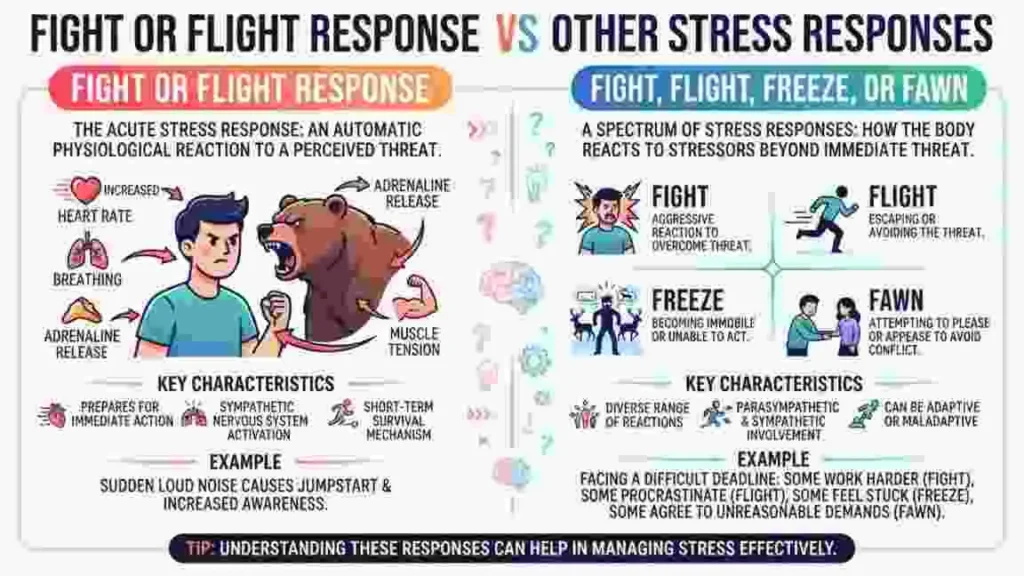
Your body has systems that work without you having to think about them. One of these is the sympathetic nervous system. It helps turn on the fight or flight response when you face stress or danger.
For example, imagine that you are walking home and suddenly see a large dog running toward you.
These changes can help you react quickly.
The response does not mean that you will always fight or run. People can react to stress in different ways.
What Does “Fight” Mean?
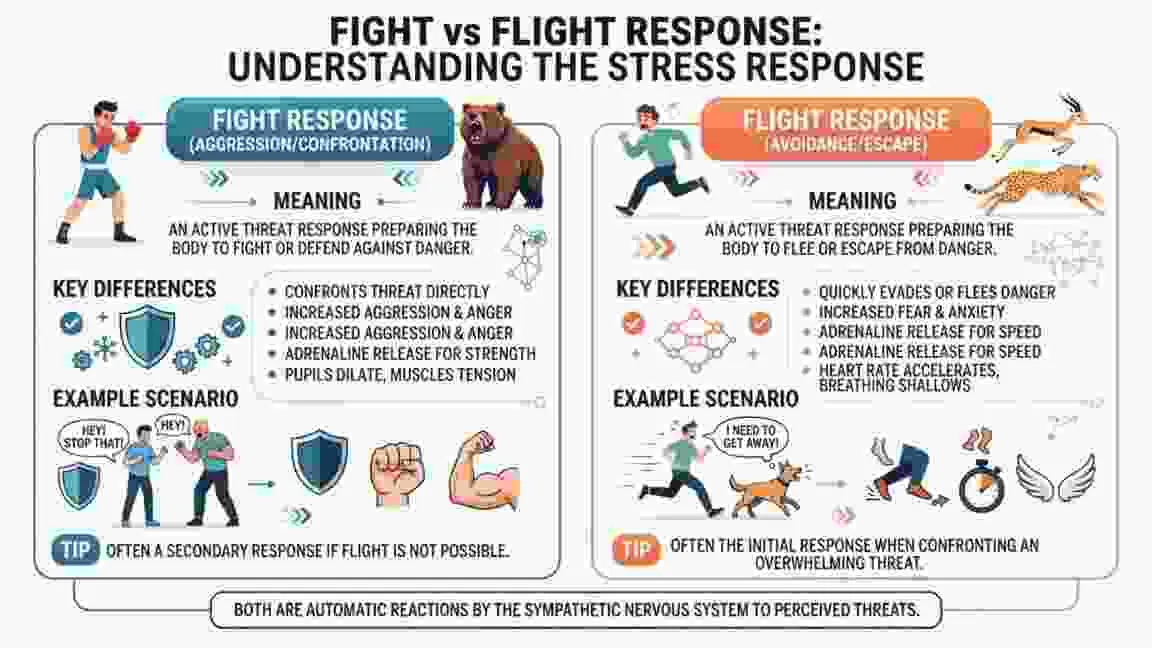
Fight means facing a threat instead of moving away from it.
For example, a person may try to protect themselves when they feel attacked.
The body can become ready for fast physical action. The heart pumps faster, breathing increases, and muscles get more blood and energy.
The word “fight” does not always mean a physical fight. It can also describe a strong urge to face a problem or danger.
For example:
- You stand up for yourself during a conflict.
- You try to protect someone from danger.
- You face a difficult situation instead of avoiding it.
What Does “Flight” Mean?
Flight means moving away from a threat.
It does not mean flying.
Here, flight means escape or getting away.
For example, if you see a dangerous animal, you may quickly move away. Your body can help you do this by increasing your heart rate, breathing, and muscle activity.
You may also feel a strong need to leave a stressful place.
What Happens to Your Body?
The fight or flight response can cause many fast changes in your body.
Common changes include:
- Faster heart rate
- Faster breathing
- Higher blood pressure
- Tight or tense muscles
- More sweating
- Wider pupils
- More alertness
- Less digestive activity
- More energy for quick action
The American Psychological Association explains that the sympathetic nervous system helps create these changes during threatening or stressful situations.
The Cleveland Clinic also explains that the sympathetic nervous system can increase heart rate and breathing while slowing processes such as digestion.
Why Does Your Heart Beat Faster?
Your heart may beat faster so your body can move blood and oxygen to areas that need them.
This can help your muscles work during a stressful event.
Why Do You Breathe Faster?
Faster breathing helps bring more oxygen into your body.
Your body may need more oxygen when it prepares for quick action.
Why Do You Sweat?
Sweating helps control body heat. It can also happen when your body becomes highly active during stress.
Fight or Flight vs. Other Stress Responses
People do not always respond to stress by fighting or running.
Other responses can happen too.
Some people may:
- Freeze: Feel unable to move or act.
- Fawn: Try to please or calm another person to reduce danger.
- Fight: Face the threat.
- Flight: Move away from the threat.
The exact response can depend on the situation and the person. Cleveland Clinic describes fight, flight, freeze, and fawn as common ways people can respond to stress or danger.
Common Signs of the Fight or Flight Response
The signs can feel strong and may appear very quickly.
Common signs include:
- Fast heartbeat
- Fast breathing
- Sweating
- Shaking
- Tight muscles
- Feeling very alert
- Feeling nervous or scared
- Dry mouth
- Upset stomach
- Strong need to leave or act
Not everyone feels every sign.
A person may notice only one or two changes.
What Can Trigger the Fight or Flight Response?
Many things can trigger a stress response.
Some common examples include:
- A sudden loud noise
- A dangerous situation
- A car accident
- A serious argument
- Public speaking
- A difficult exam
- A job interview
- A scary movie
- A major deadline
- A sudden change
- Fear of getting hurt
The body can react to real danger, but stress can also come from situations that feel threatening or overwhelming.
Fight or Flight Response vs. Stress Response
These terms are closely related, but they are not always used in exactly the same way.
The stress response is the body’s reaction to stress.
The fight or flight response is a well-known part of that reaction. It describes the body’s quick preparation for dealing with a threat.
In simple words:
Stress → body notices a threat → fight or flight response may happen.
The response can include changes in your heart, breathing, muscles, blood pressure, and digestion.
Fight or Flight Response vs. Rest and Digest
The fight or flight response prepares your body for action.
The rest and digest state does the opposite. It helps your body calm down and focus on normal tasks such as digestion.
Your sympathetic nervous system helps activate the fight or flight response.
Your parasympathetic nervous system helps your body return toward a calmer state after the stressful event.
Think of it this way:
| Response | Main purpose |
| Fight or flight | Prepare the body for action |
| Rest and digest | Help the body calm and return to normal |
Main Differences: Fight vs. Flight
| Term | Meaning | Main Action | Example |
| Fight | Face a threat | Stay and deal with it | Protecting yourself |
| Flight | Escape a threat | Move away | Running from danger |
| Freeze | Become still | Pause or feel unable to act | Standing still after a shock |
| Fawn | Try to calm the threat | Please or agree | Trying to stop a conflict |
These responses can happen as part of the body’s reaction to stress or danger.
Origin and History of the Fight or Flight Response
The idea of the fight or flight response is linked to American physiologist Walter B. Cannon.
Cannon studied how the body reacts during strong emotions and danger. His work helped explain how the sympathetic nervous system and other body systems prepare an animal or person to deal with a threat.
The term became closely linked with Cannon’s work in the early 1900s.
Today, doctors, psychologists, and researchers still use the term when talking about the body’s reaction to stress and danger.
The basic idea is simple: when the body senses danger, it can quickly prepare for action.
British English vs. American English
There is no major British vs. American spelling difference for this term.
Both British and American English use:
fight or flight response
You may also see:
- fight-or-flight response
- fight or flight reaction
- stress response
- acute stress response
The main difference is often the use of hyphens, not the spelling of the words.
For example:
The fight or flight response can happen during stress.
You may also see:
The fight-or-flight response can happen during stress.
Both forms can be understood.
Which Form Should You Use?
For normal writing, fight or flight response is clear and easy to understand.
Use it in:
- School work
- Blog posts
- Emails
- General writing
- Online content
- Health education
If you are writing for a science or medical audience, follow the style used by your school, workplace, or publication.
The phrase fight-or-flight response is also very common, especially when the phrase works as one term before another noun.
For example:
The fight-or-flight response is a natural body reaction.
Common Mistakes
1. Mistake: Thinking “flight” means flying
Incorrect idea: Flight means the body wants to fly.
Correct: Flight means getting away from danger.
Example:
The person chose flight and moved away from the danger.
2. Mistake: Thinking fight always means violence
Incorrect idea: Fight always means starting a physical fight.
Correct: Fight means facing or dealing with a threat.
Example:
She decided to fight the problem instead of avoiding it.
3. Mistake: Thinking everyone reacts the same way
Incorrect idea: Everyone either fights or runs.
Correct: People can respond to stress in different ways.
Example:
Some people freeze when they feel scared.
4. Mistake: Thinking the response only happens during real danger
Incorrect idea: The response only happens when your life is in danger.
Correct: Stressful situations can also cause a similar body response.
Example:
He felt his heart race before his job interview.
5. Mistake: Thinking the response is always harmful
Incorrect idea: Any fight or flight response is bad.
Correct: This response is a normal body system that can help you react to danger. Long-term stress can be a health concern.
Example:
A quick stress response can help you react to a sudden danger.
10 Everyday Examples
Here are simple examples of how the phrase can be used:
- The fight or flight response can start when you feel threatened.
- Her heart started beating fast because of the stress response.
- A sudden loud noise can trigger a fight or flight response.
- The body uses the fight or flight response to prepare for danger.
- His breathing became faster during the stressful event.
- The fight or flight response helped her react quickly.
- Some people choose flight when they face danger.
- Others may choose to fight when they feel threatened.
- A scary situation can cause strong body changes.
- The body usually begins to calm after the danger passes.
Real-Life Usage
In a Conversation
“Why is my heart beating so fast?”
“You may be having a stress response.”
At School
A student may feel nervous before a big test.
The student may sweat, breathe faster, or feel their heart beat quickly.
At Work
A job interview can cause stress.
A person may feel tense before answering questions.
In an Email
You might write:
“The sudden event caused a strong stress response.”
On Social Media
People often use the term when talking about fear, stress, or anxiety.
For example:
“My fight or flight response kicked in when I heard that noise.”
Related Search Questions
What does fight or flight response mean?
It means a quick body reaction to stress or danger. The body prepares you to deal with a threat. You may feel a faster heartbeat, faster breathing, sweating, or tight muscles.
Why is it called fight or flight?
It is called fight or flight because the body can prepare you to face a threat or move away from it. “Fight” means facing the threat, while “flight” means escaping from it.
Is the fight or flight response normal?
Yes. It is a normal body response to stress or danger. Short periods of stress can help the body react to a challenge. Long-term stress can affect health, so ongoing stress should not be ignored.
What causes a fight or flight response?
A threat, fear, sudden stress, or another stressful event can cause the response. It can happen when the threat is real or when your brain sees something as dangerous.
What happens during fight or flight?
Your heart rate and breathing may increase. Your muscles may become tense. You may sweat more and become very alert. Your body makes these changes to prepare for quick action.
Can stress cause a fight or flight response?
Yes. Stress can cause the body to release hormones that produce the fight or flight response. This can increase heart rate, breathing, and blood pressure.
Usage and Search Trends
The phrase fight or flight response is widely used in health, psychology, education, and everyday conversations about stress.
People may search for terms such as:
- fight or flight response meaning
- what is fight or flight response
- fight or flight response symptoms
- fight or flight response examples
- fight or flight stress response
- fight or flight vs freeze
- what causes fight or flight response
- how does fight or flight work
These searches show that people often want a simple explanation of what the response means and why their body changes during stress.
Exact search volume can change over time and depends on the country and search tool. It is better to use verified keyword data than to give made-up numbers.
Fight or Flight Response Comparison Table
| Topic | Fight or Flight Response | Normal Calm State |
| Heart rate | Usually increases | More normal |
| Breathing | Usually becomes faster | More steady |
| Muscles | Become ready for action | More relaxed |
| Sweating | May increase | Usually lower |
| Digestion | May slow down | Works normally |
| Alertness | Increases | More normal |
| Main goal | Prepare for danger | Support normal body activity |
FAQs
1. What is the fight or flight response in simple words?
The fight or flight response is your body’s quick reaction to danger or stress. It gets your body ready to act. You may fight the threat, move away from it, or react in another way. Your heart and breathing may speed up, and your muscles may become tense.
2. What are the main signs of fight or flight?
Common signs include a fast heartbeat, fast breathing, sweating, tense muscles, shaking, and feeling very alert. Some people may also feel an upset stomach or a strong need to leave the situation. Not everyone has the same signs.
3. Is fight or flight the same as anxiety?
They are related, but they are not exactly the same. Fight or flight describes a body response to stress or danger. Anxiety can involve ongoing fear, worry, or nervousness. Anxiety can sometimes trigger a stress response, but the two terms do not mean the same thing.
4. How long does the fight or flight response last?
The length can vary. The body can start the response very quickly when it senses danger. After the stressful event ends, the body can begin moving back toward its normal state. Ongoing or repeated stress may keep the body in a stressed state for longer.
5. Can you have a fight or flight response without real danger?
Yes. Your body can react when your brain sees something as threatening or stressful. The threat does not always have to be an immediate physical danger. A stressful event, fear, or strong worry can also produce body changes linked to the stress response.
6. What is the difference between fight and flight?
Fight means facing or dealing with a threat. Flight means moving away from the threat. Both describe ways the body can prepare to respond to danger. People can also freeze, try to calm the situation, or react in other ways.
7. Is the fight or flight response bad for you?
The response itself is a normal part of how the body deals with stress. It can help you react to danger. The bigger concern is long-term or repeated stress. Chronic stress may contribute to or worsen health problems.
Conclusion
The fight or flight response is a natural body reaction to stress, fear, or danger. It helps prepare you to act when your brain sees a threat.
The word fight means facing the threat. Flight means moving away from it. The body can also react in other ways, such as freezing or trying to calm the situation.
During this response, your heart may beat faster. Your breathing may increase. Your muscles may become tense. You may sweat more and become highly alert. These changes help prepare your body for quick action.
The response is a normal part of the body’s stress system. It can help you deal with sudden danger or pressure. However, long-term stress can affect your health, so ongoing stress should be taken seriously.
In simple terms, the fight or flight response is your body’s quick alarm system. It helps you get ready when something feels dangerous or stressful.
URL Slug
/fight-or-flight-response/

Emily Carter is an English grammar writer based in Portland, Oregon, with 7+ years of experience turning tricky grammar rules into simple, easy lessons.