The words strips and stripes look very similar, so it is easy to mix them up. They have almost the same letters, but they do not mean the same thing.
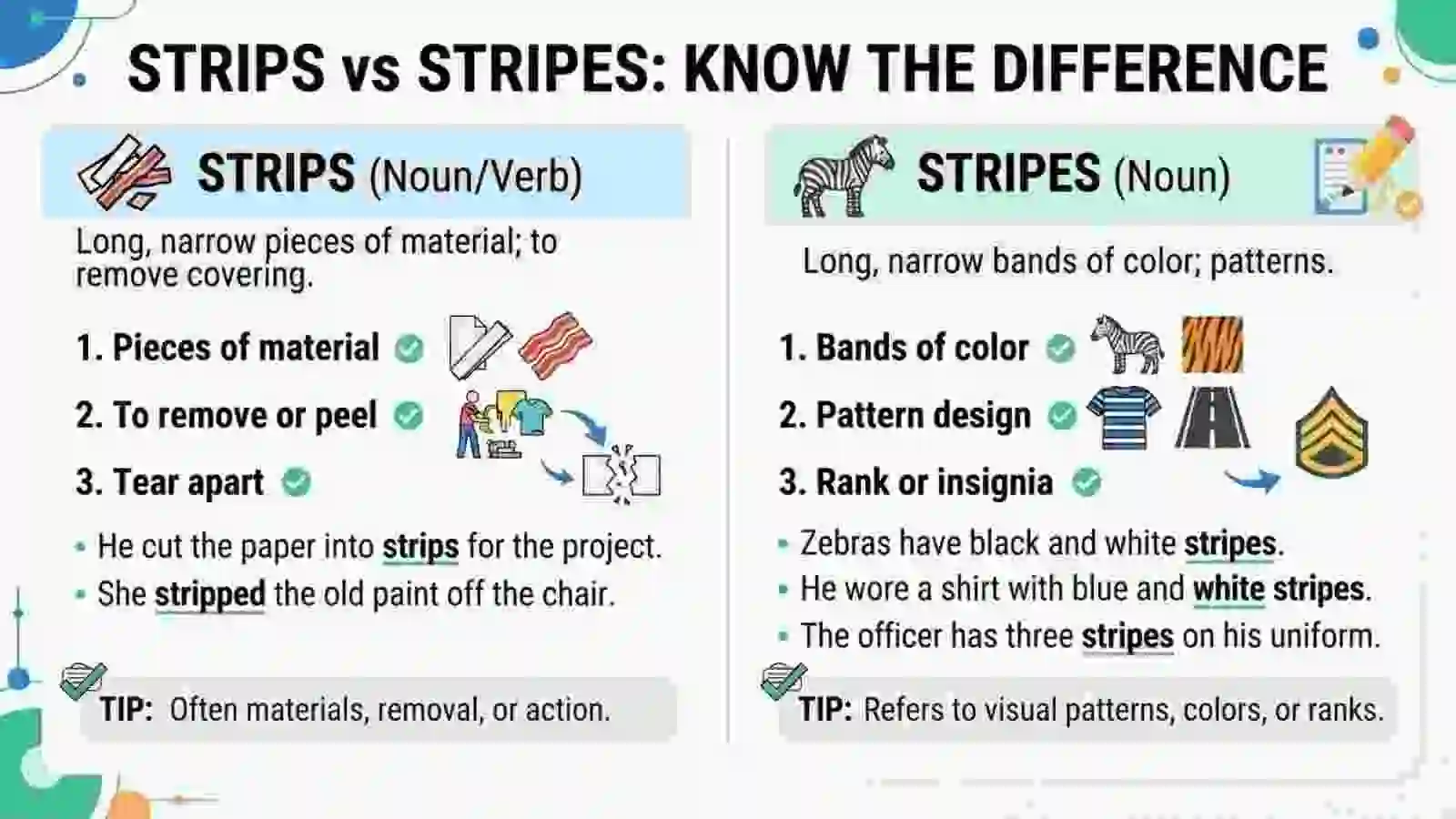
Strips can mean long, narrow pieces of something. It can also be the verb form of strip, which means to remove something. For example, you can cut paper into strips, or you can strip paint from a wall.
Stripes, on the other hand, are long lines or bands that are often seen on clothes, flags, animals, and other objects. A shirt can have blue and white stripes. A zebra has black and white stripes.
People often search for this phrase because they want to know which word fits a sentence. They may also wonder if the words have different spellings in British and American English.
The good news is simple. Strips and stripes are both correct words, but you use them in different ways.
This guide explains the difference in very simple English. You will learn their meanings, origins, common mistakes, everyday examples, and easy ways to remember which word to use.
Strips vs Stripes – Quick Answer
Strips usually means long, narrow pieces of something, or it can mean removing something.
Stripes means long, narrow lines or bands, often used as a pattern.
Simple examples
- Cut the paper into strips.
- The shirt has blue and white stripes.
- She strips the old paint from the wall.
- The zebra has black and white stripes.
Easy way to remember
Think of strips as pieces.
Think of stripes as lines or patterns.
| Word | Simple meaning | Example |
| Strips | Long, narrow pieces | Cut the paper into strips. |
| Stripes | Long lines or bands | The shirt has stripes. |
The extra e in stripes can help you remember that the word often describes a pattern.
The Origin of Strips vs Stripes
The two words come from different word forms, even though they look very similar.
Strips comes from the word strip. The word has been used in English for a long time. A strip can mean a narrow piece of something. It can also mean to remove something, such as clothes, paint, or a covering.
For example:
- a strip of paper
- a strip of cloth
- strip the paint
- strip the wall
Stripes comes from the word stripe. A stripe means a long, narrow line or band. It can describe a pattern on clothing, flags, animals, and many other things.
For example:
- red stripes
- blue stripes
- zebra stripes
- stripes on a flag
The main difference comes from the base words strip and stripe.
Adding s gives:
strip → strips
stripe → stripes
So, the spelling difference is not a British or American English rule. The two words have different meanings.
British English vs American English Spelling
There is no major British versus American spelling difference between strips and stripes.
Both British English and American English use:
- strips
- stripes
The meaning also stays the same.
| Feature | British English | American English |
| Long narrow pieces | strips | strips |
| Lines or bands | stripes | stripes |
| Spelling of strips | strips | strips |
| Spelling of stripes | stripes | stripes |
| Main meaning | Same | Same |
You can use strips and stripes in the same way in both forms of English.
For example:
British English:
“The shirt has blue stripes.”
American English:
“The shirt has blue stripes.”
There is no spelling change here.
Which Spelling Should You Use?
You should not choose between these words based on the country you live in.
Instead, choose the word based on what you mean.
Use strips when you mean narrow pieces or when you mean removing something.
Examples:
- strips of paper
- strips of chicken
- strips of cloth
- strips of wood
Use stripes when you mean lines or bands that form a pattern.
Examples:
- stripes on a shirt
- black and white stripes
- stripes on a flag
- zebra stripes
For US readers
Use strips for pieces or removal.
Use stripes for lines and patterns.
For UK and Commonwealth readers
The same rule applies.
For global English
The same rule works almost everywhere.
The key is not the country. The key is the meaning of the sentence.
Common Mistakes with Strips vs Stripes
Mistake 1: Using “strips” for a clothing pattern
Wrong:
“The shirt has blue strips.”
Correct:
“The shirt has blue stripes.”
A clothing pattern uses stripes.
Mistake 2: Using “stripes” for pieces of paper
Wrong:
“Cut the paper into stripes.”
Correct:
“Cut the paper into strips.”
Small pieces use strips.
Mistake 3: Forgetting the final “e”
Wrong:
“The zebra has black and white strips.”
Correct:
“The zebra has black and white stripes.”
A zebra has stripes.
Mistake 4: Thinking one word is British
Neither word belongs only to British or American English.
Both forms are standard in both varieties.
Mistake 5: Mixing up “strip” and “stripe”
Remember:
Strip = piece or remove
Stripe = line or band
This simple rule can help you choose the right word.
Strips vs Stripes in Everyday Examples
These words appear in many types of writing.
In Emails
Strips:
“Please cut the labels into small strips before sending them.”
Stripes:
“The new design uses blue and white stripes.”
In News
Strips:
“Workers cut the material into thin strips.”
Stripes:
“The team showed off its new shirt with bright stripes.”
On Social Media
Strips:
“I cut the paper into strips for my craft project.”
Stripes:
“I love this shirt with colorful stripes!”
In Formal Writing
Strips:
“The material was cut into narrow strips.”
Stripes:
“The flag contains several horizontal stripes.”
In Casual Conversation
Strips:
“Can you cut the chicken into strips?”
Stripes:
“Those stripes look great on your shirt.”
In Everyday Descriptions
You may see strips when talking about food, paper, cloth, wood, or other materials.
You may see stripes when talking about clothes, animals, flags, sports shirts, and designs.
Strips vs Stripes – Google Trends & Usage Data
Search interest for these words can change based on the topic and country.
Strips has many uses because it can refer to pieces of material and can also come from the verb strip. This gives the word a wide range of uses.
Stripes is often linked to clothing, animals, flags, sports designs, and other patterns.
Searches may increase when people are looking for:
- clothing patterns
- zebra patterns
- shirt designs
- flag designs
- craft materials
- food preparation
- spelling help
- word meanings
The exact search volume can also change over time. More importantly, the search intent behind the two words is different.
Someone searching for strips may want to know about pieces, cutting, or removing something.
Someone searching for stripes may want to know about patterns or lines.
For SEO, this means an article should explain both meaning and context, rather than treating the words as simple spelling variants.
Strips vs Stripes Comparison Table
| Feature | Strips | Stripes |
| Base word | strip | stripe |
| Main meaning | Narrow pieces | Lines or bands |
| Can be a verb form? | Yes | Usually a noun form |
| Used for patterns? | No | Yes |
| Used for pieces? | Yes | No |
| Example | strips of paper | stripes on a shirt |
| British spelling | strips | stripes |
| American spelling | strips | stripes |
Easy Memory Trick
Use this simple trick:
STRIPS = PIECES
Think:
“Strips of paper.”
STRIPES = LINES
Think:
“Stripes on a shirt.”
You can also remember the final e in stripes by thinking of a design or pattern.
If you are talking about something that looks like long lines, choose stripes.
If you are talking about something cut into narrow pieces, choose strips.
FAQs
1. What is the difference between strips and stripes?
Strips usually means narrow pieces or the act of removing something. Stripes means long lines or bands that form a pattern.
2. Is “strips” correct?
Yes. Strips is the plural of strip and can also be a verb form.
3. Is “stripes” correct?
Yes. Stripes is the plural of stripe and usually refers to lines or bands.
4. Are strips and stripes the same?
No. They look similar, but they have different meanings.
5. Are strips and stripes different in British and American English?
No. Both British and American English use the same spellings.
6. Does a zebra have strips or stripes?
A zebra has stripes because its body has a pattern of long lines or bands.
7. Do you cut paper into strips or stripes?
You cut paper into strips because strips are narrow pieces.
8. Does a shirt have strips or stripes?
A shirt with a line pattern has stripes.
Conclusion
The difference between strips and stripes is simple once you know what each word means. They are both correct English words, but they describe different things.
Use strips when you mean long, narrow pieces of something. You can have strips of paper, cloth, chicken, or wood. The word can also come from the verb strip, which means to remove something.
Use stripes when you mean long lines or bands that make a pattern. You can see stripes on shirts, flags, zebras, sports clothes, and many other things.
There is no British or American spelling change for these words. Both forms of English use strips and stripes in the same way.
The easiest rule is to remember strips = pieces and stripes = lines or patterns. When you focus on the meaning, it becomes much easier to choose the correct word.