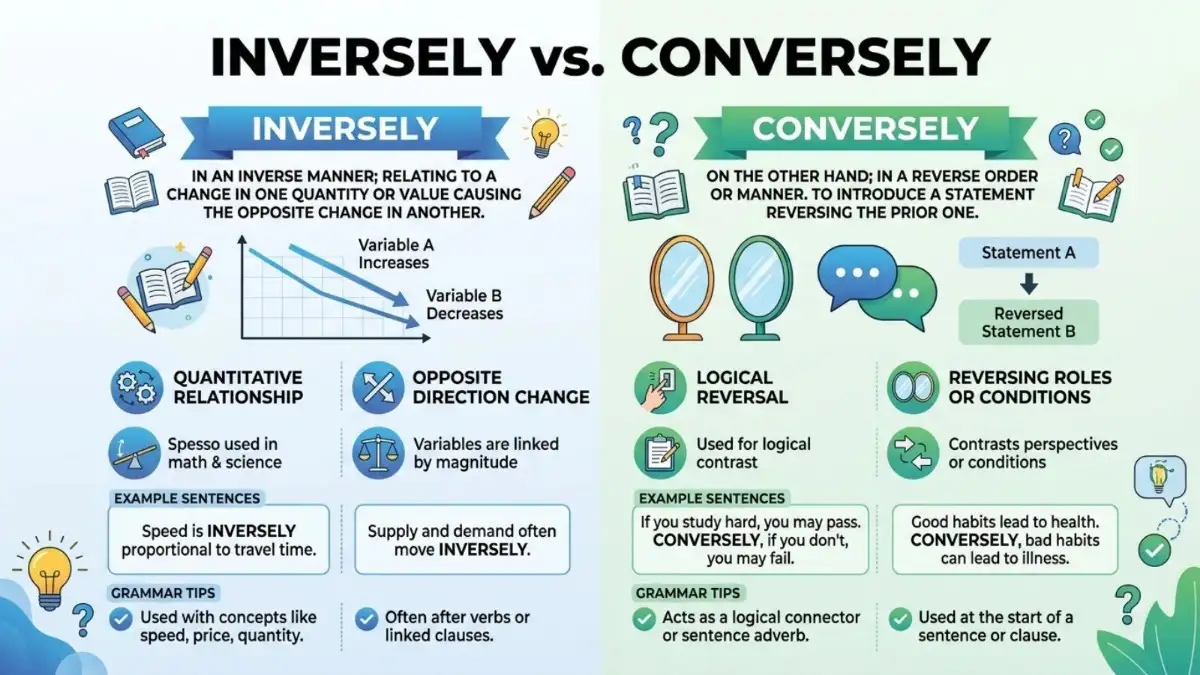
Inversely vs conversely can be confusing because both words are used when two ideas have some kind of relationship. They often appear in academic writing, science, business, and formal English. However, they do not mean the same thing.
Inversely usually describes a relationship where one thing changes in the opposite direction from another. If one value goes up while another goes down, the two values may be inversely related. For example, “As speed increases, travel time decreases.” The two changes move in opposite directions.
Conversely means “in the opposite way” or “on the other hand.” It introduces an opposite idea, result, or situation. For example, “The north is dry. Conversely, the south is wet.”
People search for inversely vs conversely because both words contain the idea of opposition. The key difference is simple: inversely often describes an opposite relationship between things, while conversely usually introduces a contrasting or opposite statement.
This guide explains both words with simple rules, examples, common mistakes, usage tips, and easy ways to remember the difference.
Inversely vs Conversely – Quick Answer
The short answer is:
- Inversely means in an opposite or reversed relationship.
- Conversely means in the opposite way or from the opposite point of view.
- Inversely often describes how two things change in relation to each other.
- Conversely often connects two opposite statements or situations.
Use inversely for an opposite relationship
Price and demand are inversely related.
This means that as one changes, the other tends to change in the opposite direction.
Another example:
As speed increases, travel time decreases. The two are inversely related.
Use conversely for an opposite idea
The north receives heavy rain. Conversely, the south is very dry.
Here, conversely introduces an opposite situation.
Another example:
John enjoys working alone. Conversely, Sarah prefers teamwork.
The second statement gives the opposite situation.
Easy rule
Think:
Inversely = opposite relationship
Conversely = opposite idea or situation
The Origin of Inversely vs Conversely
The two words have different histories, even though both are linked to the idea of turning or changing direction.
The origin of inversely
Inversely comes from inverse, which comes from Latin inversus, meaning “turned upside down” or “turned around.” It is related to the Latin verb invertere, meaning “to turn inward, turn upside down, or reverse.” (etymonline.com)
The word inverse entered English in the late Middle Ages.
Over time, inverse developed the meaning of something that is opposite or reversed.
The adverb inversely means “in an inverse manner.”
For example:
The two variables are inversely related.
The word is especially common in mathematics and science.
The origin of conversely
Conversely comes from converse.
Converse comes from Latin conversus, meaning “turned around” or “turned about.” It comes from convertere, meaning “to turn around” or “turn together.” (etymonline.com)
English later developed conversely as an adverb meaning “in an opposite way” or “in reverse.”
Today, writers often use it to introduce a contrasting statement.
The first plan is expensive. Conversely, the second plan is cheap.
Why do the words cause confusion?
Both words have a connection to turning or reversing.
But their modern uses are different.
Inversely focuses on a relationship or reversed direction.
Conversely focuses on an opposing statement, condition, or point of view.
British English vs American English Spelling
There is no major spelling difference between British and American English for inversely or conversely.
Both varieties use:
- inversely
- conversely
- inverse
- converse
The main difference is not spelling. It is style and context.
Both words are more common in formal writing than in casual conversation.
Comparison table
| Word | British English | American English | Main use |
| inversely | Inversely | Inversely | Opposite relationship |
| conversely | Conversely | Conversely | Opposite or contrasting idea |
| inverse | Inverse | Inverse | Opposite or reversed |
| converse | Converse | Converse | Opposite or reverse case |
| inversion | Inversion | Inversion | Reversal |
| conversion | Conversion | Conversion | Change from one form to another |
British English
British writers use inversely in science, mathematics, and formal explanations.
The two values are inversely proportional.
They also use conversely to introduce an opposite idea.
The first method is slow. Conversely, the second method is fast.
American English
American English uses the same spellings and meanings.
The variables are inversely related.
Conversely, the new system costs less.
So, you do not need to change either word based on your audience.
Which Spelling Should You Use?
There is no spelling choice between the two words. Instead, choose the word that matches your meaning.
Use inversely when talking about relationships
Choose inversely when one thing changes in the opposite direction from another.
The two values are inversely proportional.
Interest rates and borrowing may be inversely related.
This use is common in science, mathematics, economics, and statistics.
Use conversely when comparing two situations
Choose conversely when you want to say “in the opposite case” or “on the other hand.”
Some people enjoy city life. Conversely, others prefer the countryside.
For academic writing
Both words can work well in academic writing.
Use inversely when describing a measurable relationship.
Use conversely when moving from one case to an opposite case.
For everyday writing
You may not need either word in casual writing.
Instead of:
Conversely, we could choose the cheaper option.
You could simply write:
On the other hand, we could choose the cheaper option.
This sounds more natural in casual English.
Common Mistakes with Inversely vs Conversely
Mistake 1: Using conversely for a mathematical relationship
Incorrect:
Temperature and pressure are conversely related.
Better:
Temperature and pressure are inversely related.
Use inversely when describing an inverse relationship.
Mistake 2: Using inversely to introduce an opposite opinion
Incorrect:
I prefer working at home. Inversely, my brother likes working in an office.
Better:
I prefer working at home. Conversely, my brother likes working in an office.
Here, the second sentence gives an opposite situation.
Mistake 3: Thinking inversely means simply “opposite”
Inversely can involve opposition, but it often describes a specific relationship.
The two variables are inversely proportional.
This means their relationship follows an inverse pattern.
Mistake 4: Using conversely when you mean “completely different”
Conversely usually connects related ideas that contrast with each other.
The first option is expensive. Conversely, the second option is affordable.
The two options are being compared.
Mistake 5: Using both words in the same way
They are not interchangeable in every sentence.
Compare:
Sales and price are inversely related.
The city is crowded. Conversely, the countryside is quiet.
The first describes a relationship. The second introduces a contrast.
Inversely vs Conversely in Everyday Examples
In emails
Conversely can help when comparing two choices.
The first supplier offers lower prices. Conversely, the second offers faster delivery.
Inversely may appear in technical or business emails.
These costs appear to be inversely related to production volume.
In news writing
As temperatures rise, energy demand falls. The two factors are inversely related.
For contrast:
The coastal area received heavy rain. Conversely, inland areas stayed dry.
On social media
Formal words like conversely are less common in casual posts, but they can still appear.
Some people love busy cities. Conversely, I prefer quiet towns.
You could make it more casual:
Some people love busy cities. I prefer quiet towns, though.
In formal writing
Both words are useful.
The study found an inverse relationship between the two variables.
The first group improved quickly. Conversely, the second group showed little change.
In science
Inversely is especially common.
The pressure is inversely related to volume under certain conditions.
mathematics
You may see:
y is inversely proportional to x.
This means that as one value increases, the other decreases in a defined relationship.
Inversely vs Conversely – Google Trends & Usage Data
People search for inversely vs conversely because both words can appear when writers discuss opposite ideas.
However, their usage patterns differ by context.
Inversely is strongly connected with technical language. It appears often in:
- Mathematics
- Physics
- Chemistry
- Economics
- Statistics
- Research
- Academic writing
Conversely is more common in general formal writing. It appears in:
- Essays
- Reports
- News
- Business writing
- Academic discussions
- Comparisons
Search interest can change over time and by country. Google Trends can show where people search for these words, but search data does not determine whether a word is grammatically correct.
Usage by country
There is no major British versus American difference in the spelling of either word.
Both British and American writers use:
inversely
and
conversely
The difference is mainly about context and writing style.
Usage by meaning
If the sentence discusses a measurable relationship, inversely is often the better choice.
If the sentence moves from one idea to an opposite idea, conversely is often the better choice.
Inversely vs Conversely: Comparison Table
| Feature | Inversely | Conversely |
| Part of speech | Adverb | Adverb |
| Basic meaning | In an opposite or reversed relationship | In an opposite way |
| Main use | Relationships | Contrasts |
| Common in science | Very common | Less common |
| Common in math | Very common | Less common |
| Common in essays | Common | Very common |
| Can introduce a new sentence? | Sometimes | Yes |
| Example | The values change inversely. | Conversely, the other group improved. |
| Simple replacement | In an opposite relationship | On the other hand |
Inversely Proportional vs Conversely Related
These phrases are not the same.
Inversely proportional
When two quantities are inversely proportional, they have a specific mathematical relationship.
For example:
If one value doubles, the other may become half as large.
This is a mathematical rule.
Conversely
Conversely does not describe a mathematical formula.
It simply introduces an opposite case or idea.
The first plan is expensive. Conversely, the second plan is affordable.
There is no special mathematical relationship here.
Easy Trick to Remember Inversely vs Conversely
Use this simple trick:
Inversely = inverse relationship
Think:
Inverse → inversely
If two things move in opposite directions, inversely may be the right word.
Price and demand can be inversely related.
Conversely = contrast
Think:
Conversely → contrast
If you are turning from one idea to the opposite idea, use conversely.
The first option is cheap. Conversely, the second is expensive.
Another easy test is to replace the word.
If “in an inverse relationship” fits, use inversely.
If “on the other hand” fits, use conversely.
FAQs;
1. What is the difference between inversely and conversely?
Inversely usually describes an opposite relationship between two things. Conversely introduces an opposite idea, situation, or point of view.
2. Can inversely and conversely be used interchangeably?
Usually, no. They can both relate to opposition, but they perform different jobs.
The variables are inversely related.
Conversely, the other group improved.
3. What does inversely mean?
Inversely means in an opposite or reversed relationship. It is common when two quantities change in opposite directions.
4. What does conversely mean?
Conversely means in the opposite way, or “on the other hand.” It introduces a contrasting idea or situation.
5. Is conversely formal?
Yes. Conversely is more common in formal and academic writing than in everyday speech.
In casual writing, you can often use:
on the other hand
instead.
6. Is inversely used in science?
Yes. Inversely is very common in science and mathematics.
For example:
The variables are inversely proportional.
7. What is an easy way to remember the difference?
Remember:
Inversely = inverse relationship
Conversely = opposite idea
If you can say “on the other hand,” conversely may fit. If you are describing how two values change in relation to each other, inversely is often the right choice.
Conclusion;
The difference between inversely vs conversely becomes much easier when you focus on the job each word does. Inversely usually describes an opposite or reversed relationship between two things. It is common in mathematics, science, economics, and technical writing.
For example:
The two variables are inversely related.
This means they change in opposite directions or follow an inverse relationship.
Conversely is different. It usually introduces an opposite idea, situation, or point of view.
The first option is expensive. Conversely, the second option is affordable.
You can often replace conversely with “on the other hand.”
There is no important British versus American spelling difference. Both varieties use inversely and conversely with the same basic meanings.
The easiest way to remember the difference is this: inversely = inverse relationship, while conversely = opposite idea. If you are writing about numbers, variables, or measurable changes, inversely is often the better choice. If you are contrasting two statements or situations, choose conversely. This simple rule will help you use both words with confidence.