You want to describe a cozy little cafe with soft lights and warm smells. You type “homely” in your review and hit post. But wait, does that word mean what you think it means? In some places, yes. In other places, it means something you did not mean to say at all.
This is a word pair where the wrong pick can change how nice your sentence sounds. Let’s fix this so you never say the wrong thing by mistake.
Quick Answer
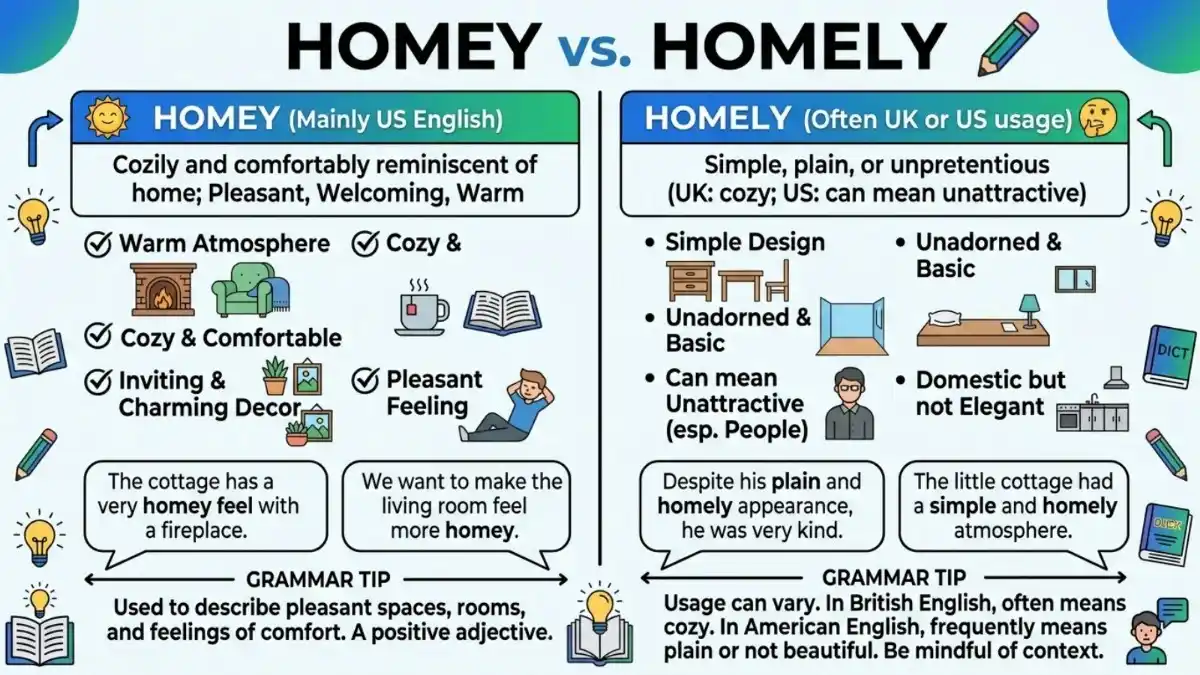
Homey means warm and cozy, like a place that feels like home. This is almost always a nice thing to say. Example: “The cabin had a homey feel, with soft blankets and a fire.”
Homely can mean two very different things, based on where you are. In the US, it often means plain-looking, when talking about a person’s face. In the UK, it means the same warm, cozy feeling as “homey.”
Simple rule: if you’re American, use “homey” for cozy places. Be careful with “homely,” since it can sound rude about looks. If you’re British, “homely” is safe and means the same nice thing as “homey.”
Why This Word Split Into Two Meanings
This word has a strange story, and it’s good to know so you don’t hurt someone’s feelings by mistake.
Both words come from the same start, “home,” plus a small part that means “like” or “close to.” So at first, both words just meant “like home,” warm and cozy, no bad meaning at all.
Over time, American English slowly changed the meaning of “homely.” Instead of just talking about a cozy place, people in the US started using it to talk about a person’s looks, and not in a nice way. It came to mean plain, or not pretty, kind of like saying someone looks “simple” instead of “pretty.”
At the same time, “homey” grew on its own in American English to take over the cozy, warm meaning that “homely” had left behind. British English never made this same change, so “homely” there still keeps its warm, cozy meaning, the same one it started with.
Breaking Down the Real Difference
| Homey (mostly American) | Homely (American meaning) | Homely (British meaning) | |
| Feeling | Warm, cozy | Plain-looking, not pretty | Warm, cozy |
| Used for | Places, rooms, food | A person’s looks | Places, people, feelings |
| Nice or not nice? | Nice | Can sound rude | Nice |
| Example | “Their kitchen felt so homey.” | “He called her plain and homely.” | “Their house had a lovely, homely feel.” |
A Simple Way to Check Yourself
Ask this: am I talking about a place feeling warm and cozy, or am I talking about how someone looks?
If it’s about a cozy place, and you’re writing for American readers, “homey” is the safe, clear word to use.
If it’s about a cozy place, and you’re writing for British readers, “homely” works just fine and means the same nice thing.
If you’re talking about how a person looks in American English, be very careful with “homely,” since it usually is not a kind word.
Try It Yourself
Guess the right meaning before you check the answer.
- An American food blog: “This soup has such a ___ taste.” → homey
- A British house listing: “A ___ cottage with a warm feel.” → homely
- An old American way to talk about someone’s looks: “She was called ___ by the neighbors.” → homely (meaning plain, not nice)
- An American review of a bed and breakfast: “The rooms felt so ___ and warm.” → homey
- A British review of a cafe: “Such a ___ little spot for tea.” → homely
If most of these felt clear, you’ve got the tricky part of this word pair figured out already.
Which Word Should You Actually Use?
Writing for American readers, about a cozy place: Use “homey.” It’s the safe, clear pick with no chance of sounding rude.
Writing for British readers, about a cozy place: “Homely” is just fine and warm here, no need to skip it.
Talking about a person’s looks in American English: Try to skip “homely” unless you truly mean the older, less kind meaning. It’s often better to just not use this word for people.
Writing for readers from many countries: “Homey” tends to be the safer, clearer pick overall, since it has no chance of sounding rude in American English.
Reading an old British book or story: If you see “homely” used for a place, it almost always means warm and cozy, the older, kinder meaning that never changed in the UK.
Common Mistakes People Make
Using “homely” for a cozy place in American writing. Some Americans might still get it, but others could take it the wrong way, so “homey” is the clearer, safer word.
Thinking “homely” is always rude. It’s not, most of all in British English, where it still just means warm and cozy, with no bad meaning at all.
Forgetting this word pair changes meaning by country. This is not like most spelling differences. The real meaning changes based on American English versus British English, which makes this pair a bit more tricky than a simple spelling swap.
Using “homely” for someone’s looks without thinking about how it sounds. In American English, this word can sound unkind, even if that was not the plan at all.
Seeing These Words in Real Life
An American Airbnb review: “Such a homey little apartment, we felt right at home.”
A British house listing: “This lovely cottage has a homely, warm feel.”
An old American story: “She was plain and homely, but kind at heart.”
A British cooking show comment: “This homely stew reminds me of my grandmother’s kitchen.”
An American design blog: “Add soft light and warm colors for a homey feel.”
Why People Search This So Often
Writers and reviewers search “homey vs homely” a lot, most of all while talking about places like homes, cafes, or hotels, wanting to sound warm and welcoming without picking a word that sounds wrong by mistake.
People reading old British books or shows search this pair too, since seeing “homely” used for a cozy place can feel odd if they only know the American meaning.
People learning English also search this often, trying to understand why one simple word can mean two almost opposite things, based on where you are.
A Few Related Word Pairs Like This
| Pair | Meaning Shift |
| Homey / Homely | Same start, but “homely” means different things in the US and UK |
| Pants | Means trousers in the US, but underwear in the UK |
| Chips | Means fries in the UK, but a snack food in the US |
| Football | Means soccer almost everywhere, but American football in the US |
Common Questions;
Is “homely” always rude in American English? Not always, but it often means plain-looking when talking about a person, so it’s safer to skip it in that case.
Why does “homely” mean something nice in the UK but not always in the US? Because American English slowly changed the word’s meaning over time to talk about looks, while British English kept the old, warm meaning tied to home and comfort.
Which word should I use if I’m writing for readers all over the world? “Homey” tends to be the safer pick, since it skips the risk of sounding rude that “homely” can carry in American English.
Can “homely” ever mean a cozy place in American English? It’s less common, but some Americans still use it that way. Just know it carries some risk of being taken the wrong way, so “homey” is often the safer word.
Is this the same kind of change as British spelling versus American spelling? Not quite. This is not just a spelling change, like “colour” versus “color.” The real meaning shifts based on the country, which makes this pair a bit more unusual.
How can I remember which one to use safely? If you’re American and talking about a cozy place, use “homey.” If you’re British, “homely” is safe for the same warm feeling. When not sure, “homey” is often the safer word around the world.
Did “homey” and “homely” always have different spellings? Not really, they both grew from the same word. Over time, American English leaned on “homey” for the cozy meaning, while “homely” picked up its different, sometimes unkind meaning about looks.
Wrapping This Up;
“Homey” and “homely” both start from the same warm idea, feeling like home. But over time, American English split them apart. “Homey” kept the cozy, warm meaning. “Homely” moved toward talking about a person’s plain looks instead. British English never made that same change, so “homely” there still just means warm and welcoming.
The safest rule to remember: use “homey” for cozy places, most of all if you’re writing for American readers. Save “homely” for British writing, or be extra careful with it in American English, since it does not always sound the way you might think.
Once this small difference clicks, you’ll never risk saying the wrong thing by mistake, and your writing about cozy places will always sound as warm as you meant it to.

Emily Carter is an English grammar writer based in Portland, Oregon, with 7+ years of experience turning tricky grammar rules into simple, easy lessons.