You’re texting a friend, or writing a quick note. You want to say something is floating in the air. Or maybe you want to talk about cleaning the living room floor. Your fingers type “hoover.” Wait, is that even the right word? Or did you mean “hover”?
Good news. Once you see how these two words split, you won’t mix them up again.
The Fast Answer
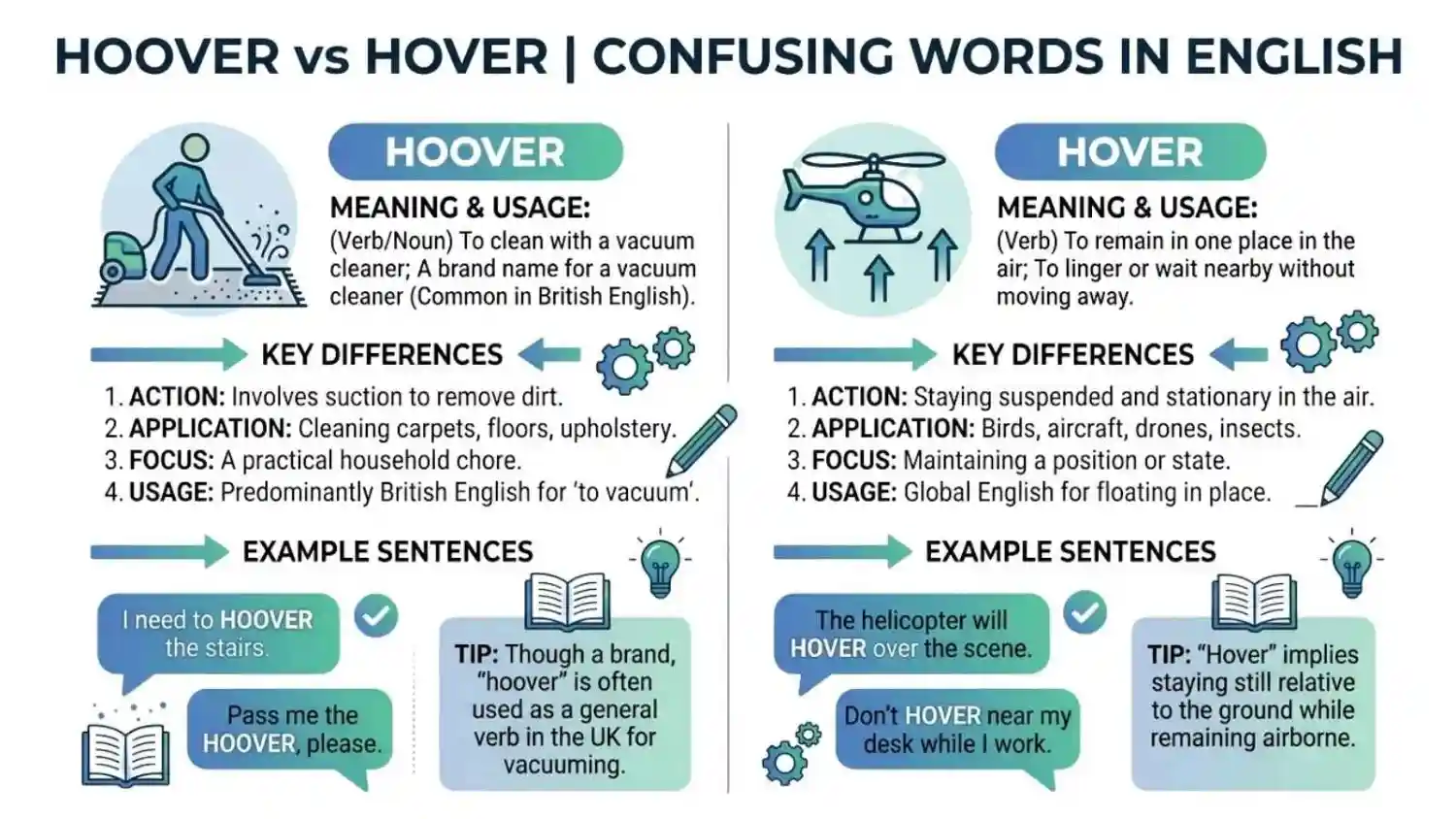
Hover means to stay in one spot in the air. It does not move up, down, or land. Think of a bee floating over a flower.
Hoover is a word some people use to mean “vacuum.” It comes from an old, very famous brand name for vacuum cleaners.
- “The bird seemed to hover just above the water.” (floating in one place)
- “Can you hoover the living room before guests come?” (British word for vacuuming)
Both words look close. Both sound close. But they mean two very different things.
Why People Mix These Up
These two words share almost the same letters, just moved around a bit. Your eyes see “hover” and “hoover” and for a second, your brain treats them like the same word in two outfits.
The mix-up grows since “hoover” is not used the same way everywhere. In the US, most people just say “vacuum.” In the UK, “hoover” is a normal, everyday word for the same task. If you don’t hear “hoover” often, it can feel like a typo of “hover,” instead of its own real word.
Where These Words Came From
Hover is the older word. It goes back hundreds of years in English. It first meant to wait around in one place. Over time, it grew to mean anything that stays still in the air, like a bird, a helicopter, or a drone.
Hoover has a newer and stranger story. It comes right from a brand name: the Hoover Company. This was one of the first and most famous makers of vacuum cleaners. The brand became so well known in the UK that people began using “hoover” as a normal word for any vacuum cleaner. They even use it as an action word, meaning to vacuum something.
This kind of thing happens more than you’d think. A brand name gets so popular that people use it for the whole group of things, not just that one company’s product. This is why some people say “Kleenex” instead of tissue, or “Xerox” instead of photocopy.
It also helps to know that the Hoover Company did not plan this. It just happened slowly, over many years. The brand showed up in so many British homes that its name stopped feeling like a brand name at all. To many people in the UK, “hoover” simply became the word for the object itself, the same way “fridge” became the daily word for refrigerator.
A Closer Look at Each Word
Hover almost always talks about movement, or staying still, in the air. It shows up in nature, in tech, and even in daily phrases about waiting close by, like “she hovered near the door, unsure if she should knock.”
Hoover, on the other hand, is tied close to cleaning. In British English, you’ll hear it a lot in daily life: “I need to hoover before the guests come,” or “the hoover broke again.” It’s used both as a thing (the machine itself) and as an action word (the act of vacuuming).
British English vs American English
This word pair connects to a real regional split, much like other well-known US vs UK word swaps.
| Word | Region | Example |
| Hover | Everywhere, same meaning | “The drone hovered above the field.” |
| Hoover | Mostly UK, means vacuum | “I’ll hoover the hallway later.” |
| Vacuum | Mostly US, same as hoover | “I’ll vacuum the hallway later.” |
So while “hover” stays the same everywhere, “hoover” as a stand-in for “vacuum” is really a British habit. It’s tied to how strongly that one brand name took over daily talk there.
Other Brand Names That Became Daily Words
Hoover is not alone in this. English has a few words that started as brand names and slowly became normal, daily words for a whole group of things.
| Brand Name | Became the Daily Word For |
| Hoover | Vacuum cleaner (mostly UK) |
| Kleenex | Facial tissue |
| Band-Aid | Bandage |
| Jacuzzi | Hot tub |
| Thermos | Insulated bottle |
Seeing this pattern helps explain why “hoover” feels so normal in British English. It’s not a strange one-off case. It’s part of a common habit in language, where a strong, early brand name just takes over as the word for the whole group of things.
A Simple Way to Remember
Try this trick: hover has an “e,” just like the word “float.” Floating is basically what hovering means. Pair those two “e” words in your head.
Hoover has two “o’s,” just like the two wheels you might picture on an old vacuum cleaner rolling across the floor.
Easy rule: floating in place? Use “hover.” Cleaning the floor? Use “hoover,” if writing in British English, or just say “vacuum” in American English.
Common Mistakes People Make
Mistake 1: Wrong: “The helicopter began to hoover above the building.”
Fix: “The helicopter began to hover above the building.” (Floating in the air always uses “hover.”)
Mistake 2: Wrong: “I need to hover the carpet before the party.”
Fix: “I need to hoover the carpet before the party.” (This is a British word for vacuuming, so it needs “hoover.”)
Mistake 3: Wrong: Using “hoover” in American writing, and hoping readers get it the same way.
Fix: In the US, use “vacuum” instead, since “hoover” is not a common daily word there.
Mistake 4: Wrong: Thinking “hoover” is just a spelling error for “hover.”
Fix: “Hoover” is a real word in British English. It comes from a famous vacuum brand, not a typo.
Everyday Examples
In a text message (UK style): “Can you hoover the stairs before Mum gets home?”
In a nature show: “The hummingbird can hover in place for several seconds at a time.”
On social media: “My cat watches the hoover like it’s a monster every single time. “
In a tech article: “The new drone can hover steady even in strong wind.”
Search Trends and Usage Data
People search “hoover or hover” for a few clear reasons.
- UK readers: Many searches just check that “hoover” is a normal, correct word for vacuuming in British English.
- US readers: Some searches come from people who heard “hoover” from a British friend, TV show, or book, and wonder if it’s a typo.
- Writers and students: Others search this while trying to pick the right word for floating versus cleaning, mostly in careful or school writing.
Both words stay in steady use. But the split between them depends a lot on which type of English you’re reading or writing.
Why Getting This Right Matters
In daily chat, mixing these words up rarely causes real trouble, since the setting usually makes the meaning clear. But in written work, mostly work read by people from many countries, using “hoover” without knowing it might confuse US readers is worth thinking about.
Picture a cleaning company’s website that says “we’ll hoover your carpets” for a US crowd. Some readers might pause, unsure if that’s a typo for “hover,” since “hoover” is just not part of daily American talk. Picking the clearer word for your reader helps stop this kind of mix-up before it starts.
The same idea works the other way too. A US company writing “we’ll vacuum your carpets” for a UK crowd would not confuse anyone. But it might feel just a bit less normal to a British reader who has heard “hoover” their whole life. Matching your word choice to your reader is a small thing. But it makes writing feel more familiar and easy to trust.
Frequently Asked Questions
1. Is “hoover” used anywhere outside the UK? It’s most common in the UK, but it’s also known in some other places with strong ties to Britain, like Ireland.
2. Why did the brand name “Hoover” become a normal word? The Hoover Company was one of the first and most loved vacuum brands in the UK, so its name slowly became the go-to word for the whole product group.
3. Do Americans ever say “hoover” instead of “vacuum”? Rarely. Most Americans use “vacuum” for both the thing and the action, and “hoover” is not a normal part of daily American English.
4. Can “hover” ever relate to cleaning? No. “Hover” is only about floating or staying still in the air, with no link to cleaning at all.
5. Is “hoovering” a real word form? Yes, in British English, “hoovering” is a totally normal word form, just like “vacuuming” is in American English.
6. Are there other brand names that became daily words like this? Yes, quite a few. “Kleenex” for tissue and “Band-Aid” for bandages are two well-known American cases of the same pattern.
7. Is there an easy way to remember which spelling to use? Yes. Hover has one “o” and links to floating. Hoover has two “o’s” and links to a vacuum’s rolling wheels.
The Bottom Line
Hoover or hover? These words look close, but they mean two very different things. Hover always means floating or staying still in the air. Hoover, mostly in British English, means vacuuming, thanks to one old vacuum brand becoming part of daily talk.
Next time you’re not sure which one fits, think about what’s really going on. Something floating in place needs “hover.” Cleaning the floor, mostly if writing in British English, needs “hoover.” That one quick check will keep your writing clear, no matter where your reader lives.
It’s a small word pair, but it’s a fun little reminder of how much history and habit shape the words we use every day, sometimes without us even knowing it.

Emily Carter is an English grammar writer based in Portland, Oregon, with 7+ years of experience turning tricky grammar rules into simple, easy lessons.