You’re writing a sentence about moving something to a spot. You type “onto,” but then you stop. Wait, isn’t there a word called “unto” too? Are they the same word? Or do they mean two different things?
Good news. This one has a clear answer, and it’s easier than it looks.
The Fast Answer
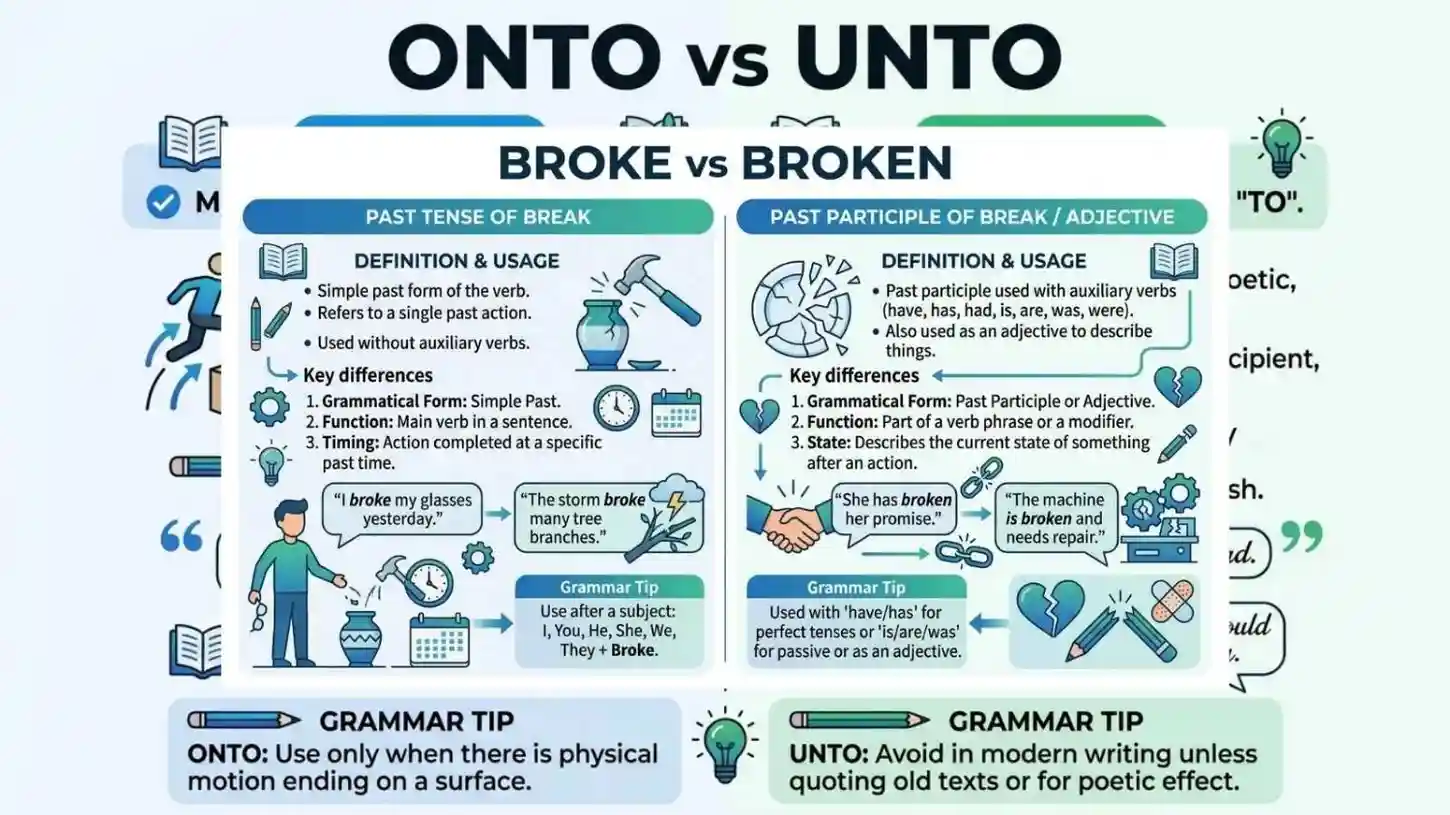
Onto means to move to a spot, or to be on top of something. It’s used all the time in daily talk and writing.
Unto is an old word that means “to.” It’s rarely used today, mostly found in old books, prayers, or poems.
- “The cat jumped onto the table.” (moved on top of something)
- “Do unto others as you would have them do unto you.” (an old, well-known saying)
Both words look close. But one is common today. The other one is mostly old and rare.
Why People Mix These Up
Both words end in “-to,” and both feel like they’re pointing you somewhere. Since they look and sound so close, it’s easy for your brain to blend them together, mostly if you’ve read a bit of old writing before.
The mix-up also happens since “unto” still shows up in a few very famous old lines, like old sayings or lines from old books. Seeing it once in a while makes it feel more normal than it actually is in daily writing today.
Where These Words Came From
Onto is a newer word, made by joining “on” and “to.” It became its own word since people needed a clear way to talk about moving to the top of something, like “she climbed onto the roof.” Before “onto” became common, people often just used “on to” as two separate words.
Unto is much older. It comes from Old English, where “un-” once worked as a kind of extra push, added to “to.” Long ago, “unto” was a normal, everyday word, used the same way we use “to” today. Over hundreds of years, “unto” slowly faded from daily talk, but it stuck around in old writing, old prayers, and famous old lines that people still quote today.
A Closer Look at Each Word
Onto always points to movement onto a surface, or being placed on top of something. “He climbed onto the bus.” “She stepped onto the stage.” “The dog jumped onto the couch.” In every case, something is landing on top of something else.
Unto simply means “to,” in an old, formal style. “Give unto others.” “Speak unto them.” It works the exact same way “to” works today, just in a much older, more formal tone.
Side-by-Side Table
| Word | Meaning | Example |
| Onto | Moving to a spot, on top of something | “The bird landed onto the branch.” |
| Unto | An old word for “to” | “He spoke unto the crowd.” |
| On to | Two separate words, still sometimes used | “Let’s move on to the next topic.” |
| To | The modern, common word | “She walked to the store.” |
A Simple Way to Remember
Try this trick: onto has the word “on” hiding right inside it, which matches its meaning, moving on top of something.
Unto feels old, just like words such as “thee” and “thou,” which also show up in old writing and prayers.
Easy rule: talking about moving onto something today? Use “onto.” Reading or writing something old-style, formal, or poetic? “Unto” might fit there instead.
Common Mistakes People Make
Mistake 1: Wrong: “She walked unto the store to buy milk.” Fix: “She walked to the store to buy milk.” (In normal, everyday writing, “to” fits here, not the old word “unto.”)
Mistake 2: Wrong: “The cat jumped unto the table.”
Fix: “The cat jumped onto the table.” (This shows movement onto a surface, so it needs “onto.”)
Mistake 3: Wrong: Using “unto” in daily writing or texting, thinking it sounds fancy or smart.
Fix: “Unto” can feel out of place in normal writing today. Save it for old-style quotes, poems, or formal, old-feeling writing.
Mistake 4: Wrong: Writing “on to” as one word when it should stay as two separate words.
Fix: “Onto” and “on to” can both be correct, depending on the sentence. “Move on to the next step” uses two words, since “on” belongs with “move,” not with “to.”
Everyday Examples
In a text message: “Can you hop onto the call in five minutes?”
In an old, well-known saying: “Do unto others as you would have them do unto you.”
On social media: “Just stepped onto the plane, vacation mode fully on!”
In a formal or poetic piece of writing: “Speak unto the people, and let your words carry hope.”
Search Trends and Usage Data
People search “onto or unto” for a few clear reasons.
- Students and writers: Many people search this while reading old books, poems, or religious texts, wanting to understand what “unto” actually means.
- Everyday writers: Some people search this simply to confirm that “onto” is the normal, correct word for daily use.
- Word lovers: A good number of searches come from people just curious about old English words that have mostly faded from daily use.
“Onto” stays in steady, common use today, while “unto” mostly lives on through old sayings, poems, and quotes.
Frequently Asked Questions
1. Is “unto” still used in modern English? Rarely. It mostly shows up in old texts, religious writing, and famous old quotes, not in normal daily writing.
2. Is “unto” wrong to use today? Not wrong, just old-feeling. It can work well in poems or formal, old-style writing, but it would feel odd in a normal text or email.
3. What’s the difference between “onto” and “on to”? “Onto” is one word when talking about movement onto a surface. “On to” stays as two words when “on” belongs with an earlier word in the sentence, like “hold on to.”
4. Why does “unto” show up in old prayers and sayings? Since “unto” was the normal word for “to” long ago, it got locked into old writing from that time, which is why it still shows up in well-known old lines today.
5. Can I use “unto” in a school paper? It’s best to stick with “to” in normal school writing, unless you’re quoting an old text directly or writing something meant to sound old-style on purpose.
6. Is “unto” only used in religious writing? Mostly, yes, though it also shows up in old poems, old stories, and some formal, ceremonial speech from the past.
7. Is there an easy way to remember when to use each word? Yes. If it feels like a normal, modern sentence, use “onto” or “to.” If it feels old, formal, or poetic, “unto” might fit better there instead.
The Bottom Line:
Onto or unto? These two words might look close, but they live in very different worlds. Onto is common today, used constantly to talk about movement onto a surface or a spot. Unto is an old word for “to,” mostly found in old books, prayers, and famous old lines, rarely used in normal writing anymore.
If you’re writing something for today, in a text, an email, or a school paper, “onto” is almost always the word you want. Save “unto” for old quotes, poems, or writing that’s meant to feel old-style and formal on purpose.
It’s a small word pair, but it’s a fun peek into how English changes over time. Words that were once totally normal, like “unto,” slowly fade into the background, replaced by simpler, newer choices, while still living on in the old lines we all still quote today. Next time you spot “unto” in an old saying, you’ll know exactly why it’s there, and why it feels just a little different from the words we use every day now.