Have you ever looked at a product label and wondered whether you should say expiry vs expiration? Both words describe the end of a valid period, but they are not used in the same way everywhere. The main difference comes from regional English.
Expiry is more common in British English and many other countries that follow British English. Expiration is more common in American English.
Both words can describe the time when something stops being valid, useful, or available. You may see them on food, medicine, documents, memberships, cards, and official forms.
People often search for expiry vs expiration because they see both forms online or on different products. They want to know which word is correct and which one they should use in their own writing.
The good news is that neither word is wrong. The best choice depends on your audience and the type of English you use.
In this guide, we will explain the difference, look at British and American usage, show common examples, and give you a simple rule to remember.
Expiry vs Expiration: Quick Answer
Expiry and expiration have almost the same meaning. Both refer to the end of a valid period.
The main difference is regional use.
- Expiry is more common in British English.
- Expiration is more common in American English.
Examples
British English:
Check the expiry date on the package.
American English:
Check the expiration date on the package.
Both sentences mean that you should check the date when the product is no longer considered valid or usable.
You may also see:
- expiry date
- expiration date
- expiry time
- expiration date
- expiry of a contract
- expiration of a license
So, if you write for a British audience, expiry is usually the better choice. If you write for an American audience, expiration is usually more natural.
The Origin of Expiry vs Expiration
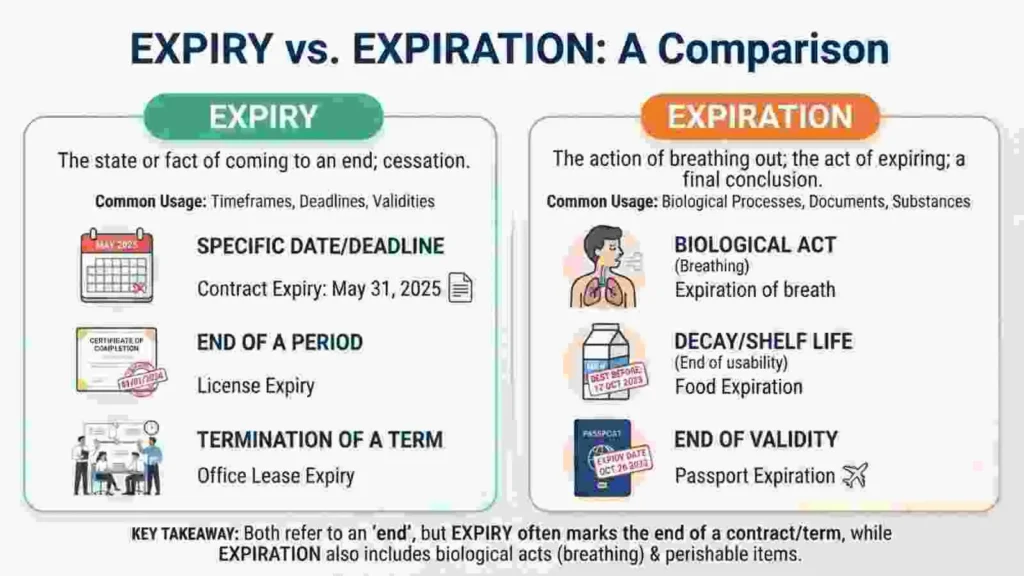
The words expiry and expiration come from the same basic idea: something coming to an end.
Expire comes from the Latin word expirare, which means “to breathe out.” The word later developed the sense of something ending or coming to an end.
The English word expire has been used for many centuries. It can describe the end of a period, contract, license, or other form of validity.
Expiry developed from expire. It means the act or time of ending. It is especially common in British English.
Expiration comes from expire as well. It uses the ending -ation, which forms nouns in English.
Over time, different forms became more common in different English-speaking regions.
British English tends to prefer expiry in many everyday uses:
The expiry date is printed on the box.
American English often prefers expiration:
Check the expiration date on the box.
The spelling difference is not caused by a different meaning. Both words point to the same basic idea.
British English vs American English Spelling
The biggest difference between expiry vs expiration is regional preference.
British English commonly uses expiry, while American English commonly uses expiration.
| Use | British English | American English |
| End of validity | expiry | expiration |
| Product date | expiry date | expiration date |
| License | expiry | expiration |
| Contract | expiry | expiration |
| Membership | expiry | expiration |
| Card | expiry date | expiration date |
British English Examples
Please check the expiry date before using the product.
My passport is close to its expiry date.
The offer has passed its expiry date.
American English Examples
Please check the expiration date before using the product.
My passport is close to its expiration date.
The offer has passed its expiration date.
Both forms are understood in many English-speaking countries. The choice mainly depends on the audience.
Which Spelling Should You Use?
The best word depends on who will read your writing.
For US Readers
Use expiration if your audience is mainly American.
For example:
Check the expiration date before buying the product.
This sounds natural in American English.
For UK Readers
Use expiry for a British audience.
For example:
Check the expiry date before buying the product.
This is a common British English form.
For Commonwealth Readers
Countries such as Australia, New Zealand, and some other Commonwealth countries may use expiry more often, although usage can vary by country and context.
If you are writing for a specific country, it is best to follow that country’s normal style.
For a Global Audience
Both words are widely understood.
If you need one simple choice for a global website, choose the form that matches your site’s main audience. Consistency is more important than switching between the two.
For a US-focused website, use expiration.
For a UK-focused website, use expiry.
Common Mistakes with Expiry vs Expiration
Writers often make a few simple mistakes with these words.
Mistake 1: Thinking One Word Is Wrong
Some people think expiry is incorrect because they are used to American English.
That is not true.
Expiry is a standard English word.
Likewise, expiration is a standard English word.
Mistake 2: Mixing Regional Styles
A writer may use expiry in one paragraph and expiration in the next.
This is not always grammatically wrong, but it can make your writing look less consistent.
Better:
Choose one form based on your audience and use it throughout the page.
Mistake 3: Writing “Expiry Date” for a US Audience
This is understandable, but expiration date is more natural in American English.
Instead of:
Check the expiry date.
Use:
Check the expiration date.
Mistake 4: Thinking Expiry and Expiration Have Different Meanings
In most common uses, they refer to the same basic idea.
The main difference is regional preference, not meaning.
Mistake 5: Confusing Expire With Expiry
These words have different grammar roles.
Expire is a verb:
My passport will expire next year.
Expiry is a noun:
The expiry date is next year.
Expiration is also a noun:
The expiration date is next year.
Expiry vs Expiration in Everyday Examples
Let’s look at how these words appear in common writing.
In Emails
British English:
Please renew your membership before its expiry.
American English:
Please renew your membership before its expiration.
Both sentences tell the reader to renew the membership before it ends.
In News Writing
British English:
The agreement is nearing its expiry date.
American English:
The agreement is nearing its expiration date.
News writers choose the form that matches their publication’s style.
On Social Media
British English:
Don’t forget to check the expiry date before using it!
American English:
Don’t forget to check the expiration date before using it!
Both work well for their intended audiences.
In Formal Writing
British English:
The contract will end upon its expiry.
American English:
The contract will end upon its expiration.
Both forms are suitable for formal writing.
In Everyday Speech
You may hear:
When does your passport expire?
This sentence uses expire, the verb, and works in both British and American English.
For the noun, the regional difference appears:
What is the expiry date?
or
What is the expiration date?
Expiry vs Expiration: Google Trends & Usage Data
Searches for expiry vs expiration often come from people who see both terms on websites, products, forms, cards, and official documents.
The search pattern also reflects regional English.
Expiration is strongly associated with American English, while expiry is strongly associated with British English and several other varieties of English.
The terms also appear in different contexts.
| Context | Common British Form | Common American Form |
| Food label | expiry date | expiration date |
| Medicine label | expiry date | expiration date |
| Credit card | expiry date | expiration date |
| Passport | expiry date | expiration date |
| Contract | expiry | expiration |
| Membership | expiry | expiration |
| License | expiry | expiration |
Search interest can also change depending on the topic. People may search for these terms when checking food dates, medicine labels, passports, credit cards, subscriptions, or legal documents.
Google Trends can show changes in search interest over time and by country, but it does not mean one form is grammatically better than the other.
For SEO, the best choice is to match the word your target readers are most likely to use.
If your website targets the United States, expiration is usually the stronger natural choice.
If your website targets the United Kingdom, expiry is usually the stronger choice.
Expiry vs Expiration: Comparison Table
| Feature | Expiry | Expiration |
| Basic meaning | End of validity | End of validity |
| Word type | Noun | Noun |
| British English | Very common | Less common |
| American English | Less common | Very common |
| Common phrase | expiry date | expiration date |
| Food labels | Common | Common |
| Medicine | Common | Common |
| Contracts | Common | Common |
| Passports | Common | Common |
| Credit cards | Common | Common |
| Formal writing | Yes | Yes |
| Correct spelling | Yes | Yes |
FAQs About Expiry vs Expiration
1. Is expiry and expiration the same thing?
In most common uses, yes. Both refer to the end of a valid period. The main difference is regional usage.
2. Is expiry British or American?
Expiry is more common in British English.
3. Is expiration American English?
Yes. Expiration is the more common form in American English.
4. Should I say expiry date or expiration date?
Use expiry date for British English and expiration date for American English.
5. Is “expiry” a correct English word?
Yes. Expiry is a standard English noun and is widely used in British English.
6. Is “expiration” a correct English word?
Yes. Expiration is a standard English noun and is especially common in American English.
7. Which one should I use on my website?
Match your main audience. Use expiration for a US-focused website and expiry for a UK-focused website. For a global website, choose one style and use it consistently.
Conclusion

The difference between expiry vs expiration is simple. Both words describe the end of a valid period. The main difference is where they are most common.
Expiry is more common in British English and is often seen in phrases such as expiry date. Expiration is more common in American English, especially in the phrase expiration date.
Neither word is wrong. You should choose the form that fits your readers.
If you write for people in the United States, expiration will usually sound more natural. If you write for people in the United Kingdom, expiry will usually be the better choice. Some other English-speaking countries may also prefer expiry, but local usage can vary.
Remember that expire is the verb:
My passport will expire soon.
Expiry and expiration are nouns:
The expiry date is soon.
The expiration date is soon.
Once you know this simple regional difference, you can use these words with confidence. Pick the form that matches your audience, keep your writing consistent, and you will avoid most problems with expiry vs expiration.