Have you ever seen the words fairing and faring and wondered which one is correct? They look almost the same, but they have very different meanings.
Fairing and faring are both real English words. However, you cannot use them in the same way.
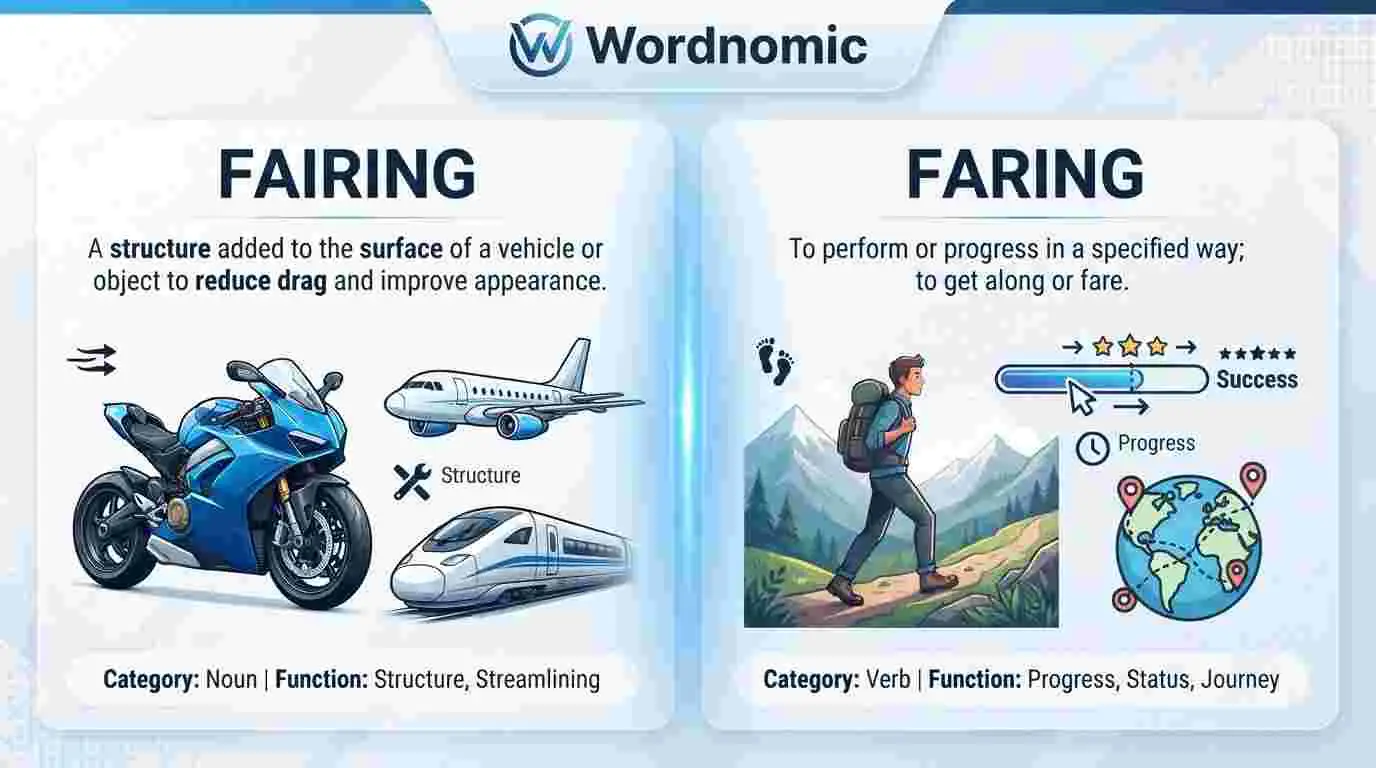
Fairing is mainly a noun. It refers to a part or cover that helps make a vehicle, aircraft, or other object smoother or more aerodynamic.
Faring is the present participle of the verb fare. It means doing, getting on, or progressing in a certain way. For example, you can ask, “How are you faring?” This means “How are you doing?” Cambridge lists faring as the present participle of fare.
The extra i in fairing makes a big difference. If you are writing about a motorcycle part, fairing is usually the word you need. If you are talking about how a person, team, business, or project is doing, use faring.
Let’s look at the difference in simple terms.
Fairing vs Faring: Quick Answer
Fairing and faring have different meanings.
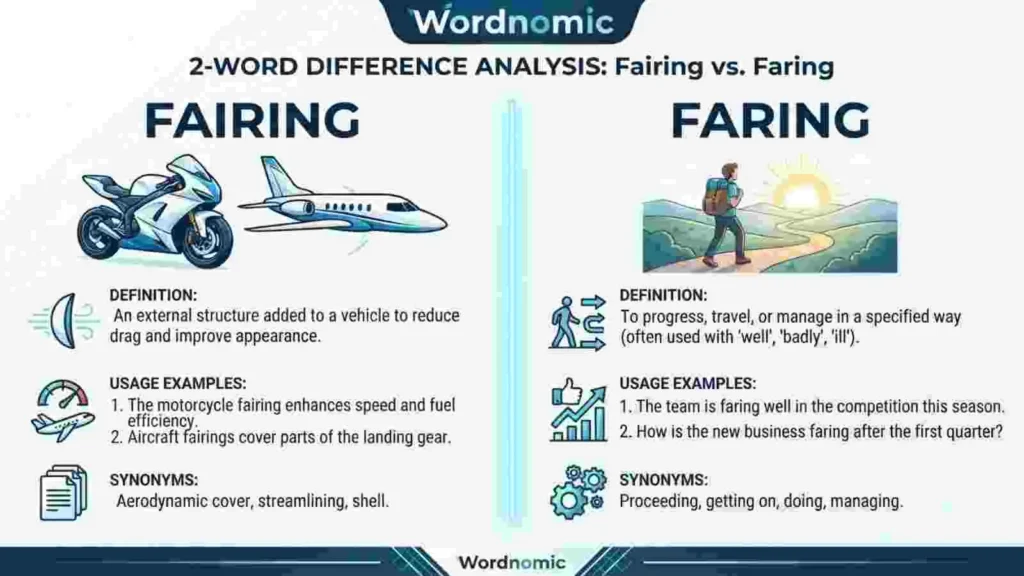
- Fairing = a cover or part that helps make a vehicle or object smooth.
- Faring = doing or progressing in a certain way.
Examples
- The motorcycle has a new fairing.
- How is your new business faring?
- The aircraft has a smooth body fairing.
- The students are faring well in school.
So, remember:
Fairing = a part or cover.
Faring = doing or progressing.
What Does Fairing Mean?
Fairing is a noun used mainly in technical and transport contexts.
A fairing is a part that covers or surrounds another part of a vehicle or machine. It often has a smooth shape.
The purpose can include reducing air resistance, protecting parts, or improving the shape of a vehicle.
You may see fairings on:
- Motorcycles
- Aircraft
- Bicycles
- Cars
- Boats
- Rockets
- Other machines
For example:
The rider replaced the damaged fairing on his motorcycle.
Here, fairing means a physical part of the motorcycle.
A motorcycle fairing can cover parts of the bike and help improve its shape and airflow.
Cambridge examples also use fairing in transport and aircraft contexts, such as a wheel-well fairing.
Examples of Fairing
- The motorcycle needs a new fairing.
- The mechanic repaired the front fairing.
- The aircraft has a smooth fairing around the wheel area.
- The bike’s fairing was damaged in the crash.
- The new fairing gives the motorcycle a cleaner look.
What Does Faring Mean?
Faring comes from the verb fare.
The verb fare means to do, progress, or experience something in a certain way.
So, faring means doing or progressing.
For example:
How are you faring at your new job?
This means:
How are you doing at your new job?
Cambridge defines faring as the present participle of fare. It gives examples such as people or groups “faring well” or “faring poorly.”
Examples of Faring
- How are you faring at school?
- The team is faring well this season.
- How is the new business faring?
- She is faring better than expected.
- The company is faring poorly this year.
Fairing vs Faring: Main Difference
The easiest way to understand the difference is to look at their meanings.
| Word | Meaning | Part of Speech | Example |
| Fairing | A cover or part on a vehicle or machine | Noun | The bike has a new fairing. |
| Faring | Doing or progressing | Verb form | How are you faring? |
The words look similar, but they belong to different word groups.
Fairing usually names a thing.
Faring describes an action or state.
Fairing and Faring in Sentences
Here are some simple examples.
Fairing
The motorcycle has a large fairing.
The word refers to a physical motorcycle part.
The mechanic removed the front fairing.
Again, fairing refers to a part.
The aircraft’s fairing was damaged.
The word describes a physical cover or structure.
Faring
How are you faring in your new job?
Here, faring means doing.
The team is faring well this year.
Here, faring means progressing.
The company is faring better than expected.
The word tells us how the company is doing.
Fairing vs Faring: How to Remember
A simple memory trick can help.
Think of Fairing as a Thing
Fairing has air inside it:
fAIRing
This can remind you of air and aerodynamics.
Fairings are often used on motorcycles, aircraft, and other vehicles to create a smoother shape.
Think of Faring as Fare
Faring comes from fare.
For example:
How are you faring?
Think:
How are you doing?
This makes the difference easier to remember.
Common Mistakes With Fairing and Faring
Many people mix these words because they look and sound similar.
Mistake 1: Using Fairing for a Person
Incorrect:
How are you fairing at your new job?
Correct:
How are you faring at your new job?
Use faring when you mean doing or progressing.
Mistake 2: Using Faring for a Motorcycle Part
Incorrect:
The motorcycle needs a new faring.
Correct:
The motorcycle needs a new fairing.
Use fairing for the physical vehicle part.
Mistake 3: Thinking Fairing Means Doing Well
Some people may confuse fairing with faring because of the similar spelling.
But fairing does not mean doing well.
Use faring for that meaning.
Fairing vs Faring: British English and American English
Both fairing and faring are used in British and American English.
There is no major British-American spelling difference between these two words.
The important difference is their meaning.
British English
- fairing
- faring
American English
- fairing
- faring
The spelling stays the same.
The word faring comes from fare, which Cambridge lists as a verb meaning to succeed or be treated in a stated way.
Which Word Should You Use?
Use the word that matches your meaning.
Use Fairing When:
You are talking about a physical part or cover.
Examples:
- motorcycle fairing
- aircraft fairing
- wheel fairing
- vehicle fairing
Use Faring When:
You are talking about how someone or something is doing.
Examples:
- faring well
- faring badly
- faring better
- faring worse
A quick test can help:
Can you replace the word with “doing”?
If yes, you probably need faring.
For example:
How are you faring?
You can say:
How are you doing?
So faring is correct.
If you are naming a physical vehicle part, use fairing.
Fairing vs Faring Examples
Here are more everyday examples.
Fairing Examples
- The motorcycle has a new fairing.
- The mechanic repaired the damaged fairing.
- The bike’s front fairing looks great.
- The aircraft has a smooth fairing.
- He ordered a replacement fairing.
- The old fairing was cracked.
- The rider removed the side fairing.
- The new fairing improves the bike’s appearance.
Faring Examples
- How are you faring at college?
- The team is faring well.
- The company is faring better this year.
- How is your project faring?
- The students are faring well in their exams.
- The new product is faring poorly.
- She is faring better than before.
- The business is faring well in the new market.
Fairing or Faring in Real Life
You are more likely to see fairing in technical, automotive, motorcycle, aviation, or engineering writing.
For example:
The motorcycle’s fairing was replaced after the accident.
You are more likely to see faring in general writing.
For example:
How is your new job faring?
You may also see faring in news stories, business reports, sports writing, and everyday questions.
For example:
The team is faring well this season.
The economy is faring better than expected.
How are the students faring in their exams?
Related Words
Understanding a few related words can make this topic easier.
Fare
Fare is the base verb.
It can mean to do or progress in a certain way.
Example:
How did you fare in the test?
Fared
Fared is the past form of fare.
Example:
The team fared well in the final.
Cambridge lists fared as the past simple and past participle of fare.
Faring
Faring is the -ing form.
Example:
The team is faring well.
Fairing
Fairing is a noun for a cover or structure used on vehicles and machines.
Example:
The motorcycle has a new fairing.
Frequently Asked Questions
Is fairing or faring correct?
Both fairing and faring are correct words. They have different meanings. Fairing usually refers to a physical cover or part, while faring means doing or progressing.
Is “how are you fairing?” correct?
No, not if you mean “How are you doing?” The correct sentence is:
How are you faring?
What is a fairing on a motorcycle?
A motorcycle fairing is a body panel or cover that helps shape and protect parts of the motorcycle. It can also help improve airflow around the bike.
What does faring mean?
Faring means doing or progressing in a certain way. For example, “She is faring well” means “She is doing well.”
Is faring a real word?
Yes. Faring is the present participle of fare.
What is the difference between fairing and faring?
Fairing is usually a noun for a physical cover or part. Faring is a verb form that means doing or progressing.
How can I remember the difference?
Think of fairing as a vehicle part and faring as an action.
Fairing = part
Faring = doing
Featured Snippet Answer
Fairing vs faring: Fairing is a noun that usually means a smooth cover or body part on a vehicle, aircraft, or machine. Faring is the present participle of fare and means doing or progressing. For example, “The motorcycle has a new fairing,” but “How are you faring at work?”
Conclusion
Fairing and faring are both correct words, but they do not mean the same thing.
Use fairing when you mean a physical cover or part. You may see this word when reading about motorcycles, aircraft, cars, or other machines.
Use faring when you mean doing or progressing. It comes from the verb fare. For example, “How are you faring?” means “How are you doing?” Cambridge confirms that faring is the present participle of fare.
The easiest way to remember the difference is simple:
Fairing = a physical part.
Faring = doing or progressing.
Once you learn this small difference, you can choose the right word with confidence.
SEO Meta Title
Fairing vs Faring: What Is the Difference?
URL Slug
fairing-vs-faring

Emily Carter is an English grammar writer based in Portland, Oregon, with 7+ years of experience turning tricky grammar rules into simple, easy lessons.