Have you ever stopped while writing and wondered whether to use invokes vs evokes? These two words look and sound very close, so it is easy to mix them up. Both words come from the same Latin root and have a basic idea of “calling” something. However, they do not mean the same thing in modern English.
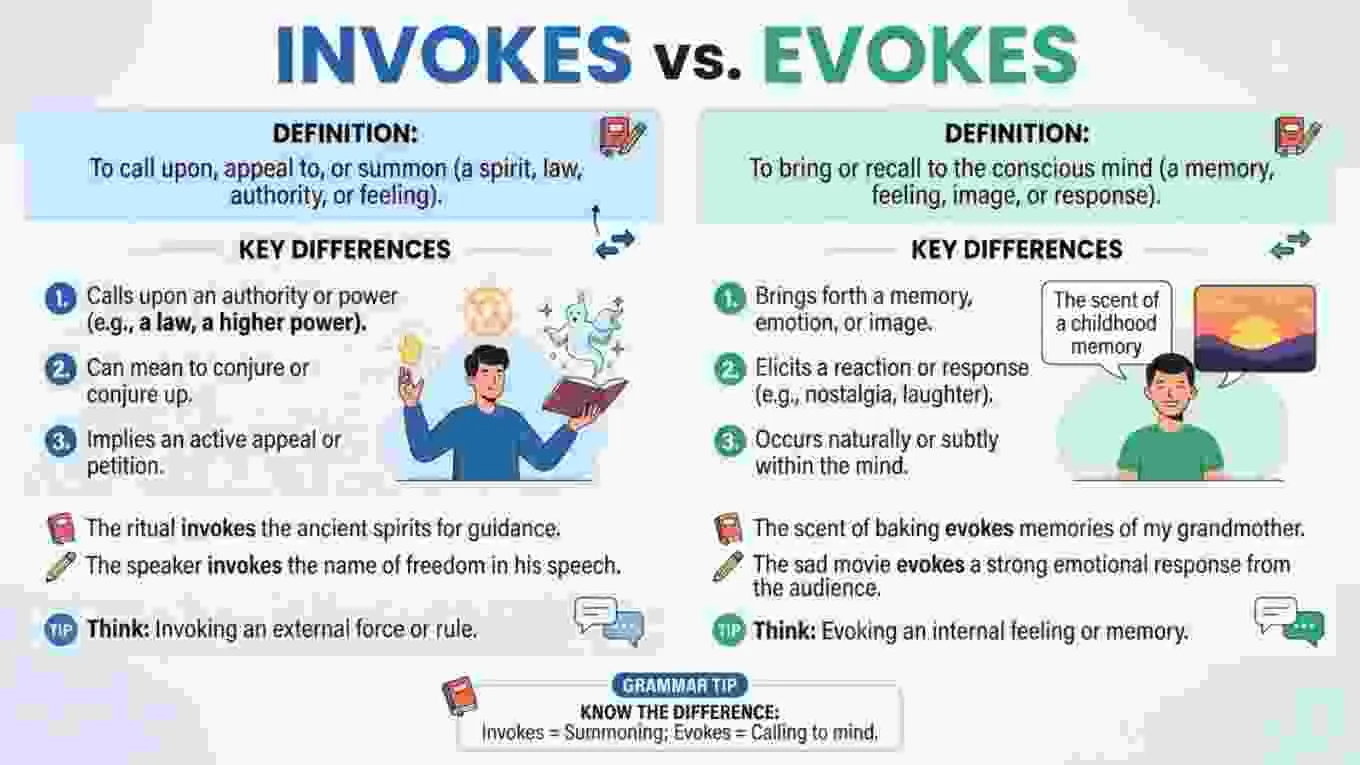
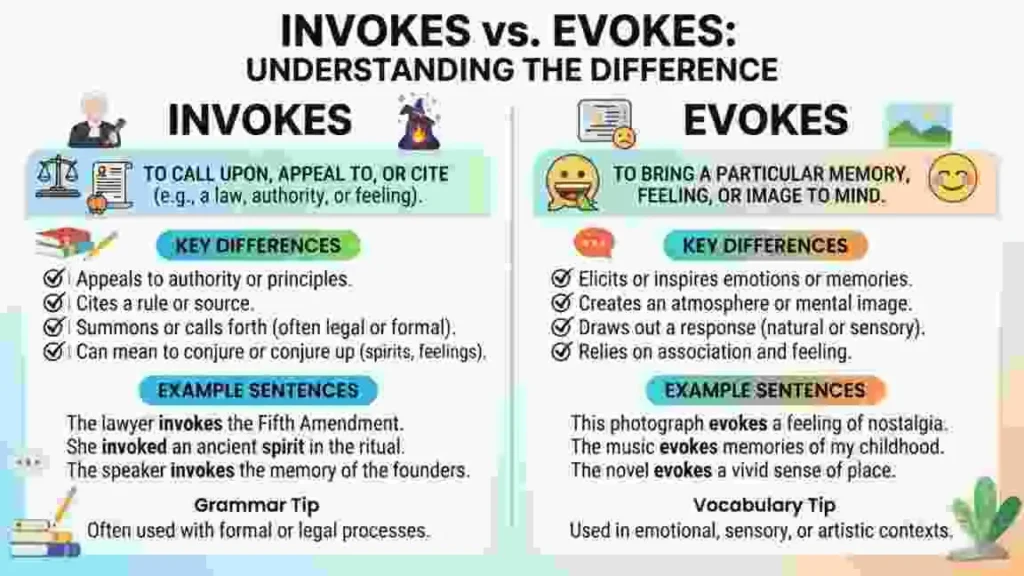
Invoke usually means to call upon something for help, support, authority, or effect. You may invoke a law, a right, a rule, or a higher power.
Evoke usually means to bring a feeling, memory, image, or reaction to mind. A song can evoke a memory, while a photo can evoke strong feelings.
This small difference matters in emails, school work, business writing, news reports, and legal writing. Using the wrong word can change the meaning of your sentence.
The good news is that the rule is simple. If something calls upon a law, right, power, or authority, use invoke. If something brings up a feeling, memory, image, or reaction, use evoke.
Invokes vs Evokes: Quick Answer
Invokes and evokes are both correct words, but they have different uses.
| Word | Simple meaning | Common examples |
| Invokes | Calls upon or uses something for support or effect | invokes a law, invokes a right |
| Evokes | Brings a feeling, memory, image, or reaction to mind | evokes memories, evokes sadness |
Examples
Invoke:
- The lawyer invokes the law to support her case.
- The company invokes its safety policy.
- The speaker invokes the right to free speech.
Evoke:
- The old photo evokes childhood memories.
- The song evokes feelings of joy.
- The smell of bread evokes memories of home.
A simple rule can help:
Invoke = call upon.
Evoke = bring to mind.
Both words are verbs. Invokes and evokes are the third-person singular forms used with words such as he, she, it, or a singular noun.
The Origin of Invokes vs Evokes
The similarity between these words is not an accident. Both words come from Latin and share the root vocare, which means “to call.” They are also linked to the Latin word vox, meaning “voice.”
Invoke comes from the Latin invocare, meaning “to call upon” or “to appeal to.” It entered English in the late 15th century through French.
Evoke comes from the Latin evocare, meaning “to call out,” “rouse,” or “summon.” It entered English later, around the early 17th century. Its use for feelings and memories developed later.
The prefixes also give us a useful clue:
- in- can carry the idea of calling upon something.
- e- comes from a form of Latin ex-, linked with calling something out.
This history helps explain why the words look so much alike. They have a shared family history, but English gave them different jobs.
Today, invoke often points to an outside source, such as a law, right, rule, authority, or power.
Evoke often points to something that comes into the mind or creates a response, such as a memory, feeling, image, or emotion.
British English vs American English Spelling
There is no spelling difference between British and American English for these words.
Both forms use:
- invoke
- invokes
- invoked
- invoking
- evoke
- evokes
- evoked
- evoking
The main difference is not spelling. The difference is meaning and use.
| Form | British English | American English | Meaning |
| Invoke | invoke | invoke | Call upon something |
| Invokes | invokes | invokes | Calls upon something |
| Invoked | invoked | invoked | Called upon something |
| Evoke | evoke | evoke | Bring something to mind |
| Evokes | evokes | evokes | Brings something to mind |
| Evoked | evoked | evoked | Brought something to mind |
Examples in Both Forms
British English:
The lawyer invokes the client’s legal rights.
American English:
The lawyer invokes the client’s legal rights.
There is no spelling change.
Another example:
British English:
The song evokes memories of school.
American English:
The song evokes memories of school.
Again, the spelling stays the same.
So if you are writing for readers in the UK, USA, Canada, Australia, or other English-speaking places, you do not need to change the spelling.
Which Spelling Should You Use?
You do not need to choose a British or American spelling here. Both use the same forms.
Instead, choose the word based on what you want to say.
Use “invokes” when something is called upon
Use invokes when a person, group, or thing calls upon:
- a law
- a rule
- a right
- an authority
- a power
- a principle
- a name
- a formal policy
For example:
The lawyer invokes the law during the case.
The company invokes its refund policy.
The speaker invokes the right to remain silent.
Use “evokes” when something brings a response to mind
Use evokes when something brings up:
- a memory
- a feeling
- an emotion
- an image
- a reaction
- a sense of place
- a mood
For example:
The old house evokes memories of childhood.
The painting evokes a feeling of peace.
The movie evokes strong emotions.
Easy rule
Ask yourself:
Am I calling upon something?
If yes, use invokes.
Am I bringing a feeling, memory, or image to mind?
If yes, use evokes.
Common Mistakes with Invokes vs Evokes
Because these words look similar, writers often use one when they need the other.
Mistake 1: Using “invokes” for a memory
❌ The old song invokes memories of school.
For normal modern English, evokes is the better choice.
✅ The old song evokes memories of school.
The song brings the memories back to the person’s mind.
Mistake 2: Using “evokes” for a legal right
❌ The lawyer evokes the right to remain silent.
Use invokes because the lawyer is formally calling upon a legal right.
✅ The lawyer invokes the right to remain silent.
Mistake 3: Using “invokes” for an emotion
❌ The painting invokes sadness.
The natural word is evokes because the painting creates or brings out an emotion.
✅ The painting evokes sadness.
Mistake 4: Using “evokes” for a law
❌ The judge evokes the law.
When someone calls upon or applies a law as authority, invokes fits better.
✅ The judge invokes the law.
Mistake 5: Thinking one word is wrong
Neither word is wrong.
Both invoke and evoke are standard English words. The problem comes when writers use them in the wrong context.
Invokes vs Evokes in Everyday Examples
Seeing the words in real sentences makes the difference easier to remember.
In Emails
Invoke:
The manager invokes the company’s safety policy.
Evoke:
Your message evokes memories of our first project.
In business emails, invoke often appears with rules, policies, rights, or agreements.
In News Writing
Invoke:
The government invokes emergency powers after the storm.
Evoke:
The speech evokes strong reactions from the public.
News writing often uses invoke for laws and powers and evoke for feelings and reactions.
On Social Media
Invoke:
The post invokes the importance of free speech.
Evoke:
This photo evokes so many happy memories.
Social media can use both words. The right choice depends on the meaning.
In Formal Writing
Invoke:
The court invokes an earlier legal decision.
Evoke:
The writer evokes a strong sense of nostalgia.
Invoke is common in legal and formal writing. Evoke is common in writing about art, books, music, feelings, and memories.
In Everyday Speech
Invoke:
He invokes his right to remain silent.
Evoke:
That smell evokes memories of my grandmother’s kitchen.
The same simple rule works in everyday English.
Invokes vs Evokes: Google Trends & Usage Data
People search for “invoke vs evoke,” “invoke or evoke,” and “invokes vs evokes” because the words look and sound alike. They also share the same Latin root, which makes the confusion understandable.
Search interest for this type of word comparison usually comes from people who want help with word choice, grammar, school writing, professional writing, and English learning.
It is important not to treat the two words as spelling variations. Invoke and evoke are separate words with different meanings.
In English-speaking countries such as the United States, United Kingdom, Canada, and Australia, the spelling remains the same. There is no British spelling such as evouke or an American spelling such as invok. The standard forms are invoke and evoke.
Usage also changes by topic.
| Context | More common word | Example |
| Law | Invoke | invokes a legal right |
| Rules | Invoke | invokes a company rule |
| Authority | Invoke | invokes official authority |
| Rights | Invoke | invokes the right to appeal |
| Memories | Evoke | evokes childhood memories |
| Feelings | Evoke | evokes happiness |
| Music | Evoke | evokes strong emotions |
| Art | Evoke | evokes a sense of peace |
| Nostalgia | Evoke | evokes nostalgia |
Current dictionary examples also show evoke being used with memories, emotions, reactions, and artistic effects, while invoke is commonly linked with laws, rights, authority, and formal appeals.
Invokes vs Evokes: Comparison Table
| Feature | Invokes | Evokes |
| Basic idea | Calls upon | Brings to mind |
| Main use | Authority, law, rights, rules | Feelings, memories, images |
| Common object | Law or right | Memory or emotion |
| Common in legal writing | Yes | Less common |
| Common in creative writing | Sometimes | Yes |
| Common with memories | No, usually | Yes |
| Common with emotions | Sometimes, but not usually | Yes |
| British spelling | invokes | evokes |
| American spelling | invokes | evokes |
| Example | The lawyer invokes the law. | The song evokes memories. |
FAQs About Invokes vs Evokes
1. What is the main difference between invokes and evokes?
Invokes means calls upon something, such as a law, right, rule, or authority. Evokes means brings a memory, feeling, image, or reaction to mind.
2. Is “invoke” a formal word?
Yes. Invoke often appears in legal, business, academic, and formal writing. For example, a lawyer may invoke a legal right.
3. Is “evoke” used for emotions?
Yes. Evoke commonly describes something that creates or brings out a feeling or emotion.
For example:
The song evokes sadness.
4. Can I use invoke and evoke in the same sentence?
Yes, if each word has its own correct meaning.
For example:
The speech invokes a legal principle and evokes strong emotions.
Here, invokes refers to the principle, while evokes refers to the emotions.
5. Do British and American English spell these words differently?
No. British and American English use the same spellings: invoke and evoke.
6. Is “invokes” the past tense of invoke?
No. Invokes is the present-tense form used with a singular subject.
Example:
The lawyer invokes the law.
The past tense is:
The lawyer invoked the law.
7. How can I remember the difference?
Use this easy rule:
Invoke = call upon.
Evoke = bring to mind.
Think of a lawyer invoking a law and a song evoking a memory.
Final Takeaway
The difference between invokes vs evokes becomes easy once you focus on the meaning. Both words are correct, and neither is a British or American spelling variation of the other. They simply have different jobs.
Use invokes when someone calls upon something for help, support, authority, or effect. This can include a law, rule, right, policy, principle, or power.
Use evokes when something brings a feeling, memory, image, or reaction to mind. A song can evoke memories. A photo can evoke happiness. A story can evoke sadness.
Both words come from Latin roots connected with the idea of calling. That shared history explains why they look so similar.
When you are unsure, ask one simple question: Am I calling upon something, or am I bringing something to mind?
If you are calling upon a law or right, choose invokes. If you are bringing back a feeling or memory, choose evokes.
Once you learn this simple rule, you can use both words with confidence in emails, school work, business writing, news, and formal documents.

Emily Carter is an English grammar writer based in Portland, Oregon, with 7+ years of experience turning tricky grammar rules into simple, easy lessons.