Choosing a doctoral degree can be a big step. You may see DPhil at one university and PhD at another. This can make students wonder if they are the same degree or if one is higher than the other.
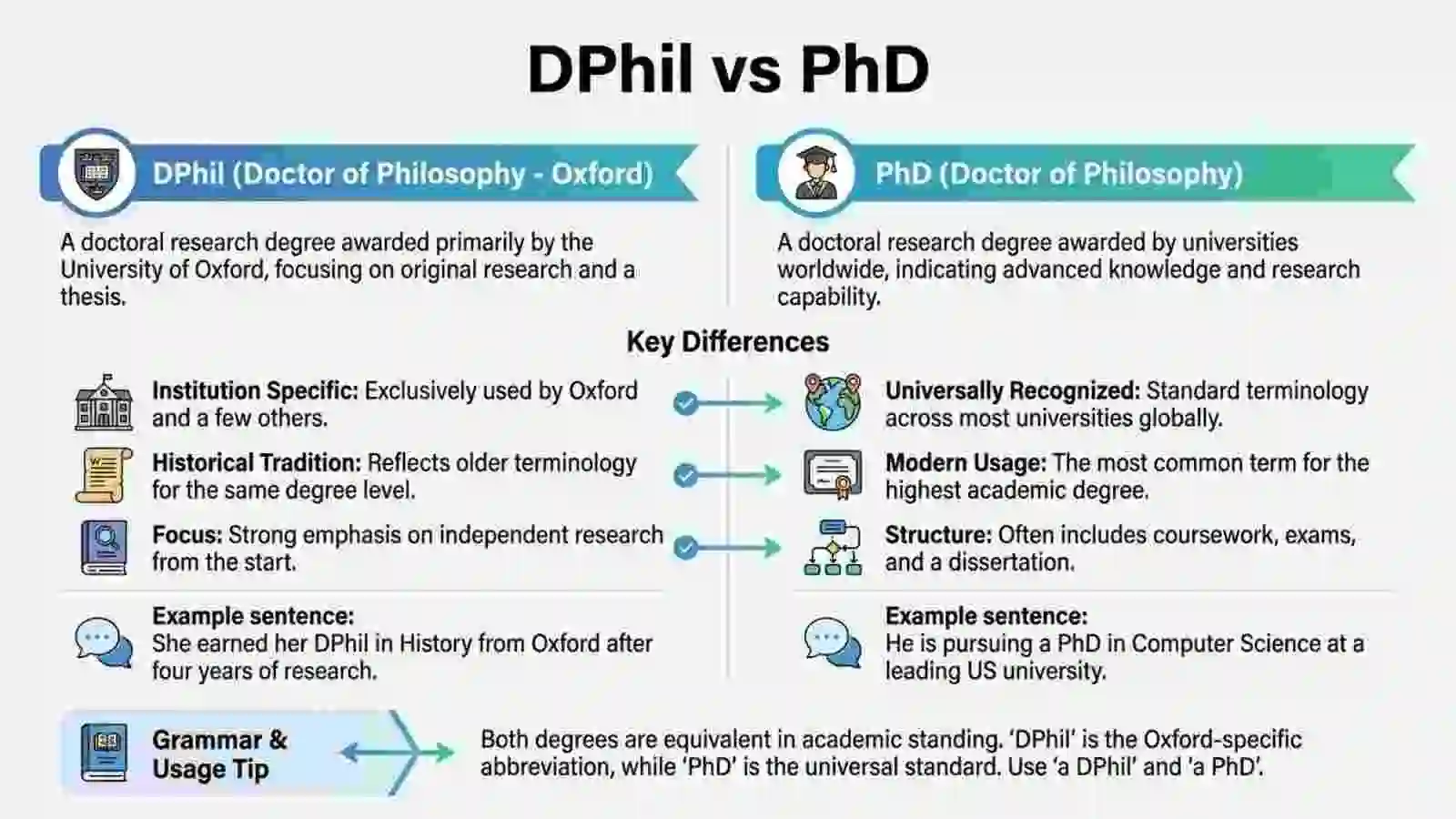
The good news is that DPhil and PhD are both research doctorates. In most cases, they are at the same academic level. The main difference is the name used by the university.
PhD stands for Doctor of Philosophy. It is the most common name for a research doctorate around the world.
DPhil also means Doctor of Philosophy. The letters come from the Latin order of the words, Doctor Philosophiae. Some universities use DPhil instead of PhD.
The two degrees usually involve original research, a thesis or dissertation, and an oral exam or defense.
In this guide, we will explain DPhil vs PhD, their meaning, history, spelling, entry rules, and common mistakes. You will also learn which term you should use when talking about doctoral study.
DPhil vs PhD: Quick Answer
DPhil and PhD are usually equivalent research doctorates.
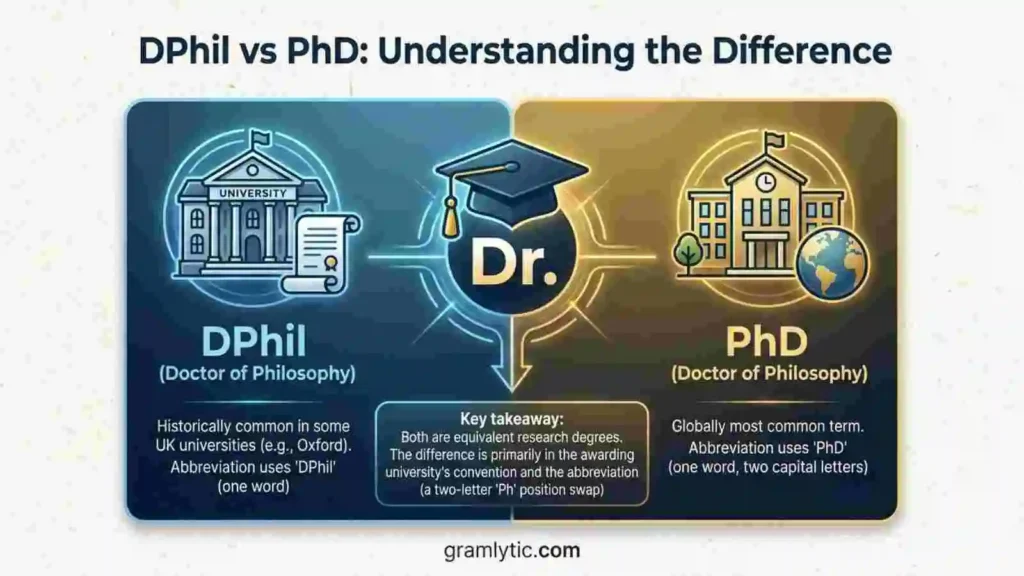
The main difference is the name, not the academic level.
- PhD = Doctor of Philosophy
- DPhil = Doctor of Philosophy
- Both are usually research-based doctoral degrees.
- Both normally require original research.
- Both can lead to careers in research, teaching, industry, or other professional fields.
Simple example
A university may offer a:
PhD in Chemistry
Another university may offer a:
DPhil in Chemistry
This does not mean that the DPhil is automatically higher than the PhD.
The university decides which name it uses.
The easiest answer
DPhil and PhD usually mean the same level of doctoral degree. The university decides which name to use.
The Origin of DPhil vs PhD
The difference between DPhil and PhD comes from the way the degree title is written.
What does PhD mean?
PhD stands for Doctor of Philosophy.
The name comes from the Latin phrase Philosophiae Doctor.
The letters are arranged as:
Ph = Philosophy
D = Doctor
So:
PhD = Doctor of Philosophy
Despite the word “Philosophy,” a PhD is not limited to the subject of philosophy.
You can earn a PhD in many fields, such as:
- Chemistry
- Biology
- Physics
- Computer science
- Education
- History
- Engineering
- Economics
- Psychology
What does DPhil mean?
DPhil is another form of the same degree name.
It comes from the Latin form:
Doctor Philosophiae
The order of the words gives us:
D = Doctor
Phil = Philosophy
So:
DPhil = Doctor of Philosophy
Why do universities use different names?
Different universities and education systems developed their own naming styles.
Most universities use PhD.
Some universities use DPhil.
The name does not by itself tell you that one degree is harder or more valuable than the other.
British English vs American English Spelling
Unlike words such as colour and color, DPhil and PhD are not mainly a British versus American spelling issue.
They are different abbreviations for the same degree title.
Comparison table
| Feature | DPhil | PhD |
| Full meaning | Doctor of Philosophy | Doctor of Philosophy |
| Origin of abbreviation | Doctor Philosophiae | Philosophiae Doctor |
| Degree level | Doctoral | Doctoral |
| Main use | Used by some universities | Used by most universities |
| Research degree | Yes | Yes |
| Spelling variation | DPhil | PhD |
DPhil in British English
DPhil is strongly linked with some British universities.
For example, the University of Oxford uses the term DPhil for many of its doctoral programs.
You may therefore see:
DPhil in Chemistry
or:
DPhil in English
PhD in British English
Many British universities use PhD.
For example:
PhD in Chemistry
So even in the UK, you can see both terms.
PhD in American English
PhD is the standard term used by most American universities.
You will normally see:
PhD in Chemistry
rather than:
DPhil in Chemistry
Important point
Do not change DPhil to PhD when writing the official name of a degree.
If a university calls its program a DPhil, use DPhil.
If it calls the program a PhD, use PhD.
Which Degree Should You Choose?
The important thing is not whether the name says DPhil or PhD.
Instead, look at the actual program.
Check:
- Research topic
- Supervisor
- University
- Entry requirements
- Funding
- Course length
- Thesis rules
- Research facilities
- Career options
- Location
If you are applying in the UK
You may find both DPhil and PhD programs.
Do not assume that DPhil is better because the name looks different.
Compare the programs and choose the one that fits your research goals.
If you are applying in the US
You will usually see PhD.
The term DPhil is much less common in the United States.
If you are applying internationally
PhD is usually the easier term for people around the world to recognize.
However, always use the official name shown by the university.
For your CV
Use the exact degree title awarded by your university.
For example:
DPhil in Chemistry
or:
PhD in Chemistry
Do not change the official degree name just to match another country.
Common Mistakes with DPhil vs PhD
Mistake 1: Thinking DPhil is higher than PhD
❌ A DPhil is always higher than a PhD.
This is not correct.
In most cases, both refer to a doctoral research degree at the same level.
Mistake 2: Thinking PhD means philosophy only
❌ You can only get a PhD in philosophy.
This is false.
A PhD can be awarded in many academic fields.
For example:
PhD in Chemistry
PhD in Computer Science
Mistake 3: Changing DPhil to PhD
If a university officially awards a DPhil, do not change it to PhD when listing your qualification.
Use the official title:
DPhil in Chemistry
Mistake 4: Writing D.Phil.
DPhil is a common form of the abbreviation.
You may see other styles in some contexts, but when referring to a university’s official degree name, follow that university’s spelling and format.
Mistake 5: Thinking DPhil means a different subject
DPhil does not mean a different subject from PhD.
Both names refer to Doctor of Philosophy.
DPhil vs PhD in Everyday Examples
These terms often appear in university websites, applications, CVs, emails, and academic profiles.
1. In a university application
You may see:
I am applying for a PhD in Chemistry.
Or:
I am applying for a DPhil in Chemistry.
Both can describe a doctoral research program, depending on the university.
2. In an email
A student might write:
I am interested in applying for a PhD in your research group.
Another student might write:
I am interested in applying for the DPhil program in Chemistry.
The correct term depends on the program.
3. On a CV
Write the official degree title:
DPhil in Chemistry, University of Oxford
or:
PhD in Chemistry, [University Name]
4. In academic writing
You may write:
She completed her PhD in biology.
Or:
He completed his DPhil in chemistry.
Again, the university’s official degree title decides which abbreviation you should use.
5. On social media
You may see profiles that say:
PhD researcher
or:
DPhil researcher
Both can describe people working toward a research doctorate.
DPhil vs PhD: Google Trends & Usage Data
People search for DPhil vs PhD because the two terms can look like different degrees.
Searches often come from students who are:
- Comparing universities
- Looking for doctoral programs
- Applying for scholarships
- Checking degree requirements
- Preparing a CV
- Planning academic careers
- Moving between countries
Which term is more common?
PhD is much more widely used as a general term.
It appears across many countries and university systems.
DPhil is less common and is linked to a smaller number of universities.
The exact level of search interest can change over time and by country, so you should not treat a single Google Trends result as a measure of academic quality.
Where is DPhil more common?
DPhil is strongly associated with certain universities in the United Kingdom.
Where is PhD more common?
PhD is common across:
- The United States
- Canada
- The United Kingdom
- Australia
- Europe
- Asia
- Many other countries
For international searches, PhD is usually the more familiar term.
Search intent behind “DPhil vs PhD”
When someone searches this keyword, they usually want to know:
Are DPhil and PhD the same?
Is one better?
Which degree should I apply for?
Does a DPhil have the same value as a PhD?
In most cases, the answer is that both are doctoral research degrees, but the exact program rules can differ by university.
DPhil vs PhD: Side-by-Side Comparison
| Category | DPhil | PhD |
| Full name | Doctor of Philosophy | Doctor of Philosophy |
| Degree level | Doctorate | Doctorate |
| Main purpose | Original research | Original research |
| Thesis | Usually required | Usually required |
| Research | Core part of degree | Core part of degree |
| Oral exam | Often required | Often required |
| Global use | Less common | Very common |
| US use | Rare | Very common |
| UK use | Used by some universities | Very common |
| Academic value | Doctoral level | Doctoral level |
| Meaning | Same degree title | Same degree title |
Is one better?
Not simply because of the name.
A DPhil from one university can have different entry rules, funding, and research requirements from a PhD at another university.
The university and program matter more than the abbreviation.
DPhil vs PhD for Chemistry Students
If you are interested in chemistry, you may see both terms when searching for doctoral study.
For example:
PhD in Organic Chemistry
or:
DPhil in Chemistry
Both can involve advanced research.
Your work may focus on areas such as:
- Organic chemistry
- Analytical chemistry
- Physical chemistry
- Materials chemistry
- Inorganic chemistry
- Computational chemistry
- Environmental chemistry
If you are comparing programs, focus on the research group, supervisor, facilities, funding, and project rather than only the degree name.
A Simple Memory Trick
You do not need to memorize the Latin terms.
Just remember:
DPhil = Doctor of Philosophy
PhD = Doctor of Philosophy
The letters are arranged differently, but the degree title is the same.
Easy rule
DPhil and PhD are usually two names for the same type of research doctorate.
The university decides which abbreviation it uses.
FAQs About DPhil vs PhD
1. Is a DPhil the same as a PhD?
In most cases, yes. Both are doctoral research degrees. The main difference is the name used by the university.
2. Is a DPhil higher than a PhD?
No. A DPhil is not automatically higher than a PhD. Both are normally doctoral degrees.
3. What does DPhil stand for?
DPhil stands for Doctor of Philosophy. The abbreviation comes from the Latin word order Doctor Philosophiae.
4. What does PhD stand for?
PhD stands for Doctor of Philosophy. It comes from the Latin Philosophiae Doctor.
5. Is DPhil better than PhD?
No. You should not choose a degree simply because it is called DPhil. Compare the university, research project, supervisor, funding, and program rules.
6. Is DPhil only used in the UK?
No, but it is much more closely associated with some UK universities. PhD is much more common around the world.
7. Which is better for an international student, DPhil or PhD?
Neither is automatically better. Choose the program with the best research fit, supervisor, funding, and career value for your goals.
Conclusion
The difference between DPhil vs PhD is mainly the way the degree title is written. Both DPhil and PhD mean Doctor of Philosophy, and both normally refer to research-based doctoral degrees. They are usually at the same academic level.
The main difference is where the terms are used. PhD is the more common name around the world and is especially common in the United States and many other countries. DPhil is less common and is strongly linked with some universities in the United Kingdom.
If you are choosing between programs, do not focus only on the degree name. Look at the research topic, supervisor, university, funding, facilities, entry rules, and career options. These factors can have a much bigger effect on your experience.
For a CV or application, always use the official degree name given by your university. If the university calls it a DPhil, write DPhil. If it calls it a PhD, write PhD.
In short, DPhil and PhD are usually equivalent doctoral degrees, with different abbreviations rather than different academic levels.