
Have you ever wanted to say that someone spoke very directly, but you were not sure whether to use blatantly or bluntly? These two words can seem close because both can describe something that is clear or direct. However, they do not have the same meaning.
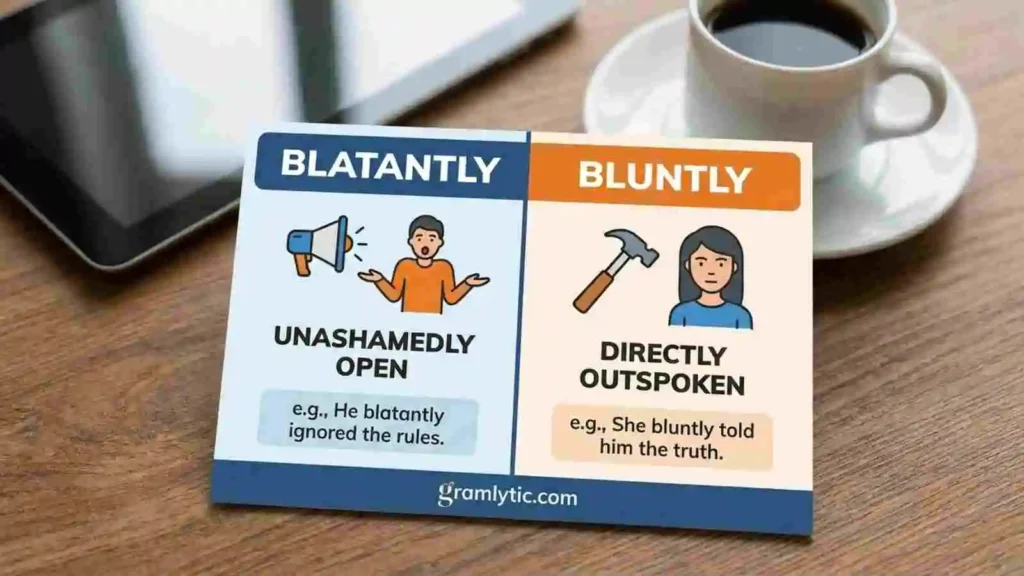
Blatantly usually means something happens in a very obvious or open way, often in a way that is wrong, rude, or hard to ignore. For example, “He blatantly ignored the rules.”
Bluntly means speaking in a very direct way, without trying to make your words softer. For example, “She bluntly told him that his plan would not work.”
This guide explains blatantly vs bluntly in simple English. You will learn what each word means, how to use them, where they come from, and how they differ in real sentences.
Blatantly vs Bluntly: Quick Answer
Blatantly means openly, obviously, or in a way that is hard to hide. It often describes something wrong, unfair, or shocking.
Bluntly means in a very direct and plain way. It often describes how someone speaks.
Simple examples
- He blatantly broke the rules.
- She bluntly said that she did not like the idea.
In the first sentence, the person broke the rules openly.
In the second sentence, the person spoke in a direct way.
The easiest difference
Blatantly = openly and obviously
Bluntly = directly and without soft words
The Origin of Blatantly vs Bluntly
Although blatantly and bluntly both describe how something is done, they come from different words.
The origin of Blatantly
Blatantly comes from the adjective blatant.
The word blatant has been used in English for several centuries. It came into English through an older word linked to the idea of something that makes a loud noise or is very noticeable.
Over time, blatant developed its modern sense of something that is very obvious or done openly.
Today, blatantly often has a negative meaning.
For example:
He blatantly lied to his manager.
This means that he lied in a very obvious way.
Another example is:
The company blatantly ignored the law.
The action was open and clear. It was not hidden.
The origin of Bluntly
Bluntly comes from the adjective blunt.
Blunt has long been used to describe something that is not sharp, such as a blunt knife.
The word later gained a meaning connected with speech and behavior.
When someone speaks bluntly, they speak in a direct way. They do not use many soft or polite words.
For example:
He bluntly rejected the offer.
This means he rejected it in a very direct way.
Why are the words different?
The words have different roots and meanings.
Blatantly comes from blatant.
Bluntly comes from blunt.
Their endings are also different because they are formed from different adjectives.
British English vs American English Spelling
There is no major spelling difference between British and American English for blatantly and bluntly.
Both forms are normally spelled the same:
- blatantly
- bluntly
The same spelling works in British English, American English, Canadian English, Australian English, and other forms of English.
Comparison table
| Word | British English | American English | Meaning |
| Blatantly | blatantly | blatantly | Openly or obviously |
| Bluntly | bluntly | bluntly | In a direct way |
Examples in British and American English
British English:
He blatantly ignored the warning.
She bluntly refused the offer.
American English:
He blatantly ignored the warning.
She bluntly refused the offer.
The spelling does not change.
Important point
Do not assume that every word has a US and UK spelling.
Some words change, such as:
- colour / color
- centre / center
- realise / realize
But blatantly and bluntly do not normally change between these forms of English.
Which Spelling Should You Use?
You can use blatantly and bluntly in both British and American English.
The real issue is not spelling. The important question is meaning.
For US English
Use blatantly when something is very obvious or openly wrong.
Use bluntly when someone speaks in a very direct way.
For UK and Commonwealth English
The same rule applies.
Use blatantly for something obvious and often unacceptable.
Use bluntly for direct speech or behavior.
For global English
Both words are widely understood.
If you are writing for an international audience, focus on the meaning rather than spelling.
A useful tip
Ask yourself:
Am I talking about an obvious action?
Use blatantly.
Am I talking about direct speech?
Use bluntly.
Common Mistakes with Blatantly vs Bluntly
Many mistakes happen because people think these words are interchangeable.
They are not always interchangeable.
Mistake 1: Using blatantly for direct speech
❌ She blatantly told me that my idea was bad.
This sentence may be possible in some contexts, but it focuses on the obvious or open nature of the action, not simply the direct way she spoke.
If you mean she spoke without softening her words, use:
✅ She bluntly told me that my idea was bad.
Mistake 2: Using bluntly for an obvious violation
❌ He bluntly broke the rules in front of everyone.
If your main meaning is that he broke the rules openly and clearly, blatantly is better.
✅ He blatantly broke the rules in front of everyone.
Mistake 3: Thinking blatantly always means honestly
Blatantly does not mean “honestly.”
For example:
He blatantly lied.
This means his lie was obvious or open.
It does not mean he told the truth.
Mistake 4: Thinking bluntly always means rudely
Bluntly can sound rude, but it does not always mean rude.
It mainly means direct and not softened.
For example:
She bluntly explained the problem.
The person may sound firm, but the sentence does not automatically mean she was rude.
Mistake 5: Confusing blunt with blatant
Remember:
Blunt = direct speech
Blatant = obvious action
This simple difference can prevent many errors.
Blatantly vs Bluntly in Everyday Examples
Both words appear in everyday speech and writing.
1. In emails
You may use bluntly when describing direct communication.
To put it bluntly, we cannot accept the proposal.
This means the writer wants to state the truth directly.
You may use blatantly when describing an obvious problem.
The supplier blatantly ignored our agreement.
The supplier ignored the agreement in an open and obvious way.
2. In news writing
Blatantly is common when news reports describe an obvious violation or unfair action.
The official was accused of blatantly breaking the rules.
Here, the word shows that the action was open and clear.
Bluntly can describe a direct statement.
The minister bluntly rejected the claim.
The minister gave a direct answer.
3. On social media
People often use bluntly when giving strong opinions.
Bluntly, I do not think this plan will work.
They may also use blatantly to point out something obvious.
They are blatantly copying another company’s idea.
4. In formal writing
Both words can appear in formal writing, but use them with care.
Blatantly often works well when discussing clear violations.
The report shows that the company blatantly ignored safety rules.
Bluntly can work when reporting a direct statement.
The director bluntly rejected the proposal.
5. In everyday conversation
You might say:
Bluntly, I think you should try again.
Or:
He blatantly ignored my message.
The first sentence focuses on the way someone speaks.
The second focuses on an obvious action.
Blatantly vs Bluntly: Side-by-Side Comparison
| Feature | Blatantly | Bluntly |
| Base word | Blatant | Blunt |
| Main idea | Obvious or open | Direct or plain |
| Often describes | Actions or behavior | Speech or statements |
| Can have a negative tone? | Often | Sometimes |
| Means rude? | No | Not always |
| Means obvious? | Yes | No |
| Means direct? | Not usually | Yes |
| Example | He blatantly cheated. | She bluntly refused. |
More examples
| Blatantly | Bluntly |
| He blatantly lied. | She bluntly disagreed. |
| They blatantly broke the law. | He bluntly rejected the idea. |
| She blatantly copied the work. | She bluntly told me the truth. |
| The company blatantly ignored the warning. | He bluntly answered the question. |
Blatantly vs Bluntly: Google Trends & Usage Data
Search interest for blatantly and bluntly comes from different types of language questions.
People often search for blatantly when they want to understand words such as:
- blatantly obvious
- blatantly false
- blatantly wrong
- blatantly ignored
- blatantly disrespectful
The word often appears in discussions about actions that are easy to see or hard to defend.
People search for bluntly in connection with phrases such as:
- put bluntly
- bluntly speaking
- speak bluntly
- said bluntly
- to put it bluntly
The phrase “to put it bluntly” is especially useful in everyday and formal English.
Country and context
Both words are used in:
- The United States
- The United Kingdom
- Canada
- Australia
- New Zealand
- Other English-speaking regions
There is no major US versus UK spelling issue with either word.
Usage depends more on context than on country.
Blatantly is more likely when writers describe obvious behavior.
Bluntly is more likely when writers describe direct speech.
Search intent
People who search “blatantly vs bluntly” are usually trying to answer one main question:
Which word should I use when I want to say something is obvious or direct?
The answer depends on what you want to describe.
A Simple Memory Trick
Use this trick to remember the difference:
Blatantly = Blatant
Think:
Blatantly obvious
Something is so clear that you cannot miss it.
Bluntly = Blunt
Think:
Blunt words
Someone speaks directly without softening the message.
Remember this sentence
Blatantly describes what is obvious. Bluntly describes how someone speaks.
This is not a rule for every possible sentence, but it is a very useful guide.
FAQs;
1. What is the difference between blatantly and bluntly?
Blatantly means openly or obviously, often when something is wrong or unacceptable. Bluntly means in a direct way, especially when someone speaks without softening their words.
2. Is blatantly the same as obviously?
They can have similar meanings in some sentences. However, blatantly often adds a sense that something is openly wrong, unfair, or shocking.
3. Does bluntly mean rudely?
Not always. Bluntly means speaking in a direct and plain way. That style can sound rude, but blunt speech is not always rude.
4. Can I use blatantly for a person?
Yes, when you describe something that the person does in an obvious or open way.
He blatantly ignored the rules.
5. Can I use bluntly for speech?
Yes. This is one of the most common uses.
She bluntly told him to leave.
6. Is “to put it bluntly” correct?
Yes. “To put it bluntly” is a common English phrase. It means you are about to say something in a very direct way.
7. Do blatantly and bluntly have different US and UK spellings?
No. Both words normally have the same spelling in British and American English.
Conclusion;
Understanding blatantly vs bluntly becomes easy when you focus on the meaning of each word. Blatantly means openly or obviously. It often describes an action that is clearly wrong, unfair, or hard to hide. For example, someone may blatantly ignore a rule.
Bluntly means in a direct and plain way. It often describes speech or a statement. For example, someone may bluntly reject an idea or bluntly tell someone the truth.
The words also have different base forms. Blatantly comes from blatant, while bluntly comes from blunt.
There is no major British and American spelling difference. Both forms use the same spelling in both types of English.
The easiest rule is simple: use blatantly for something obvious and open, and use bluntly for direct speech. Once you learn this small difference, you can use both words with confidence.

Emily Carter is an English grammar writer based in Portland, Oregon, with 7+ years of experience turning tricky grammar rules into simple, easy lessons.