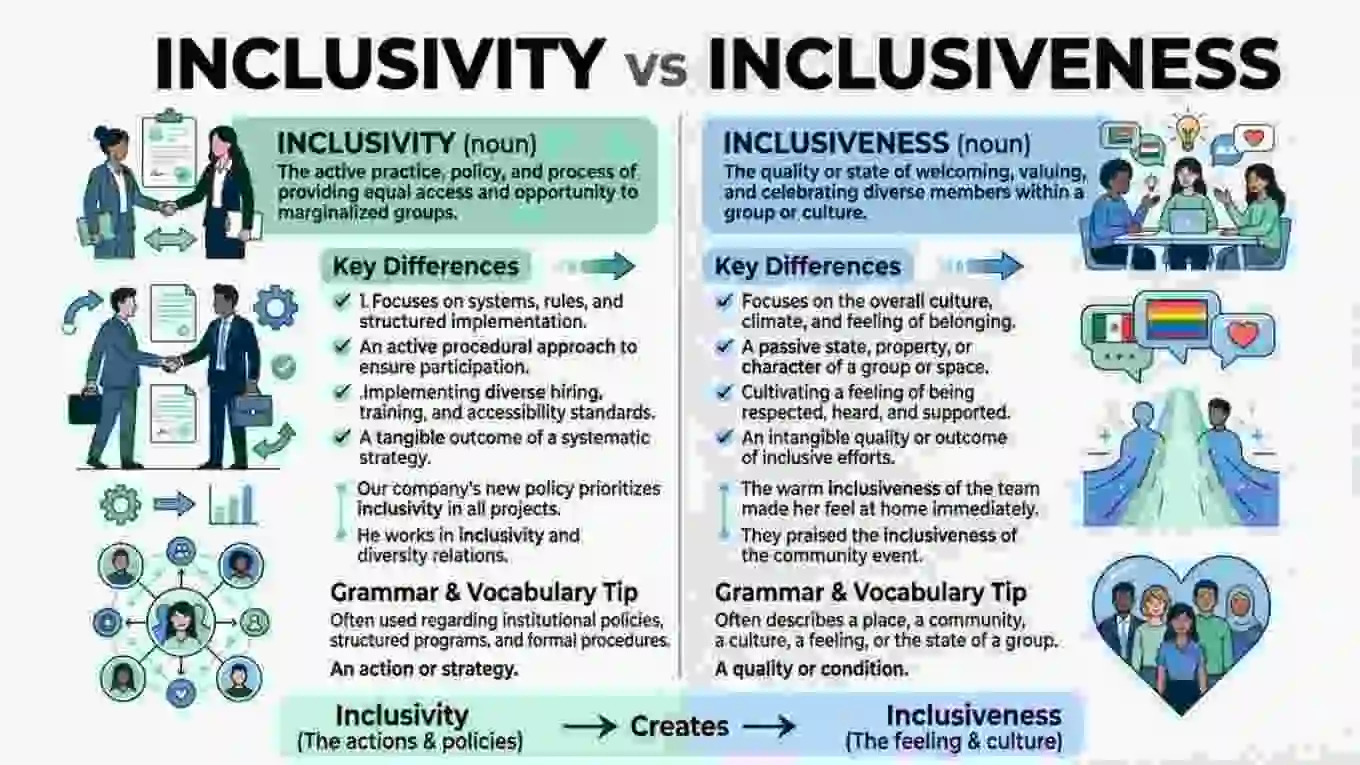
The words inclusivity and inclusiveness are very close. Both talk about making sure people feel welcome, valued, and able to take part. This makes it easy to wonder if there is a real difference between them.
If you have seen both words in school, work, news, or social media, you may ask, “Which one should I use?” The good news is that both inclusivity and inclusiveness are correct English words. In many cases, they can mean almost the same thing.
However, there can be a small difference in how people use them. Inclusivity often focuses on the goal or practice of including people. Inclusiveness can focus more on the quality or nature of being open to everyone.
People often search for “inclusivity vs inclusiveness” because the two words look and sound similar. They also appear in similar sentences. Knowing the small difference can help you choose the better word for work, school, formal writing, and everyday speech.
In this guide, we will compare inclusivity and inclusiveness in simple terms. You will learn their meanings, origins, common mistakes, examples, and the best word to use in different situations.
Inclusivity vs Inclusiveness: Quick Answer
Inclusivity and inclusiveness are both correct nouns. They both relate to the idea of including people and making sure they are not left out.
The main difference is one of focus.
Inclusivity often refers to the effort, practice, or goal of including different people.
The company wants to improve inclusivity in the workplace.
Inclusiveness often describes the quality of being open, welcoming, and accepting of different people.
The inclusiveness of the school makes new students feel welcome.
These meanings can overlap.
In many cases, you can use either word without changing the main meaning.
Simple rule
Think of:
Inclusivity = the practice or goal of including people.
Inclusiveness = the quality of being inclusive.
This is not a strict grammar rule. English speakers often use the two words in similar ways.
The Origin of Inclusivity and Inclusiveness
Both words come from the word inclusive.
Inclusive comes from the Latin word includere, which means “to shut in” or “include.”
The Latin word later influenced French and then English.
The English word include has been used for many years. It means to contain something or to make someone part of a group.
From include, English developed the adjective inclusive.
For example:
- include
- inclusive
- inclusivity
- inclusiveness
The two nouns use different endings.
Inclusivity uses -ity.
Inclusiveness uses -ness.
These endings can form nouns from adjectives.
For example:
- active → activity
- equal → equality
- kind → kindness
- dark → darkness
- inclusive → inclusivity
- inclusive → inclusiveness
The two endings can create words with slightly different shades of meaning, but the difference is not always strong.
Why do both words exist?
English often has more than one way to form a noun from the same adjective.
Both inclusivity and inclusiveness developed as ways to talk about the state, quality, or practice of being inclusive.
Over time, both became accepted English words.
British English vs American English Spelling
There is no major spelling difference between British English and American English for inclusivity or inclusiveness.
Both forms use the same spelling.
| Word | British English | American English |
| Inclusivity | Inclusivity | Inclusivity |
| Inclusiveness | Inclusiveness | Inclusiveness |
| Inclusive | Inclusive | Inclusive |
This means you do not need to change the spelling based on your audience.
The bigger choice is which word fits your sentence best.
British English examples
The school is working to improve inclusivity.
The inclusiveness of the team is clear.
American English examples
The company values inclusivity.
The inclusiveness of the program helps many people.
Both forms of English accept both words.
Which Word Should You Use?
Choosing between inclusivity and inclusiveness depends mostly on the meaning you want to stress.
Use “inclusivity” for goals and actions
Inclusivity often works well when talking about efforts to include people.
Examples:
The company has a new inclusivity plan.
The school wants to improve inclusivity.
The group is focused on inclusivity.
This word is common in workplace, school, social, and policy discussions.
Use “inclusiveness” for a quality or nature
Inclusiveness can work well when you are describing how open and welcoming something is.
Examples:
The inclusiveness of the event impressed us.
Her inclusiveness made everyone feel welcome.
The inclusiveness of the group helped new members feel comfortable.
For US readers
Both words are correct.
Inclusivity may be a good choice when talking about programs, goals, policies, or efforts.
Inclusiveness may be useful when describing a quality or attitude.
For UK and Commonwealth readers
The same basic advice applies.
Both words are accepted and understood.
For global writing
If you want a modern and direct word, inclusivity is often a strong choice.
If you want to describe the quality of being open and welcoming, inclusiveness can work well.
Common Mistakes with Inclusivity vs Inclusiveness
Mistake 1: Thinking one word is incorrect
Some people think inclusiveness is wrong because inclusivity sounds more common.
That is not true.
Both are correct words.
Mistake 2: Using “inclusive” as a noun
Incorrect:
The company wants more inclusive.
Better:
The company wants more inclusivity.
Or:
The company wants to be more inclusive.
“Inclusive” is an adjective. It can describe a person, group, policy, or action.
Mistake 3: Using the wrong form after “of”
Both words can follow “of.”
Examples:
The inclusivity of the program was praised.
The inclusiveness of the program was praised.
Both sentences are grammatically correct.
Mistake 4: Assuming they always have exactly the same meaning
The words are close, but they can have different focus.
Inclusivity often points to the practice or effort.
Inclusiveness can point to the quality or nature.
Still, context matters more than a strict rule.
Mistake 5: Adding unnecessary endings
Do not write forms such as:
- inclusivety
- inclusivness
- inclusiviness
The correct forms are:
- inclusivity
- inclusiveness
Inclusivity vs Inclusiveness in Everyday Examples
These words appear in many types of writing.
In emails
We are working to improve inclusivity across our team.
Or:
We value the inclusiveness of our workplace.
Both can work.
In news
News writing may use inclusivity when discussing policies, education, sports, or workplaces.
Example:
The new policy aims to increase inclusivity in schools.
On social media
People often use inclusivity in short posts.
Example:
Our event is built around inclusivity and respect.
In formal writing
Both words can appear in reports and academic writing.
Examples:
The study looks at inclusivity in higher education.
The report discusses the inclusiveness of the program.
In the workplace
You may see phrases such as:
- workplace inclusivity
- team inclusivity
- workplace inclusiveness
- inclusive workplace
- inclusivity policy
- inclusiveness policy
In education
Examples:
The school wants to improve inclusivity.
The inclusiveness of the classroom helps students feel welcome.
Inclusivity vs Inclusiveness: Comparison Table
| Feature | Inclusivity | Inclusiveness |
| Part of speech | Noun | Noun |
| Basic meaning | The practice or goal of including people | The quality of being inclusive |
| Focus | Often effort or action | Often quality or nature |
| Common use | Policies, goals, programs | Attitudes, groups, environments |
| British spelling | Inclusivity | Inclusiveness |
| American spelling | Inclusivity | Inclusiveness |
| Correct word? | Yes | Yes |
Side-by-side examples
| Inclusivity | Inclusiveness |
| workplace inclusivity | workplace inclusiveness |
| social inclusivity | social inclusiveness |
| improve inclusivity | value inclusiveness |
| promote inclusivity | show inclusiveness |
| inclusivity policy | inclusiveness of a group |
Both columns contain correct phrases. The best choice depends on what you want to say.
Inclusivity or Inclusiveness: Which Sounds More Natural?
In modern English, inclusivity is often used in discussions about plans, policies, goals, and social change.
For example:
The company has a strong focus on inclusivity.
Inclusiveness can sound more descriptive.
For example:
The inclusiveness of the team was easy to see.
However, these are not fixed rules.
A good writer should focus on the sentence and the meaning instead of trying to force a strict difference.
If you are unsure, look at the noun that follows the word and ask what you want to stress.
Are you talking about an effort or goal?
Choose inclusivity.
Are you describing a quality or nature?
Inclusiveness may be a better fit.
Inclusivity vs Inclusiveness: Google Trends & Usage Data
Both words are used in modern English, but their use can vary by country and topic.
Inclusivity is especially common in discussions about:
- workplaces
- education
- social policy
- organizations
- media
- events
- product design
Inclusiveness is also used in these areas, but it often appears when writers describe the quality of a group, place, or system.
Search interest may also change with current events.
For example, when people discuss workplace policies, searches for inclusivity may rise.
When people discuss whether a group or environment welcomes different people, inclusiveness may appear more often.
There is no major US versus UK spelling difference.
Both countries use:
inclusivity
and
inclusiveness
For SEO writing, the best approach is to answer the search question directly. Explain that both words are correct, show the small difference in focus, and give examples that match real situations.
FAQs;
1. Is inclusivity a correct word?
Yes. Inclusivity is a correct English noun. It refers to the practice, effort, or goal of including people.
2. Is inclusiveness a correct word?
Yes. Inclusiveness is also correct. It often refers to the quality of being open and welcoming to different people.
3. What is the difference between inclusivity and inclusiveness?
The words are very close.
Inclusivity often focuses on the practice or goal of including people.
Inclusiveness often focuses on the quality of being inclusive.
4. Is inclusivity or inclusiveness more common?
Inclusivity is widely used in modern discussions about workplaces, education, policy, and social issues. Inclusiveness is also common, especially when describing a quality.
The better word depends on the sentence.
5. Are inclusivity and inclusiveness interchangeable?
Often, yes. In many sentences, replacing one with the other does not change the main idea.
However, the words can have a slightly different focus.
6. Is there a British spelling for inclusivity?
No separate British spelling is needed. British and American English both use inclusivity.
7. Should I use inclusivity or inclusiveness in formal writing?
Both are acceptable.
Use inclusivity when discussing a goal, policy, or effort to include people.
Use inclusiveness when describing the quality of being open and welcoming.
Conclusion;
The difference between inclusivity vs inclusiveness is small. Both words are correct English nouns, and both relate to the idea of including people and making them feel welcome.
Inclusivity often focuses on the practice, effort, or goal of including people. For example, a company may create a plan to improve inclusivity.
Inclusiveness often focuses on the quality or nature of being open to different people. For example, you can talk about the inclusiveness of a team or school.
Still, the two words often overlap. English speakers may use them in similar ways, and context usually makes the meaning clear.
There is also no British versus American spelling problem. Both English forms use inclusivity and inclusiveness.
If you are writing for a modern workplace, website, school, or general audience, inclusivity is often a clear and direct choice. But inclusiveness is fully correct when you want to describe the quality of being inclusive.
The key is simple: understand the small difference in focus, then choose the word that fits your sentence best.

Welcome to the official author page of Clara Wordsmith, grammar writer at Wordnomic. Clara specializes in explaining confusing English words, grammar rules, spelling differences, and vocabulary topics with clear examples and beginner-friendly explanations.