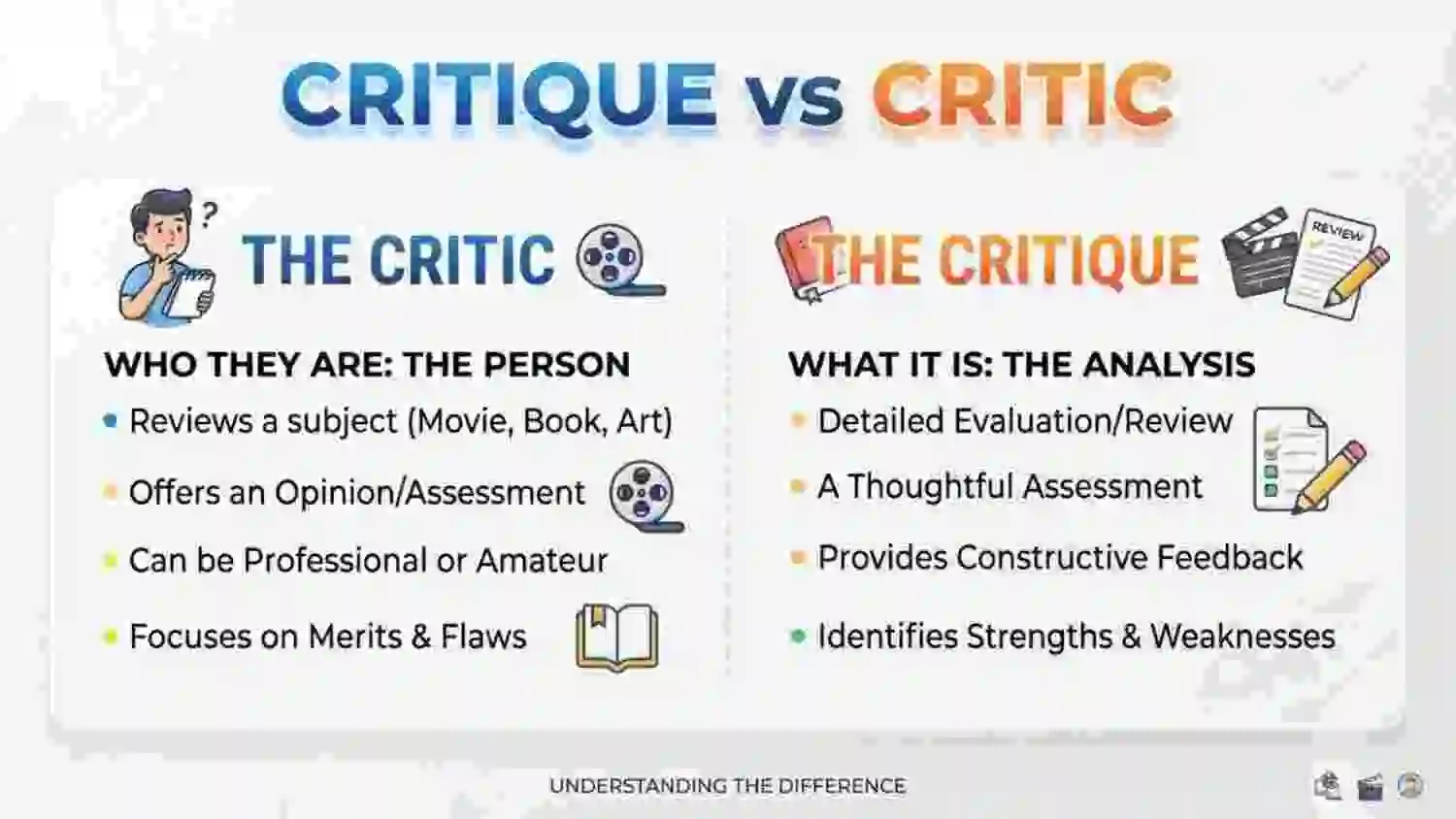
Critique vs critic can be confusing because both words relate to judging or discussing the quality of something. They also look and sound similar. But they do not have the same job in a sentence.
A critique is an analysis or review of something. It can be a written or spoken discussion that points out both good and bad parts. A critic is a person who gives opinions or reviews about something, such as a book, movie, play, or work of art.
For example, if Sarah reviews a movie, Sarah is the critic. Her written review of the movie is the critique.
The easiest way to remember the difference is simple: a critic is a person, while a critique is a review or analysis.
These words are common in school, work, art, books, movies, and everyday writing. Knowing the difference helps you choose the right word and avoid common grammar mistakes.
Critique vs Critic – Quick Answer
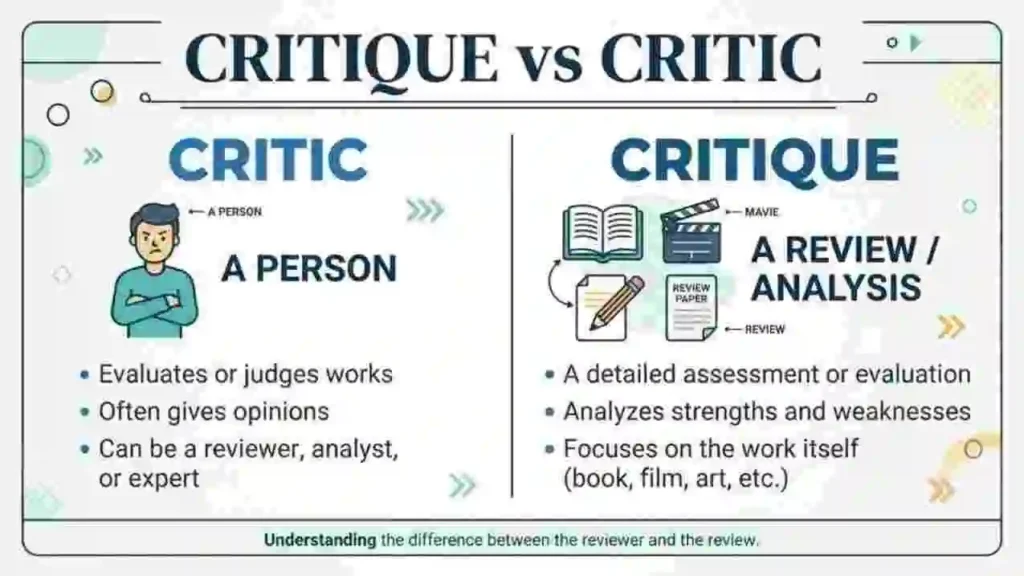
A critic is a person who reviews or judges something.
A critique is a detailed review or analysis of something.
Example:
- Critic: Maria is a movie critic.
- Critique: Maria wrote a critique of the movie.
So:
Critic = person
Critique = review or analysis
There is also a verb critique, which means to examine or review something carefully.
Example:
The teacher asked us to critique the essay.
What Does Critique Mean?
The word critique can work as both a noun and a verb.
As a noun, a critique is a careful review or analysis of something.
The student wrote a critique of the book.
As a verb, critique means to examine something and give an opinion about its good and bad points.
The teacher asked the students to critique the report.
A critique does not have to be completely negative.
It can explain what works well and what could be better.
What Does Critic Mean?
A critic is a person who gives opinions about the quality of something.
Critics often write or speak about:
- Movies
- Books
- Music
- Art
- Theater
- Food
- Television
- Restaurants
For example:
The film critic gave the movie a positive review.
The person is the critic. The review they write can be called a critique.
Main Differences Between Critique and Critic
The biggest difference is the type of word.
Critique Is a Review or Analysis
A critique is the work of examining something carefully.
The professor gave a critique of my paper.
Here, the critique is the analysis.
Critic Is a Person
A critic is someone who reviews or judges something.
The critic praised the new film.
Here, the critic is the person.
Critique Can Be a Verb
This is another important difference.
Please critique my essay.
Here, critique means “review and give feedback.”
Critic is not normally used this way.
You would not say:
Please critic my essay.
That is incorrect.
Critique vs Critic: Origin and History
Both words are linked to the Greek root kritikos, which relates to judging or making judgments.
Critique came into English through French and refers to a detailed review or critical discussion.
Critic also has roots connected to the idea of judging or evaluating something.
Over time, English developed separate uses for the two words.
Today, critic usually means a person who reviews or judges something, while critique usually means the review, analysis, or the act of reviewing something.
The words are related, but they have different roles in modern English.
British English vs American English
There is no major spelling difference between British English and American English for these words.
Both use:
- critic
- critique
The meanings are also the same.
For example:
British English:
She is a film critic.
American English:
She is a film critic.
The same applies to critique.
The main issue is not British vs American spelling. It is knowing whether you mean the person or the review or analysis.
Which One Should You Use?
Use critic when you are talking about a person.
He is a food critic.
Use critique when you are talking about a review or analysis.
He wrote a critique of the restaurant.
Use critique as a verb when you mean to review or examine something.
The teacher asked me to critique my own work.
For Everyday Writing
Use critic for a person.
The critic liked the movie.
Use critique for the review.
Her critique was detailed.
For Academic Writing
Critique is common in school and college writing.
Write a critique of the research paper.
It means you should study the work and discuss its strengths and weaknesses.
For Business Writing
You can use critique when discussing feedback or review.
The team gave a detailed critique of the new plan.
For Online Writing
You may see critic in movie, book, and game reviews.
Several critics praised the new game.
You may also see critique when someone discusses the quality of a work.
Common Mistakes
1. Using “critic” for a review
Incorrect:
I wrote a critic of the book.
Correct:
I wrote a critique of the book.
Why?
A critic is a person. A critique is a review or analysis.
2. Using “critique” for a person
Incorrect:
She is a famous movie critique.
Correct:
She is a famous movie critic.
Why?
A person who reviews movies is a critic.
3. Using “critic” as a verb
Incorrect:
Please critic my essay.
Correct:
Please critique my essay.
Why?
Critique can be used as a verb. Critic is normally a noun.
4. Thinking critique always means negative feedback
Incorrect idea:
A critique only talks about bad things.
Correct idea:
A critique can discuss both strengths and weaknesses.
Example:
The professor’s critique explained what the paper did well and what needed work.
5. Confusing critique with criticism
Incorrect idea:
Critique and criticism always mean exactly the same thing.
Correct idea:
They can overlap, but critique often suggests a careful review or analysis. Criticism can refer more broadly to finding fault or expressing disapproval.
Example:
The report received criticism for its high cost.
6. Saying “a critic of an essay” when you mean the review
Incorrect:
I need to write a critic of this essay.
Correct:
I need to write a critique of this essay.
Why?
The essay needs a review, not a person.
Everyday Examples
- The critic praised the new movie.
- She wrote a detailed critique of the book.
- The teacher asked us to critique the article.
- He works as a restaurant critic.
- The critique explained the main problems with the design.
- Several critics reviewed the play.
- Can you critique my essay?
- The art critic visited the new gallery.
- Her critique included both good and bad points.
- The newspaper hired a new film critic.
- Our class discussed the critique of the novel.
- The manager asked the team to critique the new plan.
Real-Life Usage
In Conversations
People may use critic when talking about a reviewer.
“The movie critics loved it.”
They may use critique when talking about a review.
“I read her critique of the movie.”
In School
Students often use critique for class tasks.
“Write a critique of the short story.”
This means the student should study the story and explain its strengths and weaknesses.
At Work
A team may critique a plan or report.
“Let’s critique the proposal before the meeting.”
Here, critique is a verb.
In Emails
A manager might write:
“Please critique the draft before Friday.”
This asks someone to review the draft and give useful feedback.
In Movies and Books
A critic may review a movie, book, or play.
“The film critic gave the movie four stars.”
The review itself may be called a critique.
On Social Media
People often share critiques of movies, books, games, and other media.
“Here is my critique of the new film.”
Related Search Questions
What is the difference between critique and critic?
A critic is a person who reviews or judges something. A critique is a review or detailed analysis. For example, a movie critic writes a movie critique.
Is critique a noun or a verb?
Critique can be both a noun and a verb. As a noun, it means a review or analysis. As a verb, it means to review or examine something carefully.
Is critic a person?
Yes. A critic is a person who reviews or judges something. A film critic reviews movies, while a food critic reviews food or restaurants.
Can a critique be positive?
Yes. A critique can include positive comments as well as suggestions for improvement. A good critique can explain what works well and what does not work well.
Is critique the same as criticism?
Not always. The words overlap, but critique often suggests a careful review or analysis. Criticism can mean comments about faults or problems and can also refer to the broader practice of judging or reviewing.
Can I say “critique my work”?
Yes. Critique works as a verb in this sentence.
Please critique my work.
It means you want someone to examine your work and give useful feedback.
What is a person who gives a critique called?
A person who gives a critique can be called a critic in many contexts. However, the exact title depends on the field. For example, a person who reviews films is a film critic.
Usage and Search Trends
People searching for critique vs critic are usually looking for a simple grammar or vocabulary answer.
Common search variations include:
- critique vs critic difference
- critic vs critique
- difference between critic and critique
- what is the difference between critique and critic
- critique meaning
- critic meaning
- can critique be a verb
- critic meaning in English
- how to use critique in a sentence
There is no need to give made-up search volume or Google Trends numbers. Exact search data can change over time and depends on the country and search tool used.
From a normal English-use point of view, both words are widely used. Critic is common when naming a person who reviews something. Critique is common when discussing a review, analysis, or the act of reviewing something.
Critique vs Critic Comparison Table
| Term | Meaning | Usage | Example |
| Critique | A review or detailed analysis | Used as a noun | “Her critique of the book was helpful.” |
| Critique | To review or examine something | Used as a verb | “Please critique my essay.” |
| Critic | A person who reviews or judges something | Used as a noun | “She is a movie critic.” |
| Criticism | Comments about faults, problems, or quality | Used as a noun | “The plan received criticism.” |
FAQs
1. Is a critic the same as a critique?
No. A critic is a person, while a critique is a review or analysis. A critic may write or give a critique. For example, “The critic wrote a critique of the movie.” This sentence uses both words correctly because they refer to different things.
2. What is an example of critique?
“Please critique my essay” is an example of critique as a verb. “The teacher gave a critique of my essay” uses critique as a noun. In both cases, the word relates to careful review and feedback.
3. What is an example of critic?
“She is a movie critic” is a simple example. Here, critic refers to the person who reviews movies. You can also say, “The critic praised the film.” The word always refers to the person in these examples.
4. Can you critique a person?
You can critique a person’s work, ideas, actions, or performance. For example, “The manager critiqued his presentation.” It is usually clearer to say what you are reviewing rather than simply saying you are critiquing the person.
5. Is “critic” always negative?
No. A critic can give positive, negative, or mixed opinions. A movie critic may praise a film, point out problems, or discuss both. The word critic describes the role of reviewing or judging, not whether the opinion is positive or negative.
6. Is “critique” formal?
Critique can sound more formal than simple words such as “review” or “feedback.” It is common in school, college, art, business, and professional settings. In casual speech, people may simply say “review” instead.
7. What is the easiest way to remember critic vs critique?
Use this simple rule: critic = person, critique = review. If you can put “person” after the word, you probably need critic. If you mean a review or analysis, use critique. Also remember that critique can be a verb.
Conclusion
The difference between critique vs critic is simple once you focus on what each word describes.
A critic is a person who reviews, judges, or gives opinions about something. A critique is a review, analysis, or careful discussion of something. The word critique can also work as a verb. When used as a verb, it means to examine something and give feedback.
For example, a person who reviews movies is a movie critic. The review that person writes can be called a movie critique. You can also say, “Please critique my essay,” when you want someone to review your work.
The two words have related meanings, but they do different jobs in a sentence. There is no major British English or American English difference in their spelling or basic meaning.
The easiest memory trick is:
Critic = person
Critique = review or analysis
Once you remember this simple rule, it becomes much easier to choose the right word in school, work, emails, reviews, and everyday writing.

Emily Carter is an English grammar writer based in Portland, Oregon, with 7+ years of experience turning tricky grammar rules into simple, easy lessons.