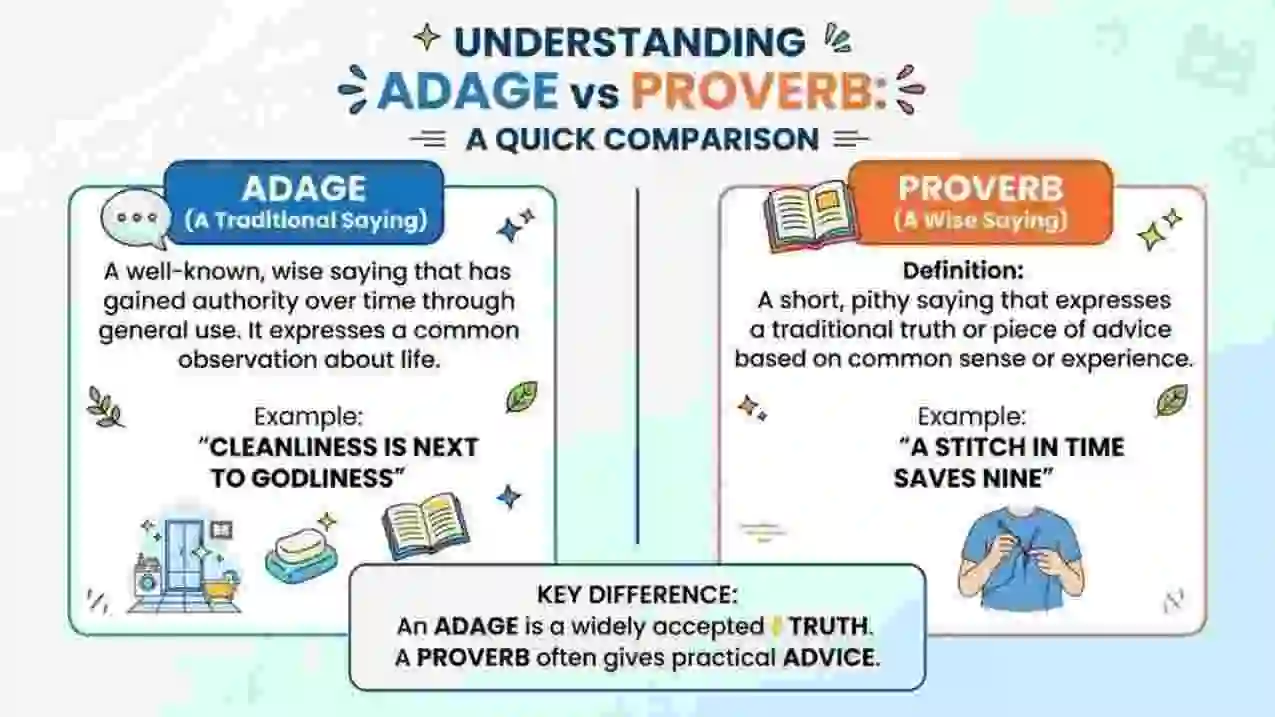
Words can look very close but still have small differences in meaning. Adage vs proverb is a good example. Both words describe short sayings that share advice, wisdom, or a lesson about life. Because they have similar meanings, people often use them as if they mean the exact same thing.
So, what is the difference between an adage and a proverb?
The short answer is that an adage is a well-known saying that gives advice or expresses a common truth. A proverb is also a short, common saying that teaches a lesson or gives advice. The two terms overlap a lot.
The main difference is usually in how the words are used. A proverb often gives a clear lesson or rule about life. An adage can be a broader term for a saying that has been repeated and accepted over time.
In this guide, you will learn the meanings of both words, their history, key differences, common mistakes, examples, and when to use each term.
Adage vs Proverb – Quick Answer
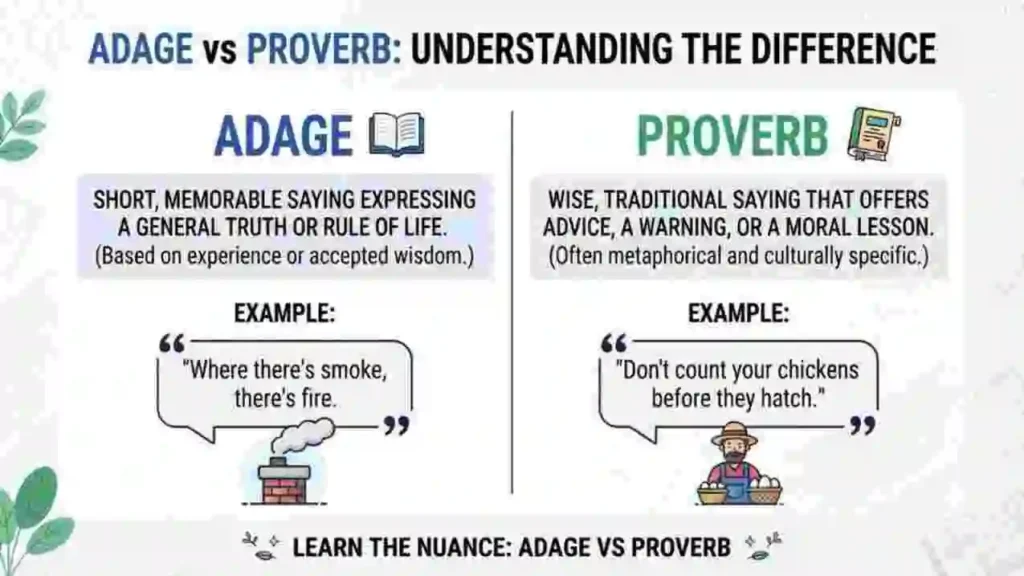
An adage is a short, old, well-known saying that expresses a general truth or piece of advice.
A proverb is a short, common saying that gives advice, wisdom, or a lesson about life.
For example:
- Adage: “Actions speak louder than words.”
- Proverb: “A stitch in time saves nine.”
Both are common sayings. In many cases, you can call the same saying either an adage or a proverb.
The main difference is that proverb often focuses on a lesson or practical advice, while adage is a wider term for a saying that has become well known over time.
What Is an Adage?
An adage is a short saying that people have used for a long time.
It usually shares a general truth, life lesson, or piece of advice. Adages often become popular because people find the idea useful or true.
For example:
“Better late than never.”
This is an adage because it expresses a common idea. It tells us that doing something late is better than not doing it at all.
Another example is:
“Practice makes perfect.”
This saying gives a simple lesson about practice and skill.
An adage does not have to rhyme. It does not need a special pattern. Its main feature is that it is a well-known saying with a useful or accepted message.
What Is a Proverb?
A proverb is also a short and well-known saying.
It usually gives advice or teaches a lesson about life, work, people, or behavior.
For example:
“Don’t count your chickens before they hatch.”
This proverb warns people not to assume that something will happen before it actually happens.
Another example is:
“Where there is a will, there is a way.”
This proverb expresses the idea that strong effort and determination can help a person find a way to reach a goal.
Main Differences Between an Adage and a Proverb
The two terms overlap, so there is no sharp line between them.
Still, there are some useful differences.
1. Meaning
An adage is a general term for an old and well-known saying.
A proverb usually carries a lesson, warning, or piece of advice.
2. Focus
Adages often state a general truth.
Proverbs often tell people how to think or act.
3. Use
People may use adage when talking about a saying as a piece of old wisdom.
People often use proverb when the saying has a clear lesson or moral idea.
4. Overlap
Many sayings can be called both an adage and a proverb.
For example:
“A picture is worth a thousand words.”
This can be called an adage because it is a well-known old saying. It can also be called a proverb because it expresses a general lesson.
Adage vs Proverb: Origin and History
The word adage comes from Latin adagium, meaning a saying or proverb. It entered English through French and became linked with old sayings that express wisdom or common truth.
The word proverb comes from Old French proverbe and Latin proverbium. It has long been used for short sayings that express wisdom or advice.
Both words have a long history in English.
People have used short sayings for centuries because they are easy to remember. A short sentence can carry an idea that would take many words to explain.
Over time, many sayings became part of everyday speech. Some came from books or famous writers. Others came from common speech and were passed from one generation to another.
British English vs American English
There is no major British English vs American English difference between adage and proverb.
Both words are used in British and American English.
The spelling stays the same:
- British English: adage
- American English: adage
- British English: proverb
- American English: proverb
The meanings are also basically the same.
The difference comes from the type of saying being discussed, not from the country where the English is used.
Which One Should You Use?
Choose adage when you want to describe an old, well-known saying that expresses a general truth.
Choose proverb when you want to focus on a saying that gives advice, a lesson, or a warning.
For example:
- “That’s an old adage.”
- “The saying is a common proverb.”
- “There is an old adage that time heals all wounds.”
- “The proverb teaches us not to judge too quickly.”
In everyday English, you do not need to worry too much about the difference. The words have a large area of overlap.
If you are writing about a specific saying, either word may work depending on the context.
Common Mistakes
Mistake 1: Thinking adage and proverb are complete opposites
Incorrect idea: An adage and a proverb have completely different meanings.
Correct idea: Their meanings overlap greatly.
Example:
“Practice makes perfect” can reasonably be described as both an adage and a proverb.
Mistake 2: Thinking every proverb must rhyme
Incorrect: A saying is not a proverb because it does not rhyme.
Correct: A proverb does not need to rhyme.
Example:
“Honesty is the best policy” does not need a rhyme to be a proverb.
Mistake 3: Thinking an adage must be very old
Incorrect: Only sayings from hundreds of years ago can be adages.
Correct: An adage is generally an old or long-established saying, but exact age is not the only factor.
Example:
A well-known saying that has been used for a long time may be called an adage.
Mistake 4: Using “adage” for any short sentence
Incorrect: Every short sentence is an adage.
Correct: An adage must express a general truth, idea, or piece of wisdom.
Example:
“The dog is outside” is not an adage.
Mistake 5: Thinking a proverb must come from one known person
Incorrect: Every proverb has a known author.
Correct: Many proverbs have no known single author.
Example:
“Actions speak louder than words” is a common saying rather than a quote with one clear modern author.
Mistake 6: Thinking only formal writers use these words
Incorrect: Adage and proverb are used only in academic writing.
Correct: Both words can appear in everyday speech and writing.
Example:
“My grandfather often used that old adage.”
Everyday Examples
Here are some natural examples:
- “My teacher shared an old adage about hard work.”
- “The proverb warns us not to judge a book by its cover.”
- “You have probably heard the adage, ‘Better late than never.'”
- “That proverb has been passed down for many years.”
- “There is an old adage that time is money.”
- “The saying works as both an adage and a proverb.”
- “She used a simple proverb to explain her point.”
- “My father often repeats this old adage.”
- “The proverb gives a useful lesson about patience.”
- “People still use this adage in everyday conversation.”
- “The old proverb helped me understand the idea.”
- “He ended his speech with a famous adage.”
Real-Life Usage
In Conversation
People often use these words when talking about common wisdom.
“As the old adage says, better late than never.”
This sounds natural in conversation.
In School
Students may see proverbs in English lessons, reading tasks, and writing exercises.
A teacher might ask:
“What lesson does this proverb teach?”
In Work
An adage can help explain a business or work idea.
For example:
“There’s an old adage: measure twice and cut once.”
The saying gives simple advice about careful work.
In Social Media
People often post short sayings online.
A caption may say:
“An old proverb worth remembering.”
In Formal Writing
Both words can appear in essays, speeches, and articles.
For example:
“The old adage reflects a common belief about hard work.”
Related Search Questions
What is the difference between an adage and a proverb?
Both are short, well-known sayings that express wisdom or a general truth. A proverb often gives a lesson or piece of advice. An adage is a broader term for an established saying. Because the meanings overlap, one saying may be described as both.
Is an adage the same as a proverb?
Not exactly, but they are very close. An adage is a well-known saying that expresses a general truth or idea. A proverb is usually a saying that gives advice or teaches a lesson. In everyday use, the two words can often describe the same saying.
Is “actions speak louder than words” an adage or a proverb?
It can be called both. It is a well-known saying that expresses a general truth, so it fits the idea of an adage. It also gives a lesson about behavior, so it can be called a proverb.
Is every proverb an adage?
There is no strict rule that separates the two groups. Since the meanings overlap, many proverbs can also be called adages. The exact label often depends on the speaker’s focus and the dictionary definition being used.
What is an example of an adage?
“Better late than never” is a common example. It expresses a general idea about doing something late instead of not doing it at all. “Practice makes perfect” is another well-known saying that can be called an adage.
What is an example of a proverb?
“A stitch in time saves nine” is a common example of a proverb. It teaches people to deal with a small problem early before it becomes a bigger problem.
Are adages and proverbs still used today?
Yes. People still use both words and many traditional sayings in speech, books, school writing, news, and online posts. Some old sayings remain common because their basic lessons still make sense in modern life.
Usage and Search Trends
People who search for adage vs proverb are usually trying to understand the difference between two very close terms.
Common search questions include:
- adage vs proverb difference
- difference between adage and proverb
- what is an adage
- what is a proverb
- adage and proverb examples
- is an adage the same as a proverb
- proverb vs adage meaning
There is no reliable reason to give a made-up search volume or Google Trends number for these terms. Search interest can change over time and across countries.
From a language-use point of view, both terms remain common in dictionaries, books, education, and general writing.
Adage vs Proverb Comparison Table
| Term | Meaning | Common Use | Example |
| Adage | A well-known saying that expresses general wisdom or truth | Talking about old or accepted wisdom | “Better late than never.” |
| Proverb | A short saying that often teaches a lesson or gives advice | Giving advice or sharing a life lesson | “A stitch in time saves nine.” |
| Both | Short, well-known sayings with wisdom | Everyday and formal writing | “Actions speak louder than words.” |
FAQs
1. Which is more general, adage or proverb?
Adage can be used as a broad term for an established saying that expresses wisdom or a general truth. Proverb often points more clearly to a saying that gives advice or teaches a lesson. Still, the two terms overlap, so the difference is not always strict.
2. Can one saying be both an adage and a proverb?
Yes. Many famous sayings fit both definitions. For example, “A picture is worth a thousand words” expresses a general truth and has been used for a long time. It can therefore be described as an adage, and it can also be treated as a proverb.
3. Is an adage always old?
An adage is normally an established saying with a history of use. The word often suggests something that people have repeated for a long time. However, there is no simple number of years that a saying must reach before it becomes an adage.
4. Does a proverb always teach a moral lesson?
Not always in a strict moral sense. A proverb usually gives advice, a warning, or a practical lesson. Some simply describe how people or life often work. The key idea is that the saying carries a useful piece of shared wisdom.
5. Are adages and proverbs quotes?
They can look like quotes, but they are not the same thing. A quote usually comes from a known speaker or source. Many adages and proverbs have no single known author. They become common sayings through repeated use.
6. Can I use “adage” and “proverb” in formal writing?
Yes. Both words are suitable for formal writing when they fit the meaning. For example, you can write, “The old adage reflects a common belief.” You can also write, “The proverb teaches a lesson about patience.”
7. What is the easiest way to remember the difference?
Think of adage as a well-known old saying and proverb as a saying that often gives advice or a lesson. Remember that the two terms overlap. A single saying can fit both descriptions.
Conclusion
The difference between adage vs proverb is small because both words describe short, well-known sayings that share wisdom or a general truth.
An adage is usually an established saying that expresses a common truth or idea. A proverb is usually a short saying that gives advice, a warning, or a lesson about life. The two meanings overlap, so many sayings can be called both an adage and a proverb.
For example, “Better late than never” can be called an adage because it is a well-known saying that expresses a common idea. It can also be viewed as a proverb because it gives useful advice.
There is no major British and American English difference in these words. Both are used in both forms of English.
If you are unsure which word to choose, look at the purpose of the saying. Use adage when you want to stress its status as an old or established saying. Use proverb when you want to stress its lesson or advice. In many cases, either word will work.