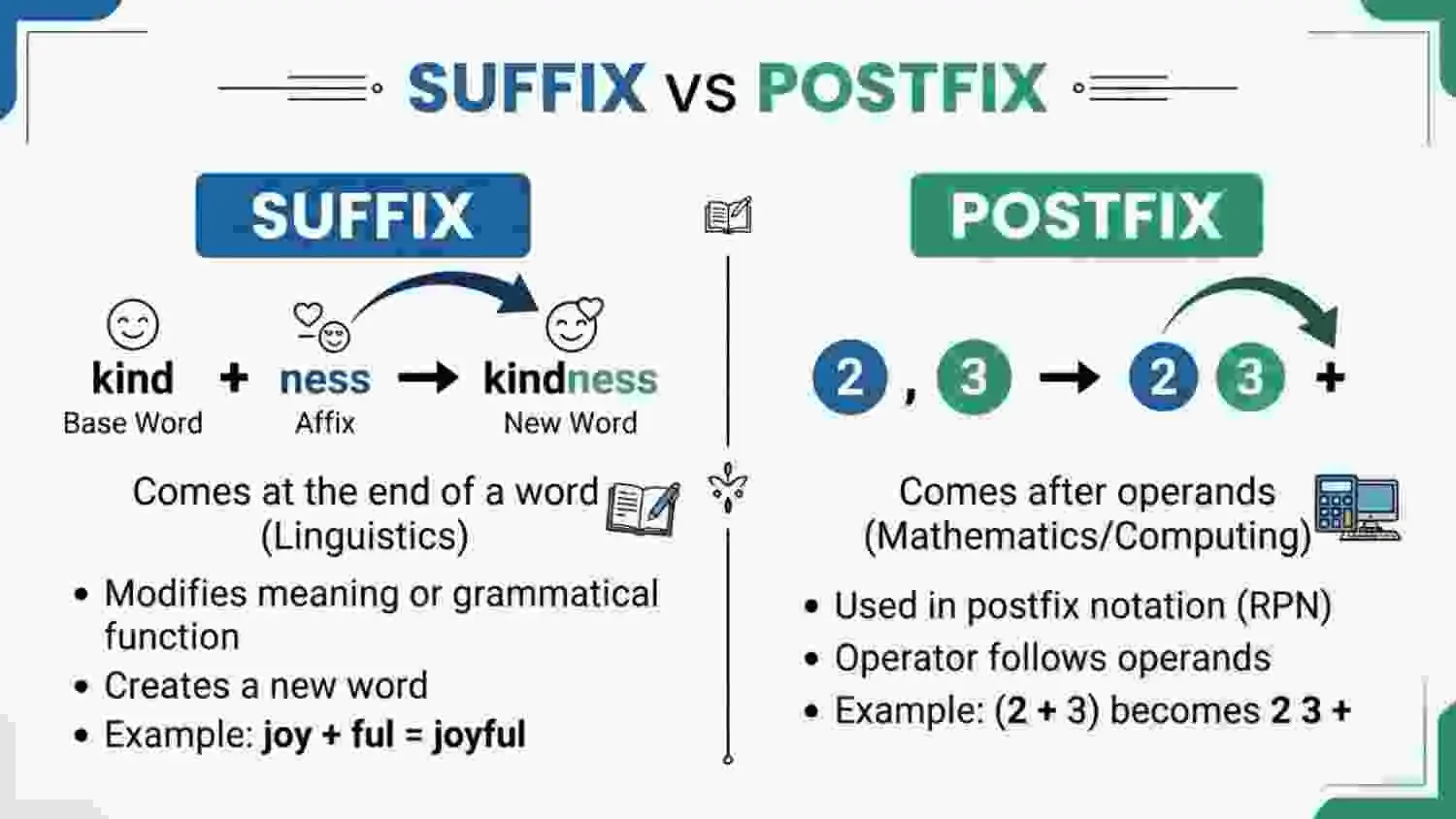
Suffix vs postfix can be confusing because both words can describe something that comes after something else. The two terms look very similar, but they do not always mean the same thing.
In English grammar and linguistics, suffix is the normal term. A suffix is a letter or group of letters added to the end of a word. For example, adding -ness to kind gives kindness. Adding -ed to walk gives walked.
The word postfix has a different use. It can mean something placed after another thing, but it is not normally the standard word for a word ending in English grammar. In computer science, postfix notation has a special meaning. For example, A B + is a postfix expression for A + B.
So, which word should you use? It depends on the subject. Use suffix when talking about word parts and grammar. Use postfix when the technical context calls for it, such as postfix notation in programming.
This guide explains the difference in simple terms.
Suffix vs Postfix – Quick Answer
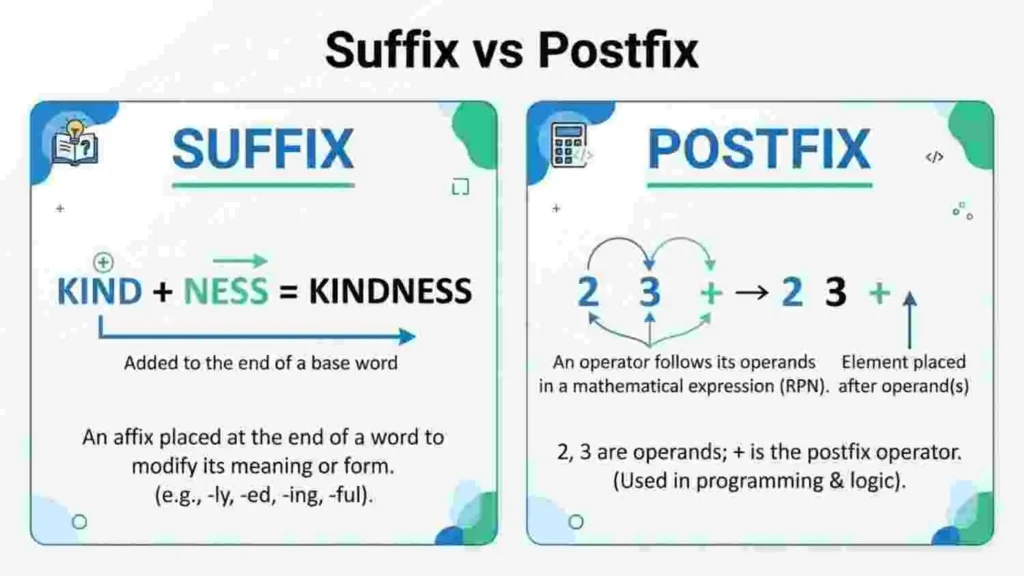
Suffix is the standard term for a letter or group of letters added to the end of a word.
Postfix means something placed after another thing. It also has special technical uses, especially in computer science.
Simple examples
Grammar:
kind + -ness = kindness
Here, -ness is a suffix.
Computer science:
A B +
This is a postfix expression for:
A + B
Easy rule
- Suffix → a word part added to the end of a word.
- Postfix → something placed after something else, often used as a technical term.
For normal English grammar, suffix is the word you should use.
Main Explanation
What Is a Suffix?
A suffix is a letter or group of letters added to the end of a word.
A suffix can change the meaning or grammatical form of a word.
For example:
- kind → kindness
- quick → quickly
- teach → teacher
- walk → walked
- hope → hopeful
In these examples, -ness, -ly, -er, -ed, and -ful are suffixes.
What Does a Suffix Do?
Suffixes can do different jobs.
A suffix can:
- Change a word’s meaning
- Change a word’s part of speech
- Show tense
- Show comparison
- Form a new word
For example:
happy → happiness
The suffix -ness changes the adjective happy into the noun happiness.
Another example:
slow → slowly
The suffix -ly changes the adjective slow into the adverb slowly.
What Is a Postfix?
Postfix has a broader meaning.
In simple terms, it means something that comes after something else.
The word can appear in different technical areas. One of the best-known uses is in computer science, where postfix notation places an operator after its values.
For example:
Infix:
2 + 3
Postfix:
2 3 +
The + operator comes after the numbers.
This is why it is called postfix notation.
Postfix in Computing
Computer science uses several terms to describe where an operator appears.
For example:
- Prefix: operator comes before the values
- Infix: operator comes between the values
- Postfix: operator comes after the values
Consider addition.
Prefix
+ 2 3
Infix
2 + 3
Postfix
2 3 +
The meaning can remain the same, but the position of the operator changes.
Main Differences Between Suffix and Postfix
The biggest difference is their field of use.
A suffix is mainly a language and grammar term. It describes a word part placed at the end of a word.
A postfix describes something placed after another element. It has special uses in areas such as computer science.
Suffix
A suffix is part of a word.
teach + er = teacher
Here, -er is a suffix.
Postfix
A postfix can describe an item that comes after another item.
2 3 +
Here, the + operator appears after the numbers, so the expression uses postfix notation.
Suffix vs Postfix Comparison Table
| Term | Meaning | Main Usage | Example |
| Suffix | A word part added to the end of a word | Grammar and linguistics | kind → kindness |
| Postfix | Something placed after another element | Computing and technical contexts | 2 3 + |
| Suffix | Can change meaning or grammar | English words | quick → quickly |
| Postfix | Describes position or order | Expressions and operators | A B + |
The two terms can both involve something that comes after something else, but suffix has a much more specific meaning in word formation.
Suffix vs Prefix
It is also useful to compare suffix with prefix.
A prefix comes at the beginning of a word.
A suffix comes at the end of a word.
Examples
Prefix:
unhappy
The prefix un- comes before happy.
Suffix:
happiness
The suffix -ness comes after happy.
Easy rule
Prefix = before
Suffix = after
This simple rule can help you understand many word parts.
Types of Suffixes
English has several common types of suffixes.
1. Noun Suffixes
These can help form nouns.
Examples:
- teach → teacher
- happy → happiness
- develop → development
Common noun suffixes include:
- -er
- -ness
- -ment
- -tion
2. Adjective Suffixes
These can help form adjectives.
Examples:
- care → careful
- use → useful
- danger → dangerous
Common adjective suffixes include:
- -ful
- -less
- -ous
- -able
3. Adverb Suffixes
The suffix -ly often forms adverbs.
Examples:
- quick → quickly
- slow → slowly
- careful → carefully
4. Verb Suffixes
Some suffixes can help form verbs.
Examples include:
- modern → modernize
- simple → simplify
- active → activate
How Suffixes Change Words
A suffix can change the role of a word.
Example 1
teach → teacher
Teach is a verb.
Teacher is a noun.
Example 2
kind → kindness
Kind is an adjective.
Kindness is a noun.
Example 3
quick → quickly
Quick is an adjective.
Quickly is an adverb.
Example 4
walk → walked
The suffix -ed shows past tense.
This shows why suffixes matter in English grammar and word building.
Origin and History
The word suffix comes from Latin. It is related to a Latin word meaning to attach underneath or after.
The term entered English through the study of grammar and language.
The word postfix also has Latin roots. Post- means after, while fix relates to attaching or placing something.
The two words therefore have a related basic idea: something is placed after something else.
However, modern language use gives them different roles.
Suffix became a standard term in grammar and word formation.
Postfix developed broader and more technical uses, including its use in computer science and expression notation.
British English vs American English
There is no major British vs American English difference between the terms suffix and postfix.
Both British and American English use suffix when discussing word endings.
For example:
The suffix -less means without.
This works in both varieties of English.
The technical term postfix also keeps the same basic meaning in both varieties.
The difference is not about British or American spelling. It is mainly about context and field of use.
Which One Should You Use?
Choose the word based on what you are talking about.
For English grammar
Use suffix.
The suffix -ly forms many adverbs.
For word formation
Use suffix.
The word kindness contains the suffix -ness.
For school work
Use suffix when discussing word parts.
The suffix -ful means “full of.”
For academic language study
Use suffix for a word ending that forms or changes a word.
For programming
Use postfix when discussing postfix notation or a postfix operator.
The expression uses postfix notation.
For general writing
Use suffix if you mean a word ending.
Do not replace suffix with postfix just because both can suggest something that comes after.
Common Mistakes
1. Using “postfix” for every word ending
Incorrect:
The word happiness has the postfix “-ness.”
Correct:
The word happiness has the suffix “-ness.”
Why?
Suffix is the standard grammar term for a word part added to the end of a word.
2. Calling a prefix a suffix
Incorrect:
The un- in unhappy is a suffix.
Correct:
The un- in unhappy is a prefix.
Why?
A prefix comes before the base word.
3. Thinking suffix and postfix are exact synonyms
Incorrect idea:
Suffix and postfix always mean exactly the same thing.
Correct idea:
They can share the basic idea of something coming after, but their common uses differ.
4. Using “suffix” for postfix notation
Incorrect:
2 3 + is suffix notation.
Correct:
2 3 + is postfix notation.
Why?
Postfix is the standard technical term for this form of expression.
5. Thinking postfix is an English grammar term
Incorrect idea:
Postfix is the normal name for all word endings.
Correct:
Suffix is the normal grammar term.
Postfix has more specific or technical uses.
6. Confusing suffix with a whole word
Incorrect idea:
“-ness” is a complete word.
Correct:
“-ness” is a suffix.
A suffix is a word part. It normally attaches to another form.
Everyday Examples
Here are simple examples of suffixes in English:
- The suffix -ness appears in kindness.
- The word teacher ends with the suffix -er.
- The suffix -ly appears in quickly.
- Careful uses the suffix -ful.
- Hopeless uses the suffix -less.
- The word development contains -ment.
- Walked uses -ed to show past tense.
- Played also uses -ed.
- The word beautiful ends with -ful.
- Dangerous uses the suffix -ous.
- In happiness, -ness helps form a noun.
- In slowly, -ly helps form an adverb.
Postfix Examples
Postfix is more common in technical examples.
For example:
Infix:
5 + 2
Postfix:
5 2 +
Another example:
Infix:
A × B
Postfix:
A B ×
The operator comes after the values in postfix notation.
Real-Life Usage
In Conversations
People usually say suffix when talking about English words.
“What suffix does this word use?”
You would not normally use postfix in this type of conversation.
In School
Students may learn suffixes such as:
- -ed
- -ing
- -ly
- -ness
- -ful
For example:
The suffix -less means “without.”
In Work
Writers, teachers, editors, and language experts may use the term suffix when discussing word structure.
In Programming
Developers and computer science students may use postfix when discussing operators and expressions.
For example:
The program uses a postfix increment operator.
In Formal Writing
The correct term depends on the subject.
For grammar, use suffix.
For a technical expression, use postfix when that field uses the term.
Related Search Questions
What is the difference between suffix and postfix?
A suffix is a word part added to the end of a word. Postfix means something placed after another element and has special technical uses. In English grammar, suffix is the normal term.
Is postfix the same as suffix?
Not exactly. The words share the basic idea of something coming after something else, but they are used differently. Suffix is the standard term in grammar and linguistics. Postfix is common in technical contexts such as postfix notation.
What is a suffix in English?
A suffix is a letter or group of letters added to the end of a word. It can change the word’s meaning, word class, or grammatical form. Examples include -ness in kindness and -ly in quickly.
What does postfix mean in programming?
In programming, postfix often describes an operator or expression where the operator comes after its value. For example, A B + is postfix notation for A + B.
Is “-ness” a suffix or postfix?
-ness is a suffix. It is added to the end of a word to form a noun. For example, kind becomes kindness. Calling -ness a postfix is not the normal grammar usage.
Is a suffix always at the end?
A suffix is placed at the end of the word or base to which it attaches. For example, -ful comes at the end of careful. In more detailed linguistic analysis, terms such as ending and suffix can have specific meanings, but the basic rule is simple.
What is the opposite of a suffix?
The common counterpart is prefix. A prefix comes before a base or word, while a suffix comes after it. For example, un- is a prefix in unhappy, while -ness is a suffix in happiness.
Usage and Search Trends
People who search for suffix vs postfix may come from two different areas.
One group is usually looking at English grammar, linguistics, or word formation. They want to know whether suffix and postfix mean the same thing.
Another group may come from programming or computer science. They may be looking for postfix notation, postfix operators, or the difference between prefix, infix, and postfix forms.
This makes context very important.
For English words, natural searches include:
- suffix vs postfix
- suffix or postfix
- difference between suffix and postfix
- what is a suffix
- what is a postfix
- suffix meaning in English
- postfix meaning in programming
- prefix vs suffix vs postfix
There is no reliable reason to add made-up search volume or ranking numbers. Exact search data should come from a current keyword research tool.
Prefix vs Infix vs Suffix vs Postfix
These terms can look similar, but they describe different ideas.
| Term | Basic Meaning | Example |
| Prefix | Comes before a word or base | un + happy = unhappy |
| Infix | Inserted inside a word or form | Used in some languages |
| Suffix | Added to the end of a word or base | kind + ness = kindness |
| Postfix | Comes after another element | A B + |
The most important point is that suffix and postfix should not be treated as interchangeable terms in every situation.
FAQs
1. Is suffix or postfix correct in English grammar?
Suffix is the standard term in English grammar. It describes a letter or group of letters added to the end of a word or base. For example, -ness is a suffix in kindness. Postfix is not the usual term for this grammar concept.
2. Are suffix and postfix synonyms?
They have a related basic idea because both can refer to something that comes after something else. However, they are not interchangeable in all contexts. Suffix has a specific role in grammar and linguistics, while postfix is often used in technical fields.
3. What is an example of a suffix?
A simple example is -ly in quickly. The base word is quick, and adding -ly forms quickly. Other common suffixes include -ness, -ful, -less, -er, and -ed.
4. What is an example of postfix notation?
A simple example is 2 3 +. In normal infix notation, we write 2 + 3. In postfix notation, the operator comes after the values, so the expression becomes 2 3 +.
5. Is “postfix” used in linguistics?
The term can appear in linguistic discussion, but suffix is the standard and much more common term for a bound word part added at the end of a word or stem. The exact use of postfix depends on the linguistic framework and context.
6. What is the difference between prefix and postfix?
A prefix comes before another element. A postfix comes after it. In programming, for example, an operator can appear before a value in prefix form or after a value in postfix form. These terms describe position.
7. Should I use suffix or postfix in an English essay?
Use suffix when your essay discusses English word endings, grammar, or word formation. Use postfix only when your subject specifically calls for that technical term. For example, write “the suffix -ness,” not “the postfix -ness.”
Conclusion
The difference between suffix vs postfix becomes clear when you look at how each term is used.
A suffix is a letter or group of letters added to the end of a word or base. It can change a word’s meaning, word class, or grammatical form. Examples include -ness in kindness, -ly in quickly, and -ed in walked.
Postfix has a broader meaning. It describes something that comes after another element. It also has important technical uses. In computer science, postfix notation places an operator after the values, as in 2 3 +.
So, if you are talking about English grammar or word formation, use “suffix.” If you are talking about a technical system such as postfix notation in programming, use “postfix.”
The two terms are related because both involve something that comes after something else. But they are not exact replacements for each other.
The easiest rule is:
Suffix = word ending
Postfix = something placed after, often in a technical context
Using the right term will make your writing clearer and more accurate.