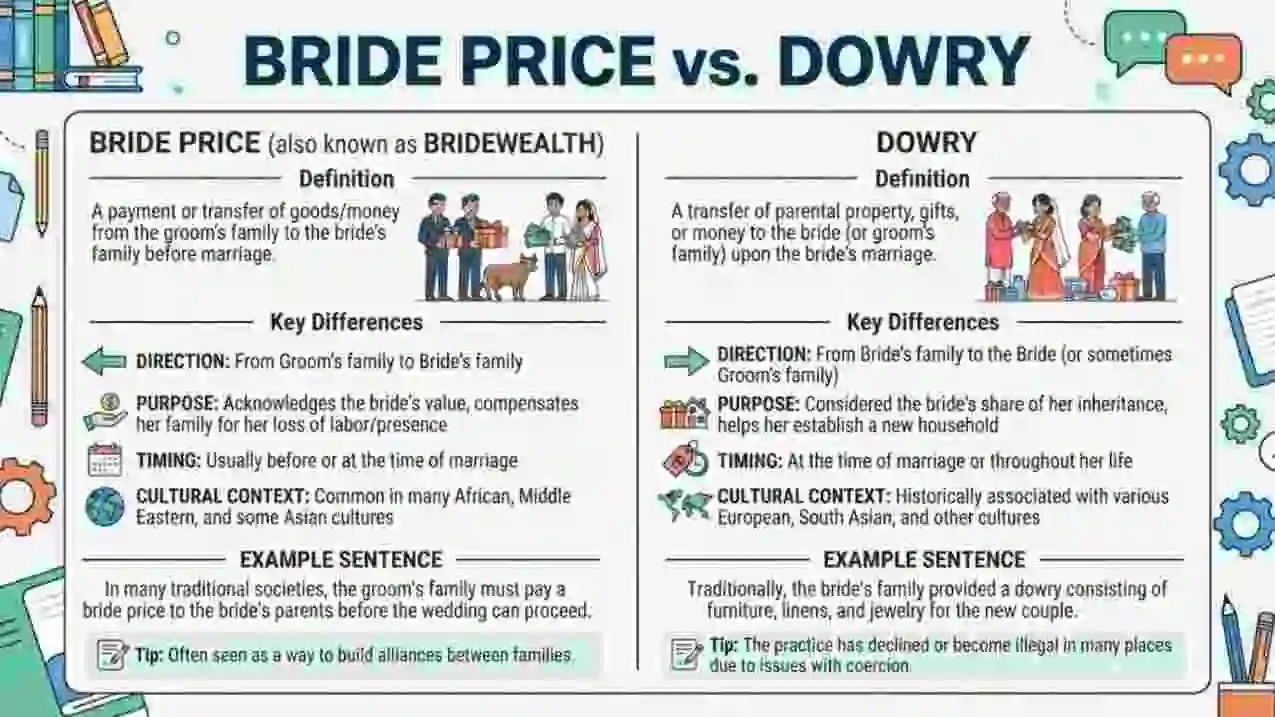
Marriage customs can look very different from one culture to another. Two terms that often cause confusion are bride price vs dowry. Both involve money, goods, or property linked to marriage, but they describe different practices.
A bride price is usually money, goods, or other wealth given by the groom or his family to the bride’s family. A dowry usually refers to money, property, goods, or other wealth given by the bride or her family to the bride herself, the groom, or the new household.
People often search for bride price vs dowry because the terms sound similar. They may also see them used in news stories, history books, or discussions about marriage customs.
The direction of the transfer is one of the easiest ways to tell them apart. With a bride price, wealth generally moves from the groom’s side to the bride’s family. With a dowry, wealth generally moves from the bride’s side to the bride, groom, or new household.
This guide explains the difference in simple words, gives clear examples, and looks at how the terms are used around the world.
Bride Price vs Dowry – Quick Answer
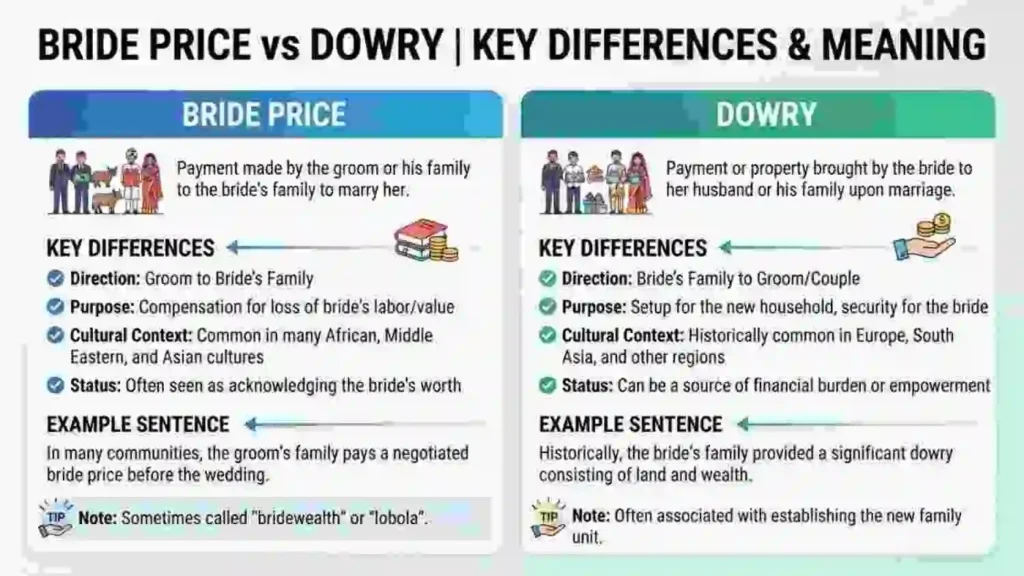
Bride price and dowry are both marriage-related transfers of money, goods, or property, but the direction of the transfer is different.
- Bride price: The groom or his family gives wealth to the bride’s family.
- Dowry: The bride or her family gives wealth connected with the marriage to the bride, groom, or new household.
Simple Example
Imagine two families are preparing for a wedding.
In a bride price system, the groom’s family may give money, livestock, or other goods to the bride’s family.
In a dowry system, the bride’s family may provide money, furniture, land, jewelry, or other property for the bride or the new household.
| Term | Basic meaning | Usual direction |
| Bride price | Payment or transfer linked to the bride and marriage | Groom’s side → Bride’s family |
| Dowry | Property or wealth brought into the marriage | Bride’s side → Bride, groom, or household |
These are broad definitions. Marriage customs vary greatly between cultures and families.
Main Difference Between Bride Price and Dowry
The main difference is who gives the wealth and who receives it.
Bride Price
Bride price is also called bridewealth in many academic sources.
It generally involves the groom or his family giving money, goods, livestock, or other wealth to the bride’s family.
The practice has existed in many societies and has taken many forms.
For example:
The groom’s family gives cattle to the bride’s family as part of the marriage agreement.
Dowry
A dowry generally consists of money, goods, property, or other wealth provided by the bride or her family in connection with marriage.
The dowry may go with the bride into the marriage or become part of the new household’s resources.
For example:
The bride’s family gives furniture, jewelry, and money to help set up the couple’s home.
The Easy Way to Remember
Think about the direction:
Bride price: Groom’s side → Bride’s family
Dowry: Bride’s side → Marriage or groom’s side
This is a useful basic rule, but real customs can be more complex.
Bride Price vs Dowry Comparison Table
| Feature | Bride Price | Dowry |
| Other term | Bridewealth | Dowry |
| Main giver | Groom or groom’s family | Bride or bride’s family |
| Common recipient | Bride’s family | Bride, groom, or new household |
| Main idea | Transfer connected to marriage and bride | Wealth brought into the marriage |
| Form | Money, livestock, goods, property | Money, property, goods, jewelry |
| Cultural use | Varies by society | Varies by society |
| Historical use | Found in many societies | Found in many societies |
| Modern use | Varies by country and community | Varies by country and community |
The table gives the general pattern. It should not be used as a rule for every culture.
The Origin and History of Bride Price and Dowry
Both practices have long histories.
History of Bride Price
Bride price has appeared in many traditional marriage systems. It can involve money, animals, food, land, or other valuable goods.
In some societies, the transfer has been connected to marriage agreements between families.
The term bridewealth is often used by researchers because it describes the transfer of wealth connected with marriage without suggesting that a bride herself is being bought.
The exact meaning and role of bridewealth have differed from one society to another.
History of Dowry
Dowry also has a long history.
Ancient societies in parts of Europe, Asia, Africa, and the Middle East used different forms of dowry.
A dowry could include money, clothing, jewelry, household goods, land, or other property.
In some historical societies, dowry helped give a woman resources when she married.
In other settings, dowry became linked to strong social pressure and large marriage expenses.
Why Did These Practices Develop?
Marriage has often involved more than two people. It can connect families, property, work, and social ties.
Marriage transfers may have helped families:
- Build relationships
- Share wealth
- Support a new household
- Transfer property
- Mark a marriage agreement
- Meet local customs
The purpose was not the same everywhere.
Bride Price vs Dowry in Different Cultures
Neither bride price nor dowry belongs to only one country or religion.
Different forms have appeared across many regions and time periods.
Africa
Bridewealth systems have existed in many African societies. Cattle, money, or other goods may be used depending on the community.
However, practices differ greatly across countries and ethnic groups.
South Asia
Dowry has been an important historical and social practice in parts of South Asia.
Modern laws in several countries restrict or prohibit dowry-related demands or payments. The exact law depends on the country.
Europe
Dowry systems were also common in parts of European history. Families could provide property or money when a daughter married.
Today, traditional dowry systems have changed or disappeared in many European societies.
Other Regions
Forms of marriage payments and property transfers have also appeared in parts of the Middle East, Asia, and other regions.
The terms should therefore be understood in their cultural context.
British English vs American English
There is no major British vs American spelling difference between these terms.
Both forms use:
- bride price
- bridewealth
- dowry
American and British writers generally use the same spellings.
Comparison Table
| Term | American English | British English |
| Bride price | Bride price | Bride price |
| Bridewealth | Bridewealth | Bridewealth |
| Dowry | Dowry | Dowry |
The main difference is not spelling. It is the meaning of the marriage practice being described.
Which Term Should You Use?
Use bride price when you mean a transfer from the groom or his family to the bride’s family.
Use dowry when you mean property or wealth provided by the bride or her family in connection with the marriage.
In academic writing, bridewealth can be useful when discussing the broader cultural practice.
For Everyday Writing
Use the simple terms:
- Bride price
- Dowry
For Academic Writing
Be more precise.
Explain who gives the wealth, who receives it, and what form it takes.
For example:
The groom’s family provided livestock as bridewealth.
This is clearer than simply saying:
The family paid for the bride.
For News Writing
Give enough context for readers to understand the practice.
Avoid assuming that every culture uses these terms in exactly the same way.
Common Mistakes with Bride Price vs Dowry
1. Saying They Mean the Same Thing
Incorrect idea: Bride price and dowry are two names for the same practice.
Correct: They usually describe different directions of wealth transfer.
2. Saying Bride Price Means Buying a Bride
This can be misleading.
Bride price or bridewealth describes a cultural marriage transfer. It does not automatically mean that a woman is being treated as property.
3. Saying Every Dowry Goes to the Groom
A dowry can be connected to the bride, groom, or new household, depending on the custom.
4. Assuming Every Culture Uses These Terms the Same Way
Marriage customs vary widely.
Always check the local meaning when discussing a specific community.
5. Using “Bride Price” for a Dowry
If the bride’s family provides wealth for the marriage, calling it a bride price may give the wrong meaning.
6. Assuming the Practice Is Still the Same Today
Historical customs can change over time.
A practice described in a history book may not reflect current life in that community.
7. Treating All Families in One Country as the Same
A country can have many cultures and marriage traditions.
Avoid broad claims about all families or communities.
Bride Price vs Dowry in Everyday Examples
Here are simple examples that show the difference.
- The groom’s family gave cattle to the bride’s family as bridewealth.
- The bride’s family provided furniture for the couple’s new home as part of the dowry.
- The couple discussed the bride price with both families.
- Her parents prepared a dowry before the wedding.
- The amount of bridewealth can vary between communities.
- The family included jewelry in the daughter’s dowry.
- The article explains the history of bride price in the region.
- The wedding custom includes a traditional marriage payment.
- The family wanted to understand the local rules about dowry.
- The researcher studied how bridewealth changed over time.
Real-Life Usage
In Conversation
What is the difference between a bride price and a dowry?
In this community, the groom’s family gives bridewealth.
In an Email
Could you explain the dowry customs for this region?
In School
Our history class discussed dowry systems in ancient societies.
At Work
The report compares bridewealth practices in several communities.
On Social Media
I learned that bride price and dowry are not the same thing.
In Formal Writing
Bridewealth and dowry describe different forms of marriage-related wealth transfer.
Related Search Questions
What is bride price?
Bride price is a marriage-related transfer of money, goods, livestock, or other wealth from the groom or his family to the bride’s family in cultures where this practice exists.
What is a dowry?
A dowry is money, property, goods, or other wealth provided by the bride or her family in connection with her marriage.
Is bride price the same as dowry?
No. The terms usually describe different directions of wealth transfer. Bride price generally moves from the groom’s side to the bride’s family. Dowry generally comes from the bride or her family.
What is another word for bride price?
Bridewealth is a common term used in academic and anthropological writing. Some sources also use “bride wealth” as two words.
Is dowry paid by the bride’s family?
Traditionally, a dowry is provided by the bride or her family, but the exact practice varies by culture and time period.
Bride Price vs Dowry – Usage and Search Trends
People search for bride price vs dowry when they want to understand the difference between two common terms used in discussions of marriage customs.
Search interest can rise around:
- Cultural studies
- History lessons
- Anthropology
- Marriage customs
- News reports
- Social discussions
- Comparative religion and culture studies
Exact Google search volume or trend numbers should not be assumed without current data.
The words can also appear in different contexts. Dowry is common in discussions of marriage property, family wealth, and social customs. Bride price and bridewealth often appear in discussions of anthropology, traditional marriage systems, and cultural practices.
Search results may also differ by country because marriage customs and laws differ across regions.
Bride Price vs Dowry: Side-by-Side Examples
| Situation | Term |
| Groom’s family gives cattle to bride’s family | Bride price / bridewealth |
| Groom’s family gives money to bride’s family | Bride price / bridewealth |
| Bride’s family gives furniture to the new household | Dowry |
| Bride’s family provides jewelry for the marriage | Dowry |
| Historical property given by a bride’s family | Dowry |
| Academic discussion of a marriage transfer from groom’s side | Bridewealth |
| General discussion of property brought into marriage | Dowry |
FAQs About Bride Price vs Dowry
1. What is the main difference between bride price and dowry?
The main difference is the direction of the transfer. Bride price generally involves the groom or his family giving wealth to the bride’s family. Dowry generally involves the bride or her family providing wealth connected to the marriage.
2. Is bride price the same as bridewealth?
The terms are often used for the same general practice. Bridewealth is common in academic and anthropological writing because it describes a marriage-related transfer without suggesting that the bride herself has a price.
3. Who pays a bride price?
In the traditional form of the practice, the groom or his family provides money, goods, livestock, or other wealth to the bride’s family. The exact rules vary between cultures.
4. Who gives a dowry?
A dowry is generally provided by the bride or her family. It may include money, property, jewelry, furniture, clothing, or other goods. The details depend on the culture and period.
5. Is dowry always money?
No. A dowry can include many forms of wealth. Depending on the culture, it may include land, jewelry, household goods, clothing, livestock, or other property.
6. Does every culture have bride price or dowry?
No. Marriage customs differ greatly around the world. Some societies have bridewealth, some have dowry, some have other forms of marriage exchange, and some have no traditional transfer of this kind.
7. Can bride price and dowry both exist?
Yes. Some marriage systems can include more than one type of transfer. Because customs vary, it is better to look at who gives what, who receives it, and what the transfer means in that society.
Conclusion
Bride price vs dowry describes two different types of marriage-related wealth transfer. The easiest way to remember the difference is to look at the direction of the transfer.
A bride price, also called bridewealth, generally involves the groom or his family giving money, goods, livestock, or other wealth to the bride’s family. A dowry generally involves the bride or her family providing money, property, goods, or other wealth connected with the marriage.
These practices have existed in many societies, but they do not look the same everywhere. Their meaning can change based on culture, history, religion, local custom, and family practice.
The terms also have no important British versus American spelling difference. The key issue is meaning, not spelling.
When writing about these customs, use clear and neutral language. Do not assume that one definition fits every society. If you are discussing a specific country or community, explain its local practice.
Understanding this difference makes it easier to read history, anthropology, news, and cultural studies without confusing bride price with dowry.

Emily Carter is an English grammar writer based in Portland, Oregon, with 7+ years of experience turning tricky grammar rules into simple, easy lessons.