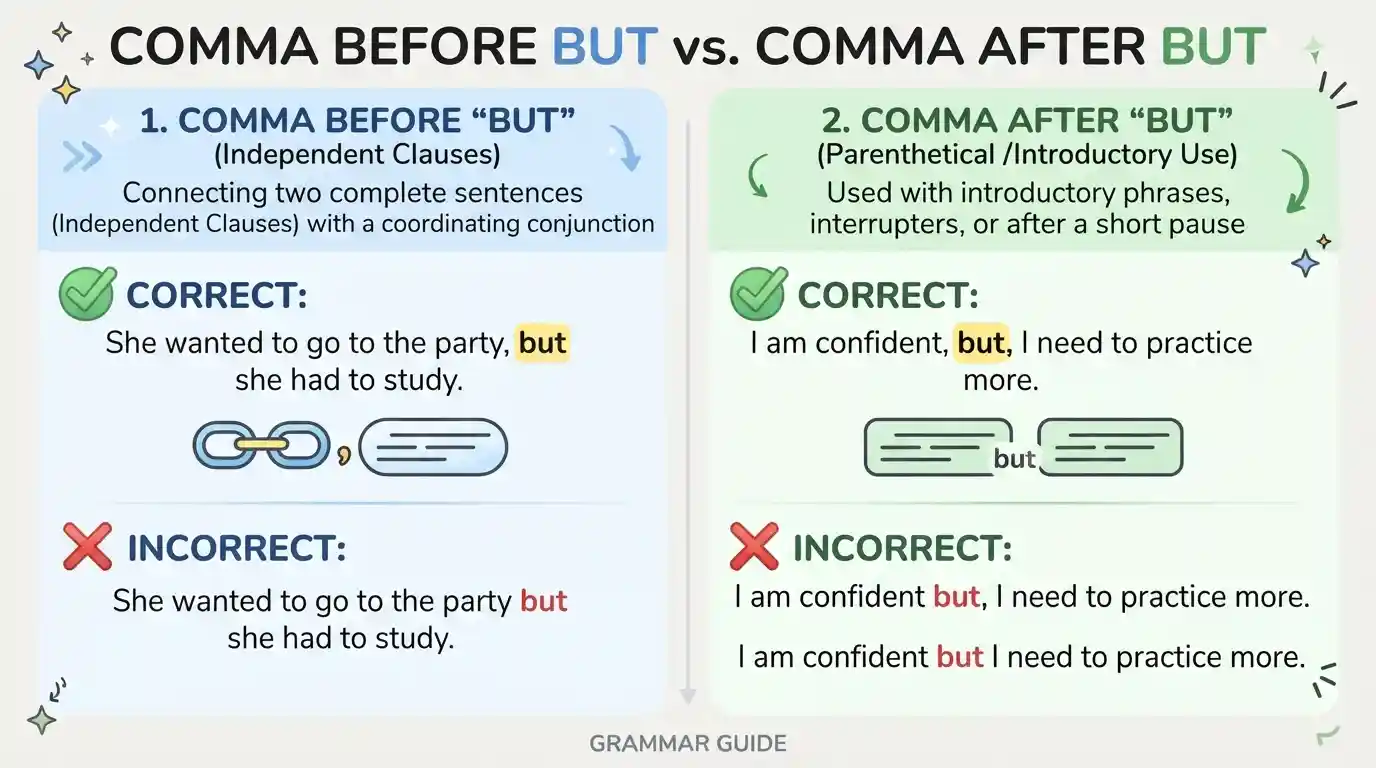
A small comma can change the flow of a sentence. One common question is comma before or after but. Should you write a comma before but, after but, or no comma at all?
The answer depends on how you use it but in the sentence.
In most cases, you need a comma before but when it joins two complete sentences. For example: “I wanted to go, but I was too tired.” You normally do not put a comma after but when it simply joins two parts of a sentence.
There are also cases where but starts a sentence or appears before extra words. In those cases, the punctuation can look different.
This guide explains the simple rules for using a comma with but. You will learn when to put a comma before but, when not to use one, whether a comma can come after but, and how to avoid common mistakes. You will also see clear examples for school, work, emails, and everyday writing.
Comma Before or After But – Quick Answer
Usually, put a comma before but when but joins two complete sentences.
Correct:
I wanted to call you, but I was busy.
Do not normally put a comma after but when it joins two parts of a sentence.
Correct:
I wanted to call you but could not.
A comma can appear after but when other grammar rules require it, such as when an interrupting phrase or introductory word follows but.
Example:
But, in this case, we need more information.
So the basic rule is:
Complete sentence + but + complete sentence = comma before but.
When Do You Put a Comma Before But?
Use a comma before but when it connects two independent clauses.
An independent clause is a group of words that can stand alone as a complete sentence.
For example:
- I was tired.
- I finished my work.
Both are complete sentences. When we join them with but, we use a comma:
I was tired, but I finished my work.
The comma shows that two complete thoughts are being joined.
More Examples
- She studied hard, but she failed the test.
- I called him, but he did not answer.
- We wanted to leave, but it started raining.
- He is young, but he is very responsible.
- The food looked good, but it tasted salty.
In each example, the words before and after but can work as complete sentences.
When Do You Not Put a Comma Before But?
You usually do not need a comma when but joins two words, phrases, or parts of the same clause.
For example:
I wanted to go but could not.
The second part, “could not,” is not a complete sentence.
Another example:
She is tired but happy.
“Happy” is not a complete clause. It simply describes the same subject.
More examples:
- He is poor but honest.
- She likes tea but not coffee.
- The room was small but clean.
- I tried to help but failed.
- They wanted to stay but had to leave.
Easy Test
Ask yourself:
Can both sides of “but” stand alone as complete sentences?
If yes, you usually need a comma.
I was tired, but I kept working.
- I was tired. ✓
- I kept working. ✓
Use a comma.
If no, you usually do not need one.
I was tired but happy.
- I was tired. ✓
- Happy. ✗
No comma is needed.
Can You Put a Comma After But?
Yes, but not simply because the word but is there.
In normal sentences, you do not place a comma immediately after but.
Incorrect:
I wanted to go, but, I was tired.
Correct:
I wanted to go, but I was tired.
However, a comma can come after but when a word or phrase inside the sentence needs to be set off.
For example:
But, honestly, I do not agree.
Here, “honestly” is an interrupting word.
Another example:
But, in my opinion, the plan will work.
The phrase “in my opinion” is set apart by commas.
The comma is not there because but requires a comma after it. It is there because of the phrase that follows.
Comma Before But vs Comma After But
These two patterns are different.
| Pattern | Example | Rule |
| Comma before but | I tried, but I failed. | Use it between two complete clauses. |
| No comma before but | I tried but failed. | No comma when the second part is not a complete clause. |
| Comma after but | But, honestly, I agree. | The following word or phrase needs commas. |
| No comma after but | But I agree. | No comma is needed. |
The most common rule is the first one.
What Does But Mean?
But is a conjunction that often shows a contrast.
It can connect two ideas that are different or unexpected.
For example:
The test was hard, but I passed.
The first idea suggests a difficult result. The second idea gives a different result.
But can also mean except in some sentences.
For example:
Everyone but John came.
Here, but means “except.”
The comma rules can change depending on how but works in the sentence.
Main Differences in Comma Use
Here are the main patterns to remember.
1. Two Complete Clauses
Use a comma before but.
I wanted to sleep, but I had homework.
2. Two Parts of One Clause
Usually, no comma.
I wanted to sleep but had homework.
3. But at the Start of a Sentence
Usually, no comma is needed.
But I still wanted to go.
You may see a comma after but when an introductory or interrupting phrase follows it.
But, after thinking about it, I changed my mind.
4. But Meaning Except
Usually, no comma is needed.
Everyone but Sarah left.
Origin and History of But
The word but has a long history in English. It comes from Old English forms such as būtan, which carried meanings related to “outside,” “except,” and “unless.”
Over time, the word developed several uses in English.
Today, but is commonly used as a conjunction to show contrast.
For example:
I wanted to stay, but I had to leave.
It can also work as a preposition, adverb, or other part of speech depending on the sentence.
Its many uses explain why punctuation around but depends on the sentence structure.
British English vs American English
There is no major British English vs American English difference in the basic comma rule for but.
Both forms of English generally use a comma before but when it joins two independent clauses.
For example:
British English:
I wanted to go, but I was busy.
American English:
I wanted to go, but I was busy.
The same basic punctuation works in both.
Style guides can differ on some fine points, especially in complex sentences, but the main rule stays the same.
Which One Should You Use?
When deciding whether to use a comma before or after but, use this simple method.
Use a comma before but when:
- But joins two complete clauses.
- The second part has its own subject and verb.
- You are joining two complete thoughts.
Example:
She wanted to leave, but her friend stayed.
Do not use a comma before but when:
- It joins two words.
- It joins two phrases.
- The second part is not a complete clause.
Example:
She wanted to leave but stayed.
Do not normally use a comma after but when:
- But simply begins a sentence.
- Nothing after but needs a comma.
Example:
But I changed my mind.
Use a comma after but when:
- An interrupting word or phrase follows.
- That phrase needs to be set off with commas.
Example:
But, honestly, I do not care.
Common Mistakes
Mistake 1: Adding a comma after but
Incorrect:
I wanted to help, but, I was busy.
Correct:
I wanted to help, but I was busy.
The comma belongs before but, not after it.
Mistake 2: Missing the comma before but
Incorrect:
I wanted to help but I was busy.
Correct:
I wanted to help, but I was busy.
Both sides are complete clauses, so use a comma.
Mistake 3: Adding a comma when the second part is not complete
Incorrect:
She is tired, but happy.
Correct:
She is tired but happy.
“Happy” is not a complete clause, so the comma is not needed.
Mistake 4: Using commas around every but
Incorrect:
He wanted to go, but, he could not.
Correct:
He wanted to go, but he could not.
Do not put a comma after but unless another punctuation rule requires it.
Mistake 5: Thinking but always needs a comma before it
Incorrect:
I tried, but failed.
Better:
I tried but failed.
The two verbs share the same subject, and “failed” does not form a separate independent clause.
Mistake 6: Using a comma after sentence-opening but
Incorrect:
But, I disagree.
Correct:
But I disagree.
A comma is not normally needed after sentence-opening but.
Everyday Examples
Here are 10 simple examples showing how commas work with but.
- I wanted to go, but I was sick.
- She called, but nobody answered.
- He is tired but happy.
- We tried to help but failed.
- The movie was long, but it was good.
- I like the shirt but not the color.
- They were late, but they still joined us.
- But I do not agree.
- But, honestly, I expected more.
- The task looked easy, but it took hours.
These examples show why the structure matters more than the word but itself.
Real-Life Usage
In Conversations
People often use but to show a change or contrast.
“I wanted to come, but I was busy.”
This is a common everyday sentence.
In Emails
You may write:
I would like to attend, but I have another meeting.
This works well in professional writing.
In School
Students often use but to connect contrasting ideas.
The experiment was simple, but the results were surprising.
At Work
You might write:
We finished the report, but we still need to check the numbers.
This clearly connects two complete thoughts.
On Social Media
Short sentences are common:
I was going to post it, but I changed my mind.
The same comma rule still applies.
In Formal Writing
The same basic grammar rule applies:
The plan seems useful, but it may cost too much.
Good punctuation makes the relationship between the two ideas clear.
Related Search Questions
Do you put a comma before or after but?
Most often, you put the comma before but when it joins two complete clauses. You usually do not put a comma after but. For example: “I wanted to leave, but I stayed.” A comma after but can appear when another part of the sentence requires one.
Does but always need a comma before it?
No. A comma is not always needed before but. Use one when but joins two independent clauses. If it joins words, phrases, or a shared clause, you usually do not need a comma.
Do you put a comma after but at the beginning of a sentence?
Usually, no. Write “But I disagree.” rather than “But, I disagree.” A comma may appear later if an interrupting phrase follows, as in “But, honestly, I disagree.”
Is it correct to say “but, however”?
Usually, this combination sounds unnecessary because both words can show contrast. Instead of “But, however, I disagree,” use “But I disagree” or “However, I disagree.”
Can a sentence start with but?
Yes. Starting a sentence with but is normal in modern English. For example: “I wanted to call you. But I was too busy.” In formal writing, some writers prefer to connect the ideas in one sentence, but starting with but is not automatically wrong.
Is a comma needed before but in a short sentence?
Length does not decide the rule. Structure does. If but joins two complete clauses, use a comma even when the sentence is short: “I tried, but I failed.”
What is the easiest way to remember the rule?
Look at the words after but. If but connects two complete thoughts, put a comma before it. If the second part cannot stand alone, you usually do not need a .
Usage and Search Trends
People search for this grammar point in several natural ways,knowing whether but joins two complete clauses or smaller parts of a sentence.
No exact search-volume or traffic figures are included because reliable current data was not established.
Comma Before or After But: Comparison Table
| Sentence Type | Comma Before But? | Comma After But? | Example |
| Two complete clauses | Yes | No | I called, but she did not answer. |
| Shared subject | Usually no | No | I called but got no answer. |
| Two adjectives | No | No | The room was small but clean. |
| Two nouns | No | No | Choose tea but not coffee. |
| But at the start | No | Usually no | But I disagree. |
| But + interrupting phrase | Depends | Yes, if needed | But, honestly, I disagree. |
| But meaning except | Usually no | No | Everyone but John left. |
A Simple Heuristic to Remember
If you often forget the rule, use this three-step test:
Step 1: Find but.
Step 2: Look at the words on both sides.
Step 3: Ask whether both sides can stand alone.
If both can stand alone:
Use a comma before but.
I was hungry, but I waited.
If the second part cannot stand alone:
Usually skip the comma.
I was hungry but patient.
This simple test works for many everyday sentences.
FAQs
1. Is the comma before or after but?
The comma usually goes before but when but joins two complete clauses. For example, “I wanted to leave, but I stayed.” A comma does not normally go directly after but. It can appear after but when an interrupting phrase requires it, such as “But, honestly, I disagree.”
2. Should I write “but, I” or “but I”?
Usually write “but I” without a comma. For example: “I wanted to help, but I was busy.” The comma belongs before but because it connects two complete clauses. “But, I was busy” is not the normal punctuation pattern.
3. Do you need a comma before but in every sentence?
No. You need a comma before but when it joins two independent clauses. You usually do not need one when but connects words or phrases. For example, “She is tired but happy” does not need a comma, while “She is tired, but she keeps working” does.
4. Can I put a comma after but?
Yes, but only when another punctuation rule calls for it. For example, “But, honestly, I do not agree.” Here, the commas surround the interrupting word “honestly.” The comma is not required simply because but appears at the start.
5. Is “I tried but failed” correct?
Yes. “I tried but failed” is correct without a comma. The two verbs share the same subject, “I,” and the second part is not an independent clause. You could also write “I tried, but I failed,” because that version contains two complete clauses.
6. Can you start a sentence with but?
Yes. A sentence can begin with but. For example: “But I still wanted to go.” This is common in modern English. Starting with but can help show a clear contrast with the previous sentence.
7. What is the easiest comma rule for but?
Remember this: complete clause + but + complete clause = comma before but. For example, “I wanted to stay, but I had to leave.” If but connects smaller parts of the same sentence, you usually do not need the comma.
Conclusion
The answer to comma before or after but depends on how but works in the sentence. The easiest rule is to look at what comes before and after it.
When but joins two complete clauses, place a comma before but.
Example:
I wanted to go, but I was too tired.
When but joins words, phrases, or parts of the same clause, you usually do not need a comma.
Example:
I wanted to go but could not.
You also normally do not put a comma directly after but. Write “But I agree”, not “But, I agree.” However, a comma can appear after but when an interrupting phrase needs to be separated.
Example:
But, honestly, I do not agree.
The best way to remember the rule is simple: complete thought + but + complete thought = comma before but. Check the sentence structure instead of assuming that every use of but needs a comma.

Emily Carter is an English grammar writer based in Portland, Oregon, with 7+ years of experience turning tricky grammar rules into simple, easy lessons.